



 Chat with AI
Exam 3: Biochemistry

Exam 1: Anatomy291 Questions
Exam 2: Behavioral science240 Questions
Exam 3: Biochemistry156 Questions
Exam 4: Biostatistics117 Questions
Exam 5: Embryology52 Questions
Exam 6: Genetics103 Questions
Exam 7: Histology24 Questions
Exam 8: Immunology129 Questions
Exam 9: Microbiology336 Questions
Exam 10: Pathology816 Questions
Exam 11: Pathophysiology464 Questions
Exam 12: Pharmacology538 Questions
Exam 13: Physiology272 Questions
Select questions type


A 2-day-old boy is being examined in the newborn nursery prior to discharge from the hospital. He was born at 38 weeks gestation by vaginal delivery. The pregnancy and delivery were uncomplicated, and the boy has been breastfeeding, stooling, and urinating normally. The patient's mother has beta-thalassemia trait, and his father has a normal hemoglobin electrophoresis. Vital signs and physical examination are normal. Which of the following hemoglobin compositions is most likely predominant in this infant?
(Multiple Choice)
4.8/5  (65)
(65) Biochemistry researchers are investigating the speed at which various carbohydrates are metabolized within the liver. They hypothesize that different monosaccharides delivered to the liver have different rates of intracellular metabolism. Which of the following substances is most likely to have the fastest rate of metabolism in the glycolytic pathway?
(Multiple Choice)
4.9/5 (79)
(79) A 78-year-old woman comes to the office due to tenderness and easy bleeding of the gums when she brushes her teeth. The patient has brushed her teeth twice a day for as long as she can remember and has not experienced these symptoms before. Physical examination shows swollen gingiva that bleed on probing. Her skin findings are shown in the image below. 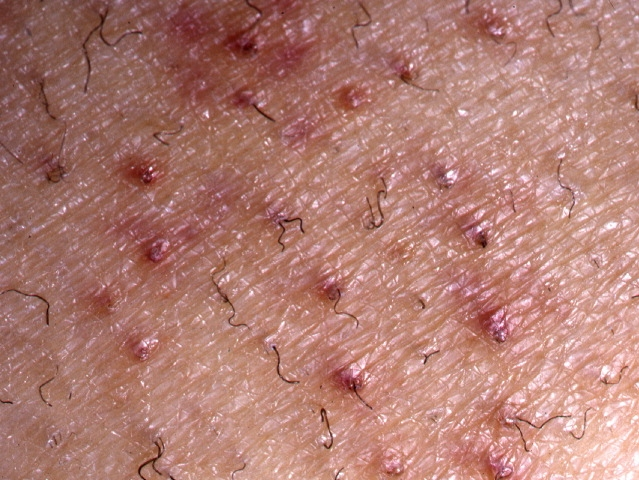 Further questioning reveals that the patient lives alone and that her diet consists primarily of tea and toast. Her symptoms are most likely caused by hypoactivity of an enzyme found in which of the following compartments?
 (Multiple Choice)
4.8/5 (85)
(85) Scientists studying the principles behind oxygen-hemoglobin dissociation have discovered a way to successfully separate hemoglobin tetramers into individual alpha and beta subunits. During an experiment, a solution is created that contains only monomeric beta-hemoglobin subunits under physiologic conditions. If measured, the oxygen dissociation curve of the dissolved beta subunits will most likely resemble which of the following lines? 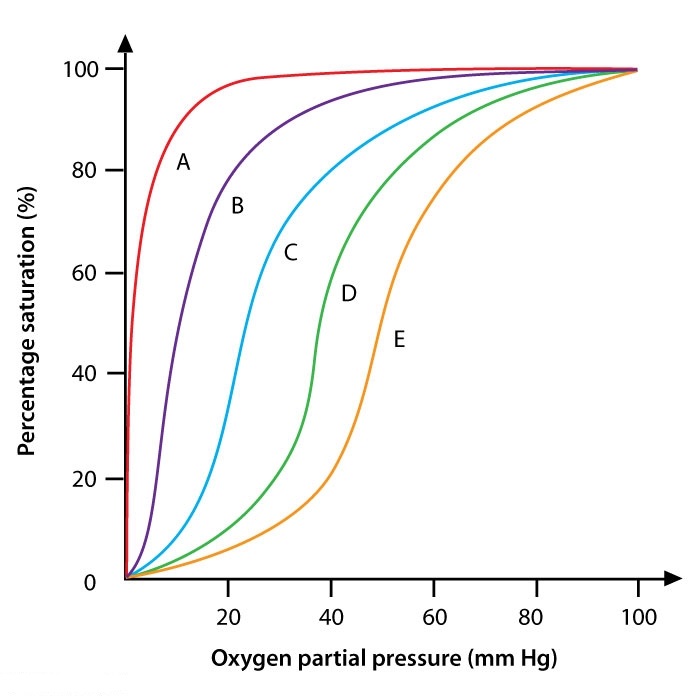
(Multiple Choice)
4.9/5 (73)
(73) A 22-year-old man comes to the office due to recurrent blistering on the back of his hands and forearms for the past several years. The patient usually develops small itchy spots but lately has had large blisters that heal with hyperpigmentation after rupturing. He has used over-the-counter topical hydrocortisone and emollients, but the symptoms have not improved. The patient works as a night security guard and has had no exposure to chemicals or animals. He drinks 2-3 cans of beer daily. Physical examination shows vesicles and erosions on the dorsum of both hands. Which of the following enzymes is most likely deficient in this patient?
(Multiple Choice)
4.8/5 (80)
(80) A dermatology researcher is studying the role of different amino acids in wound healing. She cultures mature dermal fibroblasts in growth media. After several days, the fibroblasts begin synthesizing polypeptide chains that assemble into triple helical structures, followed by fibrils. The fibrillar proteins are hydrolyzed and separated into their constituent amino acids via paper chromatography. Which of the following amino acids is most likely to be found in highest quantity in these proteins?
(Multiple Choice)
4.7/5 (88)
(88) A healthy 34-year-old coal mine worker is trapped underground following partial collapse of an access shaft. Rescue efforts are directed toward clearing the obstructed tunnel, but it takes 2 days to reach him. While being taken to the surface, the miner tells rescuers that he feels dizzy and weak. He had an emergency supply of water but has not eaten anything for over 30 hours. Fingerstick blood glucose concentration is 78 mg/dL. Which of the following biochemical reactions is most likely responsible for maintaining this patient's current blood glucose levels?
(Multiple Choice)
5.0/5 (75)
(75) A 5-month-old boy is brought to the office by his parents who are concerned that he has developmental delay. He has 3 older siblings, and the parents report that his siblings were much more active and interactive at the boy's age. The family has just moved to the United States from South America and did not have consistent primary care previously. Physical examination shows that the boy is unable to roll from front to back or back to front and does not seem to recognize his parents. Comprehensive laboratory evaluation reveals impaired tetrahydrobiopterin synthesis. Which of the following is most likely deficient in this patient?
(Multiple Choice)
4.9/5 (70)
(70) A 2-year-old boy is being evaluated at the office for failure to thrive and developmental delay. Medical history is significant for recurrent ear infections since 6 months of age. Physical examination shows corneal clouding, hepatosplenomegaly, and restricted joint mobility. Further evaluation shows deficient phosphorylation of mannose residues on certain glycoproteins in the Golgi apparatus. In unaffected patients, these proteins are normally transported to which of the following cellular locations?
(Multiple Choice)
4.7/5 (94)
(94) A 24-year-old man is evaluated for episodic anemia, jaundice, and dark urine. These episodes typically occur after the use of certain drugs or following infection. Additional history reveals that he has a brother who experiences similar episodes. Peripheral blood smear reveals red blood cells with the findings shown below. 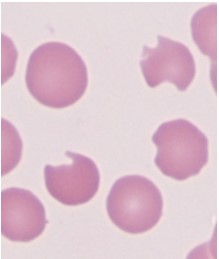 Deficiency of which of the following enzymes would most likely result in a condition similar to this patient's presentation?
 (Multiple Choice)
4.8/5 (88)
(88) A 47-year-old woman has a tumor that is causing symptoms of excessive hormone production. Surgical resection of the lesion is performed with no operative complications, and the neoplastic tissue is subjected to detailed pathologic studies. Electron microscopy reveals the tumor cells have highly developed, smooth endoplasmic reticulum. Which of the following is a possible direct effect of the substance secreted by these cells?
(Multiple Choice)
4.8/5 (80)
(80) Molecular biologists undertake a series of experiments designed to classify proteins involved in various intracellular signaling pathways. During one of the experiments, a protein mixture obtained from a cell culture is separated by gel electrophoresis and subsequently transferred to a filter membrane. Labeled double-stranded DNA probes are then used to detect a specific protein of interest in the sample. Which of the following proteins is most likely to be detected by this method?
(Multiple Choice)
4.7/5 (83)
(83) A group of investigators is studying the regulation of catecholamine synthesis in response to severe stress. In the experiments, subject rats are randomly assigned to either an experimental or a control group. The experimental rats undergo resection of the pituitary gland, and the control rats undergo craniotomy without pituitary resection. The experimental animals are subsequently found to have decreased production of epinephrine by the adrenal medulla and cortisol from the adrenal cortex compared with the control animals. Decreased activity of which of the following enzymes is most likely responsible for the lower epinephrine in the experimental animals?
(Multiple Choice)
4.8/5 (79)
(79) An 8-month-old girl is brought to the office due to irritability and regression of motor skills. The patient's birth was unremarkable and her development had appeared normal, but she can no longer sit or roll over. Her parents have also noticed that she startles easily at loud noises. Head circumference measurement is consistent with macrocephaly. Bilateral funduscopic evaluation shows a bright red fovea centralis that is surrounded by a contrasting white macula. Peripheral vision is decreased. Abdominal examination is normal. Accumulation of which of the following metabolites is most likely present in this patient's tissues?
(Multiple Choice)
4.9/5 (88)
(88) A 61-year-old man is brought to the emergency department after being found unresponsive on a sidewalk. Paramedics notice that the patient's breath smells of alcohol and that he has vomitus in his mouth. The patient also has agonal respirations, and cardiac monitoring shows pulseless electrical activity. Resuscitation efforts are unsuccessful, and he is pronounced dead on arrival. Autopsy reveals that the cause of death is airway occlusion by aspirated vomitus. In addition, foci of hemorrhage and necrosis are seen in the mammillary bodies and gray matter surrounding the third and fourth ventricles. This patient's brain findings are most likely associated with a decrease in which of the following?
(Multiple Choice)
4.9/5 (69)
(69) A 24-year-old woman comes to the office due to a persistent facial rash. The patient easily develops "sunburns" after sun exposure and her fingers "turn blue" in cold weather. She has also felt more fatigued than usual. Physical examination shows a facial rash in a butterfly distribution that spares the nasolabial folds. Laboratory studies reveal several types of autoantibodies directed against components of the cell nucleus. One specific antibody targets proteins complexed with small nuclear ribonucleic acid. These protein-ribonucleic acid complexes are most likely involved in which of the following cellular functions?
(Multiple Choice)
4.9/5 (66)
(66) A 35-year-old female is hospitalized with headaches and vomiting. She has a long history of psychiatric illness and is known to practice eccentric dietary habits. Physical findings include papilledema, dry skin and hepatosplenomegaly. Head CT scan is ordered immediately but is negative for intracranial mass. Which of the following is a likely cause of this patient's condition?
(Multiple Choice)
4.7/5 (81)
(81) A 22-year-old woman comes to the hospital due to a 5-day history of nausea, constipation, and severe, poorly localized abdominal pain. She also reports anxiety, difficulty concentrating, poor sleep quality, and tingling of the limbs. The patient has had several similar episodes in the past. She does not take any medications or use tobacco, alcohol, or illicit drugs. The patient has been restricting her diet to lose weight. On examination, the abdomen is soft, nontender, and nondistended. Bowel sounds are decreased. The patient receives an intravenous infusion of a heme preparation that leads to rapid resolution of her symptoms. The improvement in symptoms is most likely due to treatment-induced downregulation of which of the following enzymes?
(Multiple Choice)
4.7/5 (81)
(81) A 2-year-old boy is brought to the emergency department with fever, vomiting, and sleepiness. He had several episodes of emesis this morning, and his mother was unable to wake him from his afternoon nap. The boy has had mild rhinorrhea and fever for the past 3 days. Since the newborn period, the parents say that the patient has had multiple illnesses characterized by vomiting and sleepiness. Prior laboratory testing revealed increased blood ammonia levels during these episodes and markedly increased orotic acid excretion in the urine. Physical examination shows a tachypneic boy who is unresponsive to all stimuli. Which of the following enzymes is most likely to be deficient in this patient?
(Multiple Choice)
4.7/5 (65)
(65) A 6-month-old boy is evaluated in the clinic due to delayed motor development. The mother reports that the boy is weaker than other children his age. He can barely lift his head up when prone and is unable to roll to the side. Physical examination shows generalized hypotonia and decreased deep tendon reflexes. Further evaluation reveals mutation of a protein involved in the assembly of small nuclear ribonucleoproteins (snRNPs) in motor neurons. This patient most likely has impaired function of which of the following cellular elements?
(Multiple Choice)
4.8/5 (83)
(83) 
Filters
- Essay(0)
- Multiple Choice(0)
- Short Answer(0)
- True False(0)
- Matching(0)