



 Chat with AI
Exam 10: Pathology

Exam 1: Anatomy291 Questions
Exam 2: Behavioral science240 Questions
Exam 3: Biochemistry156 Questions
Exam 4: Biostatistics117 Questions
Exam 5: Embryology52 Questions
Exam 6: Genetics103 Questions
Exam 7: Histology24 Questions
Exam 8: Immunology129 Questions
Exam 9: Microbiology336 Questions
Exam 10: Pathology816 Questions
Exam 11: Pathophysiology464 Questions
Exam 12: Pharmacology538 Questions
Exam 13: Physiology272 Questions
Select questions type


A 67-year-old man comes to the office due to generalized weakness, easy fatigability, anorexia, and intermittent nausea for the past several months. He also says that he is "itching and scratching a lot." Physical examination shows bilateral lower extremity pitting edema and skin excoriations. Laboratory results show a serum creatinine level of 3.4 mg/dL and a blood urea nitrogen level of 48 mg/dL. A renal biopsy is performed. Light microscopy of the tissue sample shows widespread narrowing of the renal arterioles with deposition of homogeneous, glassy material in the vessel walls that stains pink with periodic acid-Schiff (PAS) stain. This patient most likely has which of the following underlying conditions?

Free
(Multiple Choice)
4.9/5  (82)
(82) Correct Answer: Verified
B
A 12-year-old boy is brought to the office due to a rash on the posterior neck. The patient has had this rash intermittently over the past several years. During the last 2 months, the rash has become increasingly pruritic with the cooler weather, and the patient is constantly scratching his neck. The patient has no other medical conditions and takes no medications. Vital signs are normal. The posterior neck is shown in the image below: 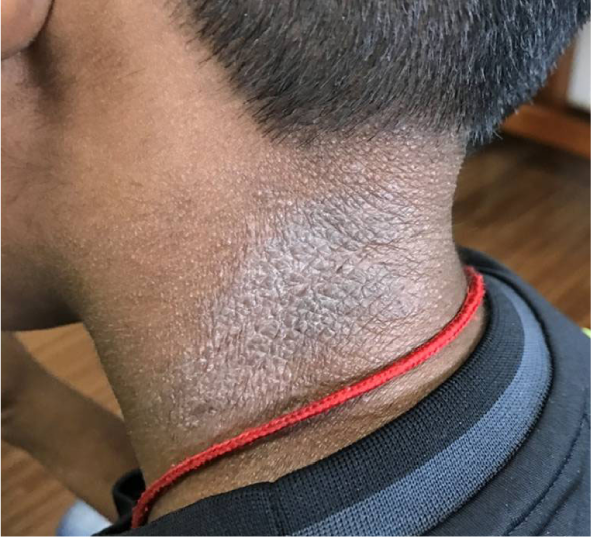 Which of the following is the most likely cause of this patient's rash?
Free
(Multiple Choice)
4.9/5 (74)
(74) Correct Answer:Verified
VerifiedC
A 38-year-old man dies suddenly at his workplace and cannot be resuscitated. He had experienced chest discomfort, shortness of breath, and fatigue in the week preceding the event. The man was overweight but otherwise had no significant medical history. He had no established primary care physician. He did not use alcohol, tobacco, or illicit drugs. Both parents are alive and healthy; a maternal uncle reportedly died of a heart attack at age 50. Autopsy was performed and myocardial findings are shown in the slide below. 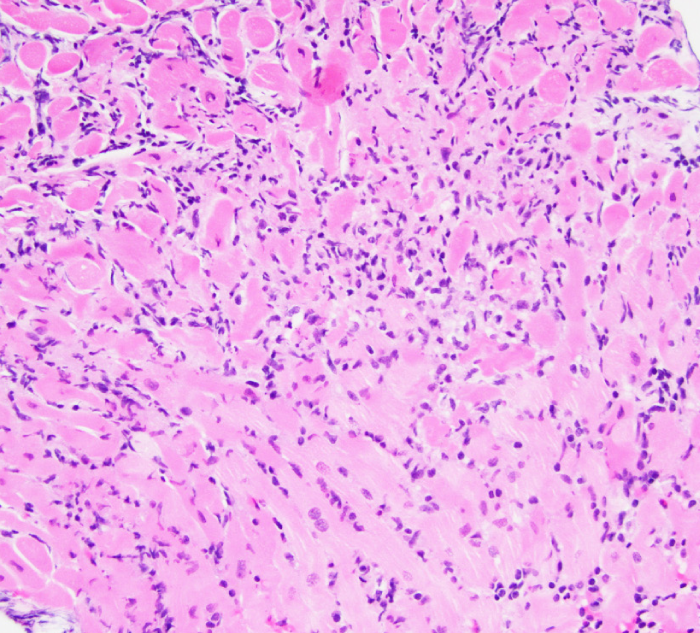 Which of the following is the most likely diagnosis?
Free
(Multiple Choice)
4.9/5 (94)
(94) Correct Answer:Verified
VerifiedA
A 62-year-old man is found dead in his apartment. An autopsy shows diffuse cerebral edema, laryngeal edema, and hyperinflated lungs. Which of the following is the most likely cause of death in this patient?
(Multiple Choice)
4.9/5 (81)
(81) A 20-year-old woman comes to the office due to intermittent pain and swelling of both knees over the past 3 months. She has no fever, chills, or abnormal vaginal discharge. The patient has no other medical conditions and is not sexually active. Temperature is 37.2 C (99 F), blood pressure is 150/90 mm Hg, and pulse is 78/min. Small, nontender oral ulcers are present. Examination shows mild tenderness of the knee joints but no effusion. The remainder of the examination shows no abnormalities. Laboratory results reveal anemia, thrombocytopenia, and elevated serum creatinine. Urinalysis shows proteinuria and red blood cell casts. Which of the following pathogenic mechanisms is most likely responsible for this patient's renal disease?
(Multiple Choice)
4.9/5 (80)
(80) A 6-year-old boy has a history of 5 bone fractures, 3 of them occurring after only minimal trauma. His birth was unremarkable following a normal pregnancy. The patient has been in the 50th percentile for both height and weight since birth, and he has reached all developmental milestones. On physical examination, he is a pleasant, interactive child with small, malformed teeth. Further evaluation shows the finding in the image below. 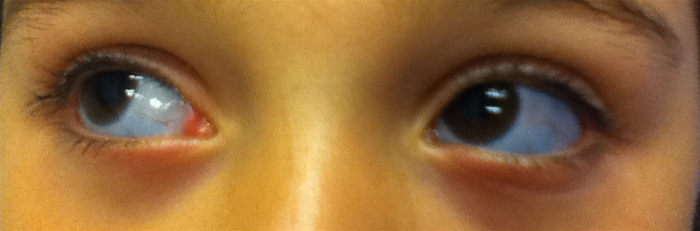 This patient's condition is most likely associated with impairment of which of the following processes?
 (Multiple Choice)
4.9/5 (82)
(82) A 5-month-old boy is being evaluated for poor weight gain since birth. He is noted to have bulky and greasy stools. A jejunal biopsy shows the findings seen in the slide below. 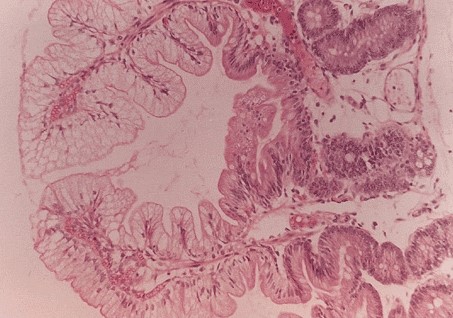 Which of the following is the most likely diagnosis?
 (Multiple Choice)
4.8/5 (76)
(76) A 42-year-old woman comes to the emergency department due to worsening jaw pain over the past week. She is unable to chew solid foods on the left side because of severe throbbing pain. The patient has had several "tooth infections" over the last year despite meticulous oral hygiene. Physical examination shows facial edema over the left mandible. Multiple teeth have decay and gingival recession, and gentle tapping of the left second molar elicits pain. This patient's current disease process is most likely to develop secondary to which of the following underlying conditions?
(Multiple Choice)
4.7/5 (73)
(73) A 26-year-old man comes to the office due to myalgia, nasal congestion, and cough. Temperature is 38.3 C (100.9 F). Examination shows nasal and pharyngeal hyperemia. Rapid influenza antigen testing of nasopharyngeal secretions is positive. Within the infected cells of the patient's respiratory tract, viral proteins are degraded and attached to major histocompatibility complex class I molecules, which are then expressed on the cell surface for presentation to cytotoxic CD8+ lymphocytes. Which of the following enzymes is most essential to initiating this process?
(Multiple Choice)
4.9/5 (78)
(78) A 28-year-old man comes to the office with bilateral skin lesions over the posterior surface of the elbows. The lesions are itchy at times; topical moisturizers have reduced the itching, but the lesions have remained. The patient has no chronic medical problems and takes no medications. Biopsy of the lesions demonstrates hyperkeratosis, parakeratosis, dilated capillaries in the dermal papillae, and foci of neutrophils in the superficial epidermis. Which of the following is the most likely diagnosis?
(Multiple Choice)
4.9/5 (86)
(86) An 81-year-old woman is brought to the emergency department by a neighbor due to abdominal pain. The pain comes in waves and is associated with nausea and vomiting. The patient is confused and unable to provide additional information. Past medical history is unknown, but she comes with a bag containing medications used in type 2 diabetes mellitus, hypercholesterolemia, hypertension, and dementia. On examination, the patient has a low-grade fever and mild tachycardia. She appears in distress due to pain. Mucous membranes are dry, and there is decreased skin turgor. Abdominal examination shows diffuse tenderness with high-pitched bowel sounds. Imaging of the abdomen reveals a complete small bowel obstruction. The patient undergoes laparotomy with extraction of a hard mass obstructing the ileocecal valve. The cholesterol content of the mass is 85%. Which of the following radiographic findings is most consistent with this patient's clinical presentation?
(Multiple Choice)
4.8/5 (91)
(91) A 36-year-old Caucasian male presents to your office complaining of periodic involuntary deviation of the head to the right, accompanied by muscle pain in his neck. The spells start spontaneously, last 30-40 minutes, and can sometimes be suppressed by placing a hand on the chin. This patient's condition can be best characterized as which of the following?
(Multiple Choice)
4.8/5 (68)
(68) A 50-year-old man is brought to the emergency department due to a severe, sudden-onset headache that started an hour ago. The patient reports that he has had mild headaches and decreased libido over the past 3 months. He has no other medical conditions and takes no medications. Physical examination reveals bilateral deficits involving the temporal visual fields and impaired extraocular eye movements. Shortly after being admitted to the hospital, he becomes acutely hypotensive and loses consciousness. The patient dies despite aggressive resuscitation efforts. Which of the following is most likely to be found on autopsy?
(Multiple Choice)
4.8/5 (71)
(71) The rates of hepatocellular carcinoma in some developing countries are many times higher than that in Western nations. A successful hepatocellular carcinoma prevention strategy in these countries would focus on incorporating:
(Multiple Choice)
4.8/5 (77)
(77) A 1-month-old, full-term boy is brought to the emergency department by his mother due to difficulty awakening him. The mother says that the infant was left alone for a few minutes this morning and rolled off a bed. Since then, he has been sleepy and less active than usual. Physical examination shows a lethargic boy with a large, full anterior fontanelle. Bilateral retinal hemorrhages are seen on funduscopic examination. Which of the following should be strongly suspected in this patient?
(Multiple Choice)
4.8/5 (82)
(82) A 6-year-old boy is brought to the emergency department due to bleeding after a dental extraction earlier this morning. The patient's past medical history is significant for painful swelling of his knee joints after minor trauma. Aspiration of the joints during several occasions yielded frank blood, and he was diagnosed with hemarthrosis. He has no known allergies. Currently, hemostasis in this patient most likely can be achieved by the administration of which of the following?
(Multiple Choice)
5.0/5 (74)
(74) A 59-year-old man is evaluated in the clinic for recent unintentional weight loss. He says, "My pants are fitting a lot looser than usual." The patient also has epigastric discomfort after meals with occasional nausea. He reports that food is not as appetizing as it used to be. He has no known medical conditions and takes no medications. The patient's father has a history of peptic ulcer disease. Upper endoscopy shows a lesion in the stomach that is biopsied; a histologic section is shown below: 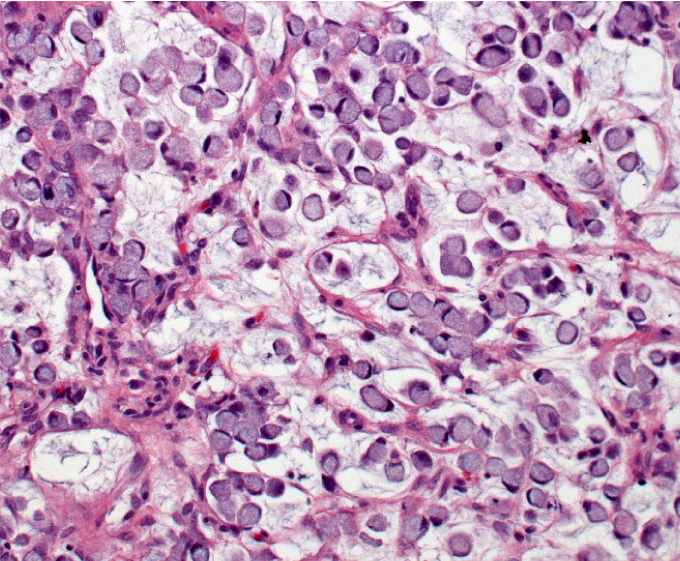 This patient's lesion is most likely to demonstrate which of the following gross findings?
 (Multiple Choice)
4.8/5 (95)
(95) A 35-year-old, previously healthy man is evaluated immediately after accidental exposure to ionizing radiation at a fluoroscopy manufacturing facility. The patient is currently asymptomatic. Vital signs are normal. Physical examination shows no abnormalities. If radiation exposure is significant, which of the following cells are most likely to be affected first?
(Multiple Choice)
4.9/5 (72)
(72) A 35-year-old woman at 38 weeks gestation undergoes induction of labor. The patient has type 2 diabetes mellitus, and her blood glucose levels were increasingly difficult to control during her third trimester despite increasing doses of insulin. During induction, the patient develops arrest of labor and undergoes a cesarean delivery. Apgar scores are 8 and 9 at 1 and 5 minutes, respectively. Physical examination shows a newborn large for gestational age with a birth weight of 4.6 kg (10.1 lb). The remainder of the examination is unremarkable, and vital signs are normal. An hour after delivery, the newborn develops hypoglycemia. Which of the following is most likely the cause of this patient's hypoglycemia?
(Multiple Choice)
4.9/5 (73)
(73) A 41-year-old woman is being evaluated for peripheral edema. The patient has gained 6.8 kg (15 lb) over the past 8 weeks. Her urine is "frothy." She has no other medical problems and takes no medications. The patient does not use tobacco, alcohol, or illicit drugs. Blood pressure is 140/90 mm Hg and pulse is 80/min. Examination shows generalized edema. Heart sounds are normal. The abdomen is soft and nontender. Serum creatinine is 1.1 mg/dL. Urinalysis shows 4+ protein, 0-3 leukocytes/hpf, and oval fat bodies. Serum contains IgG4 antibodies to the phospholipase A2 receptor (PLA2R), a transmembrane protein abundant on podocytes. Which of the following is the most likely diagnosis?
(Multiple Choice)
4.8/5 (80)
(80) 
Filters
- Essay(0)
- Multiple Choice(0)
- Short Answer(0)
- True False(0)
- Matching(0)