



 Chat with AI
Exam 13: Physiology

Exam 1: Anatomy291 Questions
Exam 2: Behavioral science240 Questions
Exam 3: Biochemistry156 Questions
Exam 4: Biostatistics117 Questions
Exam 5: Embryology52 Questions
Exam 6: Genetics103 Questions
Exam 7: Histology24 Questions
Exam 8: Immunology129 Questions
Exam 9: Microbiology336 Questions
Exam 10: Pathology816 Questions
Exam 11: Pathophysiology464 Questions
Exam 12: Pharmacology538 Questions
Exam 13: Physiology272 Questions
Select questions type


A 63-year-old man with peptic ulcer disease comes to the emergency department after several bouts of melena followed by large hematemesis. He reports nausea and feels faint. Temperature is 34.5 C (94.1 F), blood pressure is 90/46 mm Hg, pulse is 126/min, and respirations are 28/min. Physical examination reveals a lethargic man with cold extremities and sluggish capillary refill. Type O, Rh-D negative red blood cells are given as rapidly as possible via intravenous access. However, the blood transfusion rate is unacceptably slow, and the patient remains hypotensive. Which of the following will lead to the greatest improvement in flow rate?

Free
(Multiple Choice)
4.9/5  (83)
(83) Correct Answer: Verified
A
A 42-year-old weightlifter is preparing for an upcoming strength competition. After lifting a series of progressively heavier weights, he decides to increase the weight on the exercise bar to 175 kg (385 lbs), the heaviest lift he has ever attempted. He is able to hold the weight over his head for several seconds. However, his arms suddenly and involuntarily give way and he drops the weight to the ground. Which of the following structures was most likely responsible for the sudden muscle relaxation?
Free
(Multiple Choice)
4.8/5 (85)
(85) Correct Answer:Verified
VerifiedB
A 78-year-old man is being evaluated for headaches that are relieved by over-the-counter acetaminophen. He takes no other medications and is a lifelong nonsmoker. The patient's blood pressure is 180/70 mm Hg and pulse is 75/min and regular. During a prior office visit, blood pressure was 175/68 mm Hg. Physical examination shows an S4 but is otherwise unremarkable. CT scan of the head reveals no significant abnormalities. Which of the following age-related changes best explains this patient's blood pressure readings?
Free
(Multiple Choice)
4.9/5 (77)
(77) Correct Answer:Verified
VerifiedC
A 60-year-old man comes to the office to discuss sexual symptoms. Eight weeks ago, the patient was admitted to the hospital with a non-ST-elevation myocardial infarction, and a drug-eluting stent was successfully placed in the culprit coronary artery. The patient now has no cardiovascular symptoms, including when climbing stairs or taking long walks. Since discharge, he has had difficulty maintaining an erection and delayed ejaculation during sexual intercourse, but he has normal libido and regular nocturnal erections. Medications include metoprolol, rosuvastatin, aspirin, and ticagrelor. Vital signs and physical examination are normal. Which of the following is the most likely cause of this patient's sexual dysfunction?
(Multiple Choice)
4.7/5 (81)
(81) Autopsy of a 78-year-old man demonstrates decreased left ventricular cavity size and a sigmoid-shaped ventricular septum. Light microscopy shows increased collagen content within the ventricular wall. Some myocardial cells also have brownish perinuclear cytoplasmic inclusions. The changes described are most consistent with which of the following conditions?
(Multiple Choice)
4.8/5 (72)
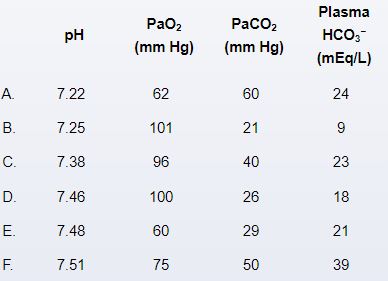
(72) A 34-year-old man travels to Peru to participate in a mountain-climbing expedition. He has no prior medical problems and takes no medications. The patient does not use tobacco, alcohol, or illicit drugs. During his trip, he stays in a high-altitude camp in the mountains at over 4,000 m (13,000 ft) above sea level. After 2 days at the camp, the patient has blood drawn by the camp's physician while breathing ambient air. Which of the following sets of arterial blood gas values is most likely to be seen in this patient?
(Multiple Choice)
4.7/5 (70)
(70) Researchers are testing various modalities to reduce glutamate-induced excitotoxic neuronal injury after ischemic stroke. The investigators record the postsynaptic potential of cortical neurons under various conditions. The neurons are exposed to glutamate, which causes them to depolarize; excessive depolarization triggers cell death. The experiment is repeated after altering the electrolyte composition of the extracellular fluid. When the extracellular magnesium concentration is increased, glutamate-induced neuron depolarization and cell death are decreased. Which of the following changes in ion conductance explains the improved neuron survival in response to magnesium?
(Multiple Choice)
4.8/5 (86)
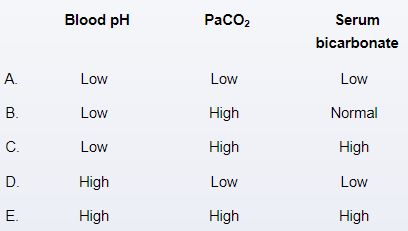
(86) A 34-year-old woman comes to the office due to a 3-day history of watery diarrhea. The patient has no fever. She has no other medical conditions and takes no medications. Blood pressure is 120/80 mm Hg and pulse is 90/min. Examination shows mild abdominal discomfort but is otherwise normal. Compared to normal laboratory values, which of the following findings are most likely present in this patient?
(Multiple Choice)
4.7/5 (67)
(67) A group of researchers is studying secondary hypertension in porcine models of renal artery stenosis. During an experiment, a clip is placed that constricts the right renal artery to 30% of its original cross-sectional area. A few days later, hemodynamic and biochemical measurements are recorded and compared to measurements obtained before clip placement. Which of the following changes is most likely to be seen in the experimental animals?
(Multiple Choice)
4.9/5 (74)
(74) A 23-year-old woman, gravida 1, para 0, comes to the office for a routine prenatal care visit. She is at 35 weeks gestation and feels well. She reports regular fetal movement and no contractions, loss of fluid, or vaginal bleeding. Pregnancy to date has been uncomplicated and the patient has no underlying medical conditions. She signed up for a clinical trial investigating prolactin. At 34 weeks gestation, she had a serum prolactin level several times higher than what was recorded prior to pregnancy. Which of the following hormones prevents lactation in this patient?
(Multiple Choice)
4.9/5 (90)
(90) A 50-year-old man with a remote history of alcohol dependence is evaluated in the clinic for chronic diarrhea and weight loss. The patient has had bloating with daily loose stools for the past 2 years. His stool is described as greasy and malodorous. Pancreatic insufficiency is suspected despite normal abdominal imaging. The patient undergoes a test in which bicarbonate concentration is measured from duodenal aspirates as hormone A is infused intravenously. The data is plotted in the graph below. 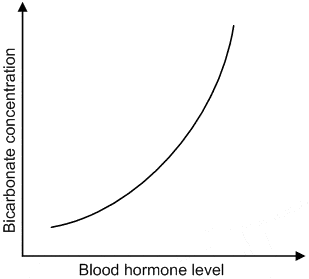 Hormone A is most likely produced by which of the following cell types?
 (Multiple Choice)
4.8/5 (68)
(68) A collection of tan fat-containing tissue is found around the kidneys and adrenal glands of a newborn during surgery. Surgical removal of the tissue would most likely contribute to:
(Multiple Choice)
4.9/5 (81)
(81) A 37-year-old woman, gravida 2 para 1, at 30 weeks gestation comes to the office to discuss her recent laboratory work. At her last visit at 28 weeks gestation, the patient drank a solution containing 50 g of glucose, and her serum glucose was abnormally elevated an hour later. Today, she is scheduled to undergo a confirmatory 3-hour glucose test. Her pregnancy has been uncomplicated, and the patient has no chronic medical conditions. She is taking a daily prenatal vitamin. Vital signs are normal. Physical examination shows a uterine size consistent with gestational age. Fetal heart rate is 140/min. Which of the following hormones is most likely contributing to this patient's abnormal laboratory findings?
(Multiple Choice)
4.7/5 (71)
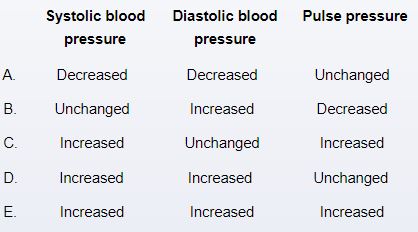
(71) A 24-year-old woman participates in a study of changes in blood pressure during aerobic exercise. She is healthy and takes no medications. During the study she is asked to run on a treadmill at incrementally increasing speed until her heart rate reaches 90% of her expected maximum heart rate. Compared to at rest, which of the following changes in blood pressure are expected during this time?
(Multiple Choice)
5.0/5 (80)
(80) A 38-year-old woman is being evaluated for shortness of breath. The patient has had poor exercise tolerance for the last several months that she initially attributed to deconditioning. Over the last several weeks, her symptoms have gotten progressively worse and she currently feels short of breath even during mild exertion. The patient has no family history of heart disease. As part of her evaluation, she undergoes right and left heart catheterization. The following data are obtained:  Which of the following is the most likely cause of this patient's symptoms?
 (Multiple Choice)
4.9/5 (72)
(72) A 21-year-old man is brought to the emergency department after being found unresponsive in a public restroom. He has a history of injection drug use. Temperature is 36.1 C (97 F), blood pressure is 110/70 mm Hg, pulse is 62/min, and respiratory rate is 8/min. On physical examination, the patient is unconscious with pinpoint pupils. Endotracheal intubation is performed, and mechanical ventilation is begun. The ventilator settings are adjusted to provide a minute ventilation of 6.0 L/min. Calculated alveolar ventilation is 4.2 L/min. Which of the following most likely accounts for the difference between these 2 parameters?
(Multiple Choice)
4.8/5 (80)
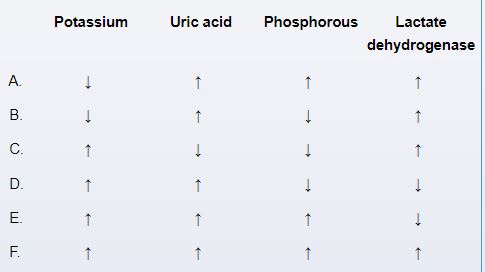
(80) A 6-year-old girl is brought to the office by her mother due to abdominal pain and vomiting. The patient has Down syndrome but has otherwise been healthy. Abdominal examination reveals the liver edge 3 cm below the costal margin and the spleen tip extending past the level of the umbilicus. Leukocyte count is 104,000/mm3, and subsequent peripheral blood smear reveals numerous lymphoblasts. The patient is diagnosed with acute lymphoblastic leukemia and combination cytotoxic chemotherapy is planned. Which of the following laboratory changes are most likely to be seen in this patient following treatment initiation?
(Multiple Choice)
4.7/5 (60)
(60) A 32-year-old man is evaluated in the emergency department due to fever, night sweats, and chills over the last several days. The patient has been using intravenous drugs recently as he is "stressed out." He has otherwise been in good health with no medical problems. Temperature is 38.3 C (101 F), blood pressure is 120/80 mm Hg, and pulse is 105/min and regular. Further evaluation reveals aortic valve endocarditis with an intracardiac abscess and small fistula formation between the aortic root and right ventricle. Doppler ultrasound interrogation of the fistula will most likely reveal which of the following blood flow patterns?
(Multiple Choice)
5.0/5 (85)
(85) A 16-year-old boy comes to the office for an annual health maintenance visit. He has no medical conditions and feels well. The patient plays football for his high school team and states he is planning to increase his physical workouts to prepare for the upcoming season. He indicates that last season he was often fatigued during the second half of games, and he plans to focus on endurance training. Physical examination shows no abnormalities. Which of the following is most likely to increase in this patient's large skeletal muscle groups after a prolonged period of regular training?
(Multiple Choice)
4.9/5 (88)
(88) A 23-year-old healthy man who lives at sea level is attempting to trek to the Mount Everest base camp at an elevation of 5,334 m (17,500 ft). While hiking, he experiences mild shortness of breath, lightheadedness, headache, and fatigue. The patient reaches the base camp after 7 days, where he is evaluated at a high-altitude clinic. He appears exhausted, but physical examination is otherwise unrevealing. Which of the following physiologic changes has most likely occurred in this patient?
(Multiple Choice)
5.0/5 (93)
(93) 
Filters
- Essay(0)
- Multiple Choice(0)
- Short Answer(0)
- True False(0)
- Matching(0)