



 Chat with AI
Exam 13: Physiology

Exam 1: Anatomy291 Questions
Exam 2: Behavioral science240 Questions
Exam 3: Biochemistry156 Questions
Exam 4: Biostatistics117 Questions
Exam 5: Embryology52 Questions
Exam 6: Genetics103 Questions
Exam 7: Histology24 Questions
Exam 8: Immunology129 Questions
Exam 9: Microbiology336 Questions
Exam 10: Pathology816 Questions
Exam 11: Pathophysiology464 Questions
Exam 12: Pharmacology538 Questions
Exam 13: Physiology272 Questions
Select questions type


A 64-year-old man presents to the office with chest discomfort and mild shortness of breath that started one hour ago after an argument with his wife. He has a long history of hypertension and diabetes mellitus. His blood pressure is 180/100 mmHg and his heart rate is 100/min. An EKG taken in the emergency department shows no signs of acute ischemia. Cardiac auscultation in the left decubitus position on full expiration reveals a presystolic sound. Which of the following best explains this physical examination finding?
(Multiple Choice)
4.9/5  (85)
(85) A 14-year-old girl is brought to the office due to abnormal menstrual periods. Since menarche, the patient's menses have been unpredictable. She does not have menstrual bleeding each month, and when she does have a menstrual period, she bleeds for 7-10 days and occasionally needs to use nearly twice as many tampons a day as her older sister. The patient underwent menarche a year ago, and her last menstrual period was 6 weeks ago. Medical history is unremarkable. BMI is 22 kg/m2. Urine pregnancy test is negative, and a complete blood count is normal. Which of the following is the most likely cause of this patient's irregular bleeding?
(Multiple Choice)
4.7/5 (79)
(79) A 35-year-old woman comes to the office due to frequent urination. She describes drinking excessive amounts of water due to unquenchable thirst. She does not take any medications. Her blood glucose level is 86 mg/dL. A standard water deprivation test is performed. The results of urine osmolality during 4 hours of dehydration are presented in the table below. The patient's plasma osmolality after 3 hours of water deprivation was found to be 298 mOsm/L, and vasopressin was then administered subcutaneously.  Which of the following is the most likely diagnosis in this patient?
 (Multiple Choice)
5.0/5 (78)
(78) A 35-year-old woman comes to the office for a follow-up appointment after recent hospitalization. The patient presented to the emergency department with fever and malaise and was diagnosed with infective endocarditis. She underwent a prolonged course of antibiotic therapy and her last dose was 5 days ago. She has no fever or shortness of breath and has resumed her daily activities. The patient has no other medical problems. Blood pressure is 128/72 mm Hg and pulse is 78/min. Auscultatory findings recorded at the left sternal border are shown in the phonocardiogram below. 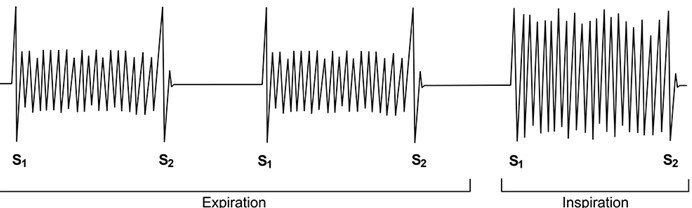 Which of the following is the most likely cause of the murmur depicted above?
 (Multiple Choice)
4.9/5 (82)
(82) A 32-year-old woman comes to the office due to neck swelling. The patient says her neck has gradually gotten larger, and she does not like how it appears in the mirror. She otherwise feels well and has no hoarseness, trouble swallowing, or shortness of breath. There is no history of head and neck irradiation. The patient has no prior medical conditions and takes no medications. She has a sister with vitiligo. Blood pressure is 110/60 mm Hg and pulse is 75/min. On physical examination, the thyroid is diffusely enlarged with no palpable nodules. There is no tracheal deviation. Serum TSH and free thyroxine levels are normal. Antibodies against thyroid peroxidase are present in high titers. The antigenic target of these antibodies is involved in which of the following processes?
(Multiple Choice)
4.7/5 (64)
(64) Physiologists are investigating renal autoregulatory mechanisms in an animal species that closely mimics human physiology. During one of their experiments, renal blood flow and glomerular filtration rate are measured in an anesthetized animal in response to changes in mean arterial pressure. The data they obtain is shown on the graph below. 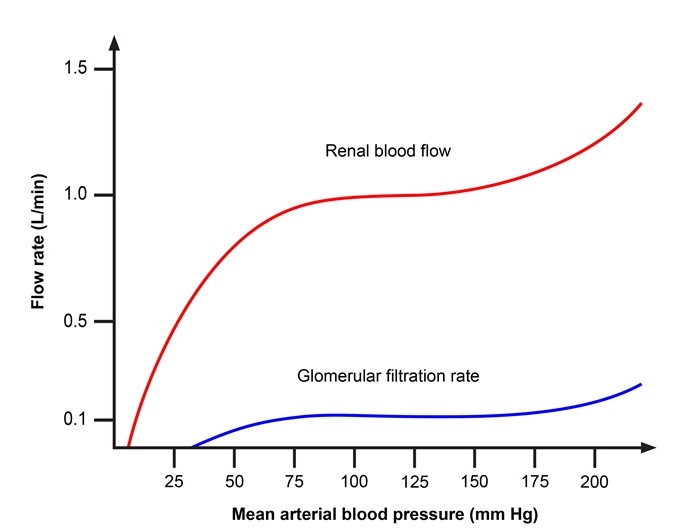 Assuming a hematocrit of 0.50, what is the best estimate of the filtration fraction when the mean arterial pressure is 120 mm Hg?
 (Multiple Choice)
4.8/5 (84)
(84) A 42-year-old man comes to the office due to leg swelling. He has also had yellowing of the eyes and progressive abdominal distension for the past 3 weeks, as well as an associated 7-kg (15.4-lb) weight gain. The patient drinks at least 8 beers a day and in the past has been admitted to the hospital for intoxication and seizures. He denies smoking or intravenous drug use. Vital signs are within normal limits. Scleral icterus, spider angiomas, and palmar erythema are present. There is no jugular venous distension, and cardiac auscultation reveals a normal rate and rhythm. Breath sounds are normal. The abdomen is diffusely enlarged, and a fluid wave is easily elicited. Pitting edema is present in the bilateral lower extremities. Which of the following pathophysiologic changes is most likely present in this patient?
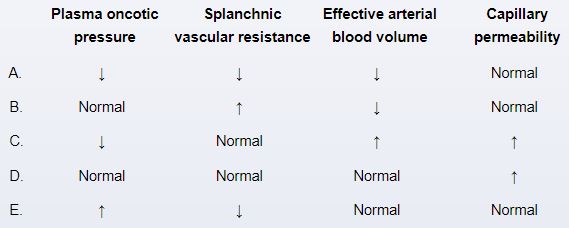
(Multiple Choice)
4.7/5 (76)
(76) An 8-year-old boy is evaluated in the office due to difficulty walking. The patient has problems running, jumping, and walking up steps. There is no history of neurological disorders in the family. Physical examination reveals weakness of lower extremity muscles bilaterally. Electron microscopy of a biopsy sample taken from calf muscle is shown below. 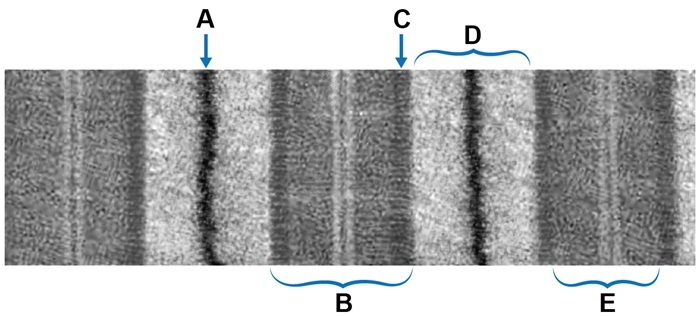 Which of the following labeled regions contains only thick filaments and no thin filaments?
 (Multiple Choice)
4.9/5 (80)
(80) A 44-year-old man comes to the emergency department due to sudden-onset shortness of breath that started a few hours ago. Last week, he sustained a crush injury after a motorcycle drove over his left foot, and he has been immobilized since then due to pain. The patient drinks alcohol occasionally and does not use tobacco or illicit drugs. Temperature is 36.1 C (97 F), blood pressure is 118/76 mm Hg, pulse is 102/min, and respirations are 28/min. BMI is 37 kg/m2. On physical examination, heart rhythm is regular with normal S1 and S2. The lungs are clear to auscultation bilaterally. The dorsum of the left foot has resolving ecchymoses and swelling compared to when he was evaluated last week. The right calf is swollen and tender. Which of the following arterial blood gas values are most likely to be present in this patient?
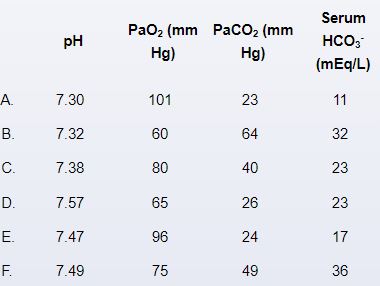
(Multiple Choice)
4.8/5 (78)
(78) A 30-year-old woman who normally resides in Florida (elevation near sea level) plans to travel to La Paz, Bolivia (elevation 3,600 m [11,900 ft]) for a week-long business trip. Medical history is unremarkable. Which of the following physiologic changes are expected during the patient's week in La Paz?
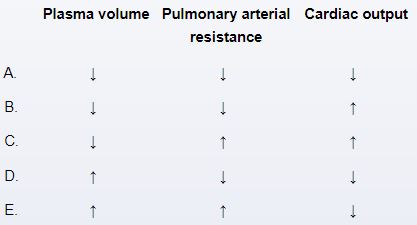
(Multiple Choice)
4.9/5 (85)
(85) A 45-year-old man comes to the office for follow-up. He was diagnosed with focal epilepsy 2 years ago and has been treated with several antiepileptic medications. Over the last 6 months, his seizure frequency has increased despite compliance with medical therapy. Neurologic examination and brain imaging are unremarkable. The patient is started on a new antiepileptic medication that selectively blocks voltage-gated calcium channels. This medication most likely affects which of the following steps of neurotransmission?
(Multiple Choice)
4.8/5 (67)
(67) A 38-year-old man is brought to the emergency department due to progressive nausea, confusion, and unsteady gait. Family members state that symptoms started 4 days ago after he went to the dentist due to a toothache, for which he was prescribed ibuprofen. He also takes lithium for bipolar disorder. On examination, he is drowsy and ataxic, having slurred speech and coarse tremors. His serum lithium level is 3.86 mEq/L (therapeutic range: 0.8-1.2 mEq/L), and serum creatinine and blood urea nitrogen are elevated. While in the emergency department, he develops a generalized tonic-clonic seizure. During emergent hemodialysis treatment, his blood is passed along a semipermeable membrane and allowed to equilibrate with a dialysate solution. Which of the following is most likely to increase the rate of drug removal?
(Multiple Choice)
4.9/5 (77)
(77) A researcher is investigating a new antiseizure drug that binds to and activates GABA-A receptors in the central nervous system. During the experiment, she isolates a nerve and uses a microelectrode to measure its membrane potential under physiologic conditions. The resting potential of the nerve is found to be −70 mV. Which of the following membrane potentials will most likely be recorded from this neuron following exposure to the new drug?
(Multiple Choice)
4.8/5 (81)
(81) A 23-year-old hiker loses a foothold and falls several feet during a mountain climb. He sustains no major injury but loses his backpack. He walks in the heat without water for the next 8 hours; by the time he reaches a shelter, he is extremely thirsty. Fluid from which of the following nephron segments is likely to be the most hypoosmotic in this individual? 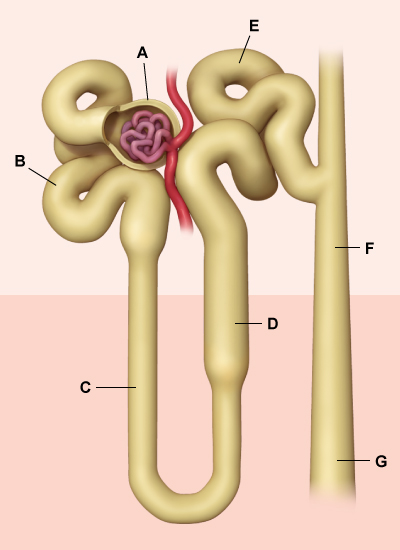
(Multiple Choice)
4.8/5 (83)
(83) A 48-year-old man with diet-controlled type 2 diabetes mellitus is being evaluated for occasional retrosternal chest pain. He has no history of hypertension, and his blood pressure measurements during office visits were always within normal limits. There is no family history of cardiovascular disease. The patient undergoes exercise treadmill stress testing. He walks for 7 minutes on the treadmill and stops due to fatigue but does not experience chest pain. His ECG does not show any abnormal changes. Heart rate ranges from 70/min at rest to 132/min at peak and mean blood pressure ranges from 95 mm Hg at rest to 112 mm Hg at peak. Which of the following parameters was most likely decreased during peak stress compared to the resting state in this patient?
(Multiple Choice)
4.9/5 (70)
(70) A 34-year-old man is brought to the emergency department after a motor vehicle collision. He has blunt abdominal trauma and bilateral femur fractures. The patient has no significant medical history and takes no medications. He does not smoke but drinks 8-12 alcoholic beverages a day. Blood pressure is 80/40 mm Hg and pulse is 110/min. Immediate resuscitation efforts are initiated, during which he receives transfusion of several units of packed red blood cells. During transport to the intensive care unit, the patient reports a tingling sensation in his fingers and toes. Serum ionized calcium level is 4 mg/dL (normal: 4.8-5.5). Which of the following is the most likely cause of this patient's current symptoms?
(Multiple Choice)
4.8/5 (83)
(83) A 5-year-old boy is brought to the office by his parents due to bed-wetting. The patient has stayed dry during the day since age 3 but has continued to wet the bed 4 or 5 nights a week. He urinates approximately 5 times during the day; the urinary stream is continuous and strong. Bowel movements occur daily and are soft. The patient is otherwise healthy and takes no daily medications. Height and weight are tracking along the 75th percentile. Vital signs and examination are normal. Urinalysis is unremarkable. This patient's bed-wetting is most likely caused by which of the following?
(Multiple Choice)
4.8/5 (83)
(83) A 54-year-old woman comes to the office due to worsening nonproductive cough and dyspnea for the past several months. She also reports anorexia and an unintentional weight loss of 7 kg (15.4 lb). The patient has no prior medical conditions, takes no medications, and is a lifelong nonsmoker. Physical examination shows decreased breath sounds on the left side. Chest x-ray reveals a large left-sided pleural effusion. Thoracentesis yields fluid with a large number of red blood cells and numerous atypical cells staining positive for mucin. Which of the following is the most likely primary mechanism of this patient's pleural effusion?
(Multiple Choice)
4.9/5 (88)
(88) A 47-year-old man comes to the emergency department due to a 30-minute history of sudden-onset severe chest pain and shortness of breath. He is on an RV road trip with his family and has had pain in and swelling of the left leg for the past 2 days. The patient has no significant medical history and takes no medications. Temperature is 37.2 C (99 F), blood pressure is 90/56 mm Hg, pulse is 124/min, and respirations are 32/min. Oxygen saturation is 82% on room air. BMI is 36 kg/m2. ECG shows sinus tachycardia. Chest x-ray shows no abnormalities. Which of the following is most likely increased in this patient?
(Multiple Choice)
4.8/5 (80)
(80) Fifty obese adults without diabetes mellitus are enrolled in a 10-week weight loss program. The program includes a low-calorie diet and moderate-intensity exercise for at least 150 minutes per week. The study subjects who are adherent to the regimen lose an average of 7 kg (15.5 lb) at the end of 10 weeks. Venous blood samples to study biochemical changes induced by weight loss are taken at the start of the trial and at the 10-week follow-up visit. Which of the following hormonal changes are likely to occur during the course of the study?
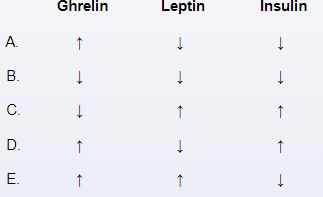
(Multiple Choice)
4.8/5 (85)
(85) 
Filters
- Essay(0)
- Multiple Choice(0)
- Short Answer(0)
- True False(0)
- Matching(0)