



 Chat with AI
Exam 13: Physiology

Exam 1: Anatomy291 Questions
Exam 2: Behavioral science240 Questions
Exam 3: Biochemistry156 Questions
Exam 4: Biostatistics117 Questions
Exam 5: Embryology52 Questions
Exam 6: Genetics103 Questions
Exam 7: Histology24 Questions
Exam 8: Immunology129 Questions
Exam 9: Microbiology336 Questions
Exam 10: Pathology816 Questions
Exam 11: Pathophysiology464 Questions
Exam 12: Pharmacology538 Questions
Exam 13: Physiology272 Questions
Select questions type


A 35-year-old man comes to the office for evaluation of an enlarged left testis. He also reports decreased libido and erectile potency for the last 2 months. The patient has no chronic medical conditions and takes no medications. Physical examination is notable for significant enlargement of the left testis and bilateral gynecomastia. His other secondary sexual characteristics are normal. Serum β-hCG is markedly elevated and serum TSH is normal. Scrotal ultrasound reveals a 3.1-cm, irregular testicular mass with cystic areas. Which of the following is the most likely cause of this patient's gynecomastia?
(Multiple Choice)
4.9/5  (76)
(76) The cardiac output and venous return curves of a healthy person are shown below with solid lines. 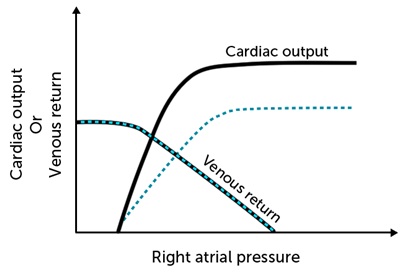 Which of the following is the most likely cause of the change depicted by the dashed lines?
 (Multiple Choice)
4.9/5 (92)
(92) Researchers are studying how the membrane potential of a postsynaptic neuron changes in response to neurotransmitter stimulation. Baseline measurements determine that the resting membrane potential is generated by high membrane permeability for a particular ion. When neurotransmitter stimulation begins, ligand-gated ion channels open (black arrow) and increase the membrane permeability for a different ion, causing a change in membrane potential. This triggers the delayed opening of voltage-gated ion channels (red arrow), which increase the membrane permeability for a third type of ion. The results of the experiment are shown in the graph below. 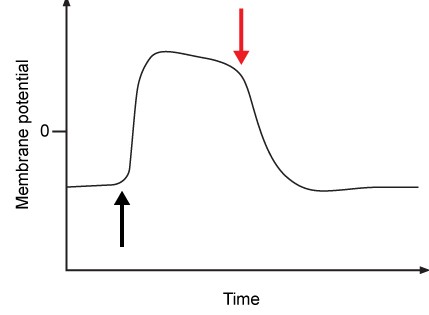 The equilibrium potentials of different ions under physiologic conditions are as follows:
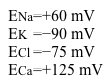 Which of the following options would best explain the changes in this neuron's membrane potential during the experiment?
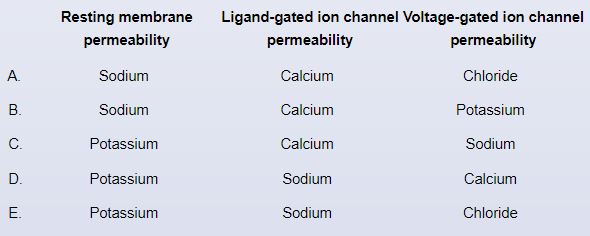
The equilibrium potentials of different ions under physiologic conditions are as follows: Which of the following options would best explain the changes in this neuron's membrane potential during the experiment?
(Multiple Choice)
4.9/5 (75)
(75) A 43-year-old man is brought to the emergency department after being found unresponsive by his wife. She says he was in his usual state of health when she left home a few hours ago. The patient has a history of depression and type 2 diabetes mellitus. He was recently laid off from work. Blood pressure is 100/60 mm Hg and pulse is 64/min. On physical examination, the patient is responsive to deep sternal rub and has mildly dry mucous membranes. Arterial blood gas analysis reveals the following: 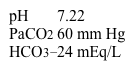 Which of the following is the most likely current acid-base status in this patient?
 (Multiple Choice)
4.7/5 (74)
(74) A 19-year-old man is brought to the emergency department due to weakness and confusion. Family members report that for the last 2 weeks he has experienced polyuria, polydipsia, and increased appetite. Medical history is remarkable for an appendectomy at age 12. The patient does not use tobacco, alcohol, or illicit drugs. Family history is significant for hypothyroidism in his brother. Temperature is 36.7 C (98 F), blood pressure is 90/60 mm Hg, pulse is 97/min, and respirations are 22/min. On physical examination, the patient is lethargic but follows simple commands. His breath has a fruity odor. This patient is most likely deficient in a hormone that normally performs which of the following actions?
(Multiple Choice)
4.9/5 (75)
(75) An 18-year-old man, who was recently started on risperidone therapy for schizophrenia, comes to the office due to involuntary deviation of his head. On examination, the patient's head is tilted toward the right side and the chin is rotated to the left. There is palpable tightening of the right sternocleidomastoid muscle. It is determined that the patient is experiencing a medication-induced dystonic reaction due to motor neuron hyperactivity. The persistent myocyte stimulation causes a substance to be released from the sarcoplasmic reticulum. This substance most likely binds to which of the following proteins to cause this patient's symptoms?
(Multiple Choice)
4.9/5 (78)
(78) A 70-year woman comes to the office due to acute midthoracic back pain that started after a ground-level fall. The patient has also had weakness and weight loss for the past 2 months. Blood pressure is 150/70 mm Hg and pulse is 110/min. Examination shows sweaty palms and a fine hand tremor. Laboratory evaluation reveals normal hemoglobin, serum calcium, serum creatinine, and 25-hydroxyvitamin D levels. Serum thyrotropin (TSH) is undetectable. X-ray reveals a compression fracture of the T7 vertebra with diffuse demineralization of the bones. Which of the following is most likely responsible for the bone abnormalities in this patient?
(Multiple Choice)
4.9/5 (79)
(79) A 54-year-old man is being evaluated for exertional dyspnea that started 6 months ago. The patient has no associated cough or wheezing. There is no known history of heart disease in his family. ECG, chest x-ray, exercise stress test, and echocardiogram are obtained to evaluate his symptoms. He subsequently undergoes right and left cardiac catheterization, and the results are as follows: 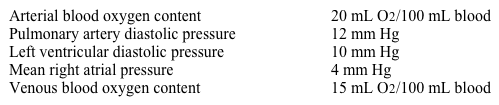 What additional information is necessary to calculate cardiac output in this patient?
 (Multiple Choice)
4.9/5 (86)
(86) A 41-year-old man comes to the office due to a 4-month history of fatigue, headache, weight loss, sweating, and palpitations. He is otherwise healthy and takes no medications. He does not use tobacco, alcohol, or illicit drugs. Physical examination reveals lid lag and a fine hand tremor. Neck examination reveals mild, diffuse enlargement of the thyroid gland. Laboratory results are as follows:  Which of the following is the most likely cause of this patient's disorder?
 (Multiple Choice)
4.8/5 (85)
(85) A large pharmaceutical company is conducting research on an experimental drug that affects blood flow in diseased tissue. A healthy 30-year-old man is enrolled in the trial, and patterns of normal blood flow through various tissues are studied. One of the patterns is shown in the image below: 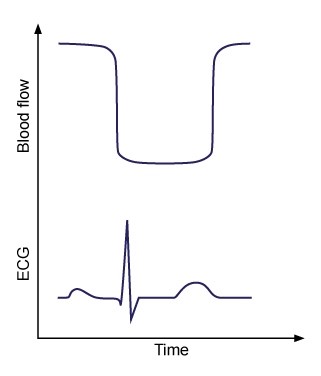 The blood flow curve was most likely obtained from tissue of which of the following?
 (Multiple Choice)
4.7/5 (65)
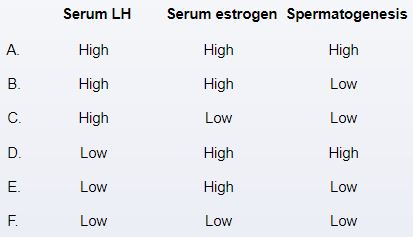
(65) A 16-year-old boy is brought to the office for evaluation of irritability, slow growth, and acne. The patient plays soccer and has been following an aggressive strength-training program. When asked, he admits to using a performance-enhancing substance for the past 6 months. What additional findings would most likely be present in this patient now compared to 6 months ago?
(Multiple Choice)
4.7/5 (87)
(87) Researchers are studying pulmonary gas exchange in various physiological and pathological states using animal models. In one experiment, the partial pressure of oxygen (PO2) in the upper airways is determined to be 150 mm Hg while breathing ambient air at rest. Analysis of the respiratory gases in a particular lung segment reveals the following: 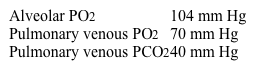 Which of the following best explains these respiratory gas findings?
 (Multiple Choice)
4.8/5 (68)
(68) An 87-year-old woman comes to the office to discuss treatment for colon cancer, which was recently diagnosed by colonoscopy. CT scan was negative for metastatic disease. The patient has no other medical conditions, and family history is unremarkable. She does not drink alcohol. Vital signs are normal. A chemotherapy regimen containing a medication that is primarily metabolized by the liver is chosen for therapy. Because of the patient's age, the physician is considering adjusting the dose to prevent adverse effects. Which of the following parameters is likely to be the most similar between this patient and a healthy 40-year-old individual?
(Multiple Choice)
4.9/5 (75)
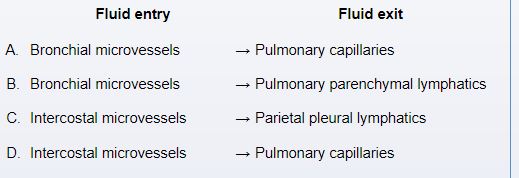
(75) Physiologists are studying the mechanisms of pleural fluid formation and absorption in the normal state. They obtain healthy experimental animals whose pleuropulmonary anatomy and physiology closely resembles that of humans. Intravenous radioisotope tracers are injected into these animals and are monitored closely to track fluid movement into and out of the pleural space. Which of the following pathways of pleural fluid turnover is most likely to be observed?
(Multiple Choice)
4.8/5 (75)
(75) A 32-year-old woman comes to the emergency department due to sudden-onset left-sided facial droop and arm weakness. The patient also has had right leg swelling after a recent road trip. She has no chronic medical conditions, and her only medication is an oral contraceptive. CT scan of the head shows a right middle cerebral artery territory acute infarction. Lower extremity ultrasound examination reveals a right femoral vein thrombus. No obvious cardiac structural abnormalities are detected on an echocardiogram. Agitated normal saline is injected into a peripheral vein to evaluate for abnormal right-to-left shunting. No bubbles are seen in the left side of the heart after several minutes. Which of the following is most appropriate to increase right-sided heart pressure to reveal an obscure intracardiac shunt?
(Multiple Choice)
4.9/5 (74)
(74) A 34-year-old man comes to the clinic for evaluation of a heart murmur. The patient has no chest pain, palpitations, dizziness, or shortness of breath at rest. He also exercises regularly without any abnormal symptoms. Cardiac auscultation in the second right intercostal space reveals an ejection click along with a soft systolic murmur radiating to the neck. A normal volume and pressure tracing of the left ventricle is shown in the image below. Which of the following letters corresponds to the opening of the valve most likely affected in this patient? 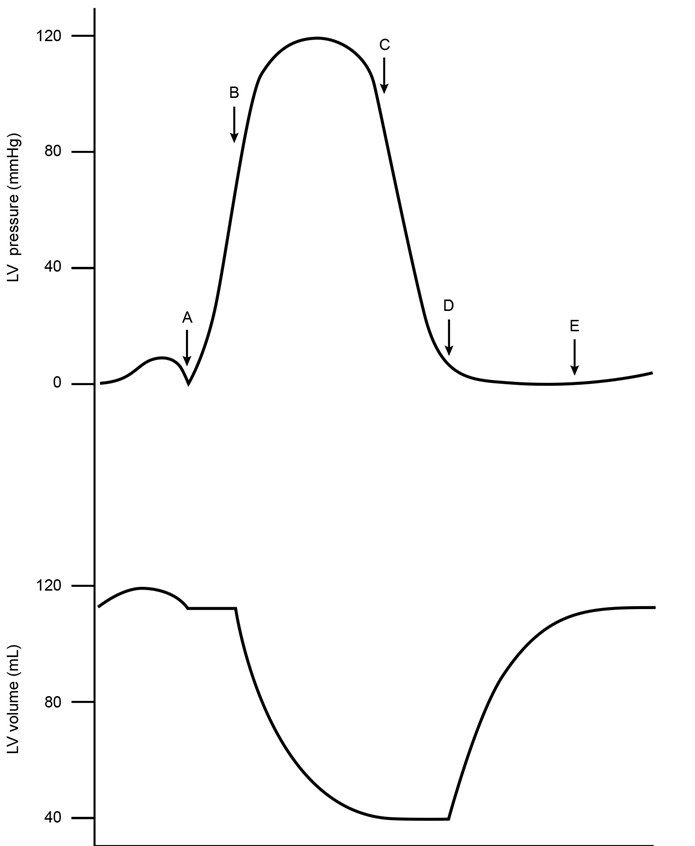
(Multiple Choice)
4.9/5 (70)
(70) A 38-year-old man comes to the office with headaches, loss of libido, and erectile dysfunction for the last 3 months. The patient has no chronic medical conditions and takes no prescription or over-the-counter medications. He does not use tobacco, alcohol, or illicit drugs. Vital signs are normal. The examination is notable for peripheral vision loss, bilateral gynecomastia, and soft testes without masses. Laboratory evaluation shows normal serum prolactin, normal β-hCG, low serum LH, and low serum testosterone. Which of the following is the most likely mechanism for this patient's gynecomastia?
(Multiple Choice)
4.9/5 (67)
(67) A 32-year-old woman is brought to the emergency department after being stuck in a malfunctioning elevator for 45 minutes. The patient says she felt extremely anxious in the closed space of the elevator and experienced dizziness, shortness of breath, generalized weakness, and blurred vision. She has no other medical conditions and takes no medications. She does not use tobacco, alcohol, or illicit drugs. Which of the following is the most likely cause of this patient's symptoms?
(Multiple Choice)
5.0/5 (87)
(87) A researcher is studying the effect of various manipulations on kidney blood flow and glomerular filtration. Which of the following is most likely to both decrease renal plasma flow and increase the filtration fraction?
(Multiple Choice)
4.8/5 (82)
(82) In an animal experiment, the pancreatic duct is cannulated and different secretory stimuli are applied to the gland. The following tracings are obtained by measuring pancreatic fluid constituents: 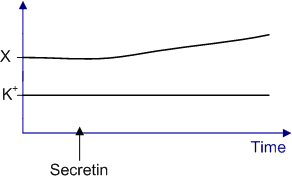 Substance 'X' is most likely which of the following?
 (Multiple Choice)
4.8/5 (67)
(67) 
Filters
- Essay(0)
- Multiple Choice(0)
- Short Answer(0)
- True False(0)
- Matching(0)