



 Chat with AI
Exam 13: Physiology

Exam 1: Anatomy291 Questions
Exam 2: Behavioral science240 Questions
Exam 3: Biochemistry156 Questions
Exam 4: Biostatistics117 Questions
Exam 5: Embryology52 Questions
Exam 6: Genetics103 Questions
Exam 7: Histology24 Questions
Exam 8: Immunology129 Questions
Exam 9: Microbiology336 Questions
Exam 10: Pathology816 Questions
Exam 11: Pathophysiology464 Questions
Exam 12: Pharmacology538 Questions
Exam 13: Physiology272 Questions
Select questions type


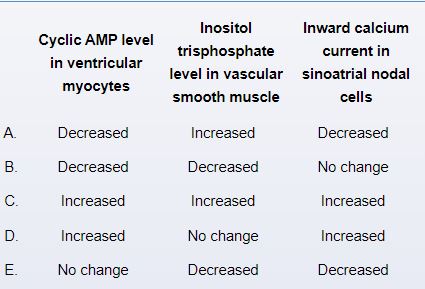
A 44-year-old previously healthy woman comes to the emergency department due to a 2-day history of left flank pain, dysuria, fever, and chills. Temperature is 38.9 C (102 F), blood pressure is 80/40 mm Hg, and pulse is 140/min and regular. Physical examination shows left costovertebral angle tenderness. Laboratory studies reveal leukocytosis, pyuria, and bacteriuria. Empiric broad-spectrum antibiotics and intravenous fluids are administered. The patient remains persistently hypotensive, and an intravenous phenylephrine infusion is begun. Several minutes later, her heart rate decreases to 100/min. Compared to just prior to the infusion, which of the following intracellular changes are expected in this patient?
(Multiple Choice)
4.7/5  (77)
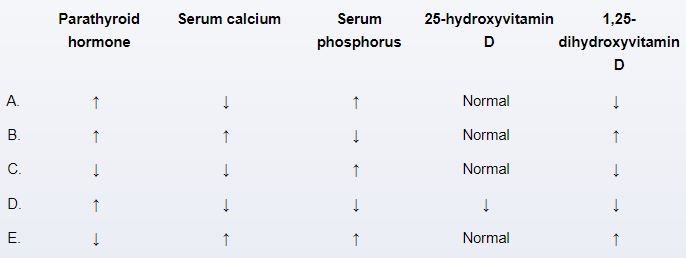
(77) A 56-year-old man with chronic renal insufficiency due to polycystic kidney disease is evaluated for placement of an arteriovenous fistula for dialysis access. Blood pressure is 140/90 mm Hg and pulse is 80/min. Examination shows 2+ bilateral edema of the lower extremities. Estimated glomerular filtration rate is 15 mL/min/1.73 m2. Which of the following sets of laboratory findings is most likely in this patient?
(Multiple Choice)
4.9/5 (86)
(86) A 63-year-old woman is hospitalized because of dyspnea on exertion and generalized fatigue. She has been hospitalized 3 times during the past year for heart failure exacerbations. Her other medical problems include essential hypertension for 20 years, myocardial infarction at the age of 58, and hypercholesterolemia. She has a 36-pack-year smoking history in addition to a 10-year history of alcohol abuse. Physical examination reveals tachycardia, distended neck veins, bilateral crackles on lung auscultation, a third heart sound on cardiac auscultation, and pedal edema. The appropriate therapy is initiated. On the third day of hospitalization, her hematocrit level increases to 50%, up from 44% on admission. An arterial blood gas analysis shows an arterial O2 partial pressure (PaO2) of 70 mm Hg. A 51Cr-tagged red blood cell infusion indicates normal red blood cell mass. Which of the following is the most likely cause of this patient's polycythemia?
(Multiple Choice)
4.8/5 (74)
(74) A 25-year-old woman is brought to the emergency department due to progressive lethargy. For the last 3 weeks, she has also had loss of appetite, constipation, muscle weakness, and increased thirst and urination. The patient's medical history is unremarkable. She takes no prescription medications but has been taking large doses of vitamin D supplements in the belief that they are beneficial for her health. The patient does not use tobacco, alcohol, or illicit drugs. On physical examination, she is stuporous and has dry mucous membranes. The metabolic abnormality most likely responsible for this patient's clinical findings can also occur in which of the following conditions?
(Multiple Choice)
5.0/5 (73)
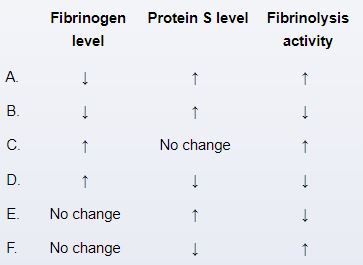
(73) A 28-year-old woman, gravida 2 para 1, at 18 weeks gestation comes to the office for a routine prenatal appointment. She is feeling well and has had no complications during this pregnancy. The patient has no chronic medical conditions and has had no previous surgeries. Her only medications are a daily prenatal vitamin and an iron supplement. Blood pressure is 110/70 mm Hg and pulse is 62/min. BMI is 24 kg/m2. Cardiopulmonary examination is unremarkable. The uterus is consistent with 18 weeks gestation and fetal heart tones are normal. There is mild bilateral pedal edema to the shins. Compared to a nonpregnant state, which of the following changes are most likely expected in this patient?
(Multiple Choice)
4.8/5 (74)
(74) A 45-year-old woman comes to the office due to a 6-month history of abdominal bloating, excessive flatulence, and watery diarrhea. Past medical history is significant for long-standing type 1 diabetes mellitus managed with insulin. Vital signs are normal. Abdominal examination shows no abnormalities. Jejunal aspirate is obtained during upper gastrointestinal endoscopy by placing a sterile catheter; culture of the aspirate reveals >10,000 colony-forming units/mL of Bacteroides species. Which of the following is the most likely cause of this patient's current symptoms?
(Multiple Choice)
4.9/5 (83)
(83) A 14-year-old girl is brought to the office to establish medical care. The patient recently immigrated to the United States with her parents from Vietnam. Vital signs are within normal limits. Phonocardiogram obtained at the left upper sternal border is shown below. 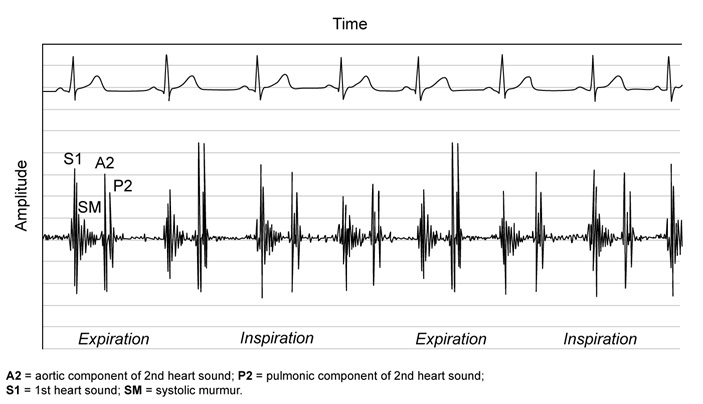 Which of the following is the most likely underlying cause of this patient's heart murmur?
 (Multiple Choice)
4.7/5 (72)
(72) Physiologists are studying the biomolecular mechanisms underlying skeletal muscle contraction. They have been analyzing muscle fibers obtained from knockout mice to determine how different cellular substances influence muscular contraction. Striated muscle fibers obtained from a specific mouse embryo fail to contract in response to a substance normally released from the sarcoplasmic reticulum. A deficiency of which of the following would best explain this finding?
(Multiple Choice)
4.8/5 (82)
(82) A 67-year-old man is brought to the emergency department by his son after a syncopal episode. The son was helping his father clean out the garage when the father said he felt dizzy. As the son was helping him into a chair, the patient lost consciousness. He woke up spontaneously about a minute later without any disorientation or confusion. ECG demonstrates bradycardia with a regular rhythm and narrow QRS complexes. There is complete desynchronization between the P waves and QRS complexes. Which of the following locations is most likely pacing this patient's ventricles?
(Multiple Choice)
4.8/5 (78)
(78) A 70-year-old woman comes to the office due to progressive exertional dyspnea over the last year. She has no chest pain or lower-extremity swelling. The patient has long-standing hypertension but has not always been adherent to her medical regimen. She is a lifetime nonsmoker. Blood pressure is 164/73 mm Hg and pulse is 88/min and regular. An S4 is heard on cardiac auscultation. The lungs are clear. Echocardiogram reveals left atrial enlargement, moderate concentric left ventricular hypertrophy, and a left ventricular ejection fraction of 67%. Which of the following changes are most likely to be seen in this patient?
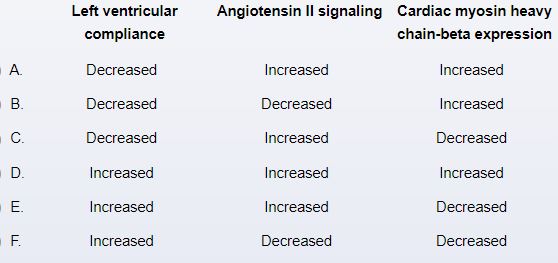
(Multiple Choice)
4.8/5 (83)
(83) A 62-year-old man comes to the office due to worsening fatigue. The patient has long-standing type 2 diabetes mellitus complicated by nephropathy. Laboratory results are as follows: 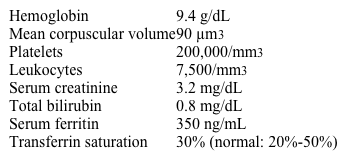 After appropriate treatment is initiated for his anemia, which of the following changes is most likely to occur in this patient's erythroid cells?
 (Multiple Choice)
4.8/5 (82)
(82) A 42-year-old man comes to the office seeking advice on male contraception. He and his wife have 6 children and do not want any more, and his wife wants to stop taking oral contraceptive pills. The patient's medical history is notable for an appendectomy, during which he had no complications from the procedure or the associated anesthesia. He does not smoke. On examination, the patient has a normal circumcised penis with no visible genital lesions and no palpable abnormalities in the scrotum. After appropriate discussion regarding contraceptive options, the patient elects to undergo a vasectomy. The patient should be advised to expect which of the following side effects during the first few months following the procedure?
(Multiple Choice)
4.9/5 (86)
(86) A 32-year-old man comes to the office due to progressive dyspnea, dizziness, and chest discomfort. He has no prior medical problems but had a mild respiratory illness 2 weeks earlier that resolved spontaneously. His father has a history of myocardial infarction. Echocardiography shows pericardial fluid accumulation with late diastolic collapse of the right atrium. Which of the following physical examination findings is most likely to be seen in this patient?
(Multiple Choice)
4.7/5 (72)
(72) The circuit shown below has an inflow pressure of 120 mmHg and an outflow pressure of 40 mmHg. 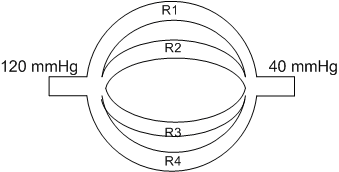 Resistance in each of the four vessels shown is 2 mmHg/mL/min (R1 = R2 = R3 = R4 = 2 mmHg/mL/min). What is the total peripheral resistance of the circuit shown on the slide?
 (Multiple Choice)
4.9/5 (64)
(64) A 43-year-old man comes to the office due to occasional chest discomfort over the last 6 weeks. He thinks he is most likely experiencing musculoskeletal pain but is concerned due to family history of heart disease. The patient has no medical conditions and does not use tobacco. He leads an active lifestyle and exercises every day. He undergoes treadmill exercise stress testing. Baseline blood pressure is 122/75 mm Hg and pulse is 54/min. After 10 minutes of exercise, his blood pressure is 155/80 mm Hg and pulse is 150/min. He has no chest pain and ECG shows no abnormalities. Compared to pretest conditions, which of the following is the single most important limiting factor for left ventricular myocardial blood supply during the test?
(Multiple Choice)
4.9/5 (72)
(72) A patient is treated with a gonadotropin-releasing hormone (GnRH) infusion. An intravenous line is placed and connected to a reservoir through a computerized pump. The pump is programmed to deliver a predetermined dose of GnRH every 90 minutes, which results in a sharp rise in serum GnRH levels with each dose, followed by a rapid return to baseline. LH and FSH levels are monitored in the initial phase of treatment. Which of the following is the most likely indication for using this GnRH infusion?
(Multiple Choice)
4.8/5 (64)
(64) A 56-year-old man comes to the emergency department due to palpitations that started several hours ago. He has not had similar symptoms before. The patient has had no chest pain, shortness of breath, lightheadedness, or syncope. He drinks alcohol on weekends and does not use illicit drugs. He has no family history of heart disease. Blood pressure is 145/78 mm Hg. BMI is 40 kg/m2. ECG is shown in the exhibit.
 The patient is treated medically in the emergency department. He is then taken to the electrophysiology laboratory for radiofrequency catheter ablation to terminate his arrhythmia. The ablation procedure should create a conduction block through which of the following areas?
 (Multiple Choice)
4.8/5 (86)
(86) A 52-year-old man is brought to the emergency department after being found unresponsive on the street. The patient's medical history is unknown. Temperature is 36.2 C (97.2 F), blood pressure is 108/62 mm Hg, and pulse is 72/min. On physical examination, he is unresponsive to verbal and tactile stimuli but moans to deep sternal rub. An arterial blood gas analysis on room air shows a partial pressure of oxygen of 60 mm Hg. The partial pressure of oxygen in his alveoli is calculated to be 68 mm Hg. Which of the following is the most likely cause of this patient's symptoms?
(Multiple Choice)
4.8/5 (81)
(81) A 22-year-old woman with no prenatal care has a normal vaginal delivery. On physical examination, the infant's external genitalia are atypical and ambiguous. There is an intermediate clitorophallic length and a perineal urethral opening. Well-circumscribed, mobile masses are palpable bilaterally in the inguinal area. Vital signs are normal. Serum testosterone level is within normal limits. A karyotype is performed and shows 46,XY. This infant most likely has a deficiency in which of the following enzymes?
(Multiple Choice)
4.7/5 (79)
(79) A 30-year-old nulliparous woman comes to the office for evaluation of infertility. She has been attempting to conceive with her partner of 10 years for the past 2 years. Menarche was at age 11, and her menstrual cycles occur 2-3 times per year and last 7-10 days. The patient does not use tobacco, alcohol, or illicit drugs. Her blood pressure is 128/84 mm Hg and pulse is 84/min. BMI is 35 kg/m2. Physical examination shows mild acne and hair growth on the upper lip and chin. This patient is at greatest risk for which of the following complications?
(Multiple Choice)
4.8/5 (78)
(78) 
Filters
- Essay(0)
- Multiple Choice(0)
- Short Answer(0)
- True False(0)
- Matching(0)