



 Chat with AI
Exam 13: Physiology

Exam 1: Anatomy291 Questions
Exam 2: Behavioral science240 Questions
Exam 3: Biochemistry156 Questions
Exam 4: Biostatistics117 Questions
Exam 5: Embryology52 Questions
Exam 6: Genetics103 Questions
Exam 7: Histology24 Questions
Exam 8: Immunology129 Questions
Exam 9: Microbiology336 Questions
Exam 10: Pathology816 Questions
Exam 11: Pathophysiology464 Questions
Exam 12: Pharmacology538 Questions
Exam 13: Physiology272 Questions
Select questions type


An 80-year-old man participates in a study designed to evaluate the effects of aging on the liver. He has undergone a liver biopsy every 10 years since age 40 so that researchers can identify age-related histologic changes. The subject is healthy and has no relevant family history. He does not use alcohol or illicit drugs. BMI is 21.5 kg/m2. Physical examination is unremarkable; laboratory studies, including complete blood count, liver function tests, cholesterol levels, and hemoglobin A1c, are within normal limits. Which of the following histologic changes has most likely developed over time in this individual?
(Multiple Choice)
4.7/5  (68)
(68) A 4-week-old infant is evaluated for frequent episodes of hypoglycemia. The patient is found to have elevated insulin levels during periods of fasting. Several members of his family have a similar condition. Genetic testing reveals a mutation involving potassium channels expressed in pancreatic beta cells. The mutated channels have a higher sensitivity to the substance that normally modulates their activity, causing increased beta cell secretory activity. Which of the following substances normally binds to and regulates the ion channels that are responsible for this patient's hypoglycemia?
(Multiple Choice)
4.8/5 (86)
(86) A 53-year-old man comes to the office due to difficulty breathing and increasing fatigue. He has shortness of breath at night and has been sleeping in a recliner to help relieve his dyspnea. Medical history is significant for hypertension and hyperlipidemia. Two months ago, the patient suffered a myocardial infarction that was not revascularized due to a delay in seeking treatment. He quit smoking afterward, but had previously smoked a pack of cigarettes daily for 25 years. On cardiac auscultation, a low-frequency diastolic heart sound is heard shortly after the second heart sound when the patient lies in the left lateral decubitus position. Cardiac imaging shows hypokinesis of the left ventricular free wall. Which of the following is most likely to accentuate this patient's abnormal auscultation finding?
(Multiple Choice)
4.9/5 (93)
(93) Respiratory physiologists conduct a study to assess the airway resistance of the lower respiratory tract in healthy volunteers. During the experiment, they measure total cross sectional airflow resistance as it changes between each airway generation. Which of the following graphs is most likely to be observed in this study?
(Multiple Choice)
4.8/5 (82)
(82) A healthy 80-year-old man has participated in a longitudinal study over the past 30 years to study the effects of aging on overall cardiovascular status. He has undergone annual testing with echocardiography and his left ventricular ejection fraction has remained stable throughout the 30 years. Which of the following changes is most likely responsible for the preserved left ventricular ejection fraction in this patient?
(Multiple Choice)
4.7/5 (81)
(81) A 69-year-old man is brought to the emergency department with sudden onset palpitations and dyspnea. His medical history is significant for hypertension and gastroesophageal reflux disease. ECG reveals a heart rate of 120/min with an irregularly irregular rhythm, narrow QRS complexes, and no organized P waves. Which of the following physiologic factors most likely determines the ventricular contraction rate in this patient?
(Multiple Choice)
4.9/5 (86)
(86) Researchers are studying treatment of osteoporotic fractures. Subjects with pelvic fractures due to osteoporosis are divided into 2 groups. The control group receives physical therapy along with calcium and vitamin D supplementation. The experimental group receives a parathyroid hormone analogue in addition to the standard therapy. It is found that the subjects who receive hormonal treatment have a shorter time to fracture healing and improved functional outcome. The benefits of the investigational medication are attributed to increased osteoblastic activity. An elevated level of which of the following markers is most likely to reflect the medication effect in these subjects?
(Multiple Choice)
4.7/5 (76)
(76) A 44-year-old man comes to the office due to increasing shortness of breath. While climbing the stairs to his second-floor apartment, the patient must now stop halfway to catch his breath. He has a history of nonischemic cardiomyopathy and chronic heart failure with reduced ejection fraction. After evaluation, treatment with a new medication is begun that improves his symptoms by increasing urine output and decreasing peripheral vascular resistance. The medication works by inhibiting a metalloprotease to prolong the action of endogenous polypeptides. These polypeptides are most likely secreted by which of the following cell types?
(Multiple Choice)
4.8/5 (74)
(74) A 23-year-old man undergoes exercise physiology testing at sea level. He jogs on a treadmill to achieve a moderate-intensity physical activity level based on a target heart rate of 50%-70% of his estimated maximum heart rate. An increase in which of the following is expected at the peak of his exertion?
(Multiple Choice)
4.8/5 (85)
(85) A 54-year-old man is admitted to the hospital due to cough, shortness of breath, and chest discomfort. He has a known history of coronary artery disease and underwent coronary artery bypass graft surgery 3 years ago. As a result of drug therapy, the left ventricular pressure-volume loop changes from a solid to a dashed line, as shown in the graph below (the loop is unchanged in areas where no dashed line is seen): 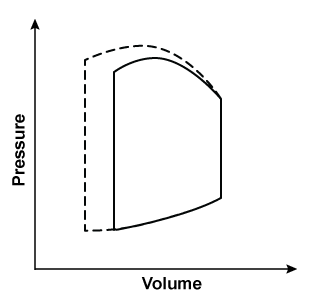 Which of the following parameters is most likely increased as a result of this change?
 (Multiple Choice)
4.8/5 (78)
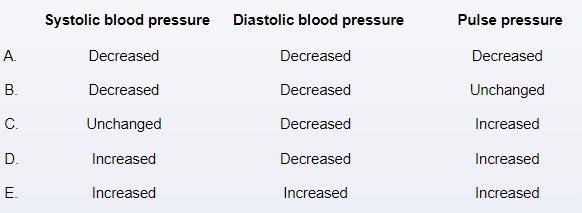
(78) A 30-year longitudinal study that follows untreated individuals with no known cardiovascular disease from age 50 to 80 is performed to investigate normal age-related cardiovascular changes. Several parameters are measured annually. Patients age 80 are most likely to show which of the following changes compared to when they were age 50?
(Multiple Choice)
4.9/5 (76)
(76) Researchers are measuring regional variations in pulmonary ventilation (V) and blood flow (Q) in healthy individuals while they stand in the upright position. The results are graphed with the x-axis denoting the position along the lung from base to apex. Which of the following curves is most likely to be observed?
(Multiple Choice)
4.9/5 (77)
(77) Physiologists are studying the forces governing glomerular ultrafiltration using a single nephron in an intact kidney of an experimental animal. Hydrostatic pressure in the glomerular capillary and Bowman space is measured using micropipette transducers. Colloid osmotic pressure in the glomerular capillary is estimated using the difference in plasma protein concentration in the afferent and efferent arterioles. The glomerular surface is assumed to be functionally intact with negligible filtration of plasma proteins into the Bowman space. From the data obtained, net filtration pressure is calculated at 10 mm Hg. A substance is instilled into the renal artery, and measurements are repeated. The net filtration pressure after the intervention is 20 mm Hg. Which of the following substances was most likely used in this experiment?
(Multiple Choice)
4.9/5 (73)
(73) A 55-year-old man comes to the hospital due to progressive fatigue and weakness. Medical history includes type 2 diabetes mellitus and obesity. Laboratory results are as follows: 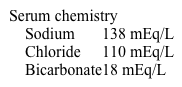 Which of the following is the most likely diagnosis?
 (Multiple Choice)
4.7/5 (62)
(62) A 46-year-old man comes to the office with chest pain and dyspnea on exertion. He has no known medical problems and leads a sedentary lifestyle. He is a lifetime nonsmoker. Noninvasive cardiac testing is nondiagnostic. Left and right heart catheterization is planned. During the procedure, the catheter records periodic pressure changes with a maximum of 25 mm Hg and minimum of 2 mm Hg. The catheter is advanced further, and then shows periodic pressure changes with a maximum of 25 mm Hg and a minimum of 10 mm Hg. Assuming the results of the procedure are normal, the first set of readings was most likely obtained from which of the following locations?
(Multiple Choice)
4.8/5 (81)
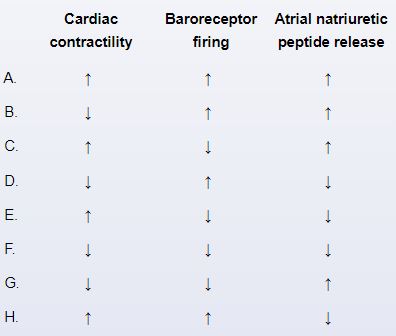
(81) A 20-year-old, previously healthy woman is brought to the emergency department after a motor vehicle collision. The patient was a restrained, rear-seat passenger when another car struck the side door. There was extensive damage to the vehicle, resulting in a prolonged extrication time. On arrival at the emergency department, blood pressure is 90/60 mm Hg and pulse is 120/min. On physical examination, the patient is alert but appears anxious, pale, and diaphoretic. There is no obvious head or neck injury. The lungs are clear bilaterally and cardiac auscultation reveals tachycardia. The abdomen is soft. Several actively bleeding lacerations are present on the lower extremities. X-rays show pelvic and left femoral shaft fractures. Which of the following findings are most likely present in this patient?
(Multiple Choice)
4.9/5 (76)
(76) A 23-year-old female is being evaluated for infertility. Hormone studies reveal a normal rise in the blood estradiol level during the first phase of the menstrual cycle. Androgens synthesized in this patient's ovaries are converted to estradiol in which of the following cell types?
(Multiple Choice)
4.9/5 (93)
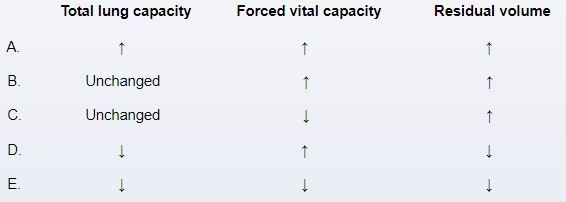
(93) An 81-year-old man comes to the office after an upper respiratory tract infection. His symptoms have largely resolved except for a mild, nonproductive cough that is especially bothersome at night. Medical history includes hypertension and knee osteoarthritis. The patient is still physically active and plays golf on the weekends. He is a retired insurance executive and has no known environmental exposures. He has no history of smoking. Physical examination is unremarkable, and chest x-ray is normal. Pulmonary function testing is considered in this patient. Compared to midlife, which of the following changes are most likely expected as a result of normal aging in this patient?
(Multiple Choice)
4.8/5 (86)
(86) A 3-year-old boy is brought to the office with 5 days of productive cough and fever. Examination shows a tachypneic, ill-appearing child with rales over the right lower lung. Chest x-ray reveals right lower lobe pneumonia. The boy is admitted to the hospital for intravenous antibiotics. Review of his medical history shows 4 prior pneumonias, and his weight is at the third percentile. Further testing demonstrates high sweat chloride content, and genetic sequencing shows a mutation in a transmembrane protein. Which of the following best describes the dysfunctional transmembrane protein causing this patient's disease?
(Multiple Choice)
4.8/5 (85)
(85) A 37-year-old man comes to the office due to difficulty sleeping. He says that his new job as a business executive is very stressful and requires considerable travel. During the past 3 months, the patient has made numerous trips between the United States and France. He experiences insomnia and daytime sleepiness for several days after these trips, but his sleep then improves significantly. Which of the following hypothalamic nuclei is most likely responsible for this delayed improvement in his symptoms?
(Multiple Choice)
4.9/5 (64)
(64) 
Filters
- Essay(0)
- Multiple Choice(0)
- Short Answer(0)
- True False(0)
- Matching(0)