



 Chat with AI
Exam 9: Microbiology

Exam 1: Anatomy291 Questions
Exam 2: Behavioral science240 Questions
Exam 3: Biochemistry156 Questions
Exam 4: Biostatistics117 Questions
Exam 5: Embryology52 Questions
Exam 6: Genetics103 Questions
Exam 7: Histology24 Questions
Exam 8: Immunology129 Questions
Exam 9: Microbiology336 Questions
Exam 10: Pathology816 Questions
Exam 11: Pathophysiology464 Questions
Exam 12: Pharmacology538 Questions
Exam 13: Physiology272 Questions
Select questions type


A 42-year-old man is brought to the emergency department following an episode of generalized tonic-clonic seizure witnessed by his family. He has no prior history of seizure but has had headaches for the past several weeks. The patient works in construction. He has no history of travel outside the United States and has never had any pets. He smokes a pack of cigarettes daily and drinks 3-4 cans of beer every evening. Physical examination is notable for a postictal state, oral thrush, and several enlarged cervical and inguinal lymph nodes. An MRI of his brain with contrast is shown in the image below. 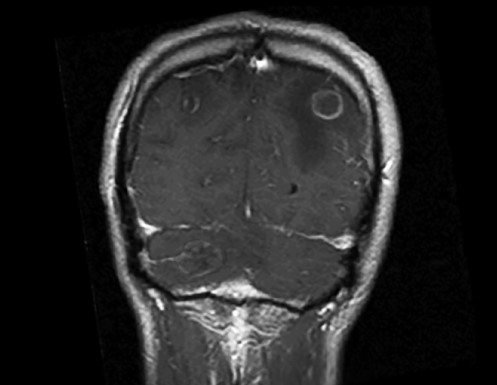 Which of the following is the most likely cause of this patient's symptoms?
Free
(Multiple Choice)
4.8/5  (86)
(86) Correct Answer: Verified
E
A 48-year-old man comes to the hospital due to 10 days of persistent fever, chills, fatigue, and dyspnea. He had a splenectomy at age 28 after a motor vehicle accident and received the appropriate vaccines. The patient does not use tobacco, alcohol, or illicit drugs. He recently traveled from New York City to Connecticut for a family wedding. His temperature is 38.6 C (101.5 F), blood pressure is 118/70 mm Hg, and pulse is 108/min. Lung examination reveals coarse crackles. Laboratory studies are as follows: 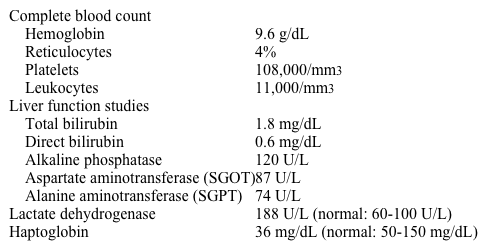 Chest x-ray reveals bilateral infiltrates. A peripheral blood smear shows normocytic, normochromic anemia with ring- and cross-shaped intraerythrocytic inclusions. The vector responsible for this patient's current condition can also transmit which of the following organisms?
Free
(Multiple Choice)
4.9/5 (70)
(70) Correct Answer:Verified
VerifiedA
A 30-year-old man is admitted to the intensive care unit after his wife found him unconscious at home. She says that he has lost a significant amount of weight recently despite no significant change in dietary habits. Laboratory studies show a serum pH of 7.1 and positive serum ketones. His mucus membranes are extremely dry. Treatment is initiated, and the patient's condition improves. However, he now has fever, headache, and eye pain. Examination of the nasal cavity shows a black necrotic eschar adherent to the inferior turbinate. Which of the following procedures would most likely reveal the pathogen responsible for this patient's infection?
Free
(Multiple Choice)
4.8/5 (75)
(75) Correct Answer:Verified
VerifiedC
An unvaccinated 20-month-old girl is brought to the emergency department with a rash. Three days ago, she developed a fever along with cough, congestion, and red eyes. The rash appeared on her face yesterday and spread to her trunk, arms, and legs today. The patient's temperature is 39.4 C (103 F). She is lethargic and ill appearing. Physical examination shows conjunctival injection and a diffuse, maculopapular, erythematous rash. She is admitted to the hospital for further management. Deficiency of which of the following is associated with a high rate of complications from this patient's condition?
(Multiple Choice)
4.8/5 (78)
(78) An 18-year-old man comes to the emergency department due to 3 days of fever, myalgias, and profound fatigue. He was feeling fine prior to the onset of symptoms. The patient has a history of intermittent asthma for which he uses an inhaler as needed. He is a senior in high school and plays on the football team. Temperature is 38 C (100.4 F), blood pressure is 110/80 mm Hg, pulse is 88/min, and respirations are 16/min. BMI is 22.1 kg/m2. On physical examination, the patient is found to have swollen lymph nodes in his neck and behind his ears. The tip of the spleen is palpable 1 cm below the left costal margin. Laboratory results are notable for the following: 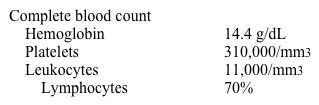 Which of the following is most likely to be elicited on further history?
 (Multiple Choice)
5.0/5 (72)
(72) A 65-year-old man comes to the emergency department due to fevers and malaise for the last 48 hours. The patient initially experienced fevers and chills, which subsequently progressed to fatigue to the point that he had difficulty performing routine tasks this morning. He has also had a mild headache. The patient lives in eastern Massachusetts with his wife. He is retired and spends time gardening and swimming at a local public pool. The patient traveled to Thailand 2 years ago with his family and to Florida 2 months ago. Temperature is 38.9 C (102 F), blood pressure is 122/70 mm Hg, and pulse is 114/min and regular. The oropharynx is dry and has no lesions. Lung examination demonstrates coarse crackles bilaterally. The abdomen is soft and mildly tender throughout with palpable splenomegaly. He has no rash or open wounds. Peripheral blood smear is shown in the exhibit.
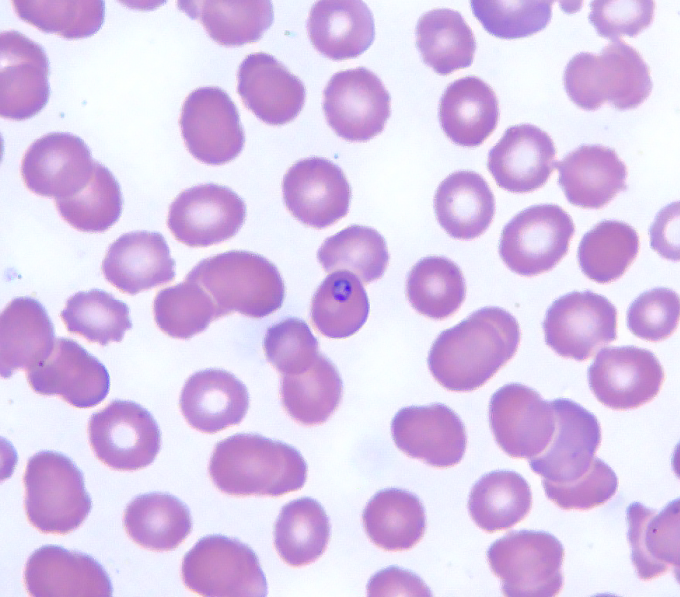 Which of the following is the most likely source of this patient's infection?
 (Multiple Choice)
4.9/5 (82)
(82) A 54-year-old man comes to the emergency department due to worsening fever, cough, and shortness of breath. The patient initially presented a week ago with a fever, headache, myalgia, nasal discharge, and a sore throat. He tested positive for influenza A and was discharged home with symptomatic treatment. The patient's symptoms gradually improved, but over the past 2 days he has had high fevers, cough productive of yellowish sputum, sharp right-sided chest pain, and shortness of breath. The patient has no other medical problems and does not use tobacco, alcohol, or illicit drugs. Temperature is 38.9 C (102 F), blood pressure is 118/66 mm Hg, and pulse is 110/min. Physical examination reveals right-sided lung crackles. Chest x-ray reveals infiltrates in the right lung. Which of the following pathogens is most likely to be isolated from this patient's sputum?
(Multiple Choice)
4.9/5 (74)
(74) A 65-year-old man comes to the office due to pain, redness, and swelling in his right calf. The patient is diagnosed with cellulitis and is started on clindamycin. A few days after starting treatment, he develops watery diarrhea and abdominal cramps. The patient is hospitalized, and complete blood count reveals leukocytosis. The toxin responsible for his current condition most directly impairs which of the following components of intestinal mucosal cells?
(Multiple Choice)
4.9/5 (81)
(81) A 3-year-old girl is brought to the emergency department with abrupt-onset vomiting followed by frequent, large-volume, watery diarrhea for the last day. She has no prior medical conditions but has not received recommended vaccinations. Temperature is 37.8 C (100 F). Physical examination shows mild dehydration. The abdomen is soft and mildly tender to palpation throughout. Bowel sounds are increased. Polymerase chain reaction testing of the stool sample yields a virus with a segmented, double-stranded RNA genome. Which of the following pathologic findings is most likely to be present in this patient?
(Multiple Choice)
4.9/5 (80)
(80) A 10-week-old boy is brought to the office for a follow-up visit. As part of his routine immunization schedule, the patient received the first dose of the Haemophilus influenzae type b (Hib) conjugate vaccine when he was 8 weeks old. However, following vaccine administration, he developed anaphylaxis, requiring epinephrine administration and hospitalization. As a result, the decision was made not to administer additional doses of the Hib vaccine. The patient was born full-term by uncomplicated vaginal delivery and has otherwise been healthy. Physical examination is unremarkable. His older brother has completed the full vaccination course. This patient is at highest risk of which of the following infections compared to his brother?
(Multiple Choice)
4.9/5 (67)
(67) A 29-year-old man is evaluated for a skin rash involving his hands, feet, and scalp for the last 2 weeks. The rash is mildly pruritic and has progressively worsened. The patient has a history of HIV and is not adherent with antiretroviral therapy. Skin examination shows erythematous patches with scales and crusting. Biopsy of the rash shows organisms burrowed in the epidermis, as shown below: 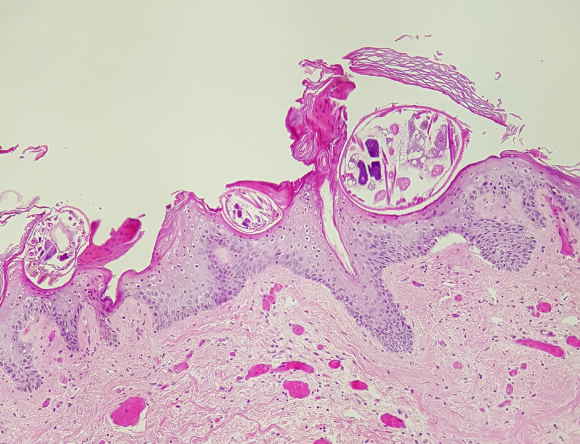 Which of the following is the most appropriate treatment for this patient?
 (Multiple Choice)
4.8/5 (71)
(71) Health authorities are investigating an outbreak of respiratory infections among a group of military recruits. Fifteen recruits reported persistent cough, low-grade fever, and malaise. Apart from the low-grade fever, physical examination was largely unremarkable. Chest x-rays were all notable for pulmonary infiltrates that appeared more severe than what would have been expected based on assessment of the patients' clinical status. Sputum specimens were obtained, and the causative organism required a complex acellular medium enriched with cholesterol to grow. Which of the following organisms is the most likely cause of the outbreak?
(Multiple Choice)
4.9/5 (68)
(68) A 54-year-old woman is brought to the emergency department after a generalized tonic-clonic seizure. The patient had fever, night sweats, fatigue, and productive cough during the previous week. She underwent a renal transplant 2 years ago and takes immunosuppressive therapy. On examination, she is febrile and postictal. There are scattered lung crackles and normal heart sounds. Leukocyte count is elevated, and chest x-ray reveals patchy bronchopneumonia with several nodules. Brain imaging shows multifocal abscesses. Sputum Gram stain reveals filamentous, branching gram-positive rods as shown below: 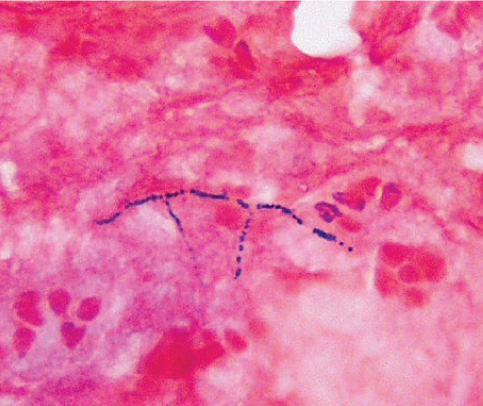 This pathogen is likely to demonstrate which of the following characteristics?
 (Multiple Choice)
4.8/5 (88)
(88) An 86-year-old woman is hospitalized for a urinary tract infection due to Escherichia coli and is being treated with ceftriaxone. She has a history of advanced dementia, coronary artery disease, and congestive heart failure. On the fifth day of hospitalization, she seems agitated. The nurse also reports that the patient had 3 episodes of diarrhea the previous night. Her temperature is 38.3 C (101 F). In addition to appropriate hand hygiene, which of the following equipment is necessary before examining this patient?
(Multiple Choice)
4.9/5 (77)
(77) An epidemiologic study is conducted after a sudden increase in the rate of severe postoperative infections in a rural hospital. It is determined that all the patients who developed the infection were operated on with surgical instruments sterilized by a specific autoclave machine. The machine was found to be inadequately sterilizing the equipment due to a malfunction limiting the temperature to 100 C (212 F) during the 15 minute cycle. These patients most likely developed infection from which of the following bacteria?
(Multiple Choice)
4.7/5 (65)
(65) A 26-year-old woman comes to the office due to fever, malaise, and joint pain. A week ago, the patient had pain in the small joints of her right hand, which improved spontaneously but was quickly followed by pain in the right ankle and left wrist. She has no prior medical problems and takes no medications. Temperature is 38 C (100.4 F), blood pressure is 124/82 mm Hg, and pulse is 90/min. The extremity joints are not erythematous or swollen, but tenderness is present along the tendons of the left wrist and right ankle. Several small, nontender pustules are seen on the extremities. There is no other rash. Blood culture in a selective growth medium consisting of chocolate agar and multiple antibiotics yields the causative pathogen. Which of the following strategies would most likely have prevented this patient's current condition?
(Multiple Choice)
4.7/5 (85)
(85) A 13-year-old boy with cystic fibrosis comes to the clinic with a persistent cough over the past 2 weeks despite treatment with several oral antibiotics. Temperature is 36.7 C (98.1 F). Pulmonary examination reveals diffuse wheezing. Pulmonary function testing is consistent with an exacerbation of the underlying disease, and the patient is admitted for broad-spectrum intravenous antibiotics and aggressive respiratory therapy. Induced sputum is collected for cultures. In addition to blood, chocolate, and MacConkey agar, this patient's sputum should also be cultured on which of the following media?
(Multiple Choice)
5.0/5 (86)
(86) A 43-year-old man undergoes induction chemotherapy for acute myeloid leukemia. Three weeks later, he is hospitalized with fever, cough, and generalized weakness. On physical examination, his temperature is 38.1 C (100.7 F), blood pressure is 102/68 mm Hg, and pulse is 125/min. The patient's pulse oximetry shows 95% on room air. Crackles are heard over the right upper lung. His hemoglobin level is 9.5 g/dL, and leukocyte count is 900/mm3 with an absolute neutrophil count of 100/mm3. Chest x-ray reveals a dense infiltrate involving the right upper lung lobe. Broad-spectrum antibiotic therapy is instituted. Five days later, the patient is still febrile. Bronchoscopy with biopsy is performed and the tissue samples from the bronchoscopy grow mold. Which of the following organisms is most likely responsible for this patient's current condition?
(Multiple Choice)
4.8/5 (70)
(70) A 46-year-old man comes to the emergency department due to worsening blurry vision, difficulty swallowing, and dry mouth for the past hour. He has also been having nausea and abdominal discomfort but has no headache or fever. The patient has no prior medical conditions and takes no medications. He smokes a pack of cigarettes daily but does not use alcohol or illicit drugs. The patient has not traveled recently but attended a community potluck event yesterday where he sampled home-canned foods. Physical examination shows bilateral ptosis and sluggish pupillary response. Which of the following steps in neuromuscular transmission is most likely affected in this patient? 
(Multiple Choice)
4.8/5 (77)
(77) A 22-year-old man who recently immigrated to the United States comes to the physician for routine care. He has no current symptoms. He takes no medications and has no known allergies. Laboratory testing yields the following results: 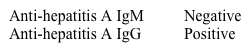 The patient's country of origin does not offer universal immunization against hepatitis A, and he says he has not been vaccinated against the virus. Which of the following do these laboratory findings most likely suggest?
 (Multiple Choice)
4.9/5 (81)
(81) 
Filters
- Essay(0)
- Multiple Choice(0)
- Short Answer(0)
- True False(0)
- Matching(0)