



 Chat with AI
Exam 9: Microbiology

Exam 1: Anatomy291 Questions
Exam 2: Behavioral science240 Questions
Exam 3: Biochemistry156 Questions
Exam 4: Biostatistics117 Questions
Exam 5: Embryology52 Questions
Exam 6: Genetics103 Questions
Exam 7: Histology24 Questions
Exam 8: Immunology129 Questions
Exam 9: Microbiology336 Questions
Exam 10: Pathology816 Questions
Exam 11: Pathophysiology464 Questions
Exam 12: Pharmacology538 Questions
Exam 13: Physiology272 Questions
Select questions type


A 56-year-old man comes to the office due to several months of progressive neck swelling. He has also had intermittent epistaxis and headaches. The patient has no chronic medical conditions and takes no medications. He does not use tobacco, alcohol, or illicit drugs, and he emigrated to the United States from rural China 12 years ago. Physical examination shows several enlarged, firm, and nontender cervical lymph nodes. Nasopharyngeal evaluation reveals a mass arising from the pharyngeal recess. Histopathological examination of the mass shows undifferentiated malignant cells of epithelial origin. Further analysis of these cells is most likely to reveal the presence of nucleic acid sequences from which of the following viruses?
(Multiple Choice)
4.8/5  (91)
(91) Volunteer studies are used to determine the infectious dose of Salmonella required to cause gastroenteritis. The curve obtained during the studies is shown in the diagram as line 2. Which of the following organisms could be represented by line 1 on this diagram? 
(Multiple Choice)
4.7/5 (90)
(90) A 34-year-old man comes to the office to establish medical care. The patient recently emigrated from Eastern Asia. He has no chronic medical conditions but reports intermittent abdominal discomfort and episodic diarrhea over the past several months. He has also had occasional dry cough and throat irritation. Physical examination shows no abnormalities. Serologic testing for Strongyloides stercoralis IgG is positive. Detection of which of the following is most suggestive of active infection by the pathogen in this patient?
(Multiple Choice)
4.8/5 (63)
(63) The influenza A virus uses a sialic acid as a receptor for cellular entry. The chemical composition of the specific type of sialic acid that the virus interacts with differs among animal species. The avian influenza virus attaches to a specific sialic acid that is present in fowl epithelial cells but absent in human cells, whereas the human influenza virus can only attach to the type of sialic acid present in human respiratory epithelium. When pig epithelial cells, which contain both types of sialic acid, are infected with the combination of avian and human influenza A viruses, some of the new avian influenza viral particles become capable of attaching to human cells. However, the progeny of this new strain of avian influenza virus is still unable to attach to human epithelial cells. Which of the following phenomena best describes the change in the avian influenza virus in this experiment?
(Multiple Choice)
4.8/5 (76)
(76) A 17-year-old boy is hospitalized with recent-onset insomnia, headaches, periodic agitation, and dysphagia. He is a high school student interested in becoming a veterinarian. He owns a snake, fish, and parrot and, about 4 weeks ago, went on a field trip to study bats in a cave. The patient has no known medical problems and is not taking any medications. He does not consume alcohol and has never used illicit drugs. Despite hospitalization and treatment, he develops painful spasms, progressive paralysis, and coma and dies. Which of the following interventions would have most likely prevented this student from developing this illness?
(Multiple Choice)
4.9/5 (71)
(71) A 56-year-old man with advanced AIDS comes to the emergency department due to several weeks of progressive fever, night sweats, weight loss, diarrhea, and generalized weakness. Physical examination shows mucosal pallor, generalized lymphadenopathy, and hepatosplenomegaly. Laboratory studies reveal anemia and elevated alkaline phosphatase and lactate dehydrogenase levels. CD4 count is 16/mm3. Bone marrow biopsy shows aggregates of epithelioid histiocytes with foamy cytoplasm and numerous acid-fast intracellular organisms. Nucleic acid amplification test of the sample for Mycobacterium tuberculosis is negative. Which of the following pathogens is the most likely cause of this patient's illness?
(Multiple Choice)
4.8/5 (77)
(77) A group of researchers collected demographic and clinical data from multiple hospitals across the nation to determine epidemiological features of nosocomial bloodstream infections. In this study, a nosocomial bloodstream infection was diagnosed if blood cultures drawn 48 hours after admission yielded a pathogenic organism. Analysis of the data collected over several decades shows that staphylococci are increasingly responsible for the identified cases. An increased use of which of the following is most likely the underlying cause of the observed trend?
(Multiple Choice)
4.8/5 (83)
(83) A 6-day-old boy is brought to the emergency department for inability to feed for 12 hours. His parents report that the infant has been unable to open his mouth and has held his hands clenched all day. The infant was delivered at home by the grandmother. The mother had no access to prenatal care but says that the pregnancy was uncomplicated. The mother immigrated to the United States 6 years ago. Physical examination shows increased muscle tone throughout, arching of the back, and dorsiflexed feet. The umbilical cord is covered with a clump of soil. The mother says that it is customary in her village where she grew up to cover the umbilical stump with dung to speed cord separation. In addition to hygienic umbilical cord care, which of the following is the most effective strategy to prevent this condition?
(Multiple Choice)
4.8/5 (76)
(76) A 29-year-old male is hospitalized with low-grade fever and high serum levels of alanine aminotransferase (ALT) and aspartate aminotransferase (AST). His serum is positive for HBsAg. You should inform the patient that the most likely outcome for his infection would be:
(Multiple Choice)
4.9/5 (89)
(89) A 21-year-old man comes to the office due to several days of intense pruritus of the inguinal-genital area. He has had no fever, dysuria, or skin rash. He is not using any new soaps, detergents, or lotions. The patient has had 3 sexual partners in the past year. He was treated for chlamydial urethritis 6 months ago and since then has been using condoms consistently. Vital signs are within normal limits. Genitourinary examination shows no urethral discharge, penile lesions, or inguinal lymphadenopathy. There are skin excoriation marks in the pubic area and other findings as shown in the exhibit.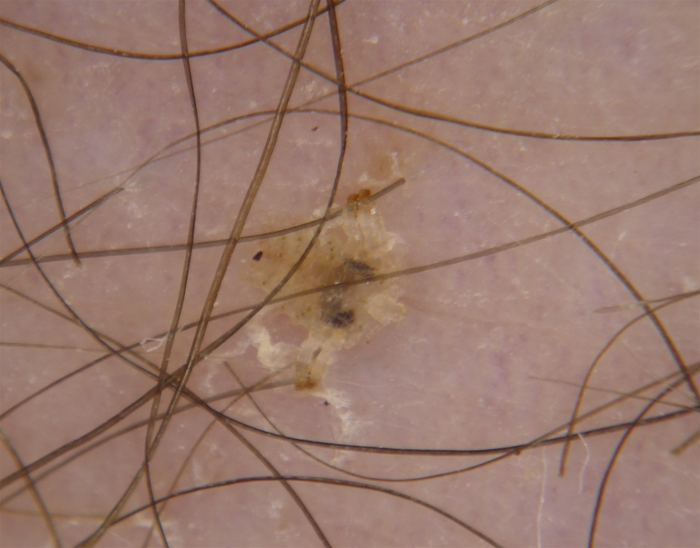 Which of the following is the most appropriate pharmacotherapy for this patient's condition?
 (Multiple Choice)
4.8/5 (75)
(75) A 23-year-old man comes to the emergency department with fever, severe headache, and vomiting. He has not felt well for the past 2 weeks due to fatigue, intermittent low-grade fevers, and headaches. The patient is HIV positive and spent several months in prison 3 years ago. Temperature is 38.6 C (101.5 F). Neck stiffness is present on physical examination. A CT scan reveals no intracranial lesions. Cerebrospinal fluid analysis is notable for the following: 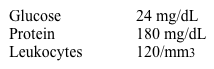 Cerebrospinal fluid cultures grow Mycobacterium tuberculosis with significantly decreased activity of intracellular catalase peroxidase. The isolates would most likely exhibit resistance to which of the following agents?
 (Multiple Choice)
4.8/5 (77)
(77) A 24-year-old woman, gravida 1 para 0, at 26 weeks gestation comes to the emergency department due to abdominal cramping and vaginal bleeding. She recently emigrated from Bolivia and reports no prior medical problems. The patient's only medication is a daily multivitamin. Immunization status is unknown. The patient spontaneously delivers a stillborn fetus with multiple congenital malformations. Fetal autopsy reveals microcephaly with thin cerebral cortices, ventriculomegaly, and subcortical calcifications. Viral RNA of a neurotropic virus is detected in body fluids of the mother and the fetus. Transplacental transmission of this virus causes apoptosis of neural progenitor cells in the developing fetus, leading to disruption of neuronal proliferation, migration, and differentiation. Which of the following viruses most likely caused this patient's in utero infection?
(Multiple Choice)
4.8/5 (77)
(77) A 24-year-old woman comes to the office due to spotting after vaginal intercourse. She also has some yellow vaginal discharge and dysuria but no pelvic pain or cramping. The patient has taken combination oral contraceptives for the past 3 years and has had no menses for the past year. Her mother was diagnosed with cervical cancer at age 47. BMI is 35 kg/m2. Vital signs are normal. On examination, the abdomen is soft and nontender. Speculum examination reveals purulent discharge from the cervical os, and the cervix is friable. On bimanual examination, there is no cervical motion tenderness, and the adnexa are nontender bilaterally. Urine pregnancy testing is negative. Microscopy of the discharge shows abundant neutrophils. If left untreated, this patient's condition could lead to which of the following complications?
(Multiple Choice)
4.9/5 (83)
(83) A 64-year-old man comes to the emergency department due to worsening left lower extremity pain, swelling, and redness over the past 3 days. The patient has had no trauma but reports feeling feverish. Medical history is significant for hypertension and obesity. Temperature is 38 C (100.4 F), blood pressure is 130/86 mm Hg, pulse is 92/min, and respirations are 18/min. BMI is 35 kg/m2. Physical examination shows diffuse erythema extending up to the left midcalf with indistinct border. There is increased warmth, tenderness, and edema of the left leg. No areas of fluctuation or purulent exudate are present, but the interdigital skin of the feet is macerated and fissured. Laboratory testing shows neutrophilic leukocytosis, and Doppler ultrasonography is negative for deep venous thrombosis. Infection with which of the following organisms is most likely responsible for this patient's current symptoms?
(Multiple Choice)
4.9/5 (81)
(81) A 59-year-old woman is brought to the emergency department with fever, skin flushing, and an altered level of consciousness. Her blood pressure is 50/20 mmHg, and her heart rate is 120/min despite receiving IV fluids. If blood cultures are positive for E. coli, which of the following bacterial factors is most directly responsible for this patient's current condition?
(Multiple Choice)
4.9/5 (77)
(77) A 7-year-old girl is brought to the office due to a diffuse rash. The father says she developed a lace-like, erythematous rash this morning on her stomach, back, and extremities. Two days ago, the girl developed red, flushed cheeks. She also had congestion, headache, and a low-grade fever for 3 days earlier this week. Last week, her younger brother had similar symptoms that resolved spontaneously. The infectious agent most likely responsible for this patient's disease replicates in progenitors of which of the following cell lines?
(Multiple Choice)
4.9/5 (75)
(75) Several residents of a long-term care facility develop febrile illness within a short period of time. Symptoms include fever, nonproductive cough, myalgia, rigors, dyspnea, and diarrhea. Organisms found in induced sputum samples stain poorly with Gram stain but are visualized easily using silver stain. Urine testing for bacterial antigens is positive in most of the affected individuals. Which of the following is the most likely source of this outbreak?
(Multiple Choice)
4.8/5 (77)
(77) A 40-year-old woman is evaluated for neck pain that has gradually worsened over the past several months. The patient reports a pulling sensation in her neck that causes difficulty in keeping her head straight. She has had no trauma and has no other medical conditions. Physical examination shows a spastic and thickened sternocleidomastoid muscle causing head tilt. The patient is diagnosed with idiopathic torticollis. She is treated with injections of a bacterial product into the affected muscle, with significant relief of her symptoms. The substance administered to this patient is derived from bacteria that most likely demonstrate which of the following characteristics?
(Multiple Choice)
4.8/5 (77)
(77) A 63-year-old man is brought to the emergency department due to high fever, confusion, headache, watery diarrhea, and cough. The patient smokes 2 packs of cigarettes daily and has a history of chronic bronchitis. Temperature is 40.1 C (104.2 F), blood pressure is 100/70 mm Hg, pulse is 91/min, and respirations are 28/min. Sputum Gram staining reveals numerous neutrophils but no bacteria. Which of the following is the most likely cause of this patient's current condition?
(Multiple Choice)
4.7/5 (66)
(66) A 22-year-old man with fever and joint pain is found to have atypical lymphocytes on his blood smear. Further evaluation shows that his condition is caused by an enveloped virus containing partially double-stranded circular DNA. An enzyme packed in its virion has RNA-dependent DNA-polymerase activity. This patient is most likely infected with which of the following viruses?
(Multiple Choice)
4.9/5 (69)
(69) 
Filters
- Essay(0)
- Multiple Choice(0)
- Short Answer(0)
- True False(0)
- Matching(0)