



 Chat with AI
Exam 9: Microbiology

Exam 1: Anatomy291 Questions
Exam 2: Behavioral science240 Questions
Exam 3: Biochemistry156 Questions
Exam 4: Biostatistics117 Questions
Exam 5: Embryology52 Questions
Exam 6: Genetics103 Questions
Exam 7: Histology24 Questions
Exam 8: Immunology129 Questions
Exam 9: Microbiology336 Questions
Exam 10: Pathology816 Questions
Exam 11: Pathophysiology464 Questions
Exam 12: Pharmacology538 Questions
Exam 13: Physiology272 Questions
Select questions type


A 6-year-old boy whose family recently immigrated to the United States is brought to the office due to sore throat and fever. Examination shows mild tonsillar erythema with exudates. A sample from the exudates is obtained. On microscopic evaluation, there are clumped, gram-positive bacteria with polar granules that stain deeply with aniline dyes. Which of the following best explains the pathogenicity of the organism most likely responsible for this patient's condition?
(Multiple Choice)
4.9/5  (88)
(88) A 39-year-old paraplegic man with an indwelling bladder catheter comes to the emergency department complaining of 24 hours of rigors, nausea, and vomiting. His temperature is 38.9 C (102 F). Physical examination shows suprapubic and costovertebral angle tenderness. Urinalysis shows 3+ leukocyte esterase and numerous white blood cells. Urine and blood cultures grow non-lactose-fermenting Gram-negative rods. Which of the following pathogens is the most likely culprit?
(Multiple Choice)
4.9/5 (81)
(81) A 6-year-old boy is brought to the office due to persistent cough. His symptoms began with a mild, upper respiratory illness 2 weeks ago, but the cough has progressively worsened, and now spells of dry cough are often followed by vomiting. The patient has no chronic medical conditions but has not received childhood vaccinations due to parental beliefs. He recently returned from a summer camp. On physical examination, the patient is afebrile, and lungs are clear to auscultation. Testing of respiratory secretions shows gram-negative coccobacilli. Which of the following is most likely involved in the pathogenesis of this patient's symptoms?
(Multiple Choice)
4.7/5 (65)
(65) Researchers develop a novel drug to treat HIV infection. In an in vitro experiment, wild-type viral isolates are cultured with human CD4 T lymphocytes in the presence of the drug. Microscopic evaluation of these cells reveals no cytopathic changes, and no intracellular viral particles can be detected. Further analysis reveals that in the presence of the drug the virus attaches to the cellular membrane, but fusion of the viral and cell membranes does not occur. Which of the following is the most likely target of this medication?
(Multiple Choice)
4.9/5 (92)
(92) A 32-year-old man comes to the office due to 2 weeks of fever, malaise, and arthralgia. Temperature is 38.2 C (100.8 F) and pulse is 102/min. Physical examination reveals several enlarged cervical, axillary, and inguinal lymph nodes and a diffuse maculopapular skin rash. Serum aminotransferase levels are elevated. During further testing, the patient's serum is added to a mixture of cardiolipin, cholesterol, and lecithin, which leads to extensive clumping and flocculation. Evaluation for antibodies directed against which of the following is the best next step in management of this patient?
(Multiple Choice)
4.9/5 (75)
(75) A 3-year-old boy is brought to the office due to a 1-day history of fever and irritability. The mother states that the boy has been tugging at his right ear. The patient has had 2 previous episodes of acute otitis media. Temperature is 38.1 C (100.6 F). Otoscopic examination shows a perforated right tympanic membrane with erythema and purulent exudate. Cultures from the exudate yield small, oxidase-positive, gram-negative coccobacilli that grow on factor X- and factor V-supplemented media, consistent with Haemophilus influenzae. The patient's immunizations are up to date. Which of the following best explains this patient's susceptibility to the pathogen causing his current infection?
(Multiple Choice)
4.8/5 (86)
(86) A 23-year-old woman comes to the emergency department for evaluation of right lower abdominal pain and bloody vaginal discharge. Her symptoms began this morning and are progressively worsening. She is sexually active with 1 male partner. The patient takes no daily medications and has no known drug allergies. Her last menstrual period was 5 weeks ago, and she has never been pregnant. Blood pressure is 112/70 mm Hg while supine and 96/60 mm Hg while standing. The patient is tachycardic and ill appearing. On pelvic examination, the uterus is small and mobile, and there is right adnexal tenderness. Laboratory results are as follows: 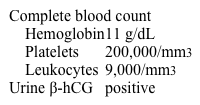 This patient's clinical presentation is most likely due to a prior infection with which of the following pathogens?
 (Multiple Choice)
4.8/5 (88)
(88) A 38-year-old woman comes to the emergency department due to 2 days of headache, nausea, and photophobia. She has had migraines since her early 20s but has had more frequent episodes over the last few years. The current headache is more severe than usual, and ibuprofen did not relieve the pain. A flulike illness preceded the symptoms. Temperature is 38.3 C (100.9 F), blood pressure is 144/86 mm Hg, and pulse is 110/min. The patient appears lethargic. Cranial nerves, sensation, and motor functions are normal. She reports neck pain when instructed to touch the chest with her chin. No skin rash is present. Noncontrast CT scan of the head shows no abnormalities. Which of the following is the best next step in management of this patient?
(Multiple Choice)
4.8/5 (68)
(68) A 43-year-old immigrant from Southern Asia suffers from a cough that has lasted for several months duration. He comes to the clinic today because of recent onset hemoptysis. On further evaluation, he reports a 15-lb weight loss over the past four months. Sputum cultures grow acid-fast bacilli that are susceptible to most antimycobacterial drugs in vitro. Isoniazid monotherapy in this patient would most likely result in:
(Multiple Choice)
5.0/5 (75)
(75) A 24-year-old female presents to your office with burning urination, urgency and frequency. She is sexually active. Urine cultures show catalase-positive, gram-positive cocci. The organism responsible for this patient's symptoms is most likely to be:
(Multiple Choice)
4.8/5 (88)
(88) A neonate born to a 26-year-old woman is evaluated in the newborn nursery. The patient was delivered vaginally at 38 weeks gestation, and Apgar scores were 8 and 9 at 1 and 5 minutes, respectively. Initial evaluation shows hydrocephalus, jaundice, and hepatosplenomegaly. Funduscopic examination reveals retinal exudates and scarring. Histopathologic evaluation of the placenta shows infiltration of lymphocytes, plasma cells, and macrophages, as well as many areas of calcification. Within the placental tissue, there are numerous intracellular, crescent-shaped organisms with a central nucleus. Which of the following maternal interventions would have been most effective in preventing this patient's condition?
(Multiple Choice)
4.8/5 (81)
(81) A 24-year-old man develops mild, nonexudative pharyngitis shortly after travel to Eastern Europe. Throat swab culture in tellurite-containing, selective media yields black, iridescent colonies. Microscopy shows club-shaped, gram-positive bacilli in a palisade arrangement, which are identified as nonpathogenic Corynebacterium diphtheriae. These bacteria can acquire virulence to become pathogenic through which of the following mechanisms?
(Multiple Choice)
4.8/5 (73)
(73) A 57-year-old woman is hospitalized with high-grade fevers, chills, and right upper abdominal pain. The patient lives in Wisconsin and has no history of international travel. Her temperature is 40 C (104 F). Physical examination of the abdomen shows rebound tenderness. Laboratory studies show elevated aspartate and alanine aminotransferases. Imaging studies reveal a fluid-filled cavity within the right lobe of the liver as shown below. 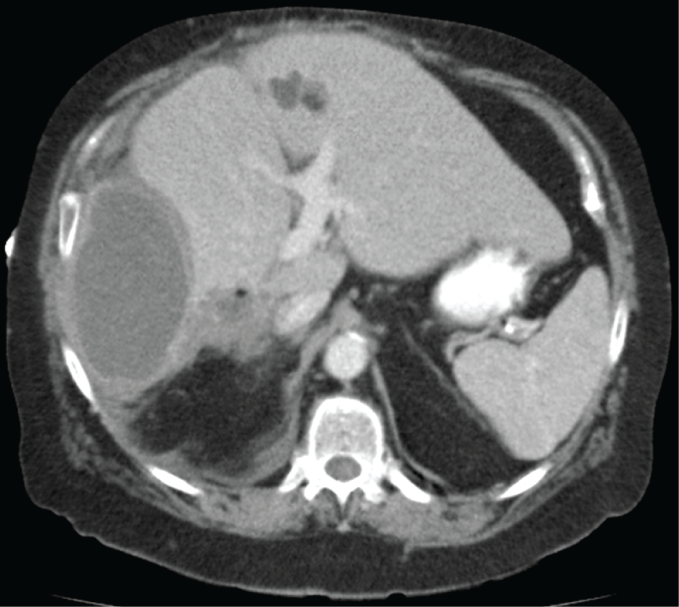 Which of the following microorganism/route combinations is most likely to be the cause of this patient's infection?
 (Multiple Choice)
4.9/5 (79)
(79) A 52-year-old active smoker comes to the office due to a 2-week history of malaise, shortness of breath, and decreased appetite. The patient has a history of bicuspid aortic valve and hypertension. His temperature is 39 C (102.2 F), blood pressure is 140/80 mm Hg, and pulse is 110/min. On examination, the patient has a systolic ejection murmur at the right upper sternal border that is unchanged from previous visits; there is a new decrescendo diastolic murmur best heard in the third intercostal space at the left sternal border. Laboratory studies show hemoglobin is 9.3 g/dL and leukocytes are 16,500/mm3. Blood cultures are positive for Streptococcus gallolyticus (formerly S bovis). Additional workup for this patient should focus on which of the following conditions?
(Multiple Choice)
4.8/5 (89)
(89) A 23-year-old man comes to the office due to penile ulcers that appeared after unprotected sexual intercourse. Physical examination shows 3 subcentimeter ulcers on the penile shaft. Microscopic examination of a scraping from an ulcer base reveals the following: 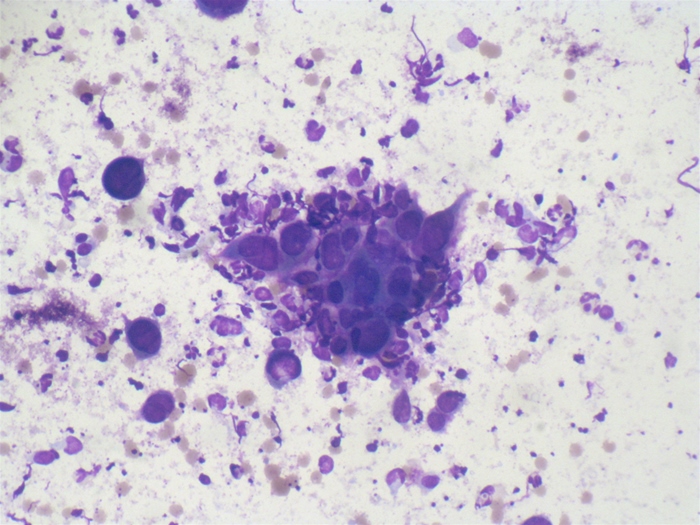 Which of the following medications is most appropriate for this patient?
 (Multiple Choice)
4.8/5 (85)
(85) A 22-year-old woman comes to the office for a routine prenatal visit. She is 16 weeks pregnant with her first child. Two months ago, she had a mononucleosis-like illness with fever, myalgia, and fatigue, and she was diagnosed with cytomegalovirus infection. The patient recovered with symptomatic treatment and is currently asymptomatic. Her other medical problems include episodic migraine headaches and benign choroidal nevus. She takes prenatal vitamins and does not use tobacco, alcohol, or illicit drugs. The patient has a family history of hypertension and glaucoma. Physical examination findings and prenatal ultrasound are unremarkable. This patient's unborn infant is at greatest risk for which of the following eye conditions?
(Multiple Choice)
4.9/5 (76)
(76) A 52-year-old man comes to the office with 3 weeks of cough, night sweats, and occasional hemoptysis. The patient also has diabetes and hypertension. He emigrated from Vietnam 15 years ago to start a job as an associate professor at a university. He has a 20-year smoking history but quit 5 years ago. Sputum cultures grown on a selective medium demonstrate mycobacteria that appear as parallel chains (serpentine cords) under microscopy. This observed growth pattern in culture medium most strongly correlates with which of the following?
(Multiple Choice)
4.9/5 (76)
(76) A previously healthy 24-year-old man is hospitalized due to 3 days of fever, chills, myalgia, and severe headache. The symptoms started on the last day of his camping trip in the Appalachian Mountains and have rapidly progressed. Temperature is 38.9 C (102 F), blood pressure is 100/56 mm Hg, and pulse is 120/min. On examination, the patient is lethargic and confused. There is no neck rigidity. The lungs are clear on auscultation and heart sounds are normal. The abdomen is soft and nontender. There is a prominent erythematous maculopapular rash on the distal forearms. No lymphadenopathy is present. The patient should be immediately initiated on a medication that targets which of the following?
(Multiple Choice)
4.9/5 (75)
(75) A 34-year-old man comes to the hospital due to several hours of difficulty swallowing, dry mouth, and blurred vision. The patient has a history of major depression. Examination shows mydriasis and poorly reactive pupils. Electrodiagnostic studies reveal normal nerve conduction velocity but decreased compound muscle action potential (CMAP). Rapid, repetitive nerve stimulation leads to facilitation of CMAP. Further review of this patient's medical history would most likely reveal which of the following?
(Multiple Choice)
4.8/5 (68)
(68) A 65-year-old man with chronic bronchitis comes to the emergency department due to 2 days of fever, chills, chest pain, and productive cough. He has been hospitalized on several occasions for exacerbations of chronic bronchitis. The patient has been advised to stop smoking but continues to smoke cigarettes. He drinks 6-10 beers daily. Temperature is 40.2 C (104.4 F), blood pressure is 100/70 mm Hg, pulse is 104/min, and respirations are 28/min. On examination, he is in mild respiratory distress. There are crackles and decreased breath sounds in the right upper lobe. His chest x-ray shows right upper lobe consolidation. Sputum microscopy reveals encapsulated gram-negative bacilli. The bacteria grow pink, mucoid colonies on MacConkey agar. Which of the following organisms is the most likely cause of this patient's condition?
(Multiple Choice)
4.8/5 (77)
(77) 
Filters
- Essay(0)
- Multiple Choice(0)
- Short Answer(0)
- True False(0)
- Matching(0)