



 Chat with AI
Exam 9: Microbiology

Exam 1: Anatomy291 Questions
Exam 2: Behavioral science240 Questions
Exam 3: Biochemistry156 Questions
Exam 4: Biostatistics117 Questions
Exam 5: Embryology52 Questions
Exam 6: Genetics103 Questions
Exam 7: Histology24 Questions
Exam 8: Immunology129 Questions
Exam 9: Microbiology336 Questions
Exam 10: Pathology816 Questions
Exam 11: Pathophysiology464 Questions
Exam 12: Pharmacology538 Questions
Exam 13: Physiology272 Questions
Select questions type


A 72-year-old man is brought to the emergency department from a skilled nursing facility due to altered mental status, skin flushing, and a high fever. His temperature is 38.9 C (102 F), blood pressure is 80/40 mm Hg, pulse is 120/min, and respirations are 26/min. If blood cultures are positive for Escherichia coli, which of the following is the most likely site of infection leading to bacteremia in this patient?
(Multiple Choice)
4.8/5  (84)
(84) An 8-year-old girl is brought to the office for evaluation of a skin rash on her upper back. The rash is not painful but is mildly pruritic. She has no prior medical conditions, takes no medications, and is up to date with vaccinations. Vital signs are within normal limits. Right scapular area skin examination is shown in the exhibit.
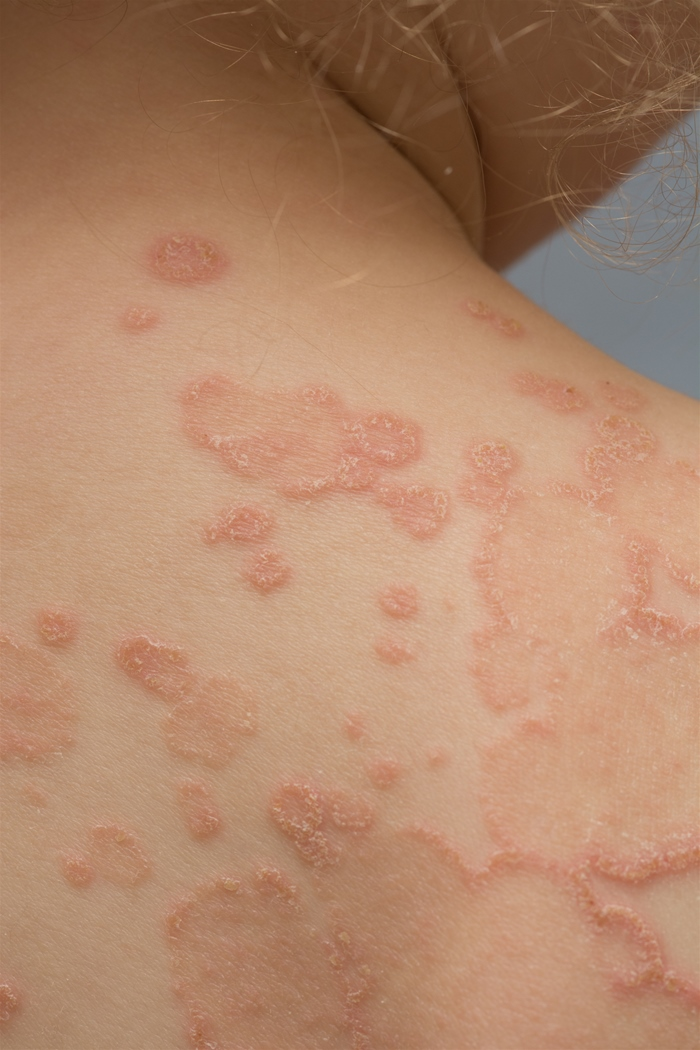 The remainder of the examination is normal. Which of the following is the most likely cause of this patient's current condition?
 (Multiple Choice)
4.7/5 (80)
(80) A 5-year-old boy is brought to the emergency department by his parents for severe respiratory distress. He has not received any immunizations due to parental preference, and his medical history is otherwise unremarkable. The patient appears very uncomfortable and anxious. He is leaning forward and making a loud, harsh sound with every inspiration. Temperature is 39.6 C (103.4 F). The patient is intubated immediately. During intubation, the epiglottis is visualized and appears markedly swollen and erythematous. Which of the following is a major virulence factor of the pathogen causing this patient's infection?
(Multiple Choice)
4.8/5 (68)
(68) A 76-year-old woman comes to the emergency department due to fever and burning with urination for 2 days and right-sided back pain for 1 day. Her temperature is 38.3 C (101 F), blood pressure is 110/80 mm Hg, pulse is 94/min, and respirations are 18/min. Examination is notable for right-sided flank tenderness to palpation. Urinalysis is positive for nitrites, leukocyte esterase, and bacteria. Urine and blood cultures are obtained, and the patient is started on antibiotic therapy. The next day, urine culture grows >100,000 colony-forming units/mL of Escherichia coli. The organism is found to have a methyltransferase that methylates ribosomal RNA. This enzyme most likely confers resistance to which of the following classes of antibiotics?
(Multiple Choice)
4.9/5 (84)
(84) A 3-week-old baby boy is brought to the emergency department with fever, irritability, and poor feeding. Examination of the cerebrospinal fluid shows a leukocyte count of 600 cells/µL (80% neutrophils), protein of 160 mg/dL, and glucose of 20 mg/dL. Blood cultures grow gram-negative rods that form pink colonies on MacConkey agar. Which of the following is the most important bacterial virulence factor for the development of this patient's condition?
(Multiple Choice)
4.8/5 (72)
(72) A 19-year-old man comes to the office with an ulcer on his penis. The patient first noticed the lesion 3 days ago. His temperature is 37.1 C (98.8 F). Physical examination shows an indurated and painless ulcer near the glans penis, with no surrounding erythema and no inguinal lymphadenopathy. The patient is a college student. He has no significant past medical history and takes no medications. He has no known drug allergies. The first-line treatment for this patient has structural similarities with which of the following?
(Multiple Choice)
4.9/5 (80)
(80) A 62-year-old man comes to the emergency department due to 3 days of severe sore throat, difficulty swallowing, and hoarseness. He has no chronic medical conditions but has not seen a physician for many years. The patient received recommended childhood vaccinations but has had none since then. He is a farmer and has not traveled recently but has been in contact with migrant farmworkers. Temperature is 38.3 C (101 F), blood pressure is 110/60 mm Hg, and pulse is 116/min. Physical examination reveals pharyngeal erythema and edema with coalescing, gray exudate. Bilateral cervical lymph nodes are enlarged and tender. A rapid streptococcal test result is negative. Throat swab culture grows non-spore-forming, gram-positive rods. Which of the following is most helpful in preventing the systemic complications of this infection in this patient?
(Multiple Choice)
4.9/5 (85)
(85) A 29-year-old woman comes to the hospital due to fever and skin rash. She returned from a trip to Brazil 10 days ago. Her symptoms started 5 days ago with a headache, retro-orbital pain, high-grade fever, and joint and muscle pains. She has also had an episode of epistaxis. Today, she noticed a skin rash all over her body. Examination shows a diffuse maculopapular rash and scattered petechiae. Laboratory study results show thrombocytopenia. Her boyfriend traveled to Brazil with her and is asymptomatic. Transmission of the pathogen causing this patient's current symptoms occurs in a manner that is most similar to which of the following diseases?
(Multiple Choice)
4.8/5 (68)
(68) A 78-year-old man is brought to the emergency department due to fever, cough, and shortness of breath. The patient recently moved into an assisted living facility after living with his family that owned several pets. He has a 40-pack-year smoking history. Temperature is 39.4 C (103 F), blood pressure is 106/62 mm Hg, pulse is 112/min, and respirations are 28/min. There is dullness to percussion and bronchial breath sounds over the left lung. Chest x-ray reveals a left lower lobe consolidation. Sputum microscopy shows gram-positive diplococci. Which of the following would have been most helpful in preventing this patient's lung infection?
(Multiple Choice)
4.9/5 (80)
(80) During the course of a week at an overnight summer camp, 4 children age 7-9 are sent to the camp health center. They each have fever, cough, congestion, sore throat, and red eyes. Physical examination of the children shows bilateral conjunctival injection and an erythematous oropharynx. Auscultation of one child also reveals crackles in the left lower lung field. All the children's symptoms improve over 7 days with supportive care. Which of the following is the most likely cause of the outbreak?
(Multiple Choice)
4.9/5 (72)
(72) A 22-year-old woman comes to the office due to worsening cough. The patient has been coughing every day for the past several months, but over the last 4 weeks, the cough has worsened, with increased amounts of thick sputum and shortness of breath. Streaks of blood have been present in the sputum on several occasions. The patient also has a history of chronic sinusitis and repeated hospitalizations for airway infections. She takes pancreatic enzyme supplements for chronic diarrhea. She does not use tobacco, alcohol, or illicit drugs. Physical examination reveals nasal polyps, a barrel-shaped chest, bilateral coarse lung crackles, and digital clubbing. Chest x-ray shows hyperinflated lungs and dilated, thickened airways. Sputum culture from this patient is most likely to yield which of the following organisms?
(Multiple Choice)
5.0/5 (83)
(83) A 52-year-old woman comes to the office due to worsening skin lesions on her right hand. The patient injured her hand while cleaning decaying vegetation from her rose garden 3 weeks ago. She washed the wound with soap and water and noticed a mildly itchy papule several days later. The lesion progressively enlarged, and 2 other similar papules appeared proximal to the original lesion. The patient has had no fever, chills, or severe pain. She has no previous medical conditions and takes no medications. The patient lives in the southeastern United States and has not traveled recently. Physical examination shows a 1-cm, nontender, red nodule on the dorsum of the right hand with 2 smaller papules in linear distribution proximal to it. Which of the following histopathologic findings is most likely present in this patient's skin lesions?
(Multiple Choice)
4.9/5 (75)
(75) A virologist is researching acyclovir-resistant herpes simplex virus (HSV). Viral DNA analysis reveals a mutation in the thymidine kinase gene, resulting in a mutated enzyme that does not phosphorylate acyclovir to its active form. In an experiment, a resistant HSV type 2 strain containing this mutation is cultured in a cell line, and the cell culture is coinfected with a nonresistant HSV type 1 strain. It is found that some of the newly produced type 1 virions acquire resistance to acyclovir, and subsequent progeny continue to be resistant. Which of the following mechanisms best explains the observed findings?
(Multiple Choice)
4.8/5 (70)
(70) A 24-year-old woman comes to the emergency department due to fevers and chills over the last 24 hours. Three weeks ago, she underwent a partial bowel resection for Crohn disease without complications. Since the surgery, the patient has had difficulty eating and has a peripherally inserted central venous catheter in place through which she is receiving parenteral nutrition. Her temperature is 38.2 C (101 F), blood pressure is 100/60 mm Hg, and pulse is 114/min. The surgical wound healed well, and her abdomen is soft and nontender. The catheter site on the left arm is mildly tender but shows no erythema. Chest x-ray reveals a properly positioned central venous line and is otherwise unremarkable. Admission blood cultures subsequently return positive for yeast. Which of the following is characteristic of the most likely organism causing this bloodstream infection?
(Multiple Choice)
4.9/5 (88)
(88) A 22-year-old man comes to the office due to skin lesions. The patient noticed a nonpainful, nonpruritic skin bump on his right knee 3 months ago, which progressively increased in size and number. He has no prior health issues and takes no medications. The patient is outdoors frequently for work and recreational activities. He is sexually active. Physical examination findings are shown in the exhibit. 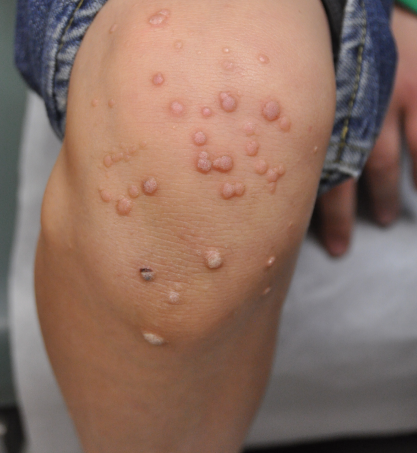 Which of the following microbial organisms is most likely responsible for this patient's current condition?
 (Multiple Choice)
4.8/5 (75)
(75) A 38-year-old woman who works as a nurse at a large community hospital is undergoing evaluation following an accidental needlestick in the operating room. The patient being operated on is not known to have any infections. As part of her evaluation, the nurse has serologic testing for viral hepatitis. Laboratory results are as follows: 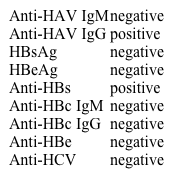 Which of the following statements is most likely to be true regarding the nurse's viral status?
 (Multiple Choice)
4.9/5 (98)
(98) A 35-year-old man is admitted to the hospital after he fell off a moving tractor and caught his right leg underneath the vehicle. The patient has no past medical history. Over the next few hours, he develops worsening severe pain and rapidly increasing swelling in the injured right leg. Crepitus is present on physical examination. Emergent radiographic imaging reveals gas in the tissues. Surgical evaluation is performed. The microorganism most likely responsible for this patient's condition is also commonly associated with which of the following conditions?
(Multiple Choice)
4.9/5 (93)
(93) A 32-year-old man comes to the office due to an acute febrile illness that developed after a deer-hunting trip in Arkansas. The patient recalls getting tick bites in the woods but initially had no symptoms. He began experiencing fever, chills, malaise, headache, and myalgia a week after his return. Physical examination shows a diffuse, maculopapular rash; clear oropharynx; normal lung and heart sounds; and mild, diffuse abdominal tenderness. Laboratory testing reveals leukopenia, thrombocytopenia, and elevated aminotransferase levels. Microscopic evaluation of the blood demonstrates mulberry-shaped, intracytoplasmic inclusions in monocytes. Which of the following is the most likely pathogen responsible for this patient's condition?
(Multiple Choice)
4.8/5 (76)
(76) A 65-year-old woman with ovarian cancer undergoing chemotherapy is hospitalized due to fever, headache, ataxia, and progressive confusion. Two days later, a 26-year-old pregnant woman is admitted to the same hospital with fever, nausea, vomiting, diarrhea, and muscle aches and spontaneously delivers a preterm infant who has generalized skin rash. Laboratory evaluation reveals that these patients' conditions were caused by the same microbial organism. The state health department is notified. Reports of similar illnesses are noted in neighboring cities. A subsequent investigation reveals that 8 people were affected, all of whom consumed food products from a single processing facility. Which of the following organisms is most likely responsible for this outbreak?
(Multiple Choice)
4.9/5 (73)
(73) A 10-year-old boy is brought to the emergency department after experiencing high fevers and chills for the last few days. He also complains of dull pain just above his left knee. He has no history of recent trauma other than minor scrapes to his knees and elbows while playing outside. Physical examination shows point tenderness 3 cm above the kneecap. There is no joint effusion. Radiographs show soft-tissue swelling and a periosteal reaction over the lower end of the femur. Which of the following organisms is most likely responsible for this patient's symptoms?
(Multiple Choice)
4.9/5 (85)
(85) 
Filters
- Essay(0)
- Multiple Choice(0)
- Short Answer(0)
- True False(0)
- Matching(0)