



 Chat with AI
Exam 8: Immunology

Exam 1: Anatomy291 Questions
Exam 2: Behavioral science240 Questions
Exam 3: Biochemistry156 Questions
Exam 4: Biostatistics117 Questions
Exam 5: Embryology52 Questions
Exam 6: Genetics103 Questions
Exam 7: Histology24 Questions
Exam 8: Immunology129 Questions
Exam 9: Microbiology336 Questions
Exam 10: Pathology816 Questions
Exam 11: Pathophysiology464 Questions
Exam 12: Pharmacology538 Questions
Exam 13: Physiology272 Questions
Select questions type


Researchers develop a novel agent to treat extrinsic asthma. In a clinical trial, patients with moderate to severe asthma treated with this medication experience fewer exacerbations. They are found to have lower levels of serum IgE, even after exposure to triggering allergens. This medication helps improve asthma symptoms by binding and inhibiting the substance produced by sensitized Th2 cells in the airways that promotes immunoglobulin isotype switching in B lymphocytes. Which of the following is the most likely target of this medication?

Free
(Multiple Choice)
4.7/5  (76)
(76) Correct Answer: Verified
C
Preventive disease specialists working in a developing country are investigating vaccination options to limit the spread of poliomyelitis. As part of the study, 2 patients are vaccinated against poliomyelitis. One patient receives an intramuscular inactivated vaccine and the other patient receives a live attenuated oral vaccine. One month after vaccination, the levels of which of the following poliovirus antibodies will differ the most between these 2 patients?
Free
(Multiple Choice)
4.8/5 (75)
(75) Correct Answer:Verified
VerifiedB
A 3-year-old girl is brought to the office after developing fever and a sore throat. The patient recently entered day care, and similar symptoms have been reported in several of the other children. Physical examination shows exudative pharyngitis and enlarged anterior cervical lymph nodes. A rapid antigen detection test confirms the diagnosis of streptococcal throat infection. Her condition resolves with antibiotic therapy. Several weeks later, she is re-exposed to Streptococcus pyogenes. The bacteria penetrating beyond the surface epithelium are immediately coated with preformed IgG antibodies. Which of the following substances acts in the most similar manner to IgG antibodies to facilitate phagocytosis?
Free
(Multiple Choice)
4.8/5 (103)
(103) Correct Answer:Verified
VerifiedB
A 23-year-old woman is brought to the emergency department due to one day of fever, vomiting, diarrhea, and muscle pains. The symptoms developed rapidly over the course of the day. The patient is confused and unable to answer questions. She has no known medical problems and takes no medications. She lives with her boyfriend. The patient's temperature is 39.1 C (102.4 F), blood pressure is 88/50 mm Hg, pulse is 120/min, and respirations are 20/min. A diffuse, erythematous, macular rash resembling a sunburn is noted on dermatologic examination; pelvic examination reveals a tampon in the vagina. Laboratory results are as follows: 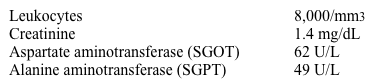 A pregnancy test is negative. Activation of which of the following cells is most likely primarily responsible for this patient's condition?
 (Multiple Choice)
4.9/5 (87)
(87) An 8-year-old boy is brought to the hospital due to severe headache and altered mental status. An aggressive, high-risk neuroblastoma is diagnosed. As part of his treatment, the patient will receive an autologous bone marrow transplant using stem cells obtained from his peripheral blood. His pretransplant evaluation reveals a history of Epstein-Barr virus infection. This patient is at greatest risk for which of the following after transplantation?
(Multiple Choice)
4.8/5 (71)
(71) A 19-year-old woman is brought to the emergency department after a motor vehicle collision. The patient's medical history includes celiac disease and 3 episodes of pneumonia. Her blood pressure is 80/45 mm Hg and pulse is 130/min. Physical examination reveals pallor, and ultrasound shows a splenic laceration. She receives a blood transfusion with O-negative packed red blood cells. During transfusion, the patient develops facial swelling, generalized hives, and shortness of breath. Which of the following is the most likely diagnosis in this patient?
(Multiple Choice)
4.7/5 (79)
(79) A 37-year-old man comes to the emergency department because of increasing pain and tenderness in his right forearm. During a bar brawl 6 days earlier, he sustained a 4-cm laceration through the skin and subcutaneous tissue of his forearm. Treatment at the time of injury included cleaning and dressing the wound. Physical examination shows erythema surrounding the wound site and expression of yellow pus when pressure is applied adjacent to the wound. Which of the following molecules is most likely responsible for causing accumulation of pus over this patient's wound?
(Multiple Choice)
4.8/5 (83)
(83) Pharmacology researchers develop a novel monoclonal antibody medication to treat the wet form of age-related macular degeneration. The antibody binds vascular endothelial growth factor, decreasing abnormal blood vessel formation in the subretinal space. In a clinical trial, the medication is found to improve visual function. During the next phase of the study, researchers use only the antigen binding fragment (Fab) of the antibody instead of the whole immunoglobulin. Which of the following is most likely to be observed with use of the antibody fragments compared to the intact immunoglobulin?
(Multiple Choice)
4.7/5 (70)
(70) A 2-year-old boy is brought to the emergency department due to wheezing and difficulty breathing. The patient had been trick-or-treating with his parents and ate several packs of candy containing peanuts. After he receives an intramuscular epinephrine injection, his symptoms resolve. At a follow up appointment, an allergy specialist places droplets of various allergens on the patient's skin and punctures the epidermis at each site. After 15 minutes, the skin at the site with peanut extract is erythematous with a raised, itchy bump that improves by the time the family leaves the office. Four hours later, the parents notice a hard, red swelling at the puncture site. Which of the following is most likely involved in this secondary reaction?
(Multiple Choice)
4.9/5 (75)
(75) A 57-year-old woman comes to the emergency department due to cough and hemoptysis. The patient also reports several months of fatigue and joint pain. Physical examination is notable for crusting of the nasal mucosa, lung crackles, and scattered palpable purpura over the lower extremities. Chest x-ray reveals bilateral, diffuse alveolar infiltrates. Laboratory studies show normocytic anemia, red blood cell casts and protein in the urine, and positive c-ANCA. After a confirmatory biopsy, treatment with rituximab infusion is planned. This medication is most likely to improve this patient's condition via which of the following mechanisms?
(Multiple Choice)
4.9/5 (81)
(81) A 24-year-old man burns his hand after grasping the handle of a hot pan while preparing a meal. Several minutes later, both the initial burn and the area around it are red without blistering. When he presses on the burn, the tissue blanches. Which of the following is most likely contributing to the reaction observed in this patient?
(Multiple Choice)
4.8/5 (63)
(63) A 4-month-old girl is brought to the office due to a rash on her cheeks for the past 2 weeks. The rash has not spread, and the patient is often seen scratching her face. There have been no changes in bath soaps and detergents; no animals or plants are in the house. Vaccinations are up to date. The patient is exclusively breastfed, with height and weight tracking along the 50th percentiles. Vital signs are normal. Skin examination is shown in the exhibit. 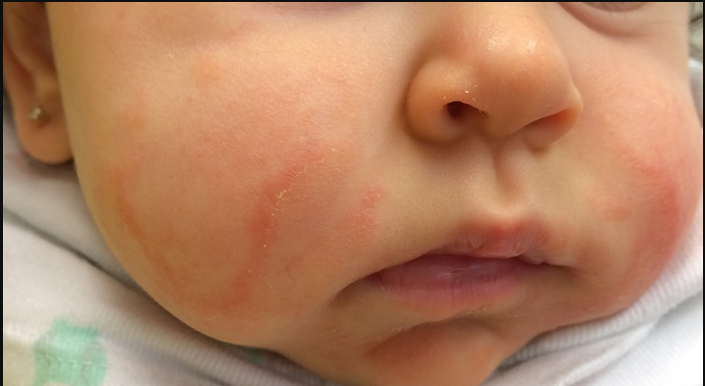 The remainder of the examination is unremarkable. Which of the following conditions is this patient at increased risk for developing?
 (Multiple Choice)
4.9/5 (71)
(71) A 34-year-old man is brought to the hospital by ambulance after being involved in a motor vehicle collision. He was an unrestrained passenger and sustained considerable trauma. On arrival to the emergency department, he is hypotensive and bleeding from several sites. The patient receives an emergency blood transfusion as part of the resuscitation efforts. Abdominal ultrasound reveals splenic laceration and blood in the peritoneal cavity. En route to the operating room, the patient develops difficulty breathing, chills, and pain in the chest and back. Urine drainage from the Foley catheter was initially clear but now appears brown in color. Which of the following is the most likely cause of this patient's new findings?
(Multiple Choice)
4.7/5 (64)
(64) A 25-year-old man comes to the office due to a 1-month history of increasing abdominal girth and swollen extremities. His BMI is 32 kg/m2. Laboratory evaluation shows decreased serum albumin and hypercholesterolemia, and urinalysis reveals heavy proteinuria and fatty casts. A renal biopsy shows findings consistent with focal segmental glomerulosclerosis. Despite aggressive medical management, the patient requires a kidney transplant from his younger sister, who is a 5 out of 6 HLA antigen match. As a part of his posttransplant immunosuppressive regimen, he takes a medication that inhibits lymphocyte proliferation by directly blocking interleukin-2 signal transduction. This mechanism best describes which of the following drugs?
(Multiple Choice)
5.0/5 (89)
(89) A 43-year-old man visiting the United States from Thailand comes to the emergency department due to 10 days of hemoptysis. He also has had night sweats but reports no fever or weight loss. Temperature is 37.7 C (99.9 F), blood pressure is 118/68 mm Hg, pulse is 86/min, and respirations are 18/min. Physical examination shows right-sided rhonchi and crackles. Chest x-ray shows an infiltrate in the right upper lobe. Sputum samples from 3 consecutive days are also obtained. After 72 hours of tuberculin skin test (TST) placement, there is no induration at the site; however, 2 of 3 sputum sample smears reveal acid-fast bacilli. Which of the following best explains the negative TST in this patient?
(Multiple Choice)
4.9/5 (86)
(86) A 5-year-old child is brought to the emergency department by his parents for right arm pain. The patient reports that he was playing hide and seek outside and felt a sharp pain on his arm while hiding in some thick bushes. His parents suspect that something had stung him. Physical examination shows an edematous and erythematous plaque with mild central pallor. A residual stinger, located central to the lesion, is readily extracted. The physical examination is otherwise not significant. Which of the following substances is most likely directly responsible for the skin findings observed in this patient?
(Multiple Choice)
4.8/5 (79)
(79) A 71-year-old man with chronic obstructive pulmonary disease (COPD) is hospitalized due to shortness of breath and wheezing. The patient is treated with bronchodilators and systemic corticosteroids for acute COPD exacerbation. His symptoms improve over the next 2 days. Before being discharged, an intramuscular vaccine containing inactivated viral components, which he normally receives annually, is administered. Several weeks later, the patient comes in close contact with an individual infected with the same virus contained in the vaccine. Which of the following is most likely to occur in this patient as a result of the vaccination?
(Multiple Choice)
4.8/5 (81)
(81) A 12-month-old boy is evaluated for an eczematous rash. Medical history is significant for several severe respiratory infections that required hospitalization. Complete blood count shows white blood cells at 9,000/mm3 and platelets at 40,000/mm3. The platelets seem abnormally small and deformed on the peripheral blood smear. Which of the following is the most likely diagnosis?
(Multiple Choice)
4.8/5 (76)
(76) A 57-year-old man underwent lung transplantation for severe emphysema 2 years ago. Over the last 6 months, he has had increasing exertional dyspnea and dry cough. The patient has adhered to his medical regimen. He does not smoke and has no exposure to secondhand smoke. Physical examination shows scattered bilateral rales and end-expiratory squeaks. Cardiac auscultation reveals no murmurs or additional sounds. Spirometry demonstrates markedly decreased FEV1 compared with findings 6 months prior, although the FVC remains largely unchanged. Chronic lung transplant rejection is suspected, and bronchoscopy with transbronchial biopsy is planned. Histopathology is most likely to show injury predominantly involving which of the following structures?
(Multiple Choice)
4.9/5 (75)
(75) An 18-month-old, partially vaccinated boy is brought to the office for a routine well-child examination. His parents have elected a delayed schedule for vaccine administration based on personal preferences. Today, the patient is scheduled to receive the Haemophilus influenzae serotype b (Hib) conjugate vaccine. The parents are given detailed information about the vaccine, but the mother asks, "Why is 'tetanus toxoid conjugate' listed on the package insert?" She adds that her son already received the diphtheria-tetanus-acellular pertussis (DTaP) vaccine. The parents request an explanation for the reason the Hib vaccine contains both the capsular polysaccharide of Hib as well as the conjugated tetanus toxoid. Which of the following best describes the purpose of Hib vaccine conjugation?
(Multiple Choice)
4.8/5 (88)
(88) 
Filters
- Essay(0)
- Multiple Choice(0)
- Short Answer(0)
- True False(0)
- Matching(0)