



 Chat with AI
Exam 8: Immunology

Exam 1: Anatomy291 Questions
Exam 2: Behavioral science240 Questions
Exam 3: Biochemistry156 Questions
Exam 4: Biostatistics117 Questions
Exam 5: Embryology52 Questions
Exam 6: Genetics103 Questions
Exam 7: Histology24 Questions
Exam 8: Immunology129 Questions
Exam 9: Microbiology336 Questions
Exam 10: Pathology816 Questions
Exam 11: Pathophysiology464 Questions
Exam 12: Pharmacology538 Questions
Exam 13: Physiology272 Questions
Select questions type


A 1-year-old boy is brought to the office for medical evaluation. The patient was recently diagnosed with type 1 diabetes mellitus. He has also had chronic diarrhea, failure to thrive, and eczematous dermatitis since early infancy. Small bowel biopsy reveals villous atrophy and extensive lymphocytic infiltration. Immunologic testing shows significantly increased serum immunoglobulins and decreased IL-10 and transforming growth factor-beta levels. Genetic testing reveals a missense mutation affecting FOXP3. Which of the following is the most likely cause of this patient's current condition?
(Multiple Choice)
4.9/5  (84)
(84) A 34-year-old woman with end-stage kidney disease secondary to IgA nephropathy is undergoing kidney transplant from an unrelated living donor. The patient receives induction immunosuppression with a rabbit antithymocyte globulin-based regimen immediately prior to the procedure. The surgery is performed without complications, and maintenance immunosuppressive therapy is begun. Ten days later, the patient experiences high fevers, generalized pruritic rash, and pain, redness, and swelling of the bilateral metacarpophalangeal joints, wrists, and knees. The erythrocyte sedimentation rate is elevated. Arthrocentesis of the involved joint yields synovial fluid with neutrophilic leukocytosis; there are no crystals and no bacteria on Gram stain. Which of the following is most likely responsible for the increased synovial membrane permeability in this patient?
(Multiple Choice)
5.0/5 (94)
(94) A 72-year-old woman is brought to the emergency department from a nursing facility due to fever, chills, and hypotension. The patient has a history of diabetes mellitus, ischemic stroke, and neurogenic bladder. She has an indwelling urinary catheter. Temperature is 38.8 C (102 F), blood pressure is 80/40 mm Hg, and pulse is 130/min. The patient is lethargic and disoriented. Her extremities are warm, and her breathing is rapid and shallow. Lungs are clear on auscultation and there are no heart murmurs. There is left costovertebral angle tenderness. The urine in her catheter appears cloudy. Her leukocyte count is elevated with left shift, and urinalysis shows pyuria and bacteruria. Which of the following chemical mediators is most responsible for this patient's current condition?
(Multiple Choice)
4.7/5 (88)
(88) A 58-year-old woman comes to the emergency department due to abdominal discomfort and bloating. Physical examination reveals ascites. Abdominal ultrasonography shows a mass in the left ovary, and subsequent paracentesis reveals malignant cells. Surgical excision of the mass is performed. Histopathology shows high-grade serous carcinoma composed of atypical cells with pleomorphic nuclei and mitotic figures. Large numbers of T cells are present in the tumor stroma; further evaluation shows the tumor expresses PD-1 ligands that interact with the PD-1 receptor on the infiltrating T cells. Which of the following is most likely occurring in the tumor microenvironment as a result of this interaction?
(Multiple Choice)
4.9/5 (80)
(80) A 38-year-old woman comes to the office due to abdominal pain. For the last 2-3 weeks, she has had increasingly severe abdominal pain associated with watery diarrhea. The patient has a history of Crohn disease treated for the last year with adalimumab, which has controlled the symptoms until now. Vital signs are normal except for a temperature of 37.8 C (100 F). Examination shows moderate tenderness in the right lower quadrant with no peritoneal signs. Laboratory results show an undetectable trough adalimumab level. Which of the following is the most likely explanation for this patient's worsening symptoms?
(Multiple Choice)
4.7/5 (90)
(90) A 7-year-old boy is evaluated for a foot wound. He sustained a splinter injury to his left foot while playing in the yard several days ago and has continued to have purulent drainage from the wound. The patient has no significant medical history and is up to date with all recommended vaccinations. Wound examination reveals a small retained foreign body with surrounding necrotic tissue and pus. Anaerobic culture of the wound swab grows thin, gram-positive rods with terminal spore, which is biochemically identified as Clostridium tetani. Which of the following most likely protected this patient from developing neurological symptoms of the infection?
(Multiple Choice)
4.7/5 (85)
(85) A 2-year-old boy is brought to the emergency department due to 4 days of worsening cough and fevers. This evening, the patient developed increasingly rapid breathing. He has a history of 2 prior episodes of cervical lymphadenitis due to Staphylococcus aureus. Temperature is 39 C (102.2 F). Blood pressure is 100/72 mm Hg, pulse is 130/min, and respirations are 35/min. Prominent intercostal and supraclavicular retractions are present. There are diffuse crackles bilaterally, with decreased breath sounds at the lung bases. Heart sounds are normal. The patient is intubated. Laboratory results are as follows: 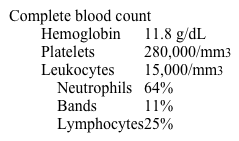 Bronchioalveolar lavage fluid tests positive for Aspergillus fumigatus. Serum immunoglobulin levels are normal. Which of the following is the most likely underlying cause of this patient's presentation?
 (Multiple Choice)
4.9/5 (75)
(75) Once the patient recovers from his acute illness, Candida antigen injection into his skin reveals no signs of inflammation after 48 hours. The same test performed in his mother produces 12 mm of skin induration within 48 hours. Which of the following cells are directly involved in the effector response observed in the mother?
(Multiple Choice)
4.8/5 (88)
(88) A 28-year-old woman is treated with high-dose prednisone for severe lupus nephritis. Several hours after therapy is initiated, she becomes very agitated and delusional. Blood pressure is 130/70 mm Hg and heart rate is 110/min. A basic metabolic profile, complete blood cell (CBC) count, and urinalysis are obtained. The CBC differential is expected to show an increase in which of the following as a result of this patient's therapy?
(Multiple Choice)
4.8/5 (84)
(84) A 4-year-old male is exposed to latex gloves during a minor surgical procedure and is subsequently found to produce anti-latex IgM antibodies. Several months later he develops a severe allergic reaction to latex and is found to have a high level of serum anti-latex IgE antibodies. Which of the following cytokines is most likely responsible for this anti-latex antibody isotype change?
(Multiple Choice)
4.9/5 (71)
(71) A 63-year-old man comes to the physician after noticing a reddish tinge to his urine for the last couple of days. During evaluation of his hematuria, an abdominal CT scan reveals a left-sided renal mass. Further workup also shows multiple pulmonary and bone nodules. CT-guided biopsy of a peripherally located lung nodule demonstrates renal cell carcinoma. High-dose interleukin-2 (IL-2) is started, and 4 weeks later there is a significant reduction in his tumor burden. Which of the following mechanisms was most likely responsible for regression of his malignancy?
(Multiple Choice)
4.9/5 (92)
(92) A 56-year-old woman comes to the emergency department with facial swelling and difficulty breathing. She woke up today with a "feeling of fullness" in her lips, and 2 hours later her husband said that her lips looked puffy. There is no itching or skin rash. The patient has had no similar symptoms before. She has a history of gastroesophageal reflux disease and takes lansoprazole daily. She also began taking lisinopril 2 months ago for hypertension. The patient's blood pressure is 135/75 mm Hg. On examination, there is moderate swelling of her lips and tongue. Mild audible stridor without wheezing is present. Which of the following is the most likely mechanism responsible for this patient's symptoms?
(Multiple Choice)
4.9/5 (88)
(88) A 24-year-old hospital phlebotomist comes to the occupational health clinic after sustaining a needlestick injury while drawing blood from a hepatitis B-positive patient. She has no medical history and received the complete hepatitis B vaccination series prior to her hospital employment a year ago. She is closely monitored over the next 6 months with repeat hepatitis B serologies and does not develop clinical or laboratory evidence of infection. Which of the following mechanisms most likely explains her immunity?
(Multiple Choice)
4.9/5 (70)
(70) A 65-year-old woman is enrolled in a clinical trial to test a new medication for rheumatoid arthritis. The patient's condition has been poorly controlled despite prolonged treatment with multiple disease-modifying antirheumatic drugs. The new medication is a CTLA4-Ig fusion protein that prevents CD28 from binding to CD80/86 on antigen-presenting cells. A month after treatment begins, the patient reports a significant reduction in joint pain and stiffness. Laboratory results reveal reduced levels of C-reactive protein and IL-2. Which of the following is the most likely underlying cause of this patient's treatment response?
(Multiple Choice)
4.8/5 (89)
(89) A 28-year-old man comes to the office with a 2-month history of dull low back pain and morning stiffness. The pain had an insidious onset, and the patient does not recall any recent trauma. He attempted treatment with acetaminophen and spinal manipulation, which did not provide relief. The patient has usually slept on his back but now must lie on his side to fall asleep easily. Past medical history is unremarkable. Vital signs are normal. Physical examination shows limited anterior flexion of the spine. There is no swelling or warmth of any peripheral joints. X-rays reveal narrowing of the sacroiliac joints. Which of the following is most strongly associated with this patient's disease?
(Multiple Choice)
4.9/5 (82)
(82) A 36-year-old woman with fistulizing perianal Crohn disease comes to the office for a follow-up appointment. Eight weeks ago, the patient began receiving intermittent injections of infliximab, a chimeric human-mouse monoclonal antibody targeted against tumor necrosis factor-alpha. She reports improvement in fistula discharge and discomfort but has experienced fever, diffuse joint pain, and an itchy rash 5-7 days after each of the recent treatments. The symptoms spontaneously resolve after 2-3 days. The patient has no other medical conditions and has no history of drug allergies. A delayed drug reaction due to formation of antibodies against foreign drug components is suspected. Which of the following mechanisms is most likely responsible for resolution of these drug reactions?
(Multiple Choice)
4.7/5 (80)
(80) A 34-year-old electric company worker comes to the physician with a skin rash on his right leg. He has not eaten any new foods or changed detergents, soaps, or lotions. On further questioning, the patient recalls that he recently worked on a repair job in an unmaintained, wooded area. He had atopic dermatitis as a child but no other significant illnesses. On physical examination, he appears uncomfortable and is constantly scratching his leg. His lungs are clear bilaterally and his heart sounds are normal. Examination of his right leg shows the findings in the image below. 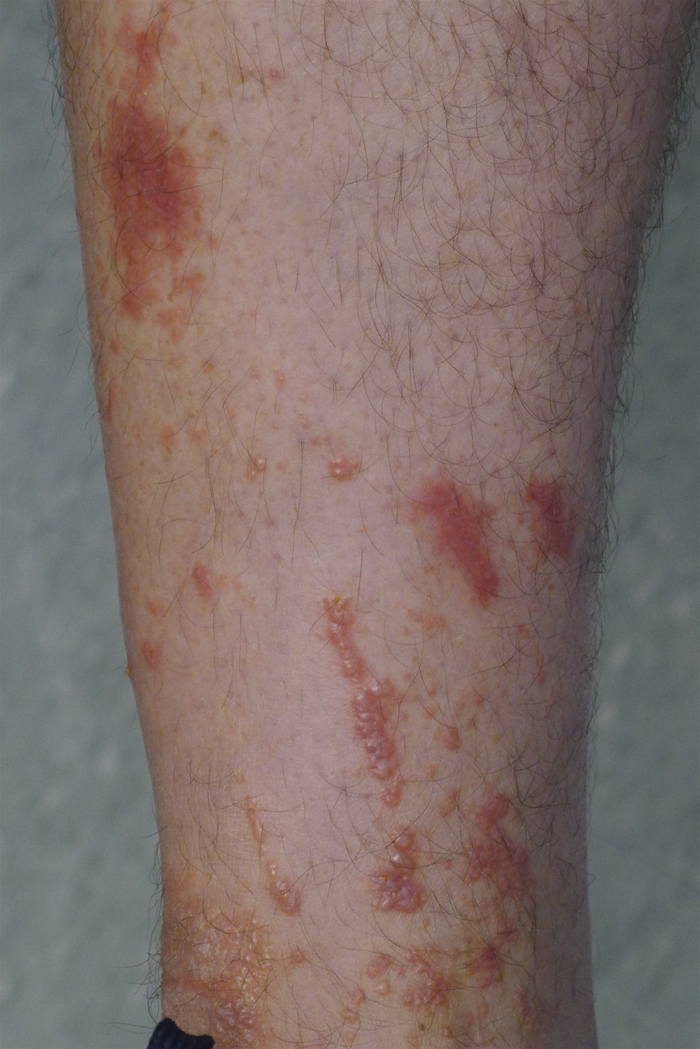 Which of the following cells is most responsible for causing the tissue damage seen in this patient?
 (Multiple Choice)
4.9/5 (95)
(95) A 34-year-old man comes to the office due to severe fatigue. The patient was diagnosed with paroxysmal nocturnal hemoglobinuria 3 years ago, and he has required several blood transfusions due to anemia. Treatment is initiated with a monoclonal antibody that prevents formation of the protein complex leading to hemolysis in this patient. Prophylactic pharmacotherapy will be required to prevent infection by which of the following organisms?
(Multiple Choice)
4.7/5 (77)
(77) A 6-month-old boy is brought to the clinic by his mother and grandmother for a routine well-child visit. The child was born full-term and has no medical problems. He recently learned to sit with support and is starting to eat pureed foods. Vital signs and physical examination are normal. As part of the routine pediatric immunization schedule, the pneumococcal conjugate vaccine is ordered. The patient's grandmother says that she recently received the pneumococcal polysaccharide vaccine. Which of the following statements is true regarding the difference between the pneumococcal conjugate and polysaccharide vaccines?
(Multiple Choice)
4.9/5 (85)
(85) The acidification of lysosomes within antigen presenting cells is prevented in an experimental setting. The affected cells show impaired interaction with T lymphocytes upon antigen exposure. The observed effect most likely results from a low cell surface expression of which of the following molecules?
(Multiple Choice)
4.9/5 (63)
(63) 
Filters
- Essay(0)
- Multiple Choice(0)
- Short Answer(0)
- True False(0)
- Matching(0)