



 Chat with AI
Exam 8: Immunology

Exam 1: Anatomy291 Questions
Exam 2: Behavioral science240 Questions
Exam 3: Biochemistry156 Questions
Exam 4: Biostatistics117 Questions
Exam 5: Embryology52 Questions
Exam 6: Genetics103 Questions
Exam 7: Histology24 Questions
Exam 8: Immunology129 Questions
Exam 9: Microbiology336 Questions
Exam 10: Pathology816 Questions
Exam 11: Pathophysiology464 Questions
Exam 12: Pharmacology538 Questions
Exam 13: Physiology272 Questions
Select questions type


A 45-year-old man comes to clinic for routine follow-up. He has a history of end-stage renal disease due to autosomal dominant polycystic kidney disease, and he underwent a deceased-donor kidney transplant 4 years ago. The patient has hypertension that initially resolved following the transplant but redeveloped 6 months ago. Review of his recent laboratory studies reveals a progressive increase in serum creatinine levels over the last few months. Urinalysis is within normal limits. On ultrasonography, the transplanted kidney is reduced in size. A biopsy of the graft is most likely to show which of the following?
(Multiple Choice)
4.9/5  (70)
(70) A 68-year-old man comes to the office for a follow-up appointment. He has a history of advanced melanoma that is unresectable and resistant to adjuvant regimens. The patient recently began receiving monoclonal antibody infusions for advanced melanoma. The monoclonal antibodies block a specific cell surface receptor found on T lymphocytes. As a result, T cells capable of recognizing tumor antigens have improved ability to destroy cancer cells. Which of the following cell surface receptors is most likely blocked by the treatment?
(Multiple Choice)
4.9/5 (79)
(79) A 7-year-old boy is brought to the office due to sudden onset of facial swelling 2 hours ago. He has had no itching or pain other than a sore throat over the last 2 days, for which he has taken acetaminophen. The patient has had similar episodes of facial swelling that resolved spontaneously after a few days. Temperature is 37 C (98.6 F), blood pressure is 100/78 mm Hg, pulse is 95/min, and respirations are 24/min. Examination shows nonpitting edema of the cheeks, lips, and tongue; there is no tenderness or erythema. Which of the following studies is most likely to be abnormal?
(Multiple Choice)
4.9/5 (81)
(81) A 13-month-old boy is brought to the clinic after repeated infections for the past 4 months, including otitis media, pneumonia, and erysipelas. Although his infections have been responsive to treatment, his father is concerned about the number of infections. The patient also has persistent diarrhea, and a recent stool antigen detection assay was positive for Giardia lamblia. An immunoglobulin panel demonstrates very low serum levels of all immunoglobulin types. Intradermal injection of Candida antigens results in a large indurated nodule within 48 hours. This patient's lymph nodes most likely lack which of the following structures?
(Multiple Choice)
4.8/5 (90)
(90) A 19-year-old man comes to the office due to a painful subcutaneous forearm nodule. Two weeks earlier, he received a laceration on his left forearm while playing soccer and had sutures placed. The lesion is biopsied, and results are shown in the image below: 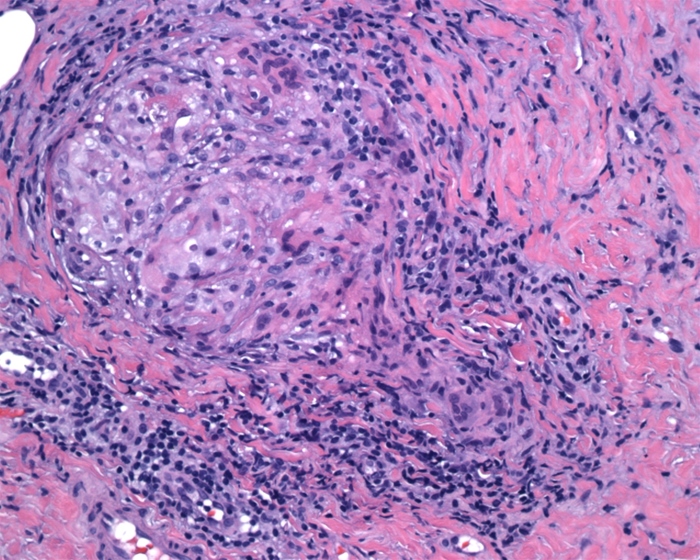 Which of the following is most likely responsible for this patient's condition?
 (Multiple Choice)
4.9/5 (87)
(87) A 44-year-old man with a chronic cough and progressive weight loss comes to the emergency department. He has lost 5 kg (11 lb) over the past 3 months. The patient recently emigrated from Southeast Asia. Temperature is 37.4 C (99.3 F), blood pressure is 113/70 mm Hg, pulse is 78/min, and respirations are 18/min. Chest x-ray reveals an apical left lung infiltrate. Sputum Gram stain and cultures are negative. However, culture of a lung biopsy specimen grows acid-fast bacilli. Microscopy of the lung specimen is shown below. 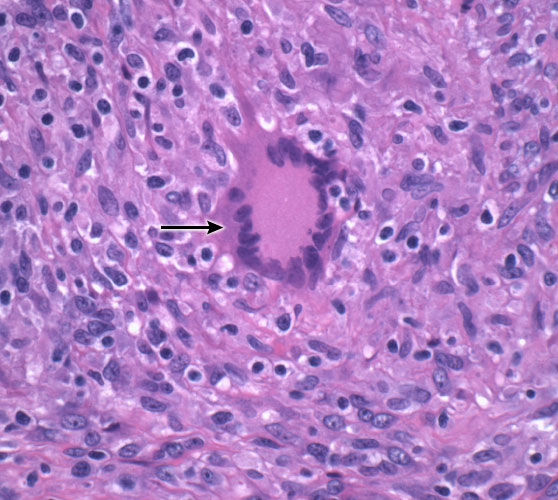 Which of the following processes is most likely to contribute to formation of the finding indicated by the arrow?
 (Multiple Choice)
4.7/5 (84)
(84) A 10-month-old boy is hospitalized for respiratory distress due to Pneumocystis jiroveci pneumonia. The patient has had repeated episodes of otitis media and thrush; weight is below the 5th percentile. Laboratory evaluation reveals normal levels of circulating B and T cells with low levels of all immunoglobulins. Genetic testing reveals a rare autosomal recessive mutation resulting in a defect in the regulation of human leukocyte antigen gene transcription. Flow cytometry of the patient's peripheral blood compared with a healthy control is shown in the illustration below: 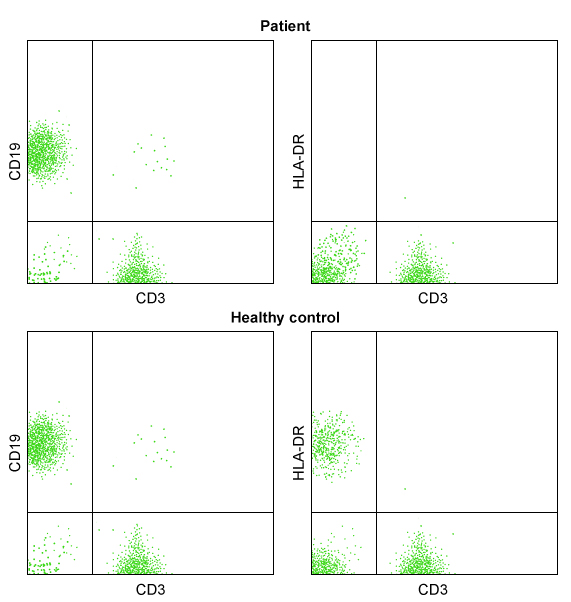 Which of the following processes is most likely to be impaired by this patient's mutation?
 (Multiple Choice)
4.8/5 (80)
(80) A 23-year-old man comes to the physician with dysuria and increased urinary frequency. He is an active duty member of the US military and recently returned from sub-Saharan Africa, where he had been stationed for the last year. The patient's symptoms have persisted for several months and have failed to resolve following antibiotic treatment. His blood eosinophil count is elevated. Urine microscopy shows schistosome eggs. He is started on praziquantel and experiences improvement in his symptoms. The elevated eosinophils in this patient contribute to the host defense against schistosomiasis through which of the following mechanisms?
(Multiple Choice)
4.9/5 (70)
(70) A 52-year-old woman comes to the emergency department with pain and redness affecting her left leg. The patient's symptoms began 2 days ago and have progressed to the point where she cannot walk without experiencing severe pain. Physical examination shows a large, erythematous area with indistinct margins over her left leg. The area feels hot and indurated and is exquisitely tender. She is admitted to the hospital for severe left leg cellulitis and is started on intravenous cefazolin. Several minutes after the infusion is started, she experiences shortness of breath, diffuse itching, and dizziness. Her blood pressure is 64/38 mm Hg and heart rate is 130/min. On examination, there is a diffuse erythematous skin rash and bilateral wheezing is heard on lung auscultation. Which of the following is most likely to be elevated in this patient's serum as a result of her medication reaction?
(Multiple Choice)
4.8/5 (65)
(65) A 55-year-old man is evaluated due to a nonhealing left forearm wound. The patient had an excisional biopsy of a suspicious skin lesion at the site of the wound several weeks ago. He has a history of uncontrolled type 2 diabetes mellitus and hypertension. Vital signs are within normal limits. Physical examination shows a 2.5-cm wound surrounded by erythema on the left forearm. Upregulation of which of the following would most likely improve fibroblast proliferation and reepithelization in this nonhealing wound?
(Multiple Choice)
4.8/5 (89)
(89) A 28-year-old man comes to the emergency department after sustaining an accidental penetrating injury to the left eye. Examination shows left globe perforation with decreased visual acuity. The right eye is normal. The patient is otherwise healthy. Surgical treatment is performed with subsequent improvement in vision. Two months later, the patient experiences pain, photophobia, and diminished vision in the right eye. Evaluation shows leukocytes in the anterior chamber and vitreous humor and choroidal deposits consistent with granulomatous panuveitis. Disruption of which of the following immune processes is most likely responsible for this patient's current condition?
(Multiple Choice)
5.0/5 (80)
(80) The patient's anaphylactic reaction is determined to be mediated by antigen-specific IgE antibodies attached to high-affinity receptors on the surface of mast cells and basophils. Which of the following mechanisms is most likely to trigger vasoactive substance release by these cells?
(Multiple Choice)
4.8/5 (88)
(88) A researcher identifies a group of malignant epithelial cells in the sigmoid colon that have decreased their surface expression of MHC class I antigen. Which of the following immune effector cell types is most likely to kill the transformed epithelial cells?
(Multiple Choice)
4.7/5 (79)
(79) A 24-year-old recent Russian immigrant describes a long history of weight loss, night sweats and nagging cough. Imaging and biopsy of his lungs reveal numerous apical granulomas with central caseous necrosis. Surrounding the necrotic areas are large cells with abundant pale cytoplasm. Which of the following surface markers is most specific for those cells?
(Multiple Choice)
4.8/5 (83)
(83) A 23-year-old man comes to the emergency department due to 7 days of fever and malaise. He has also had nausea and a poor appetite. The patient has no significant medical history but regularly uses injection drugs and has had multiple sexual partners. Temperature is 38 C (100.4 F). On physical examination, there is scleral icterus. A tender, smooth liver edge is palpable 4 cm below the right costal margin. Appropriate therapy is initiated. The following graph illustrates this patient's hepatitis B serologic markers over time. 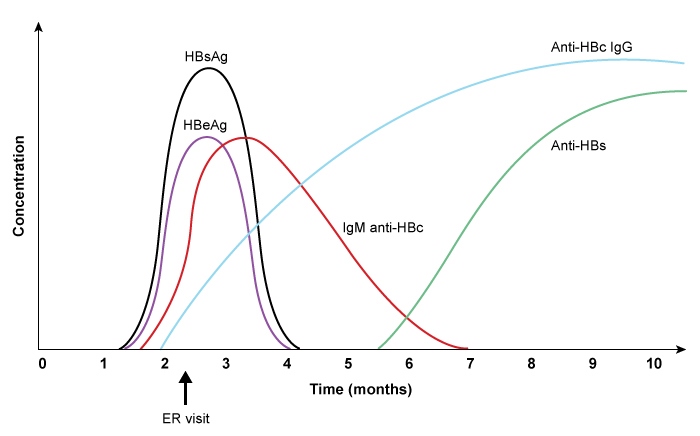 Which of the following best explains these observed findings?
 (Multiple Choice)
4.9/5 (80)
(80) A 24-year-old, previously healthy woman is evaluated for skin rash, joint pains, and renal failure. She is found to have decreased C3 and C4 levels and a normal factor B level. Which of the following most likely triggered the complement system activation in this patient?
(Multiple Choice)
4.9/5 (69)
(69) A 26-year-old man returns to the emergency department after developing a fever and skin rash. The patient was discharged from the hospital 10 days ago after treatment for a copperhead snake bite to his left leg. He received multiple doses of polyvalent Fab antivenom therapy and other supportive care during hospitalization. The patient's bite site pain, swelling, and ecchymosis have resolved; however, he has developed fever, pain in multiple extremity joints, and pruritic rash over the past 2 days. He has no chronic medical conditions. Temperature is 38.5 C (101.3 F), blood pressure is 128/70 mm Hg, pulse is 98/min, and respirations are 17/min. Physical examination shows a diffuse urticarial rash. No mucous membrane lesions are present. There is tenderness to palpation of the bilateral metacarpophalangeal joints, wrists, and ankles with no redness or swelling. Blood cell counts, serum chemistry studies, and coagulation parameters are within normal limits. Which of the following is the most likely underlying mechanism of this patient's current condition?
(Multiple Choice)
4.7/5 (68)
(68) A research scientist is comparing surface antigens X and Y that come from 2 different viruses. He obtains antibodies against antigen X from an animal previously exposed to the virus expressing this antigen. These antibodies are then attached to assay plates. Next, a fixed quantity of radiolabeled X antigen is added to the plates. Unlabeled Y antigens are then added in increasing concentrations to each plate, and the plates are washed to remove unbound antigens. Radioactivity is plotted as a function of Y antigen concentration, as shown in the graph below. 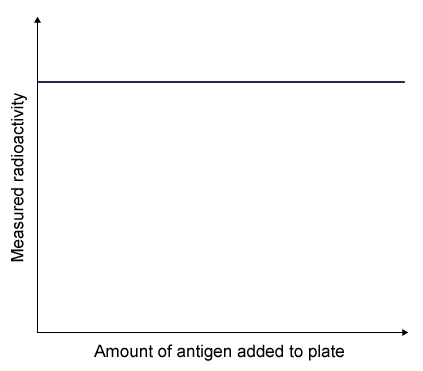 Which of the following best describes the results of this experiment?
 (Multiple Choice)
4.8/5 (80)
(80) A 26-year-old man is brought to the emergency department due to fever and lethargy. His girlfriend says the patient abruptly began experiencing fever, chills, vomiting, and diarrhea several hours ago, which were quickly followed by lightheadedness and lethargy. He has no prior medical conditions other than an episode of epistaxis after a bar fight 3 days ago. The patient does not smoke cigarettes or use injection drugs. There is no history of exposure to sick contacts, and he has not eaten anything out of the ordinary. Temperature is 38.9 C (102 F), blood pressure is 90/60 mm Hg, and pulse is 120/min. Physical examination shows a diffuse, erythematous rash. There is an anterior nasal packing in the left nostril, removal of which shows mild mucosal erythema with a purulent discharge. Cardiopulmonary and abdominal examinations reveal no abnormalities, and signs of meningeal irritation are absent. Which of the following processes is most essential in pathogenesis of this patient's current condition?
(Multiple Choice)
4.8/5 (78)
(78) A 68-year-old woman comes to the office due to recurrent bacterial sinusitis, pneumonia, and urinary tract infections over the past several months. The patient has no prior medical conditions or history of severe infections in childhood. She does not use tobacco, alcohol, or illicit drugs. Temperature is 36.6 C (97.9 F), blood pressure is 130/76 mm Hg, and pulse is 72/min. On physical examination, the lungs are clear to auscultation, heart sounds are normal, and the abdomen is soft and nontender with no hepatosplenomegaly. Laboratory testing reveals normocytic normochromic anemia. Bone marrow aspirate shows an increased number of cells, as shown below. 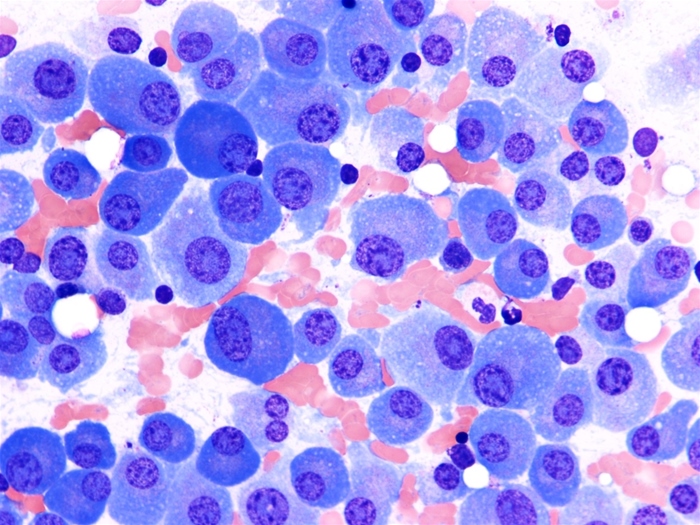 Which of the following is the most likely cause of this patient's increased susceptibility to infections?
 (Multiple Choice)
4.9/5 (85)
(85) 
Filters
- Essay(0)
- Multiple Choice(0)
- Short Answer(0)
- True False(0)
- Matching(0)