Multiple Choice
A research scientist is comparing surface antigens X and Y that come from 2 different viruses. He obtains antibodies against antigen X from an animal previously exposed to the virus expressing this antigen. These antibodies are then attached to assay plates. Next, a fixed quantity of radiolabeled X antigen is added to the plates. Unlabeled Y antigens are then added in increasing concentrations to each plate, and the plates are washed to remove unbound antigens. Radioactivity is plotted as a function of Y antigen concentration, as shown in the graph below. 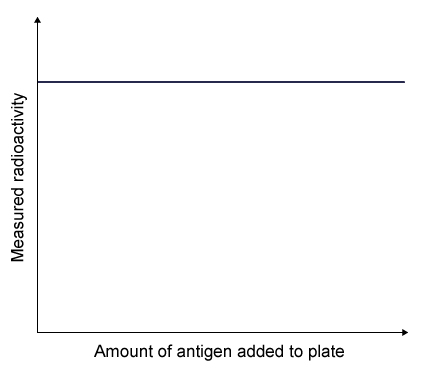 Which of the following best describes the results of this experiment?
A) Antigen X and antigen Y have no epitopes in common
B) Antigen X and antigen Y have the same epitopes
C) Antigen Y shares most of the epitopes of antigen X
D) Antigen Y shares some of the epitopes of antigen X
Correct Answer:

Verified
Correct Answer:
Verified
Q53: A researcher identifies a group of malignant
Q54: A 24-year-old recent Russian immigrant describes a
Q55: A 23-year-old man comes to the emergency
Q56: A 24-year-old, previously healthy woman is evaluated
Q57: A 26-year-old man returns to the emergency
Q59: A 26-year-old man is brought to the
Q60: A 68-year-old woman comes to the office
Q61: A 1-year-old boy is brought to the
Q62: A 34-year-old woman with end-stage kidney disease
Q63: A 72-year-old woman is brought to the