



 Chat with AI
Exam 8: Immunology

Exam 1: Anatomy291 Questions
Exam 2: Behavioral science240 Questions
Exam 3: Biochemistry156 Questions
Exam 4: Biostatistics117 Questions
Exam 5: Embryology52 Questions
Exam 6: Genetics103 Questions
Exam 7: Histology24 Questions
Exam 8: Immunology129 Questions
Exam 9: Microbiology336 Questions
Exam 10: Pathology816 Questions
Exam 11: Pathophysiology464 Questions
Exam 12: Pharmacology538 Questions
Exam 13: Physiology272 Questions
Select questions type


A 15-year-old boy develops severe cardiomyopathy following myocarditis from Coxsackie virus and is placed on the cardiac transplant list. Two weeks following his cardiac transplantation from a matched donor, he develops dyspnea on exertion. Extensive evaluation is undertaken including cardiac catheterization and endomyocardial biopsy to assess for acute allograft rejection. Which of the following histologic findings is most consistent with this diagnosis?
(Multiple Choice)
4.8/5  (78)
(78) A 24-year-old nurse comes to the office for his annual wellness visit that includes tuberculosis screening. The patient has no chronic medical conditions and does not have recent fever, cough, or other health changes. He receives an intradermal injection of tuberculin on the inner surface of his forearm. Two days later, he has a distinct area of induration 20 mm across at the injection site. Which of the following interactions is essential to the development of this patient's skin reaction?
(Multiple Choice)
4.7/5 (83)
(83) A 40-year-old woman, gravida 4 para 4, comes to the clinic due to anemia. A week ago, the patient was seen in the emergency department due to fatigue, shortness of breath, and increasingly heavy, irregular menses. Laboratory evaluation showed a hemoglobin level of 5.4 g/dL. After a transfusion with packed red blood cells, her follow-up hemoglobin level was 7.8 g/dL prior to discharge. Since then, the patient's energy and breathing have improved, and she has had no further menstrual bleeding. However, yellowing of the eyes and face has developed over the last day. Vital signs are normal. Examination reveals scleral icterus. There is no hepatosplenomegaly. Laboratory results are as follows: 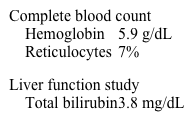 This patient's current symptoms are most likely due to which of the following antibody-antigen reactions?
 (Multiple Choice)
4.8/5 (75)
(75) Researchers are investigating the use of immune checkpoint inhibitors for the treatment of advanced colorectal cancer. They find that this therapy is more effective in patients with DNA mismatch-repair deficiency compared to patients with an intact mismatch-repair mechanism. Which of the following most likely explains the improved efficacy of the drug in the first group of patients?
(Multiple Choice)
4.7/5 (79)
(79) A 33 year-old female is being followed by her neurologist for her multiple sclerosis. She was initially diagnosed with relapsing remitting subtype after an episode of visual disturbance and an episode of paralysis. In her study of autoimmune diseases she encounters the topic of lymphocyte development and comes across a question which she poses to her neurologist during a routine follow-up visit: During the process of T-lymphocyte maturation, T cell receptors of many lymphocytes demonstrate a very high-affinity interaction with MHC molecules expressed on thymic medullary epithelial and dendritic cells. What process do these lymphocytes undergo at this time?
(Multiple Choice)
4.9/5 (83)
(83) A 14-year-old boy is brought to the emergency department by his mother after he develops a sudden rash. He was trying to retrieve a baseball that had rolled under a log when he got stung by something. By the time he told his mom, his body was covered in welts. His mother gave him diphenhydramine, but the patient's face started to swell and he was having a hard time swallowing. The patient's blood pressure is 70/50 mm Hg and heart rate is 120/min. Physical examination shows erythematous, raised plaques over the trunk, extremities, and face. Lung auscultation reveals bilateral expiratory wheezes. The mother is not aware of the child having any similar reaction in the past. Which of the following most likely triggered this patient's condition?
(Multiple Choice)
4.8/5 (81)
(81) A 10-year-old girl is brought to the office due to sneezing, rhinorrhea, and nasal congestion and itching. The symptoms began 2 days ago after she arrived at a family farm for a summer vacation. The patient has spent a few days visiting the farm during previous summer seasons. She had no symptoms at her first visit 2 years ago but recalls having similar symptoms last year. She has had no respiratory symptoms while residing in another state the rest of the year. The patient has no prior medical conditions and takes no medications. On physical examination, the nasal turbinates are enlarged and bluish; clear rhinorrhea is present. Allergic response to a farm allergen is suspected. Which of the following processes most likely occurred during the first farm visit 2 years ago?
(Multiple Choice)
4.9/5 (70)
(70) A 19-year-old woman comes to the office to discuss treatment options for seasonal sneezing, rhinorrhea, and nasal congestion. She has had these symptoms for the past few springs and summers but is now willing to "try anything" to allow her to concentrate on her upcoming final exams. The patient has no significant medical history, takes no medications, and has no drug allergies. Vital signs are within normal limits and physical examination reveals mild bilateral pale and boggy nasal turbinates with copious clear mucus. Fluticasone, an intranasal glucocorticoid, is prescribed. Which of the following is the most likely mechanism of action of this drug?
(Multiple Choice)
4.8/5 (86)
(86) An 11-year-old girl is brought to the office for a health maintenance visit. She feels well and has no chronic medical conditions. As part of routine care, the patient receives a first dose of the quadrivalent meningococcal conjugate vaccine and the 9-valent human papillomavirus vaccine. Five minutes later, while being escorted to the waiting area, the patient appears pale and reports feeling dizzy. She immediately loses consciousness, but a fall is prevented by the health care provider. Blood pressure is 70/40 mm Hg and pulse is 46/min. On physical examination, the patient has normal lung and heart sounds. There is no rash. Which of the following is the most likely cause of this patient's syncope?
(Multiple Choice)
4.9/5 (77)
(77) An 8-year-old male is brought to his pediatrician's office by his mother. The child has had a runny nose, sore throat, cough, and low-grade fever for the past 24 hours. The patient's mother recalls that several of the child's friends have been ill recently with similar symptoms. The mother asks whether the child will need antibiotics for his condition. His pediatrician recommends symptomatic therapy and feels that his illness is most likely of viral etiology. Cytotoxic CD8+ lymphocytes are able to kill virus-infected nasal epithelial cells once sensitized. Cytotoxic CD8+ lymphocyte receptors recognize foreign proteins on the epithelial cell surface. Foreign proteins are presented on the epithelial cell surface by MHC molecules. These MHC molecules comprise which of the following components?
(Multiple Choice)
4.8/5 (67)
(67) A 34-year-old woman comes to the office for tuberculosis evaluation. The patient was advised to have tuberculosis testing after her father, who came to visit from Haiti a week ago and had been living with her, was found to have active pulmonary tuberculosis. She has no history of tuberculosis or any other chronic medical conditions and takes no medications. Tuberculin skin testing is performed and results 48 hours later are negative. Eight weeks later, the patient returns for follow-up and says she feels healthy and has had no fever, cough, shortness of breath, or weight loss. Physical examination shows no abnormalities. Repeat tuberculin skin testing reveals significant skin induration around the injection site at 48 hours. Chest radiograph reveals no parenchymal opacities, pleural effusion, or enlarged lymph nodes. Which of the following immune effector cells are most important for control of the pathogen responsible for this patient's skin findings?
(Multiple Choice)
4.9/5 (78)
(78) A 5-year-old girl is brought to the office for evaluation of a persistent cough. The patient has had a productive cough daily for the past month. History includes recurrent episodes of otitis media despite bilateral ear tube placement, numerous lower respiratory tract infections, and occasional ulcerative skin lesions. Laboratory evaluation shows normal levels of total B and T cells and serum immunoglobulin. Genetic testing reveals a mutation in the TAP1 gene, which encodes a protein involved in the transport of cytosolic molecules into the endoplasmic reticulum. Which of the following processes is most likely to be impaired by this mutation?
(Multiple Choice)
4.8/5 (75)
(75) A 10-year-old boy is brought to the emergency department by his parents due to increasing lethargy and high fever for the past 12 hours. The boy was well last night but was sluggish this morning. Over the day, his activity level and responsiveness diminished. The patient was treated for Neisseria meningitidis bacteremia 2 years ago. He has received all routine vaccinations and is developing normally. Temperature is 39.6 C (103.3 F). On examination, the patient appears ill and is poorly responsive. He is tachycardic, but heart sounds are otherwise unremarkable. Lungs are clear to auscultation. Numerous purple bruise-like markings and petechiae are noted over his extremities, which have diminished capillary refill. Blood samples are drawn for total complement (CH50) and alternative complement (AH50) measurement. Which of the following sets of results is most likely to be found in this patient?
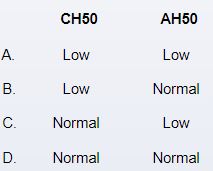
(Multiple Choice)
4.9/5 (89)
(89) A 22-year-old woman comes to the office due to 2 weeks of profound fatigue, which has prevented her from attending college classes. The fatigue was preceded by fevers and sore throat, but these have now improved. The patient is an exchange student from Turkey and has no prior medical conditions. She does not use tobacco, alcohol, or illicit drugs. Vital signs are within normal limits. Oropharyngeal examination shows no abnormalities. There are several enlarged lymph nodes posterior to the sternocleidomastoid muscle bilaterally. Cardiopulmonary examination is unremarkable. The spleen is palpable 1 cm below the left costal margin. No skin rashes or other lymphadenopathy is present. Peripheral blood evaluation shows increased numbers of abnormal white blood cells as shown in the exhibit.
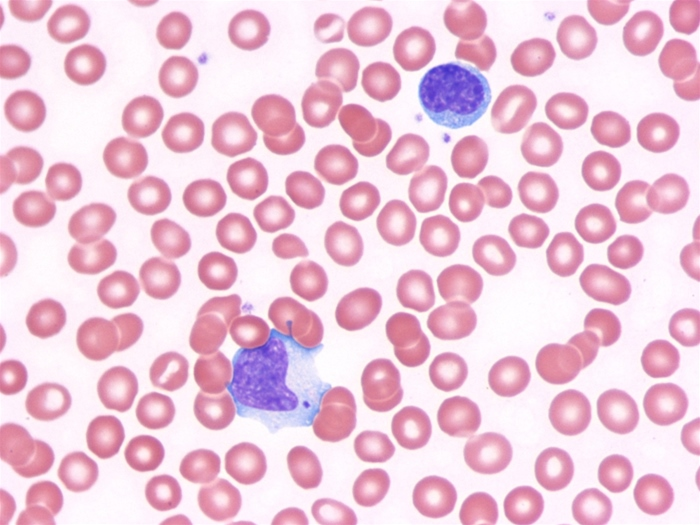 The observed cytoplasmic granules of these cells are most likely to contain which of the following substances?
 (Multiple Choice)
4.7/5 (77)
(77) A 2-year-old boy is brought to the office due to recurrent infections. He was born at term after an uncomplicated pregnancy. His mother states, "My boy is always sick with something and is constantly on antibiotics." The patient has had multiple episodes of otitis media, skin infections, and pneumonia. Incision and drainage of his skin infections revealed Staphylococcus aureus on bacterial culture but no purulence. The infections usually resolve with prolonged antibiotic courses. Laboratory testing reveals absent CD18 antigens on the surface of leukocytes. This patient's underlying condition is most likely associated with which of the following?
(Multiple Choice)
4.9/5 (87)
(87) A 2-week-old infant is brought to the emergency department due to fever, lethargy, grunting, and poor feeding. The patient was born at full term after an uneventful pregnancy and has had no prior medical issues. Blood samples are obtained for culture, and the patient is hospitalized for broad-spectrum antibiotic therapy. Cultures grow Escherichia coli. The patient's condition developed in part due to exposure to bacterial lipopolysaccharide, which stimulates NF-kB-induced transcription of inflammatory cytokines such as TNF-alpha, IL-1, and IL-6. This bacterial component most likely interacted with the patient's immune cells via which of the following?
(Multiple Choice)
4.9/5 (82)
(82) Immunoglobulins of different classes have different structures. Some immunoglobulins have long hinge regions between the Fab and Fc regions, whereas others lack the hinge region, as shown in the image below: 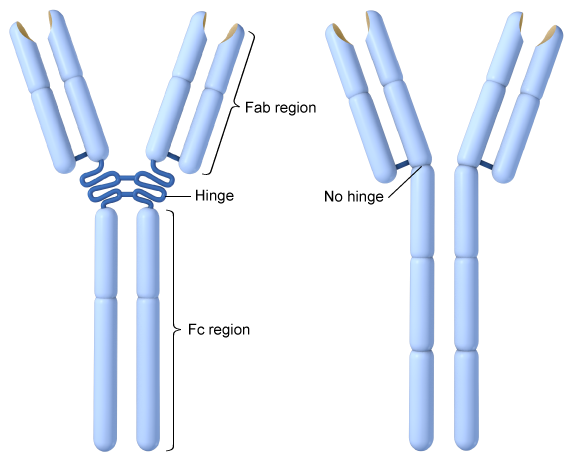 The hinge region provides movement flexibility to the Fab regions. This is most likely to affect which of the following immunoglobulin properties?
 (Multiple Choice)
4.9/5 (73)
(73) A 48-year-old woman is evaluated for a painless left breast mass. Physical examination shows a 4-cm mass with dimpling of the overlying skin; left axillary lymphadenopathy also is noted. Breast imaging reveals a spiculated soft tissue mass with microcalcifications. Biopsy of the mass demonstrates invasive ductal carcinoma. Immunohistochemistry of the tissue sample shows the tumor cells are negative for estrogen and progesterone receptors but overexpress the HER2 epidermal growth factor receptor. The patient is treated with systemic chemotherapy and a monoclonal antibody drug that binds the extracellular domain of the growth factor receptor. Repeat evaluation 6 weeks later shows a decrease in the size of the breast mass. Which of the following host factors are primarily responsible for mediating the response to the monoclonal antibody therapy?
(Multiple Choice)
4.9/5 (80)
(80) A 56-year-old man hospitalized in the intensive care unit is being evaluated for fever. He was admitted 8 days ago with respiratory failure and has had a complicated hospital course, including mechanical ventilation, central venous line placement, and broad-spectrum antibiotic therapy. The patient has a history of HIV and a hematologic malignancy. His last chemotherapy session was 2 weeks ago. Chest x-ray does not reveal a new infiltrate, and urine cultures are negative for infection. Blood cultures grow pseudohyphae-producing yeast species with an ability to form germ tubes. Which of the following most likely directly contributed to the development of fungemia in this patient?
(Multiple Choice)
4.9/5 (81)
(81) A 32-year-old woman comes to the allergy clinic due to a recurrent skin rash. The patient has had several episodes of itchy, erythematous, vesicular eruptions on her hands over the past several months. She works at a hair salon and is often exposed to hair dye and other beauty products. The patient has no other medical conditions and takes no medications. She undergoes patch testing, during which several allergens found in common cosmetic products are mounted on nonocclusive tape strips applied to her upper back. Skin findings developed after 2 days of application and are shown in the exhibit.  Which of the following processes most likely occurred in this patient to enable the development of the observed skin reaction?
 (Multiple Choice)
4.8/5 (85)
(85) 
Filters
- Essay(0)
- Multiple Choice(0)
- Short Answer(0)
- True False(0)
- Matching(0)