



 Chat with AI
Exam 5: Embryology

Exam 1: Anatomy291 Questions
Exam 2: Behavioral science240 Questions
Exam 3: Biochemistry156 Questions
Exam 4: Biostatistics117 Questions
Exam 5: Embryology52 Questions
Exam 6: Genetics103 Questions
Exam 7: Histology24 Questions
Exam 8: Immunology129 Questions
Exam 9: Microbiology336 Questions
Exam 10: Pathology816 Questions
Exam 11: Pathophysiology464 Questions
Exam 12: Pharmacology538 Questions
Exam 13: Physiology272 Questions
Select questions type


A 34-year-old primigravida at 18 weeks gestation comes to the office for a routine prenatal examination. The patient's pregnancy has been uncomplicated. She takes a daily prenatal vitamin, and her laboratory results have been normal to date. The patient's personal and family medical histories are unremarkable. During the visit, a detailed fetal ultrasound reveals unilateral hydronephrosis. Male external genitalia are also visible. If the fetal hydronephrosis is caused by obstruction, which of the following is the most likely site?

Free
(Multiple Choice)
4.8/5  (72)
(72) Correct Answer: Verified
B
Researchers working at a national foundation for prematurity and birth defects are investigating the pathological changes that can occur during embryonic kidney development. Their research focuses on the inductive signals exchanged between the metanephric diverticulum and metanephric blastema that drive their differentiation into tissues forming the mature kidney. If a toxic insult occurs during early fetal development that selectively inhibits the renal structures formed by the metanephric blastema, which of the following adult derivatives will fail to develop?
Free
(Multiple Choice)
4.7/5 (69)
(69) Correct Answer:Verified
VerifiedB
The concentrations of 2 substances in the amniotic fluid of pregnant women are graphed below. 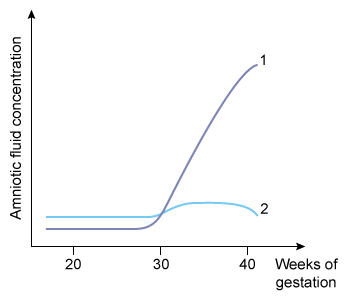 The two curves most likely correspond to which of the following?
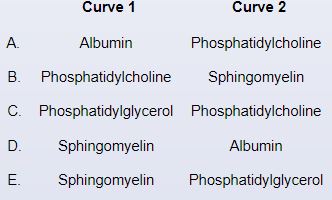
The two curves most likely correspond to which of the following?
Free
(Multiple Choice)
4.8/5 (82)
(82) Correct Answer:Verified
VerifiedB
A 3-day-old boy is brought to the emergency department due to poor feeding, emesis, and lethargy over the last 24 hours. The patient was born via uncomplicated spontaneous vaginal delivery to a 30-year-old woman who had a normal pregnancy. The boy was discharged from the newborn nursery yesterday and was breastfeeding exclusively until the onset of symptoms. Stool and urine output were normal while he was in the newborn nursery. The patient is afebrile and normotensive but tachycardic and tachypneic. He appears dehydrated, and the abdomen is distended. The patient vomits during the examination, and the vomitus is shown in the exhibit.
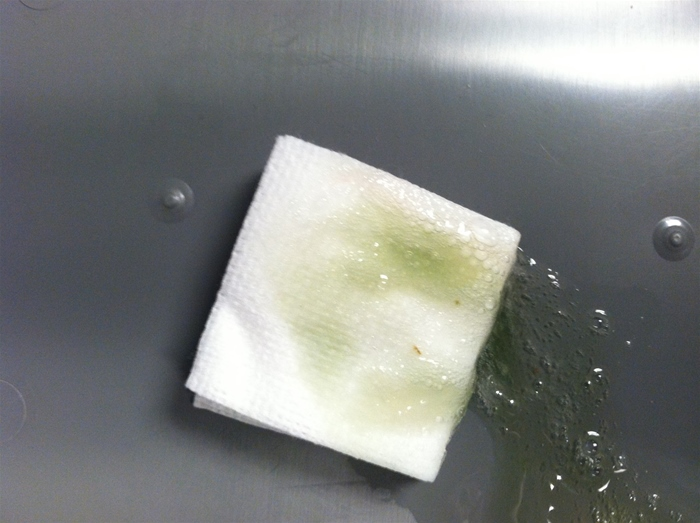 On laparotomy, fibrous bands are seen extending from the cecum and right colon to the retroperitoneum, causing extrinsic compression of the duodenum. Which of the following embryologic processes most likely failed in this patient?
 (Multiple Choice)
4.9/5 (79)
(79) A 41-year-old woman, gravida 0, comes to the office for evaluation of pregnancy. Menarche was at age 12, and her menses recur every 30 days and last 5 days. The patient and her husband have been trying to conceive for the past year and plan intercourse during her fertile window according to the ovulation predictor kit. She has no medical problems, takes no medications, and has no allergies. BMI is 23 kg/m2. Vital signs and physical examination are normal. If fertilization and implantation occurred this cycle, when would the β-hCG level first be detectable in the serum?
(Multiple Choice)
4.8/5 (69)
(69) A 32-year-old woman, gravida 4 para 0, comes to the office for evaluation of recurrent pregnancy loss. She has had 4 consecutive spontaneous abortions with the same partner. The patient has menstrual cycles approximately 28 days apart, with light bleeding for 2-3 days. She has no chronic medical conditions and takes no daily medications. The patient does not use tobacco, alcohol, or illicit drugs. Results of her hysterosalpingogram are shown in the exhibit. 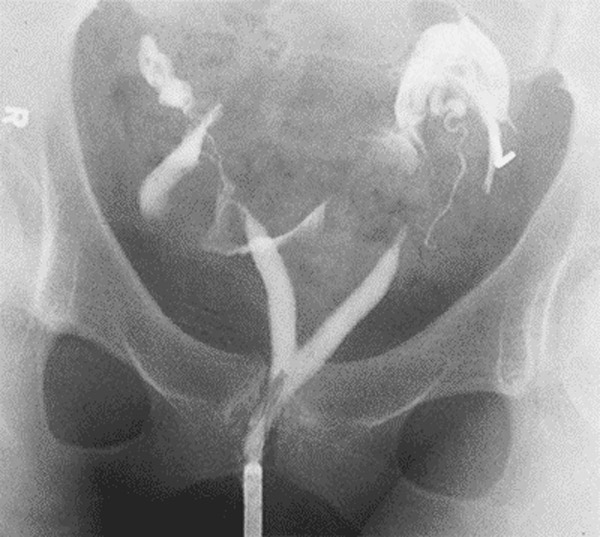 Failure of which of the following processes is the most likely underlying mechanism of this patient's condition?
 (Multiple Choice)
4.9/5 (61)
(61) A 23-year-old man comes to the office with a 2-week history of malaise, loss of appetite, and vague abdominal pain. The patient has had no nausea, vomiting, changes in his bowel habits, dysuria, urinary frequency, or hematuria. He had an appendectomy for acute appendicitis at age 15; his medical history is otherwise unremarkable. He does not use tobacco or alcohol and has had no recent travel. His father was diagnosed with colon cancer at age 60. Physical examination reveals normal bowel sounds and no guarding or rebound tenderness. Abdominal CT scan obtained as part of this patient's evaluation is shown in the image below. 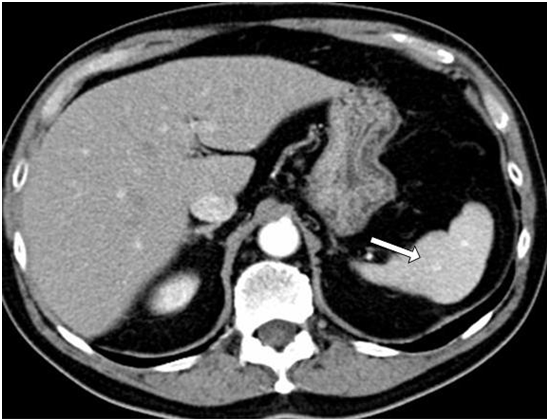 The anatomical structure indicated by the arrow originates from which of the following embryologic divisions?
 (Multiple Choice)
4.8/5 (91)
(91) A 24-year-old woman comes to the office for a routine antenatal ultrasound. She is 19 weeks pregnant by her last menstrual period. This is the patient's third pregnancy, and there have been no complications. Her family history is unremarkable, and both of her children are healthy. The ultrasound reveals a male fetus with bilaterally enlarged fetal kidneys with diffuse small cysts. The amniotic fluid volume is very low. No other anomalies are seen. Which of the following will most likely be present in the newborn after delivery?
(Multiple Choice)
4.9/5 (70)
(70) A 1-week-old boy is brought to the emergency department with poor feeding, lethargy, and unusual "muscle movements" involving the left thumb and hand over the last 2 days. The patient's mother had appropriate prenatal care, a normal pregnancy, and took no medications other than prenatal vitamins. The infant's vital signs are normal, but unusual flexion of the left wrist and thumb and extension of the fingers are observed with cuff blood pressure measurement. Physical examination reveals a hypoplastic mandible, low-set ears, bifid uvula, and cleft palate. A chest x-ray reveals decreased soft-tissue attenuation in the right anterior mediastinum. These findings most likely suggest impaired development of which of the following embryonic structures?
(Multiple Choice)
4.8/5 (76)
(76) A 32-year-old woman comes to the office at 28 weeks gestation due to dyspnea. She has been feeling short of breath when she is supine but has no other symptoms. The patient has had no prenatal care during her pregnancy. She has a history of epilepsy that is well-controlled with medication. She lives with her husband and does not use tobacco, alcohol, or illicit drugs. Her immunizations are up to date, and she has no allergies. Physical examination shows a uterine size that is larger than expected for gestational age. Sonographic assessment shows markedly elevated amniotic fluid levels. Which of the following fetal anomalies would most likely account for this patient's polyhydramnios?
(Multiple Choice)
4.8/5 (83)
(83) A 5-month-old boy is brought to the office for right-sided scrotal enlargement. The enlargement has been present since birth and increases when he cries or strains to pass a bowel movement. There is no history of trauma or infection. The boy's parents do not believe he is in pain and have not noted discoloration of the area. On ultrasonography, the enlargement is found to be a fluid collection around the right testis. The specific embryologic defect giving rise to this patient's condition can also lead directly to which of the following?
(Multiple Choice)
4.9/5 (82)
(82) A 35-year-old woman, gravida 2 para 1, comes to the office for a routine prenatal visit. Her first child was born with a hydrocele and syndactyly of the first and second toes. The patient has no significant medical problems and takes no medications except for a multivitamin. Examination reveals clear lungs and normal first and second heart sounds. The abdomen is soft and nontender. Uterine size, fetal movements, and fetal cardiac activity are all within appropriate limits. The patient undergoes amniocentesis during the 18th week of pregnancy. Amniotic fluid analysis shows an increased level of acetylcholinesterase. This patient's amniocentesis results most likely suggest failure of which of the following processes?
(Multiple Choice)
4.7/5 (71)
(71) A 23-year-old woman, gravida 2 para 1, with poorly controlled type 1 diabetes and hypothyroidism comes to the hospital with preterm, premature rupture of membrane at 30 weeks' gestation. Her medications include prenatal vitamins and insulin. Vital signs are normal and examination shows clear vaginal discharge. The patient's cervix is closed and she has no uterine contractions. Laboratory results are as follows: 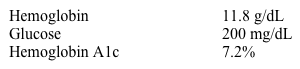 Which of the following medications has the greatest positive impact on fetal survival?
 (Multiple Choice)
4.8/5 (80)
(80) A 33-year-old man comes to the office due to episodic headaches for several months accompanied by sweating and feelings of anxiety that spontaneously resolve after 15-30 minutes. He has no other medical conditions and takes no medications. His brother recently had surgery to treat hyperparathyroidism. Blood pressure is 180/110 mm Hg, and pulse is 102/min. Laboratory results show normal serum electrolytes and renal function. CT scan of the abdomen reveals a mass in the right adrenal gland. Which of the following cells have the same embryological origin as the tissue responsible for this patient's current condition?
(Multiple Choice)
4.8/5 (83)
(83) A boy is examined in the newborn nursery shortly after birth. He was born full term by vaginal delivery to a 40-year-old woman who did not receive prenatal care. His temperature is 36.7 C (98 F), pulse is 132/min, and respirations are 38/min. Examination shows slanted palpebral fissures, epicanthal folds, thick nuchal folds, and a single palmar crease. The patient has a large, reducible midline abdominal protrusion covered by skin that is more pronounced when he cries. The umbilical stump is at the center of the protrusion. Which of the following is the most likely cause of this patient's abdominal finding?
(Multiple Choice)
4.9/5 (85)
(85) A 15-year-old girl is brought to the office due to amenorrhea. She has never menstruated, but her mother underwent menarche at age 14. The patient has no chronic medical conditions and takes no medications. She does not use tobacco, alcohol, or illicit drugs. The patient plays violin for her high school orchestra and is the captain of her junior varsity tennis team. She is not sexually active. Height is 175.3 cm (5 ft 9 in) and weight is 65 kg (143.3 lb). BMI is 21.2 kg/m2. Examination shows fully developed secondary sexual characteristics. Pelvic ultrasound shows a shortened vaginal canal with a rudimentary uterus. Which of the following is the most likely diagnosis?
(Multiple Choice)
4.9/5 (89)
(89) A 35-year-old woman, gravida 2 para 1, comes to the office for prenatal evaluation. The patient says she had been using condoms for birth control and unintentionally became pregnant. Her last menstrual period was 2 months ago, and home pregnancy tests are positive. She has not been taking prenatal vitamins. The patient has a healthy, 5-year-old daughter who was born after an uneventful pregnancy. She has a history of rheumatoid arthritis, and her joint symptoms are controlled with methotrexate therapy. The patient has no other medical conditions and takes no other medications. She does not use tobacco, alcohol, or illicit drugs. Vital signs are within normal limits, and physical examination shows no abnormalities. Serum β-hCG is elevated, and transvaginal ultrasonography shows a normal gestational sac and embryo. This patient's unborn child is at the greatest risk for which of the following congenital defects?
(Multiple Choice)
4.9/5 (65)
(65) A 3-week-old boy with discharge from the umbilicus is brought to the clinic by his parents. His postnatal course was uncomplicated, with shriveling of the cord around 14 days of life. Vital signs are normal. Examination of the area reveals a small reducible umbilical hernia, minimal clear to straw-colored discharge from the umbilicus, and erythema around the area. Laboratory results are as follows: 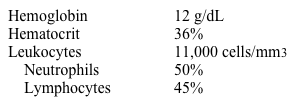 Which of the following is the most likely cause of this child's condition?
 (Multiple Choice)
4.8/5 (90)
(90) A 4-week-old boy is hospitalized with persistent vomiting, fussiness, and feeding intolerance. The emesis was initially clear but became bilious in the last few hours. The infant had been breastfeeding exclusively. His temperature is 37.2 C (99.0 F). Blood pressure and pulse are normal. Physical examination shows a normal abdomen with no rebound or guarding. An upper gastrointestinal series is obtained urgently to evaluate for malrotation and volvulus and shows normal rotation but constriction of the duodenum. An abdominal CT scan reveals pancreatic tissue encircling the duodenum. Which of the following is the most likely cause of this patient's condition?
(Multiple Choice)
4.9/5 (83)
(83) A 32-year-old woman complains of weakness in her hands and "heaviness" in her eyelids at the end of each day. Chest imaging shows an anterior mediastinal mass. The organ from which this mass most likely originated shares its embryologic origin with:
(Multiple Choice)
4.7/5 (72)
(72) 
Filters
- Essay(0)
- Multiple Choice(0)
- Short Answer(0)
- True False(0)
- Matching(0)