Multiple Choice
A 3-week-old boy with discharge from the umbilicus is brought to the clinic by his parents. His postnatal course was uncomplicated, with shriveling of the cord around 14 days of life. Vital signs are normal. Examination of the area reveals a small reducible umbilical hernia, minimal clear to straw-colored discharge from the umbilicus, and erythema around the area. Laboratory results are as follows: 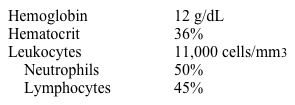 Which of the following is the most likely cause of this child's condition?
A) Absence of neutrophil migration
B) Duplication of the ureter
C) Incomplete closure of anterior abdominal wall
D) Persistence of allantois remnant
E) Persistence of omphalomesenteric duct
Correct Answer:

Verified
Correct Answer:
Verified
Q13: A 23-year-old woman, gravida 2 para 1,
Q14: A 33-year-old man comes to the office
Q15: A boy is examined in the newborn
Q16: A 15-year-old girl is brought to the
Q17: A 35-year-old woman, gravida 2 para 1,
Q19: A 4-week-old boy is hospitalized with persistent
Q20: A 32-year-old woman complains of weakness in
Q21: A 7-year-old boy is brought to the
Q22: Researchers studying neural crest cell migration in
Q23: A 32-year-old woman, gravida 1 para 0,