



 Chat with AI
Exam 5: Embryology

Exam 1: Anatomy291 Questions
Exam 2: Behavioral science240 Questions
Exam 3: Biochemistry156 Questions
Exam 4: Biostatistics117 Questions
Exam 5: Embryology52 Questions
Exam 6: Genetics103 Questions
Exam 7: Histology24 Questions
Exam 8: Immunology129 Questions
Exam 9: Microbiology336 Questions
Exam 10: Pathology816 Questions
Exam 11: Pathophysiology464 Questions
Exam 12: Pharmacology538 Questions
Exam 13: Physiology272 Questions
Select questions type


A 1-hour-old newborn girl is evaluated in the delivery room. The infant was born at term via spontaneous vaginal delivery following an uncomplicated pregnancy. The mother is gravida 2, para 2 with no significant medical history. Apgar scores were 9 and 9 at 1 and 5 minutes. The patient has been skin-to-skin with her mother and breastfed once without difficulty. Physical examination shows a pink, alert infant. Cardiac auscultation reveals a normal S1 and S2 with no murmurs, and femoral pulses are normal. Which of the following hemodynamic changes are most likely to be seen in this newborn as compared to before birth?
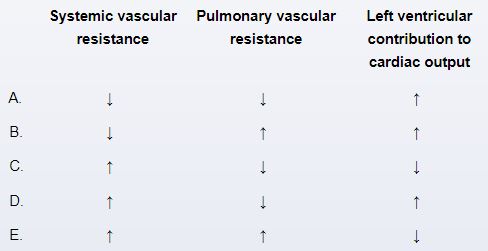
(Multiple Choice)
4.9/5  (93)
(93) A 3-year-old boy is brought to the emergency department by his parents after he develops acute abdominal pain and vomiting. Examination shows diffuse tenderness to palpation, and abdominal imaging reveals a foreign body lodged within the intestine, causing a small bowel obstruction. Laparotomy is performed to remove the foreign body; during the procedure, an incidental cyst is discovered. The cyst is connected by a fibrous band to the ileum and the umbilicus. The embryologic defect underlying the formation of this patient's cyst is also associated with which of the following?
(Multiple Choice)
4.8/5 (76)
(76) In normal female development, non-fusion of the urethral folds forms the labia minora and the vestibule of the vagina. In males, non-fusion of the urethral folds would most likely result in which of the following?
(Multiple Choice)
4.8/5 (74)
(74) A 22-year-old woman at 14 weeks gestation comes to the physician for a prenatal visit. She reports feeling well with the exception of some mild fatigue. Her pregnancy has been uncomplicated to date. On physical examination, the patient's abdomen appears larger than would be expected at 14 weeks. An obstetrical ultrasound reveals twins, a male and a female. Which of the following describes the most likely type of twin placentation in this patient?
(Multiple Choice)
4.8/5 (70)
(70) A 5-year-old boy is brought to the office by his parents for evaluation of cyanosis with minimal exertion. The boy has had occasional episodes of "turning blue" that first began during infancy and are now occurring more frequently. During the episodes, the boy assumes a squatting position as it makes him "feel better." The family recently immigrated to the United States; the boy has never had a medical checkup prior to this visit. Physical examination reveals a prominent right ventricular impulse and a harsh systolic murmur. Which of the following embryological events is the most likely mechanism that caused this patient's condition?
(Multiple Choice)
4.9/5 (86)
(86) A newborn is taken to the neonatal intensive care unit after delivery due to respiratory distress. The neonate was born full-term, and there were no significant complications during pregnancy or delivery. Once the patient is stabilized, a detailed physical examination is performed. The neonate has an underdeveloped mandible and hypoplastic zygomatic bones. Genetic testing confirms a gene mutation that results in abnormal development of the first and second pharyngeal arches. Which of the following structures is also likely abnormal in this patient?
(Multiple Choice)
4.9/5 (76)
(76) A 16-year-old obese primigravida girl comes to the emergency department in active labor. In an attempt to conceal the pregnancy from her family, the patient did not receive prenatal care or take prenatal vitamins. A fetal heartbeat is undetectable, and she delivers a stillborn boy via vaginal delivery. Examination of the stillborn shows several dysmorphic features including closely set eyes and a midline mass consistent with a proboscis. A fetal autopsy reveals fused cerebral hemispheres with an absent forebrain fissure and a single intracranial ventricle. Which of the following is the most likely mechanism for these findings?
(Multiple Choice)
4.8/5 (96)
(96) A 13-year-old boy is brought to the clinic due to progressive difficulty with breathing, hoarseness, and dysphagia. The symptoms began insidiously 6 months ago but have rapidly become worse in the last 4 weeks. The patient has no associated skin rash, pharyngeal pain, fever, weight loss, or loss of appetite. Medical history is unremarkable and the patient takes no medications. He is up to date on scheduled vaccinations. The patient's parents and siblings have no history of significant health problems. Vital signs are normal, and he is at 70th percentile for height and weight. Oropharyngeal examination reveals a large, red lingual mass. The patient subsequently undergoes excision of the mass; histopathologic preparation of the recovered tissue is shown in the image below. 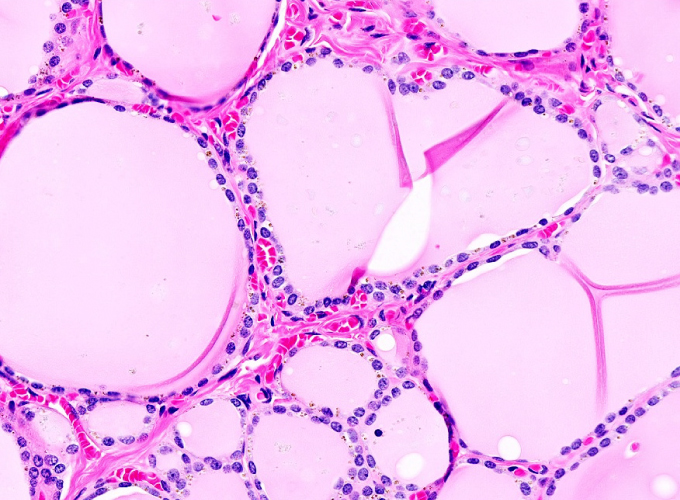 Failure of which of the following embryologic processes is most likely responsible for this patient's lesion?
 (Multiple Choice)
4.8/5 (75)
(75) A 35-year-old man comes to the emergency department due to persistent abdominal pain. Yesterday, during a soccer game, he suffered a full-speed collision with another player. He had diffuse abdominal pain at the time but did not seek care until this morning, when the pain seemed to worsen. As part of the patient's evaluation, a CT scan of the abdomen is obtained and shown in the image below. It is determined that his injury involves an organ that is supplied mainly by an artery of the foregut even though the organ itself is not a foregut derivative. Which of the following organs is most likely to be injured in this patient? 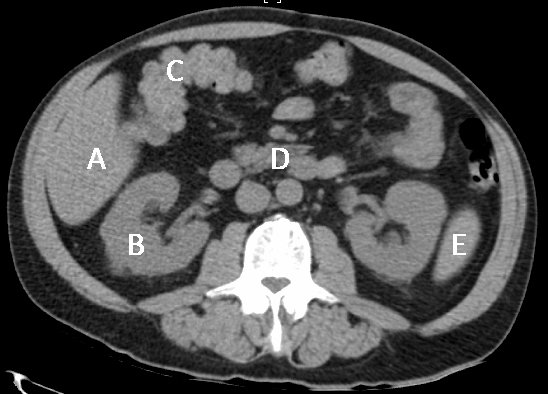
(Multiple Choice)
5.0/5 (89)
(89) A 1-hour-old boy is in the neonatal intensive care unit due to tachypnea and hypoxia. The infant was born at 39 weeks gestation via cesarean delivery due to recurrent variable decelerations. The pregnancy was complicated by lack of prenatal care. The infant weighs 3.2 kg (7 lb 1 oz). Physical examination shows a flattened nose and bilateral club feet. Breath sounds are markedly diminished bilaterally. The infant is intubated and mechanically ventilated, but oxygen levels do not improve. He dies an hour later. Which of the following is most likely to be found during autopsy of this infant?
(Multiple Choice)
4.9/5 (70)
(70) A 64-year-old man loses consciousness near the entrance to an emergency room. A physician rushes to the patient and palpates a strong pulse along the inner side of the left sternocleidomastoid muscle. The vessel palpated by the doctor is a derivative of which of the following aortic arches?
(Multiple Choice)
4.9/5 (77)
(77) A newborn is examined in the delivery room shortly after being born vaginally to a 38-year-old woman. The mother had intermittent prenatal care, and the pregnancy was complicated by bipolar disorder and chronic hypertension. Interview of the mother reveals pressured and tangential speech. She states, "I take my prescribed meds when I remember," and then adds, "I have a good memory, and I took the meds most of the time throughout the pregnancy." She claims to have smoked cigarettes occasionally but then changes the subject when asked if other substances were used during pregnancy. Examination of the neonate shows a nondysmorphic face and a mass overlying the lower spine that is covered with a patch of hair. Which of the following maternal interventions could have most likely prevented this neonate's abnormalities?
(Multiple Choice)
4.9/5 (76)
(76) 
Filters
- Essay(0)
- Multiple Choice(0)
- Short Answer(0)
- True False(0)
- Matching(0)