



 Chat with AI
Exam 7: Histology

Exam 1: Anatomy291 Questions
Exam 2: Behavioral science240 Questions
Exam 3: Biochemistry156 Questions
Exam 4: Biostatistics117 Questions
Exam 5: Embryology52 Questions
Exam 6: Genetics103 Questions
Exam 7: Histology24 Questions
Exam 8: Immunology129 Questions
Exam 9: Microbiology336 Questions
Exam 10: Pathology816 Questions
Exam 11: Pathophysiology464 Questions
Exam 12: Pharmacology538 Questions
Exam 13: Physiology272 Questions
Select questions type


An autopsy is being performed on a 72-year-old man with a history of myocardial infarction. Light microscopy of a portion of the left ventricle reveals the findings shown in the image below: 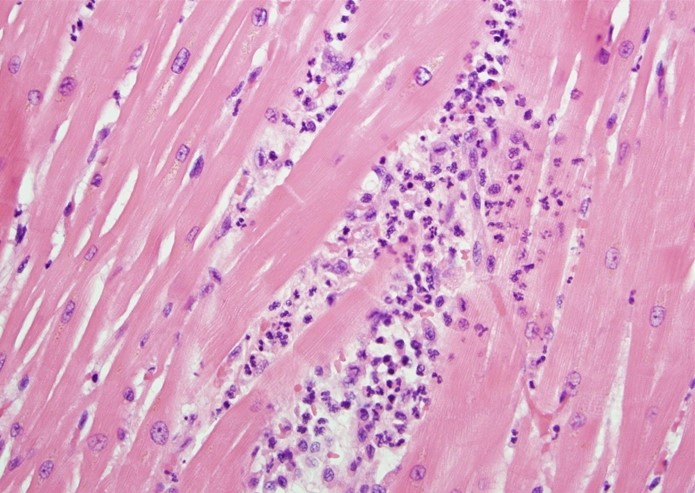 This patient most likely sustained the myocardial infarction during which of the following time frames prior to his death?
Free
(Multiple Choice)
4.8/5  (69)
(69) Correct Answer: Verified
B
A researcher is investigating factors affecting adrenal hormone synthesis and release. An intact adrenal gland is obtained from a donor cadaver, and a histologic section through the entire gland is shown below. Cells from a specific part of the gland, indicated by the arrow, are extracted for further analysis. 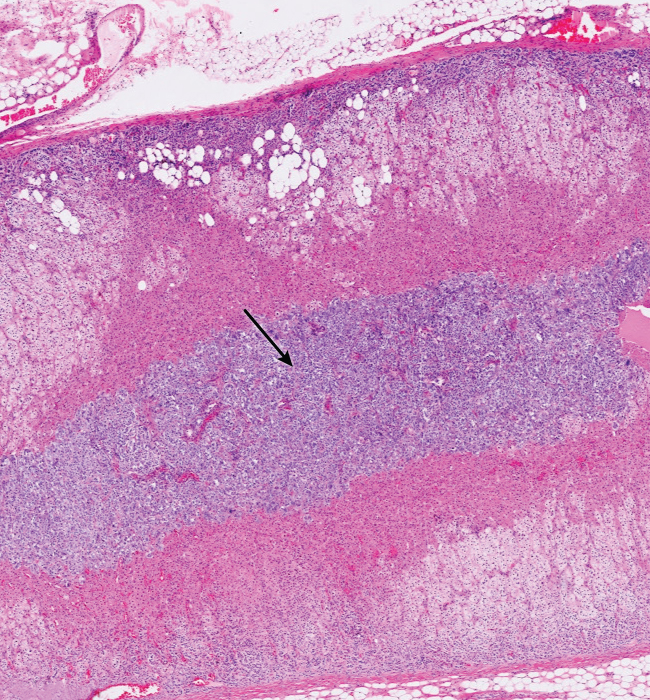 These cells are most likely to be directly activated by which of the following substances?
Free
(Multiple Choice)
5.0/5 (88)
(88) Correct Answer:Verified
VerifiedA
A 34-year-old woman comes to the office with bleeding from the right nipple. The patient has noticed blood staining her bra on several occasions over the past week but has no fever or breast pain. She has no chronic medical conditions and does not take any medications. Breast examination shows no palpable masses or skin changes. A thin, blood-tinged discharge can be expressed from the right nipple. There are no enlarged axillary lymph nodes. Which of the following is the most likely histopathologic finding in this patient's right breast?
Free
(Multiple Choice)
4.9/5 (77)
(77) Correct Answer:Verified
VerifiedC
A 43-year-old man comes to the office due to shortness of breath and fatigue. Over the last 2 weeks, his fatigue has been so profound that he has "little energy, even to get out of bed." The patient has no chills but has experienced recent weight gain and ankle swelling. He has no prior medical conditions and takes no medications. Blood pressure is 168/94 mm Hg, and pulse is 95/min and regular. The patient has bilateral lower extremity pitting edema limited to the ankles. Urinalysis reveals 2+ protein, white blood cell count of 5-7/hpf, and red blood cell count of 75-100/hpf. He undergoes a kidney biopsy; immunofluorescent microscopy findings are shown in the image below. 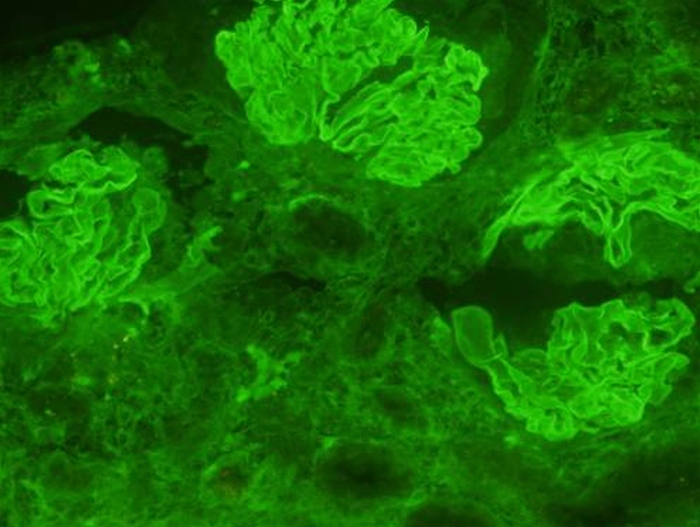 Which of the following would be the most likely finding on light microscopy in this patient?
 (Multiple Choice)
4.9/5 (91)
(91) Fourth-year medical students are recruited for a research study assessing their ability to interpret biopsy samples obtained during routine clinical practice. As part of the study, they are given samples of normal respiratory mucosa and asked to identify the cell types present after staining with hematoxylin and eosin. The students observe that the respiratory epithelium changes in composition as the airways continue distally from the trachea to the alveolar ducts. Which of the following features is last to disappear?
(Multiple Choice)
4.8/5 (76)
(76) A researcher is investigating the structure of the sarcomere using skeletal muscle obtained from an experimental animal. He develops monoclonal antibodies directed against a specific skeletal muscle protein and finds that these antibodies disrupt the binding of actin to structural support elements within the sarcomere. Electron microscopy of the sarcomere is shown in the image below. 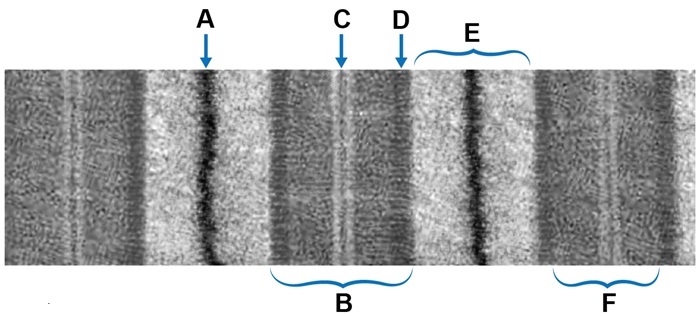 Which of the following labeled regions do these antibodies most likely bind?
 (Multiple Choice)
4.9/5 (80)
(80) A 62-year-old man comes to the office for the evaluation of jaundice. Medical history is significant for uncontrolled type 2 diabetes mellitus and morbid obesity. He does not use tobacco, alcohol, or illicit drugs. There is no family history of liver disease. Vital signs are within normal limits. BMI is 47 kg/m2. Mild scleral icterus is present. Heart and lung sounds are normal. The abdomen is nontender and nondistended. Trace bilateral lower extremity edema is present. Laboratory studies reveal elevated transaminases. A liver biopsy is obtained, and trichrome staining shows the following: 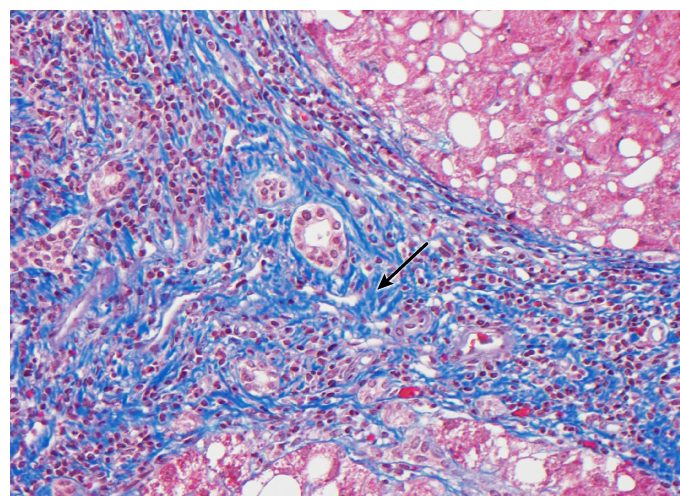 Which of the following cells is directly responsible for the histologic finding indicated by the arrow?
 (Multiple Choice)
4.8/5 (71)
(71) A 9-year-old girl is brought to the office due to 2 days of face and eye puffiness. The patient was treated for a rash on her leg with an antibiotic about 3 weeks ago. Temperature is 37.2 C (99 F) and blood pressure is 150/90 mm Hg. On physical examination, there is generalized edema but no rash. Urinalysis reveals proteinuria and hematuria. An electron microscopy image representative of this patient's disease process is shown below: 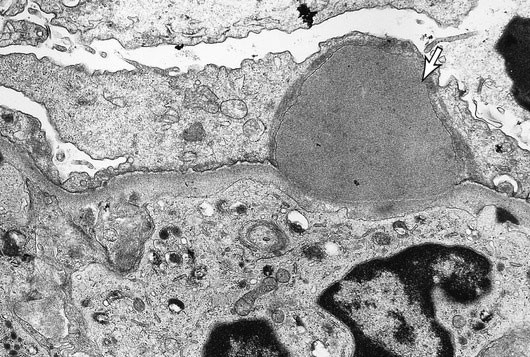 The area marked by the white arrow most likely represents which of the following?
 (Multiple Choice)
4.9/5 (91)
(91) A 68-year-old man with a history of Parkinson disease is hospitalized for pneumonia and sepsis. The patient is treated with intravenous (IV) fluids and antibiotics. He is also started on an infusion of IV dopamine for hemodynamic support. Although the manifestations of Parkinson disease are attributed to dopaminergic neuron degeneration in the substantia nigra, IV dopamine does not improve this patient's Parkinson symptoms. Which of the following cell structures accounts for this lack of responsiveness?
(Multiple Choice)
4.8/5 (78)
(78) A 20-year-old woman comes to the office due to blisters around her mouth associated with a mild burning sensation. She reports that she has been having frequent recurrence of these lesions, which resolve spontaneously within a few days. She has no medical problems and does not take any medications. Physical examination findings are shown in the image below. 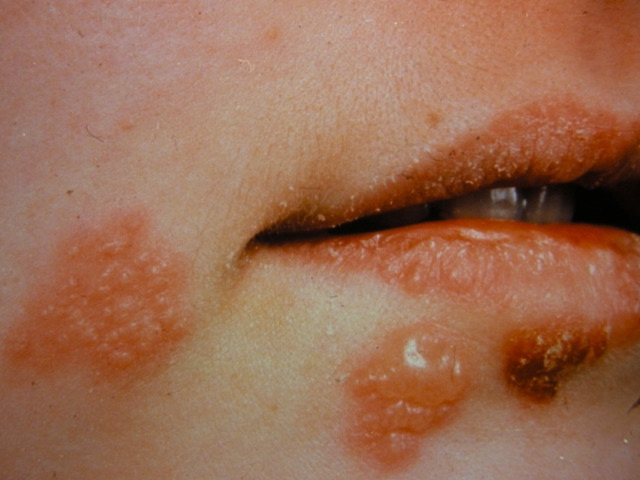 It is determined that the causative organism of this patient's condition remains in a latent state in the neuronal cell bodies of sensory ganglia. Upon reactivation, the virus is transported through the nerve axon to the skin. Which of the following proteins is most likely involved in the transport process leading to disease recurrence?
 (Multiple Choice)
5.0/5 (86)
(86) A 17-year-old boy comes to the office due to a facial lesion. The patient noticed a small area of rough skin on his lower lip several weeks ago, which has progressively enlarged. He reports no pain or itching. The patient had eczema during early childhood but has had no other chronic medical conditions. Vital signs are within normal limits. Physical examination findings are shown in the exhibit. 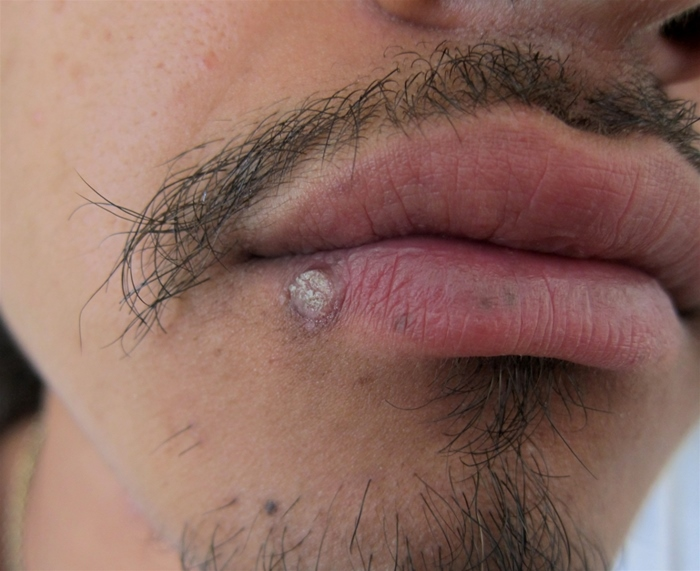 There are no other skin rashes, oral lesions, or enlarged lymph nodes. Which of the following histopathological findings are most likely present in this patient's skin lesion?
 (Multiple Choice)
4.8/5 (93)
(93) An 8-year-old boy is brought to the office due to acute facial puffiness. His mother reports that for the preceding 24 hours he has been easily fatigued and has had dark urine. The patient was treated for a skin infection 3 weeks ago but has no chronic medical conditions. Temperature is 36.1 C (97 F) and blood pressure is 140/94 mm Hg. Physical examination shows periorbital edema and mild pitting edema along the ankles. The remainder of the examination shows no abnormalities. A representative renal biopsy sample is shown in the below image. 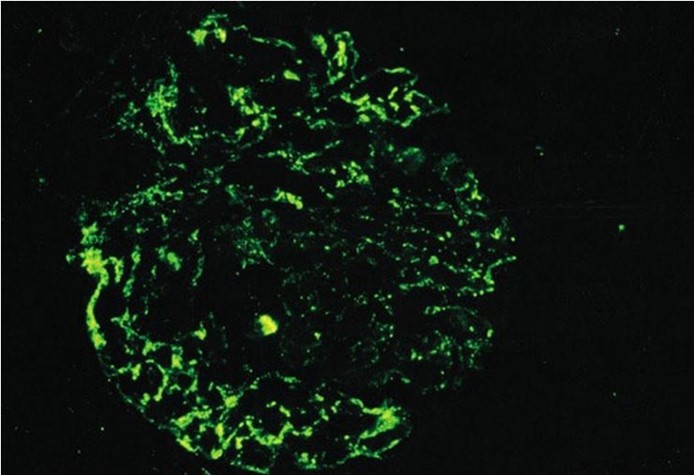 The fluorescent areas on the slide most likely indicate the presence of which of the following substances?
 (Multiple Choice)
4.9/5 (85)
(85) A 23-year-old woman, gravida 2 para 1, at 39 weeks gestation comes to the labor and delivery unit with regular painful contractions. The patient's first pregnancy was uncomplicated and resulted in a full-term, spontaneous vaginal delivery 3 years ago, and her current pregnancy has been uncomplicated. She takes a prenatal vitamin daily and has no chronic medical conditions. In response to rising estrogen levels, the patient's myometrial cells increase the expression of genes that encode the oxytocin receptor and connexin 43. These molecular changes most likely result in increased formation of which of the following?
(Multiple Choice)
4.8/5 (73)
(73) A 65-year-old woman comes to the emergency department with progressive fatigue and lower-extremity paresthesias. Medical history is otherwise insignificant and the patient takes no medications. Laboratory studies show a mean corpuscular volume of 112 fL. Upper gastrointestinal endoscopy shows atrophic mucosa in the gastric body and fundus and a normal-appearing antrum. Destruction of which of the following gastric layers is most likely responsible for this patient's symptoms? 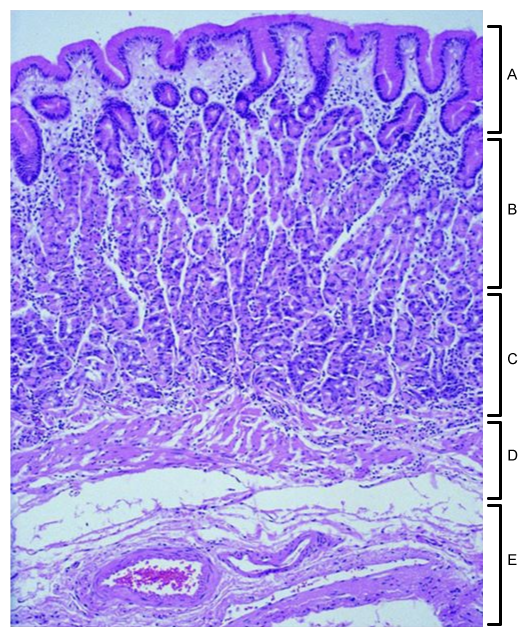
(Multiple Choice)
4.8/5 (90)
(90) Physicians involved in regenerative medicine research conduct a series of animal experiments to determine pulmonary tissue regeneration capacity. During one of the experiments, lung alveoli are exposed to NO2 and massive necrosis of the epithelial lining ensues. Histologic examination of the injured tissues a month later shows partial recovery of the alveolar epithelial lining. This regenerated tissue is most likely derived from which of the following cell types?
(Multiple Choice)
5.0/5 (89)
(89) A 6mm punch biopsy of normal appearing epidermis reveals stellar cells that contain intracytoplasmic granules having the shape of a tennis racquet. These cells demonstrate some myeloid surface markers and can interact closely with T lymphocytes. The cells described above are best referred to as which of the following?
(Multiple Choice)
4.7/5 (82)
(82) In an experiment, laboratory animals are subjected to a toxic insult that specifically targets the protein kinesin. Which of the following is most likely to be absent from tissues on histological examination as a result?
(Multiple Choice)
4.9/5 (88)
(88) A 14-month-old girl is brought to the office due to a 2-month history of diarrhea. Her parents report that she has 3-5 loose, nonbloody bowel movements daily with occasional episodes of vomiting. She was breastfed exclusively until age 9 months and has since had a well-varied diet including whole milk, fruits, vegetables, bread, and meats. However, the girl has been less interested in food over the past several weeks. There is no history of travel or contacts with similar symptoms. On physical examination, the patient appears well but has lost 1.1 kg (2.5 lb) in the last 2 months. After laboratory evaluation, duodenal biopsy findings are shown in the exhibit. 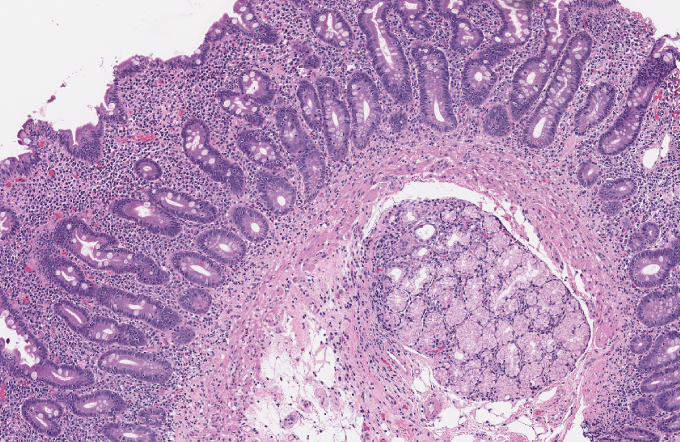 Which of the following would most likely improve this patient's symptoms?
 (Multiple Choice)
4.8/5 (62)
(62) A 42-year-old woman, gravida 4 para 4, comes to the office due to heavy and painful menstrual bleeding over the past 3 months. The patient's last menstrual period was 3 weeks ago. Menarche was at age 10, and menstrual periods last for 3-5 days and occur every 30 days. She is sexually active with her husband and does not have pain with intercourse. The patient had a bilateral tubal ligation 3 years ago after the birth of her last child. She takes no medications and has no allergies. BMI is 24 kg/m2. Vital signs are normal. On bimanual examination, the uterus is uniformly enlarged and tender. Urine β-hCG is negative. Which of the following is the most likely cause of this patient's symptoms?
(Multiple Choice)
5.0/5 (70)
(70) A 35-year-old woman, gravida 1, para 0, at 12 weeks gestation comes to the office for evaluation of genital warts. She first noticed the warts last week and is concerned that it has persisted. The patient has occasional mild pruritus but no pain. She is currently sexually active with her boyfriend and engages in oral and vaginal intercourse. Examination shows several verrucous, skin-colored lesions over the labia majora. The patient asks whether the lesion could affect her future child. The virus involved in this patient's condition also has an affinity to infect which of the following structures?
(Multiple Choice)
4.8/5 (73)
(73) 
Filters
- Essay(0)
- Multiple Choice(0)
- Short Answer(0)
- True False(0)
- Matching(0)