



 Chat with AI
Exam 11: Pathophysiology

Exam 1: Anatomy291 Questions
Exam 2: Behavioral science240 Questions
Exam 3: Biochemistry156 Questions
Exam 4: Biostatistics117 Questions
Exam 5: Embryology52 Questions
Exam 6: Genetics103 Questions
Exam 7: Histology24 Questions
Exam 8: Immunology129 Questions
Exam 9: Microbiology336 Questions
Exam 10: Pathology816 Questions
Exam 11: Pathophysiology464 Questions
Exam 12: Pharmacology538 Questions
Exam 13: Physiology272 Questions
Select questions type


A 5-week-old boy is receiving care in the neonatal intensive care unit. The patient was born at 26 weeks gestation with a birth weight of 0.79 kg (1 lb 10 oz). Echocardiography reveals a patent ductus arteriosus and a dilated left atrium. The patient has moderate pulmonary edema. During surgical ligation of the ductus arteriosus, the surgeons perform a left-sided thoracotomy, visualize the ductus, and place a small metal clamp across the vessel. Which of the following changes is most likely to take place immediately after ligation?

Free
(Multiple Choice)
4.7/5  (94)
(94) Correct Answer: Verified
C
A 56-year-old man comes to the office due to worsening cough for the past several months. He initially had a morning cough productive of minimal sputum, but now the cough occurs throughout the day with large amounts of yellowish sputum. The patient also has breathlessness on moderate exertion. He has had 3 hospitalizations over the past year for respiratory infections. The patient has smoked a pack of cigarettes daily for the past 30 years and has failed multiple attempts to quit. Oxygen saturation is 90% at rest and decreases to 84% with moderate exertion. Which of the following additional findings is most likely to be seen in this patient?
Free
(Multiple Choice)
4.8/5 (78)
(78) Correct Answer:Verified
VerifiedC
A 36-year-old woman comes to the office due to frequent urination since an exacerbation of multiple sclerosis 2 months ago. Most of her symptoms, including dizziness, leg weakness, and numbness, have improved with corticosteroid treatment. However, she has continued difficulty holding urine, and on several occasions has passed a small amount of urine while trying to reach the bathroom. She has no urine leakage during coughing or sneezing. The patient has no other medical problems. Her abdomen is soft and nontender. Neurological examination shows hyperreflexia and increased tone in the lower extremities. Her postvoid residual volume is low. 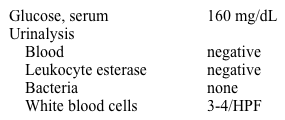 Which of the following is the most likely explanation for her urinary symptoms?
Free
(Multiple Choice)
4.9/5 (88)
(88) Correct Answer:Verified
VerifiedE
A 23-year-old Italian American man comes to the clinic for a follow-up visit. He was found to have mild anemia during a routine checkup 3 weeks ago and was started on iron supplementation. He has been taking the supplements as prescribed. The patient has otherwise been well. He feels that his energy levels are normal, and he has run several half-marathons in the last 2 years. The patient's initial hemoglobin level was 12.3 g/dL. Laboratory results obtained during today's visit are as follows: 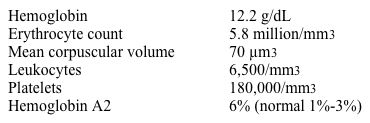 The patient's blood smear is shown in the image below.
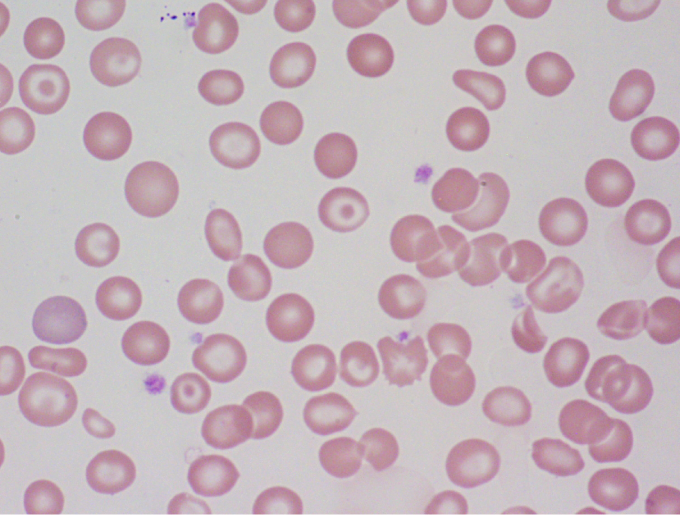 Which of the following processes is the initial step in the pathogenesis of this patient's disorder?
The patient's blood smear is shown in the image below. Which of the following processes is the initial step in the pathogenesis of this patient's disorder? (Multiple Choice)
4.7/5 (85)
(85) A 24-year-old woman comes to the office at 12 weeks gestation for prenatal counseling. She is 120 cm (3 ft 11 in) tall with short upper and lower extremities but normal torso length. Physical examination is also significant for depression of the nasal bridge and a bulging forehead. Her husband is phenotypically normal and has no medical problems. The patient knows that there is a 50% chance of passing on her condition to the fetus. An abnormality involving which of the following cells is most likely responsible for this patient's features?
(Multiple Choice)
4.8/5 (74)
(74) A 70-year-old man comes to the clinic due to intermittent leg pain and difficulty walking. He describes the pain as mild-to-moderate, deep, and lasting throughout the day. The patient has a history of osteoarthritis in his hands for which he takes over-the-counter nonsteroidal anti-inflammatory drugs, but says that he never has had problems with his knees. Physical examination shows point tenderness over the right tibia. Laboratory studies show elevated serum alkaline phosphatase. Bone biopsy shows haphazardly oriented segments of lamellar bone with prominent cement lines. The initial phase of this patient's disorder involves increased activity of which of the following cell types?
(Multiple Choice)
4.8/5 (80)
(80) A 45-year-old man comes to the office for an annual medical visit. The patient has had prediabetes for the last 2 years. He feels well and takes no medications but has gained weight since his last visit a year ago. The patient has a strong family history of type 2 diabetes mellitus. Blood pressure is 124/78 mm Hg and BMI is 32 kg/m2. Laboratory results show a fasting blood glucose of 157 mg/dL and serum creatinine of 0.7 mg/dL. Hemoglobin A1c is 7.4%. Urine assay shows no detectable albuminuria. Which of the following renal changes is most likely present in this patient at this time?
(Multiple Choice)
5.0/5 (82)
(82) A 68-year-old man comes to the emergency department due to cough, breathlessness, and chest pain. The patient has a medical history of hypertension and type 2 diabetes mellitus. He is a former smoker with a 20-pack-year history. Temperature is 38 C (100.4 F), blood pressure is 130/80 mm Hg, respirations are 22/min, and oxygen saturation is 95% while breathing ambient air. The trachea is central in position. There is dullness to percussion over the lower right lung area compared to the resonancy on the left. Auscultation of the right lower lobe reveals breath sounds that are loud, hollow, and high-pitched. When the patient recites the word "ninety-nine" in a normal voice, the sound has higher clarity and intensity over the right base compared to other lung areas. Which of the following is the most likely cause of these findings?
(Multiple Choice)
4.9/5 (75)
(75) Scientists studying the kidney's response to hypoperfusion apply a clip to a pig's right renal artery that reduces blood flow to the kidney by about 70%. After 6 months, they perform a right nephrectomy and examine the glomeruli and tubules microscopically. Which of the following cell types would be most likely to undergo hyperplasia as a result of the clip placement?
(Multiple Choice)
4.7/5 (75)
(75) Physiologists conduct a study to evaluate erythropoiesis in various age groups. In one of the studies, healthy individuals who experience acute traumatic blood loss are enrolled. They divide the patients in 2 groups: younger individuals with a mean age of 35 years and older adults with a mean age of 70. These patients have normal iron, folic acid, vitamin B12, and plasma protein studies. Results indicate that older patients with acute traumatic blood loss have a much lower reticulocyte count and a much longer time to recovery to pretrauma hemoglobin level when compared to younger patients. Which of the following age-related processes best explains the observed findings?
(Multiple Choice)
4.8/5 (90)
(90) A 53-year-old man comes to the emergency department due to progressive shortness of breath and nonproductive cough. Medical history is significant for long-standing hypertension and type 2 diabetes mellitus, for which he takes lisinopril and metformin. The patient has no drug allergies. Blood pressure is 160/100 mm Hg, pulse is 110/min, and respirations are 20/min. On physical examination, heart sounds are regular. Lung examination reveals decreased tactile fremitus over the lower right lung along with dullness to percussion. Which of the following is the most likely diagnosis?
(Multiple Choice)
4.9/5 (84)
(84) A 55-year-old man comes to the office due to several months of progressive fatigue. He does not have chest pain or shortness of breath. Medical history is significant for hypertension and obesity. BMI is 45 kg/m2. Examination shows mild mucosal pallor. Laboratory results are as follows: 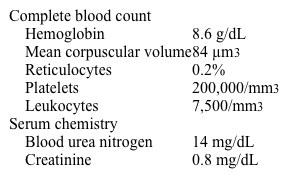 Which of the following is the most likely cause of this patient's anemia?
 (Multiple Choice)
4.9/5 (74)
(74) A 34-year-old woman comes to the office with progressive weight gain over the past year. She also has weakness, easy bruising, and irregular menstrual periods. The patient takes no medications and has no drug allergies. Blood pressure is 150/90 mm Hg and pulse is 78/min. Laboratory studies reveal an elevated serum cortisol level that is not suppressed following administration of low-dose dexamethasone. Her 24-hour urine free-cortisol concentration and plasma ACTH are elevated. Which of the following histopathologic findings are most likely to be present in this patient's adrenal glands?
(Multiple Choice)
4.7/5 (86)
(86) An 80-year-old woman is brought to the emergency department following a burn injury. The patient lives alone in an apartment. Earlier today, her clothes caught fire while she was cooking. The patient's neighbor heard her screaming and helped extinguish the fire, but the patient had already sustained burns on her face, arms, and body. She has a history of Parkinson disease and osteoporosis. Temperature is 37.4 C (99.3 F), blood pressure is 140/84 mm Hg, pulse is 110/min, and respirations are 18/min. Oxygen saturation is 95% on room air. On examination, the patient is in distress and anxious. There are partial- to full-thickness burns involving the lower face, neck, both arms, and anterior chest and abdomen. Which of the following age-related cardiopulmonary changes is most likely to increase this patient's mortality risk?
(Multiple Choice)
4.7/5 (84)
(84) A 54-year-old hospitalized man develops new-onset slurring of speech and extremity weakness. Medical history is significant for alcohol abuse. Physical examination reveals confusion, dysarthria, dysphagia, and quadriparesis. MRI of the brain shows symmetric areas of demyelination in the pons. Which of the following most likely predisposed this patient to his current condition?
(Multiple Choice)
4.7/5 (75)
(75) A 66-year-old man with diabetes mellitus is brought to the hospital due to sudden-onset chest pain and nausea. Blood pressure is 70/60 mm Hg and pulse is 60/min. Lungs are clear on auscultation. ECG shows ST-segment elevation in leads II, III, and aVF. Chest x-ray is unremarkable. The patient is diagnosed with an inferior wall myocardial infarction. Emergent cardiac catheterization reveals complete occlusion of the proximal right coronary artery. He is persistently hypotensive in the cardiac catheterization laboratory. Which of the following hemodynamic findings is most likely to be observed in this patient?
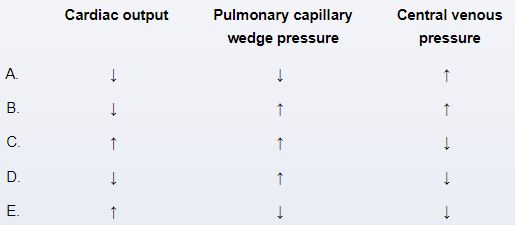
(Multiple Choice)
4.8/5 (85)
(85) A 29-year-old woman is brought to the emergency department after a syncopal episode while getting out of bed. Yesterday, the patient developed right-sided abdominal pain, which has spread across the lower abdomen over the past few hours. She also noticed a blood stain on her underwear after the syncopal episode. Her last menstrual period was 8 weeks ago. The patient uses condoms intermittently for contraception. Temperature is 37 C (98.6 F), blood pressure is 90/60 mm Hg, and pulse is 125/min. The patient has diffuse lower abdominal pain with rebound tenderness and voluntary guarding. Pelvic examination shows cervical motion tenderness and right-sided adnexal tenderness; no masses are palpated. Which of the following is the most likely diagnosis for this patient?
(Multiple Choice)
4.8/5 (75)
(75) A 19-year-old man comes to the emergency department due to intense scrotal pain over the past 6 hours. The pain started shortly after participating in a soccer game; he does not recall any specific trauma. The patient took ibuprofen at home with minimal relief. He is sexually active and has been treated twice in the past for Neisseria gonorrhoeae. Temperature is 36.9 C (98.5 F), blood pressure is 110/86 mm Hg, and pulse is 92/min. On examination, there is no inguinal adenopathy. There is significant discomfort with scrotal examination primarily on the right where a high-riding swollen mass is palpated within the hemiscrotum. The left testicle is palpated lower in the scrotum. Which of the following additional physical examination findings is most likely present in this patient?
(Multiple Choice)
4.7/5 (91)
(91) A full-term newborn is evaluated in the delivery room due to mild tachypnea and cyanosis immediately after birth. Fetal ultrasonography performed during pregnancy revealed transposition of the great arteries. Heart rate and blood pressure are normal. Oxygen saturation is 72%. Cyanosis is apparent in the hands, feet, lips, and tongue. Peripheral pulses are strong. Bedside echocardiography confirms the prenatal diagnosis; there is also a small patent foramen ovale and a small patent ductus arteriosus. Definitive surgical correction of the main congenital abnormality is planned. Pending definitive repair, which of the following temporary measures would be most likely to improve this patient's condition?
(Multiple Choice)
4.8/5 (90)
(90) A 45-year-old woman is evaluated 2 weeks after she fractured her left radius during a fall from standing height. Two months previously, she passed a renal stone. There is no family history of osteoporosis or hypercalcemia. Physical examination is unremarkable. Serum laboratory results are as follows: 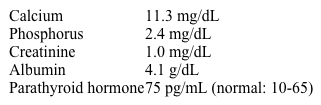 Bone density testing performed using dual-energy x-ray absorptiometry reveals osteoporosis. Which of the following is the major contributor to bone loss in this patient?
 (Multiple Choice)
4.8/5 (67)
(67) 
Filters
- Essay(0)
- Multiple Choice(0)
- Short Answer(0)
- True False(0)
- Matching(0)