



 Chat with AI
Exam 11: Pathophysiology

Exam 1: Anatomy291 Questions
Exam 2: Behavioral science240 Questions
Exam 3: Biochemistry156 Questions
Exam 4: Biostatistics117 Questions
Exam 5: Embryology52 Questions
Exam 6: Genetics103 Questions
Exam 7: Histology24 Questions
Exam 8: Immunology129 Questions
Exam 9: Microbiology336 Questions
Exam 10: Pathology816 Questions
Exam 11: Pathophysiology464 Questions
Exam 12: Pharmacology538 Questions
Exam 13: Physiology272 Questions
Select questions type


A 65-year-old man comes to the emergency department with a 3-day history of headaches localized to the right temporal region. The headaches are accompanied by intermittent blurring of vision in both eyes. He has also felt fatigued for the past week, with stiffness in his shoulders and hips. On examination, temperature is 37.5 C (99.5 F). There is tenderness on palpation of the right temporal region with enlargement of the underlying artery, as shown in the exhibit.
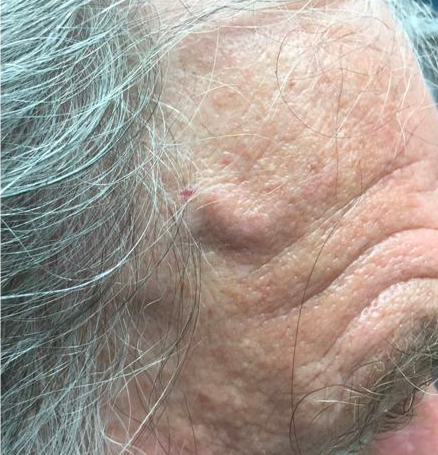 Funduscopic examination reveals edematous optic discs in both eyes. The patient has limited active abduction of the shoulder joints bilaterally. Laboratory studies show an erythrocyte sedimentation rate of 115 mm/hr. Which of the following is the most important mediator of this patient's current condition?
 (Multiple Choice)
4.9/5  (78)
(78) A 32-year-old man comes to the emergency department with chest pain that started earlier in the day. The pain is midline and sharp and increases with deep breaths but decreases when the patient leans forward. He had a mild respiratory illness a week ago. Other medical history is unremarkable. The patient is a lifetime nonsmoker and has no family history of early-onset heart attack, sudden death, or cardiomyopathy. Blood pressure is 120/70 mm Hg and pulse is 110/min and regular. Which of the following physical examination findings is most expected in this patient?
(Multiple Choice)
4.9/5 (75)
(75) A 62-year-old man is evaluated for shortness of breath. During pulmonary function testing, the patient performs a forceful and complete exhalation after maximal inhalation. The results (red curve) are compared to a healthy individual of the same age and sex (black curve), as shown in the image below: 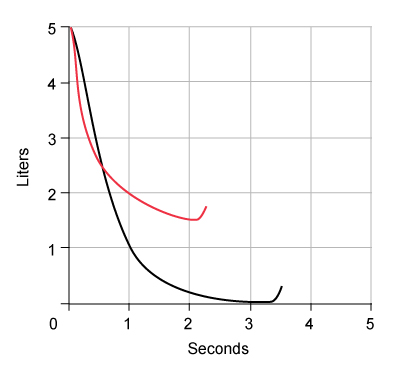 Which of the following is the most likely cause of this patient's dyspnea?
 (Multiple Choice)
4.8/5 (67)
(67) A 6-week-old term boy is brought to the office due to increased fussiness and poor weight gain. The patient has several wet diapers per day. His anterior fontanelle is flat and mucous membranes are dry. Laboratory results include the following: 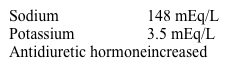 Urinalysis shows a specific gravity of 1.002. Which of the following is the most appropriate treatment for this patient's condition?
 (Multiple Choice)
4.8/5 (85)
(85) A 6-year-old boy is brought to the office due to frequent nighttime awakenings. Several times a week over the past month, he has come to his parents' bed around 3 AM, frequently crying, appearing frightened, and saying that he became lost in a crowd and couldn't find his parents. Although he is comforted by their reassurance, he refuses to return to his room and eventually falls back asleep in their bed. The boy is about to start first grade at a new school. He is healthy and developmental milestones are normal. Examination shows no abnormalities. The sleep stage associated with this child's frightening experience is characterized by which of the following?
(Multiple Choice)
4.8/5 (80)
(80) A 31-year-old woman, gravida 2 para 1, at 30 weeks gestation comes to the emergency department due to increased swelling in her face and lower extremities. She has noticed a sudden onset of swelling and a 2.72-kg (6-lb) weight gain in the last day. The patient has not urinated in the last 12 hours despite an increase in fluid intake. She has a twin pregnancy and no chronic medical conditions. Blood pressure is 154/98 mm Hg, and pulse is 98/min. Bladder catheterization yields a total of 10 mL of dark urine. Urinalysis shows no red blood cells. Which of the following pathologic factors is the most likely cause of this patient's decreased urine output?
(Multiple Choice)
4.7/5 (75)
(75) A 38-year-old woman, gravida 3 para 2, at 35 weeks gestation comes to the emergency department due to sudden-onset visual changes and headache. The patient reports "spots" in her vision for the past few hours and an occipital headache. She took a dose of acetaminophen, but it did not improve her symptoms. The patient's pregnancy has been complicated by gestational diabetes mellitus requiring insulin. Blood pressure is 168/114 mm Hg and pulse is 90/min. The pupils are equal and reactive to light. Extraocular movements are intact. Visual field testing shows partial loss of vision bilaterally. Which of the following is the most likely cause of this patient's symptoms?
(Multiple Choice)
4.7/5 (87)
(87) A 15-month-old boy is brought to the office by his parents for poor weight gain. The parents have also noticed frequent, large, foul-smelling stools. He was admitted to the hospital for a prolonged bout of bacterial pneumonia 6 months ago. Both parents are healthy and have no similar symptoms. The child was born at term at home. He is at the 20th percentile for length and 3rd percentile for weight. Vital signs are normal. On examination, the child appears thin and has a nontender, nondistended abdomen. Which of the following is most likely present in this patient?
(Multiple Choice)
4.9/5 (88)
(88) A 28-year-old woman comes to the clinic due to generalized weakness and frequent, high-volume urination. She has had no dysuria, hematuria, or abdominal pain. The patient's symptoms have been ongoing for several months, but she cannot recall exactly when they began. She has no other medical conditions. The patient is a single mother of a 2-year-old child, has little social support, and occasionally uses alcohol and marijuana "to cope with the stress." Vital signs and physical examination are normal. Blood glucose is 95 mg/dL and serum sodium is 132 mEq/L. Urinalysis shows no white or red blood cells. During further evaluation, urine osmolality is serially measured while fluid intake is restricted; vasopressin is subsequently administered 7 hours into the test. The results are shown below. 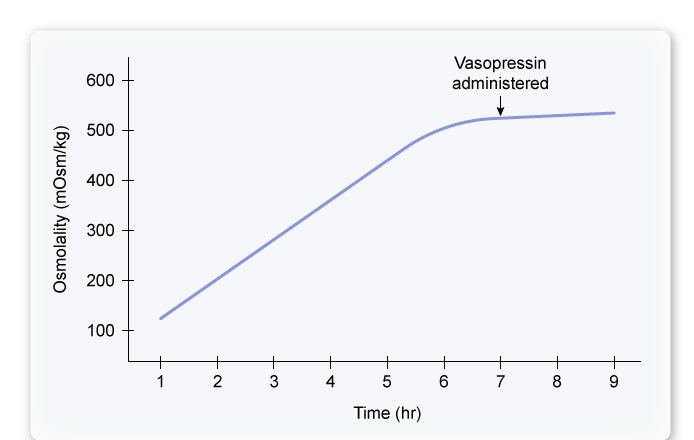 Which of the following is the most appropriate long-term treatment for this patient?
 (Multiple Choice)
4.8/5 (91)
(91) A 6-year-old Caucasian girl is brought to your office by her mother. The mother says that her daughter is "womanly," including being exceptionally tall for her age. Physical examination reveals Tanner Stage 3 breast development and coarse pubic hair. The child's height is in the 96th percentile. You explain to her mother that, although this girl is very tall now, she will ultimately be shorter than average if she does not get treatment. Which of the following is the physiologic explanation for the information you provided?
(Multiple Choice)
4.9/5 (81)
(81) A 50-year-old female presents with abdominal pain, diarrhea, and weight loss. She was diagnosed with diabetes mellitus two months ago. Her serum somatostatin level is highly elevated. Further evaluation reveals biliary stones. Suppression of which of the following hormones is most likely responsible for biliary stones?
(Multiple Choice)
5.0/5 (84)
(84) A 62-year-old woman comes to the office for diarrhea. She has had 4 or 5 watery, brown stools every day for the past 6 months. Although most episodes occur during the day, she wakes up at least once a night to defecate. There is no associated hematochezia, melena, vomiting, or unexpected weight loss. Medical history is significant for type 2 diabetes mellitus and hypertension. She takes lisinopril, insulin, and metformin. She has no recent travel or new medications. Family history is unremarkable. She does not drink alcohol. Temperature is 37.4 C (99.3 F), blood pressure is 125/80 mm Hg, and pulse is 80/min. The abdomen is nontender and nondistended. Complete blood count, serum chemistries, and stool studies are normal. Which of the following is the most likely cause of this patient's diarrhea?
(Multiple Choice)
4.9/5 (77)
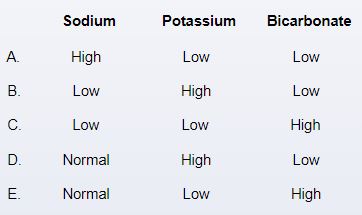
(77) A 30-year-old woman comes to the office due to generalized weakness and paresthesia. Medical history is unremarkable and she takes no medications. However, the patient says her blood pressure was elevated at a workplace health fair 3 months ago, although she attributed it to being "stressed out" and did not take any action. Blood pressure is 150/95 mm Hg. Cardiac examination is normal with full and symmetric distal pulses and no pedal edema. Laboratory evaluation shows low plasma renin activity and normal serum creatinine levels. CT scan of the abdomen reveals a solitary, hypodense, 1.5-cm right adrenal mass. Which of the following patterns of serum electrolyte concentrations would most likely be seen in this patient?
(Multiple Choice)
4.9/5 (59)
(59) A 29-year-old man is brought to the emergency department by his friend due to retrosternal chest pain for the past hour. The patient is agitated and restless. Temperature is 38.1 C (100.6 F), blood pressure is 180/106 mm Hg in the right arm and 182/104 mm Hg in the left arm, pulse is 110/min, and respirations are 20/min. Physical examination shows bilaterally dilated pupils, normal heart and lung sounds, and a nontender abdomen. ECG shows sinus tachycardia with ST-segment depression in the precordial leads. Chest x-ray reveals no parenchymal opacities or pleural effusion and a normal mediastinum and cardiac silhouette. Cardiac enzymes are normal. Sublingual nitroglycerin and benzodiazepine therapy relieve the symptoms. Which of the following is the most likely cause of this patient's chest pain?
(Multiple Choice)
4.8/5 (86)
(86) Further evaluation shows decreased von Willebrand factor activity in the patient's serum. This protein normally binds to which of the following?
(Multiple Choice)
4.8/5 (78)
(78) A 35-year-old woman, gravida 1 para 0, comes to the office for an initial prenatal visit. The patient has had no vaginal bleeding or abdominal pain and has not yet felt fetal movement. Menarche occurred at age 13. She sometimes has heavy menstrual bleeding with passage of clots, and other times she skips her menses. The patient's estimated gestational age based on her last menstrual period is 16 weeks. She has type 1 diabetes mellitus that is controlled with insulin. She smokes a pack of cigarettes daily. As part of her prenatal laboratory screening, a second-trimester maternal serum quadruple screen is performed and reveals an elevated alpha-fetoprotein level. Which of the following is the most likely etiology of this patient's abnormal screening result?
(Multiple Choice)
4.8/5 (84)
(84) A 20-year-old woman comes to the emergency department with lethargy, abdominal pain, and nausea. She has had polyuria and excessive thirst for one day. She also complains of dysuria and chills over the last few days but did not seek medical care until today. Physical examination shows tachycardia and dry mucous membranes. Laboratory results are as follows: 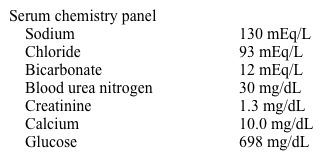 Which of the following electrolyte findings would most likely be seen in this patient?
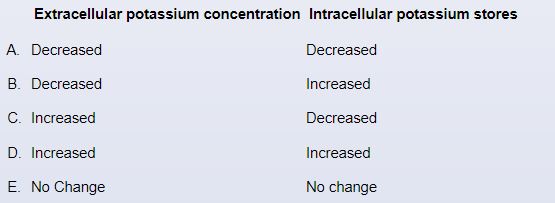
Which of the following electrolyte findings would most likely be seen in this patient?
(Multiple Choice)
4.8/5 (64)
(64) A 62-year-old woman comes to the office for medical evaluation. The patient states her 26-year-old son has developed renal failure from chronic glomerulonephritis and is undergoing dialysis therapy. She has the same blood group as her son and she wants to donate one of her kidneys to him. The patient has no chronic medical conditions and takes no medications. Vital signs are within normal limits, and physical examination shows no abnormalities. The patient understands that she may not be a compatible donor based on human leukocyte antigen (HLA) testing. In addition, which of the following age-related renal changes should be taken into consideration when assessing donor suitability?
(Multiple Choice)
4.7/5 (90)
(90) A 21-year-old male presents to his physician after noticing that his urine had a "frothy" appearance. He also complains of easy fatigability and anorexia. His past medical history is significant only for an upper respiratory infection several weeks ago. Physical examination reveals symmetric pitting edema of the ankles. Which of the following is most likely decreased in this patient?
(Multiple Choice)
4.8/5 (77)
(77) A 64-year-old woman comes to the emergency department with a 4-day history of productive cough and breathlessness. Her medical conditions include polymyalgia rheumatica, for which she takes low-dose prednisone. Physical examination shows dullness to percussion and decreased breath sounds over the right lower lobe. The abdomen is soft, nondistended, and nontender. Chest x-ray shows a right lower lobe parenchymal opacity and a moderate right pleural effusion. Thoracentesis is performed, yielding serosanguinous fluid. Pleural fluid and serum findings are as follows: 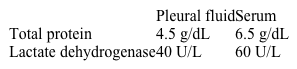 Which of the following is contributing most to the pathogenesis of this patient's pleural effusion?
 (Multiple Choice)
4.9/5 (73)
(73) 
Filters
- Essay(0)
- Multiple Choice(0)
- Short Answer(0)
- True False(0)
- Matching(0)