



 Chat with AI
Exam 11: Pathophysiology

Exam 1: Anatomy291 Questions
Exam 2: Behavioral science240 Questions
Exam 3: Biochemistry156 Questions
Exam 4: Biostatistics117 Questions
Exam 5: Embryology52 Questions
Exam 6: Genetics103 Questions
Exam 7: Histology24 Questions
Exam 8: Immunology129 Questions
Exam 9: Microbiology336 Questions
Exam 10: Pathology816 Questions
Exam 11: Pathophysiology464 Questions
Exam 12: Pharmacology538 Questions
Exam 13: Physiology272 Questions
Select questions type


A 65-year-old man with benign prostatic hyperplasia comes to the office for a follow-up appointment. He has a history of obstructive urinary symptoms that were unrelieved with tamsulosin, and a new medication was prescribed at his last visit 8 months ago. Since starting the new medication, the patient has experienced gradual improvement in urinary hesitancy and strength of urinary stream. However, he also has noticed a significant increase in the size of his breasts. The patient reports no pain or changes in weight. Glandular tissue, approximately 2 cm in diameter, is palpated under the nipples and is mildly tender to palpation. There is no nipple discharge, breast asymmetry, or rash. This patient's breast findings are most likely due to which of the following drug effects?
(Multiple Choice)
4.9/5  (92)
(92) A 34-year-old man comes to the office due to heart palpitations that are particularly prominent at night. With moderate exertion he also experiences head-pounding accompanied by involuntary head-bobbing. The patient recently emigrated from Southeast Asia and remembers being diagnosed with a heart murmur years before, but he cannot recall the type of murmur and has never received any treatment. He has no other medical conditions and takes no medications. He does not use tobacco, alcohol, or illicit drugs. The patient's father has coronary artery disease and his mother has type 2 diabetes mellitus. Based on this patient's history, which of the following findings is most likely to be present on further evaluation?
(Multiple Choice)
4.9/5 (77)
(77) A 39-year-old man comes to the clinic with a month-long history of fever, fatigue, joint pain, and an urticarial skin rash. He did not seek attention immediately as he hoped his symptoms would resolve. The patient is generally improving but is still very easily fatigued. Past medical history is unremarkable and the patient takes no regular medications, although he has not seen a physician since early childhood. He is not married and has a history of multiple heterosexual partners. The patient recently stopped smoking, drinks alcohol socially and does not use illicit drugs. Physical examination is notable for a moderately enlarged and tender liver. No jaundice is seen. Laboratory studies show significant elevations in serum alanine aminotransferase (ALT) and aspartate aminotransferase (AST). Which of the following is the most likely diagnosis in this patient?
(Multiple Choice)
4.9/5 (66)
(66) A 56-year-old woman comes to the emergency department due to 3 days of fever, chills, and retrosternal chest pain. She has end-stage kidney disease related to previous uncontrolled hypertension and receives intermittent hemodialysis through a tunneled catheter. Temperature is 39 C (102.2 F), blood pressure is 108/64 mm Hg, and pulse is 120/min. The patient is ill-appearing. The lungs are clear to auscultation, but a pericardial friction rub is present. Echocardiography reveals a moderate-sized pericardial effusion. Pericardiocentesis yields turbid fluid with a large number of neutrophils. Microbiologic analysis of this patient's pericardial fluid is most likely to reveal which of the following pathogens?
(Multiple Choice)
4.8/5 (82)
(82) A 6-year-old boy is brought to the office by his mother due to behavioral difficulties at school. His teacher has said, "He interrupts the class, doesn't listen, and cannot sit still for more than a few minutes." He has been sent home on a few occasions for hitting other children and taking their toys. The patient was adopted at age 6 months and his birth history is unknown. He runs around the office playing with various toys and is easily distracted. Vital signs are within normal limits. Weight and height are tracking on the 10th percentile, and head circumference is below the 5th percentile for age and sex. Physical examination reveals short palpebral fissures, a smooth philtrum, thin upper lip, and difficulty with both gross and fine motor coordination. Which of the following is the likely cause of this patient's condition?
(Multiple Choice)
4.9/5 (87)
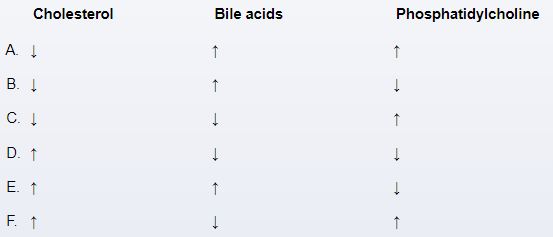
(87) A 43-year-old woman comes to the office with a 1-month history of dull abdominal pain that occurs mainly after eating. The pain is localized to the right upper quadrant and is especially severe after fatty meals. Physical examination is unremarkable. Ultrasound of the abdomen reveals several mobile echogenic foci within the gallbladder lumen. Which of the following sets of conditions is most likely present within this patient's gallbladder?
(Multiple Choice)
5.0/5 (74)
(74) A 3-year-old boy is brought to clinic by his mother due to fevers. Three weeks ago, the patient developed a fever, cough, and runny nose. He attends day care, where several children have had viral upper respiratory infections. Symptoms had briefly resolved 10 days ago, but the fever recurred last week after the patient returned to day care. Since then, he has been home due to fever occurring almost daily despite acetaminophen administration. Temperature is 38.3 C (100.9 F). Examination shows enlarged lymph nodes in the neck region. Lymphadenopathy at which of the following locations is most concerning for malignancy rather than infection in this patient?
(Multiple Choice)
4.8/5 (75)
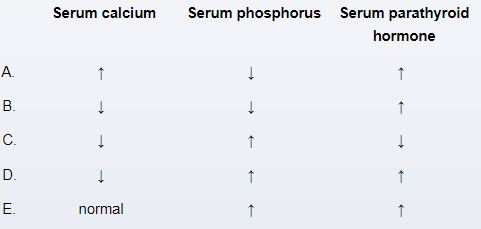
(75) A 30-year-old woman has had diarrhea and weight loss for the past several months. She also has diffuse bone pain and generalized weakness. The patient has a history of primary hypothyroidism for which she takes levothyroxine. She is 162.5 cm (5 ft 4 in) tall and weighs 45 kg (99.2 lb). BMI is 17 kg/m2. On physical examination, the abdomen is soft and nontender. Initial laboratory evaluation reveals microcytic anemia, hypoalbuminemia, normal magnesium level, and normal serum TSH concentration. The patient is found to have positive anti-tissue transglutaminase IgA antibodies. Which of the following sets of additional laboratory findings are most likely present in this patient?
(Multiple Choice)
4.8/5 (79)
(79) Atherosclerotic lesions of the coronary arteries can limit blood flow to the myocardial regions supplied by the affected vessels. In some patients, certain medications can cause a redistribution of blood flow away from the ischemic areas, exacerbating existing myocardial ischemia. Which of the following drug effects is most likely to produce this phenomenon?
(Multiple Choice)
4.7/5 (81)
(81) A 45-year-old woman comes to the office due to a 4-month history of headaches and blurred vision. She takes no medications and has no other medical problems. After the initial laboratory workup, an abdominal CT is performed that shows a 2-cm left-sided adrenal mass. The patient undergoes an uncomplicated left-sided adrenalectomy. Gross examination of the adrenal gland demonstrates a well-defined yellowish tumor within the cortex. Assuming the tumor cells are functionally similar to cells from the outermost layer of the adrenal cortex, this patient would most likely have presented with which of the following additional symptoms?
(Multiple Choice)
4.9/5 (78)
(78) A 66-year-old woman is evaluated in the clinic for worsening shortness of breath over the last year. She has no previous medical problems and is a lifelong nonsmoker. Blood pressure is 126/78 mm Hg, pulse is 82/min, and respirations are 18/min. BMI is 23 kg/m2. Physical examination shows a normal oropharynx, flat neck veins, and a midline trachea. Diaphragmatic excursion is decreased bilaterally. Lung auscultation reveals bilateral fine inspiratory crackles. Arterial blood gas analysis is performed while the patient is at rest and after a vigorous walk for several minutes. Arterial partial pressure of oxygen is normal at rest but falls significantly with exercise. Which of the following exercise-related changes is most likely contributing to the latter observation in this patient?
(Multiple Choice)
4.8/5 (77)
(77) A 5-year-old boy is undergoing a partial hepatectomy to treat a poorly draining liver abscess. He has a history of recurrent skin abscesses. Cultures from his liver abscess are growing Staphylococcus aureus, which is sensitive to the current antibiotic regimen, but the abscess has failed to improve. Genetic analysis reveals an inactivating mutation affecting a neutrophil oxidase enzyme. This patient most likely has an increased risk of infection with which of the following organisms?
(Multiple Choice)
4.9/5 (73)
(73) A 62-year-old woman comes to the office due to a 3-month history of painful, swollen wrists and knees. She also has joint stiffness, which is worse upon wakening and limits her daily activities. Review of systems is positive for fatigue. The patient's only other medical condition is hypothyroidism for which she takes levothyroxine. She smoked a pack of cigarettes daily for 20 years and quit 15 years ago. Vitals signs are within normal limits. Physical examination shows symmetric, moderate swelling of the wrists and knees. The joints are tender and warm. Range of motion is intact but painful. Plain radiographs of the symptomatic joints show joint space narrowing and marginal erosions. Which of the following cytokines are primarily involved in the pathogenesis of this patient's joint destruction?
(Multiple Choice)
4.8/5 (82)
(82) A 24-year-old woman is being evaluated for chronic fatigue. She has a history of heavy menstrual periods since menarche and also recalls frequent nosebleeds as a child. Her past medical history is otherwise insignificant and she takes no medications. Laboratory studies show a hemoglobin level of 9.2 g/dL, a mean corpuscular volume of 72 fL, and decreased levels of ferritin. Which of the following is the most likely diagnosis?
(Multiple Choice)
4.9/5 (92)
(92) A 65-year-old man is evaluated for hypotension and increasing shortness of breath shortly after placement of a right-sided subclavian central venous catheter. The patient was recently diagnosed with colon cancer without metastasis and is scheduled for surgical resection. Blood pressure is 80/50 mm Hg, pulse is 110/min, and respirations are 24/min. Examination shows jugular venous distension. Breath sounds are decreased on the right and the trachea is deviated to the left. Which of the following is the most likely cause of this patient's hypotension?
(Multiple Choice)
4.9/5 (83)
(83) The patient is tachypneic and unable to speak in full sentences. Examination reveals prolonged expiration and prominent bilateral wheezing. Heart sounds are normal. Chest imaging shows a normal-sized heart and hyperinflated lungs with a flattened diaphragm. Bedside echocardiogram reveals no intrapericardial fluid accumulation or pericardial thickening. Which of the following physiologic changes is most likely to provide immediate relief in this patient?
(Multiple Choice)
4.8/5 (79)
(79) A 75-year-old man is brought to the emergency department by paramedics following a high-speed motor vehicle accident. Several attempts are made to resuscitate him but are unsuccessful. The patient had no significant past medical history and took no medications. He was known to be in good health and tolerant of moderate levels of physical activity. Electrocardiogram findings at his last office visit showed no abnormalities. At autopsy, heavy calcifications of the aortic valve are seen. Which of the following most likely preceded the aortic valve changes observed in this patient?
(Multiple Choice)
4.9/5 (81)
(81) Electric stimulation of the musculocutaneous nerve causes a rapid twitch of the biceps muscle. Electron microscopy shows numerous vesicles within the musculocutaneous nerve terminals. In order for these vesicles to release their contents into the synaptic cleft, which of the following substances is required?
(Multiple Choice)
4.9/5 (72)
(72) The patient is admitted to the hospital for further workup and treatment. After initial evaluation, a CT scan of the chest is obtained, an image of which is shown on the slide below. 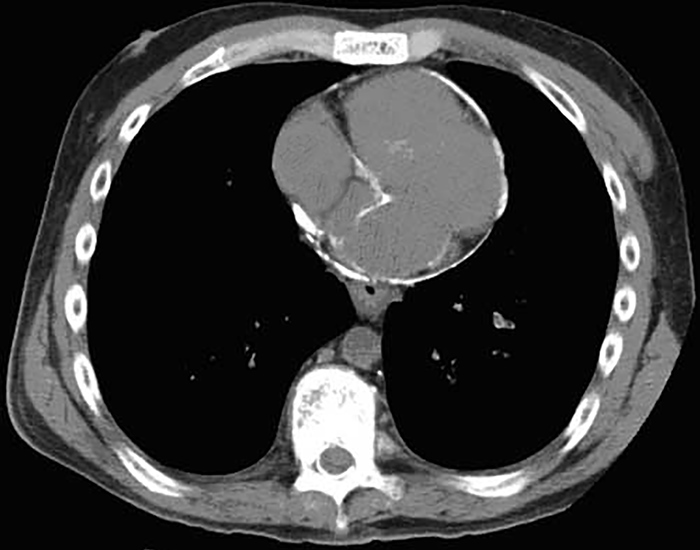 Which of the following is the most likely diagnosis?
 (Multiple Choice)
4.8/5 (81)
(81) A 34-year-old man comes to the emergency department complaining of weakness, dizziness, and paresthesias involving his face and extremities. He has never had symptoms like this before. Two hours earlier, he ate fish at a new Japanese restaurant. Neurological examination shows reduced muscle strength and decreased deep-tendon reflexes. Which of the following parts of the action potential curve is most likely impaired in this patient? 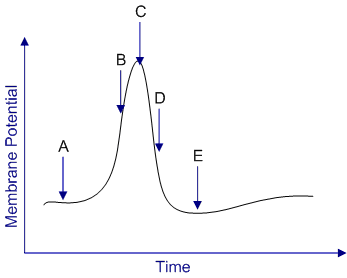
(Multiple Choice)
5.0/5 (81)
(81) 
Filters
- Essay(0)
- Multiple Choice(0)
- Short Answer(0)
- True False(0)
- Matching(0)