



 Chat with AI
Exam 11: Pathophysiology

Exam 1: Anatomy291 Questions
Exam 2: Behavioral science240 Questions
Exam 3: Biochemistry156 Questions
Exam 4: Biostatistics117 Questions
Exam 5: Embryology52 Questions
Exam 6: Genetics103 Questions
Exam 7: Histology24 Questions
Exam 8: Immunology129 Questions
Exam 9: Microbiology336 Questions
Exam 10: Pathology816 Questions
Exam 11: Pathophysiology464 Questions
Exam 12: Pharmacology538 Questions
Exam 13: Physiology272 Questions
Select questions type


A 52-year-old woman with a history of cirrhosis due to chronic hepatitis C experiences worsening dyspnea. She has no other medical conditions. Vital signs are within normal limits. Physical examination shows normal jugular venous pressure, right-sided dullness to percussion and decreased breath sounds, normal heart sounds, and moderate-sized ascites. Chest x-ray reveals a large right-sided pleural effusion with no parenchymal lesions. Thoracentesis yields transudative fluid with normal cell counts. Which of the following is the most likely underlying mechanism of this patient's pulmonary findings?
(Multiple Choice)
4.9/5  (91)
(91) A 28-year-old woman, gravida 3 para 2, at 31 weeks gestation comes to the office for a prenatal visit. The patient has had increasing shortness of breath while climbing stairs and during long walks for the past few weeks but has had no cough, sick contacts, hemoptysis, orthopnea, or chest pain. She has had no contractions or vaginal bleeding, and fetal movement is normal. The patient has no chronic medical conditions, and her pregnancy has been uncomplicated. Blood pressure is 110/80 mm Hg, pulse is 70/min, and respirations are 18/min. Fetal heart tones are normal. Cardiac examination reveals no rubs or murmurs. The lungs are clear to auscultation bilaterally. The remainder of the examination is unremarkable. Which of the following laboratory findings will most likely be found in this patient?
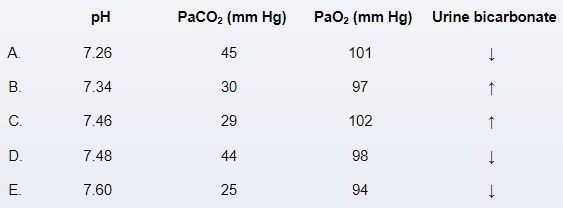
(Multiple Choice)
4.9/5 (73)
(73) A 72-year-old man comes to the office due to poor sleep. He is concerned that he is sleeping less since he retired a year ago. He says, "I used to sleep a solid 8 hours, but now I wake up several times a night. And I'm up for the day between 5:00 and 6:00 AM, which is a full hour before I want to get up. I'm probably only getting about 6 or 7 hours of sleep total." The patient typically falls asleep while watching television at 10:00 PM. He sometimes awakens to use the bathroom in the middle of the night but typically falls back asleep within 15 minutes. The patient likes to do crosswords and play golf in the mornings but occasionally takes 30-minute naps in the afternoon. The patient's wife says that he snores softly, but she has not witnessed any breathing pauses. Medical problems include hypertension and a history of depression. The patient does not use alcohol or illicit drugs. Which of the following is the most likely cause of this patient's symptoms?
(Multiple Choice)
4.8/5 (74)
(74) A 58-year-old man comes to the office due to fatigue, decreased appetite, muscle cramps, and nausea. The patient has chronic kidney disease resulting from primary focal segmental glomerulosclerosis. His current medications include a vitamin D supplement. While his blood pressure is being obtained, the patient develops carpal spasm. Bilateral lower extremity pedal edema is noted. Laboratory evaluation shows a blood urea nitrogen level of 120 mg/dL, serum creatinine level of 10 mg/dL, and serum calcium level of 6 mg/dL. Which of the following is most likely contributing to this patient's carpal spasm?
(Multiple Choice)
4.7/5 (83)
(83) A 41-year-old woman comes to the office after a positive home urine pregnancy test. Her last menstrual period was 12 weeks ago. For the past month, the patient has had increasing nausea. She vomits several times a day and has difficulty keeping any food down. The patient has 3 children, all born at term via cesarean section. On this visit, ultrasound demonstrates echogenic intrauterine tissue without an amniotic sac and multiple bilateral ovarian cysts. Hydropic villi are evacuated from the uterus during dilation and curettage. Which of the following should be closely monitored in this patient after the procedure?
(Multiple Choice)
4.7/5 (70)
(70) A 62-year-old man comes to the office due to chest pain over the last 6 months. He describes pressure-like pain in the substernal area when walking fast or climbing stairs that gradually subsides when he stops. The patient does not smoke cigarettes or use illicit drugs. He has no family history of heart disease or sudden death. Physical examination shows a mid-systolic murmur at the upper sternum and slow-rising carotid pulses. After initial evaluation, cardiac catheterization is performed and reveals 30% stenosis of the mid-left anterior descending artery. A 50 mm Hg pressure gradient is seen when a catheter is passed across the aortic valve. Which of the following is the most important contributor to this patient's presenting symptoms?
(Multiple Choice)
4.8/5 (73)
(73) A 48-year-old man comes to the office for an initial visit. He says that he feels well and has no medical problems. The patient has a 20-pack-year smoking history and does not use alcohol or illicit drugs. He is counseled on smoking cessation. To explain how smoking affects lung function, the patient is shown a graph of the expected change in forced expiratory volume in 1 second (FEV1) over time if he continues to smoke at the same rate (curve D in image). Which of the following curves most likely demonstrates the expected FEV1 over time if this patient were to stop smoking now? 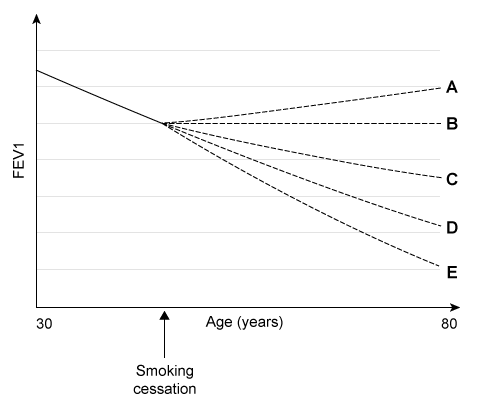
(Multiple Choice)
4.8/5 (88)
(88) A 52-year-old man comes to the office due to diarrhea. For the past 3 months, he has had loose, brown, watery stools 4 or 5 times a day; it is associated with postprandial bloating. The patient has no vomiting, melena, hematochezia, or unexpected weight changes. He was diagnosed 10 years ago with systemic sclerosis, which presented with sclerodactyly and Raynaud phenomenon. The patient does not use tobacco, alcohol, or illicit drugs. The abdomen is visibly distended but nontender and without rebound or guarding. His symptoms dramatically improve after treatment with oral antibiotics. Which of the following is most likely responsible for this patient's diarrhea?
(Multiple Choice)
4.7/5 (81)
(81) A 64-year-old man is brought to the emergency department due to severe chest pain, diaphoresis, and shortness of breath. Symptoms began suddenly on awakening and have worsened over the past 2 hours. Blood pressure is 150/90 mm Hg and pulse is 102/min. Physical examination reveals an S4. ECG shows ST-segment depression and T-wave inversion in the lateral leads. Coronary angiography reveals a ruptured atherosclerotic plaque, with a thrombus in the left circumflex artery that causes near-total occlusion. Normal endothelial cells surrounding the lesion have released large amounts of a chemical substance that help decrease thrombus propagation by inhibiting platelet aggregation. Which of the following substances was most likely secreted by these endothelial cells?
(Multiple Choice)
4.7/5 (87)
(87) A 33-year-old woman comes to a fertility clinic for evaluation. The patient has been attempting to conceive for a year. She has been monogamous for 5 years with a male partner and he has had a semen analysis with adequate sperm motility, volume, and count. The patient used oral contraceptives for 15 years but stopped a year ago. Since then, her menses have occurred every 27-31 days with 4-6 days of bleeding. Seven years ago, she was treated with ceftriaxone after presenting to the emergency department with fever, abdominal pain, and vaginal discharge. Which of the following is the most likely factor contributing to this patient's infertility?
(Multiple Choice)
4.9/5 (74)
(74) A 23-year-old woman is being evaluated for recurrent episodes of urinary tract infection. She has had 5 episodes of cystitis and an episode of pyelonephritis over the past year. The symptoms tend to occur a few days following sexual intercourse. The patient has no other medical problems and takes no medications. Her temperature is 36.7 C (98 F), blood pressure is 110/70 mm Hg, respirations are 16/min, and pulse is 65/min. Abdominal and genitourinary examinations are normal. Which of the following is the most likely predisposing factor for pyelonephritis in this patient?
(Multiple Choice)
4.9/5 (82)
(82) A 64-year-old woman comes to the emergency department due to a 2-day history of worsening abdominal pain. She has a history of gallstones but has had no surgery due to high operative risk. Medical history includes chronic obstructive pulmonary disease, hypertension, and remote cervical cancer treated with surgery and chemotherapy. Abdominal CT scan shows multiple dilated small bowel loops with a decompressed distal ileum, and an abnormal bowel indicated by the arrow shown below: 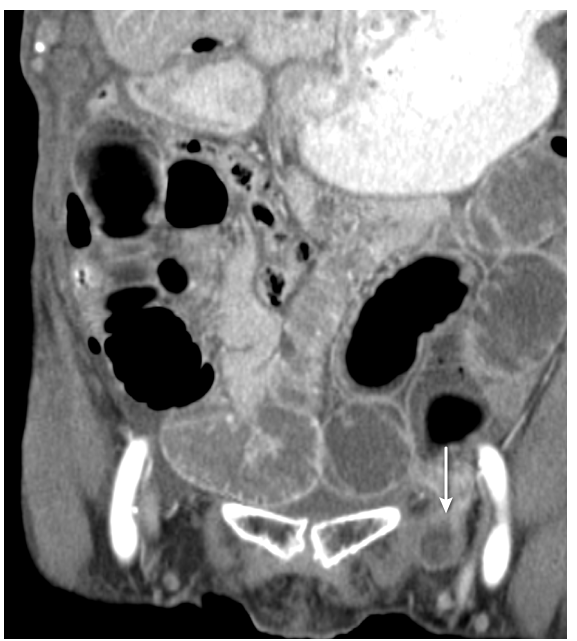 Which of the following is the most likely cause of this patient's current condition?
 (Multiple Choice)
4.9/5 (84)
(84) A 38-year-old man comes to the office with reports of dyspnea on exertion and decreased exercise tolerance. His medical history is unremarkable, and he has no history of childhood asthma or cough. He has never smoked and has no known occupational exposures. The patient has gained almost 100 lb over the past 4 years since leaving the military due to a sedentary lifestyle. He currently weighs 135 kg (297.6 lb) and has a BMI of 41 kg/m2. His respiratory rate is 22/min and pulse oximetry is 93% on room air at rest. Physical examination is notable for central obesity. Lungs are clear on auscultation bilaterally. Which of the following changes (forced expiratory volume in 1 second [FEV1], forced vital capacity [FVC], expiratory reserve volume [ERV], residual volume [RV], and total lung capacity [TLC]) are most likely to be seen on pulmonary function testing in this patient?
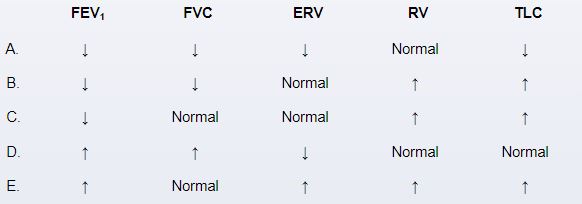
(Multiple Choice)
4.9/5 (75)
(75) A 47-year-old man comes to the office due to worsening shortness of breath for several months. The patient has no fever, weight loss, or cough. He has no other medical conditions and takes no medications. The patient does not use tobacco, alcohol, or illicit drugs. Vital signs are normal. Pulmonary examination demonstrates wheezing and poor air movement. Laboratory results are as follows: 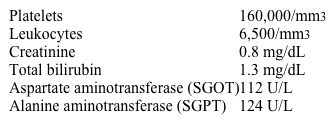 A liver biopsy is subsequently performed. Light microscopy of the tissue specimen after treatment with diastase and periodic acid-Schiff staining is shown in the exhibit.
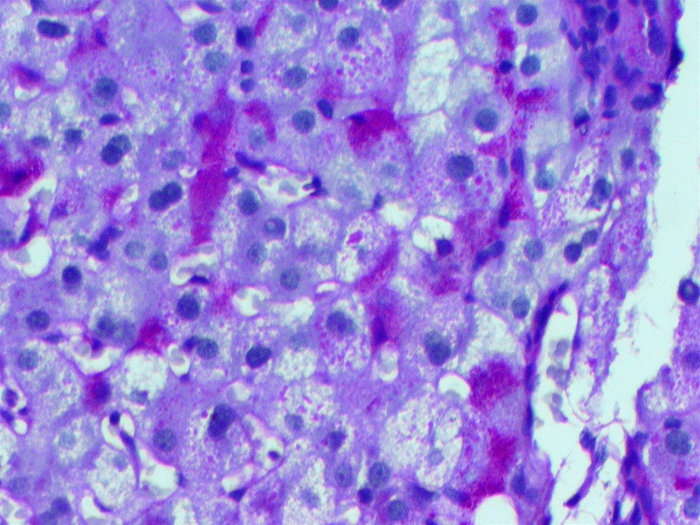 Given these findings, which of the following is the most likely cause of this patient's shortness of breath?
A liver biopsy is subsequently performed. Light microscopy of the tissue specimen after treatment with diastase and periodic acid-Schiff staining is shown in the exhibit. Given these findings, which of the following is the most likely cause of this patient's shortness of breath? (Multiple Choice)
4.7/5 (69)
(69) A 45-year-old man comes to the emergency department due to urinary incontinence. He was diagnosed with multiple sclerosis a year ago after he developed transient acute vision loss in his right eye. A few weeks ago, he began having difficulty with his balance and had several episodes of urinary incontinence. The patient's walking has improved since, but he continues to urinate involuntarily. He has noticed increasing urinary frequency and cannot control the urge to urinate. His vital signs are normal. On examination, the patient has mild spastic paraparesis with increased reflexes in the lower extremities; bilateral Babinski sign; and a thoracic sensory level to pain, temperature, and vibration. An MRI of the spine reveals a new demyelinating lesion in the mid-thoracic spinal cord. Which of the following abnormalities will most likely be found on this patient's urodynamic studies?
(Multiple Choice)
4.9/5 (80)
(80) A 19-year-old woman, gravida 1 para 0, at 29 weeks gestation comes to the emergency department due to severe right upper quadrant pain. The patient suddenly developed the pain this evening after dinner. The pain was associated with acute nausea and vomiting. She has no headaches or visual changes. The patient has no chronic medical conditions and takes no daily medications. Temperature is 36.7 C (98.1 F), blood pressure is 160/100 mm Hg, and pulse is 84/min. The abdomen is tender over the right upper quadrant, but no rebound or guarding is present. Hemoglobin is 8 g/dL. Urinalysis shows 3+ protein. Which of the following associated laboratory changes are most likely to be seen in this patient?
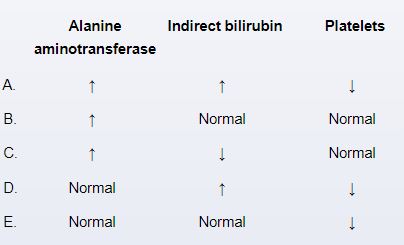
(Multiple Choice)
4.7/5 (69)
(69) A 4-week-old boy is brought to the office for a routine well-baby visit. The boy has been exclusively breastfeeding every 2-3 hours and is making 6 or 7 wet diapers a day. His urine has appeared dark yellow, and he has had a few pale-colored stools. His parents also noticed that his skin has appeared yellow for the past 2 weeks, but they were not concerned as they heard from friends that yellow skin is common with breastfeeding. The patient was born full term without complications by vaginal delivery to a primigravida. On physical examination, he is well-appearing with icteric sclerae and jaundice of the head and upper chest. Abdominal examination reveals a mildly enlarged and firm liver. Liver function results are as follows:  Which of the following is the most likely mechanism for the patient's presentation?
 (Multiple Choice)
4.9/5 (82)
(82) A 24-year-old man comes to the office due to nonproductive cough, subjective fevers, right-sided pleuritic chest pain, and increasing dyspnea for the past 4 weeks. He was empirically treated for pneumonia with levofloxacin at an urgent care center 2 weeks ago but has had no improvement. The patient is an exchange student from the Philippines. Temperature is 37.3 C (99.1 F), blood pressure is 118/66 mm Hg, pulse is 90/min, and respirations are 20/min. Physical examination is remarkable for decreased right-sided breath sounds. Chest x-ray shows a large, right-sided pleural effusion. Pleural fluid is drained, and a subsequent chest CT scan reveals right upper lobe infiltrate and calcified hilar adenopathy. This patient's pleural fluid analysis is most likely to demonstrate which of the following findings?
(Multiple Choice)
4.7/5 (86)
(86) A 23-year-old man comes to the physician at his girlfriend's insistence. She says that the patient's frequent snoring keeps her up at night and that in the last 4 months he has twice fallen asleep while they were talking. In this same period, the patient says that he has regularly fallen asleep in the afternoon while reading or watching television but typically feels refreshed after a brief nap. When asked whether he experiences any other symptoms, the patient hesitantly reveals that he sometimes hears a voice call his name prior to falling asleep. He also reports uncharacteristic episodes of clumsiness in which he has suddenly dropped objects or fallen to his knees. Examination shows no abnormalities. Which of the following is the most likely diagnosis in this patient?
(Multiple Choice)
4.8/5 (70)
(70) A 1-hour-old boy is admitted to the neonatal intensive care unit for respiratory failure. The infant was born to a 27-year-old mother, gravida 4 para 2, at 29 weeks gestation via cesarean delivery due to maternal preeclampsia with severe features. Amniotic fluid was clear. Apgar scores were 7 and 8 at 1 and 5 minutes, respectively. Birth weight is 1,120 g (2 lb 8 oz). Temperature is 36.9 C (98.4 F), pulse is 170/min, and respirations are 56/min. Pulse oximetry is 82% on room air. There are intercostal and subcostal retractions. Cardiac examination shows tachycardia without murmurs. The lungs have decreased breath sounds bilaterally. The abdomen is soft without organomegaly. Surfactant is ordered, and the team prepares for intubation. Prior to these clinical interventions, which of the following best describes the condition of this patient's lungs compared to a normal neonate?
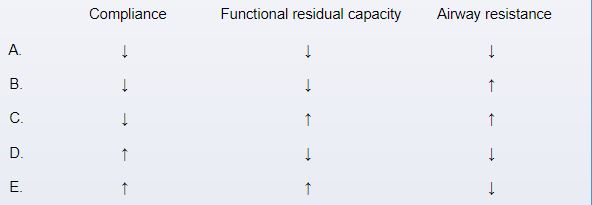
(Multiple Choice)
5.0/5 (84)
(84) 
Filters
- Essay(0)
- Multiple Choice(0)
- Short Answer(0)
- True False(0)
- Matching(0)