



 Chat with AI
Exam 11: Pathophysiology

Exam 1: Anatomy291 Questions
Exam 2: Behavioral science240 Questions
Exam 3: Biochemistry156 Questions
Exam 4: Biostatistics117 Questions
Exam 5: Embryology52 Questions
Exam 6: Genetics103 Questions
Exam 7: Histology24 Questions
Exam 8: Immunology129 Questions
Exam 9: Microbiology336 Questions
Exam 10: Pathology816 Questions
Exam 11: Pathophysiology464 Questions
Exam 12: Pharmacology538 Questions
Exam 13: Physiology272 Questions
Select questions type


A 33-year-old woman who recently immigrated to the United States is brought to the emergency department with severe shortness of breath and hemoptysis. Physical examination reveals a diastolic murmur. Chest x-ray shows severe pulmonary vascular congestion and edema. She is admitted to the hospital, treated with diuretics, and begins to feel better. However, during her hospitalization, she develops right-sided hemiparesis. Which of the following additional findings in this patient would be most suggestive of combined disease involving the mitral and aortic valves rather than exclusive mitral involvement?
(Multiple Choice)
4.9/5  (80)
(80) A 22-year-old man comes to the office for an exercise evaluation. He is an avid long-distance runner. One of his team members was disqualified recently due to health issues, which made him worried about his health. He has no medical history and does not take any medications or illicit drugs. His maternal grandfather died suddenly at age 40. Blood pressure is 125/75 mm Hg and pulse is 55/min. Transthoracic echocardiogram results are as follows: 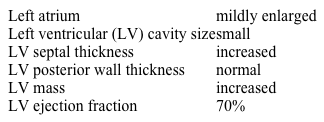 The right ventricle appears normal and there are no valvular lesions. Which of the following best explains this patient's echocardiogram findings?
 (Multiple Choice)
4.9/5 (77)
(77) A 64-year-old man comes to the office due to a lump in his neck. He has a long history of using chewing tobacco. On examination, there is an ulcerative lesion in the left floor of mouth. There is also a firm, palpable, nontender left submandibular mass. Biopsy of the submandibular mass is shown in the exhibit. 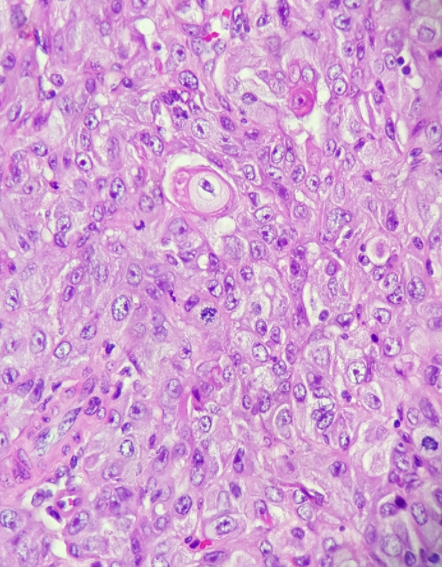 Which of the following is the most likely route of spread from the floor of mouth to the submandibular mass?
 (Multiple Choice)
4.8/5 (81)
(81) A 2-year-old girl is brought to the clinic by her mother for evaluation of ambiguous genitalia. She was born with clitoral enlargement and partial fusion of the labioscrotal folds. The patient has also had high blood pressure recorded on 3 consecutive office visits. She has been tracking at the 50th percentile for height and weight, and has not had any other medical problems. Family history is noncontributory. Laboratory studies are significant for moderate hypokalemia. Cytogenetic studies show a 46,XX karyotype. Which of the following enzymes is most likely deficient in this patient?
(Multiple Choice)
4.9/5 (81)
(81) A 44-year-old man with a long-standing history of heartburn comes to the office due to worsening substernal burning, particularly at night. The discomfort has been less responsive than usual to over-the-counter antacids. The patient also now has significant substernal pain after swallowing food. However, swallowing does not result in coughing, choking, or a sensation of food getting stuck. He has no other chronic medical conditions. Recent HIV testing was negative. The patient takes no other medications. He drinks 2 or 3 beers each evening and smokes a pack of cigarettes daily. BMI is 34 kg/m2. Vital signs are within normal limits. Physical examination reveals no abnormalities. The recent worsening of this patient's symptoms is most likely related to which of the following?
(Multiple Choice)
4.8/5 (71)
(71) A 4-month-old boy is brought to the cardiology clinic by his parents for continued follow-up of tetralogy of Fallot. The diagnosis was made during routine antenatal sonography, and the pregnancy and delivery were otherwise uncomplicated. The infant has been seen frequently in the clinic and has not had any cyanosis, respiratory distress, or difficulty feeding. The parents become concerned when their son's surgical plan is discussed because he does not have the clinical signs that other children with tetralogy of Fallot demonstrate. Which of the following is the major determinant of symptom severity in this condition?
(Multiple Choice)
4.9/5 (86)
(86) A 28-year-old woman comes to the office due to unintentional weight loss, fatigue, and sweating. The patient has no neck pain. Two months before this visit, she delivered a healthy male baby without complications. The patient has no chronic medical conditions and takes no medications. Blood pressure is 140/70 mm Hg, pulse is 110/min, and respirations are 16/min. Oxygen saturation is 98% on room air. Neck examination shows mild, diffuse enlargement of the thyroid gland with no tenderness. The remainder of the physical examination is normal. Laboratory evaluation shows low serum TSH and elevated serum thyroxine (T4) and triiodothyronine (T3). Thyroid ultrasound with Doppler flow reveals a mildly enlarged gland with decreased blood flow. Which of the following is most likely responsible for this patient's disorder?
(Multiple Choice)
4.9/5 (77)
(77) A 63-year-old man comes to the office due to exertional dyspnea that has been progressively worsening over the last 3 weeks. He sleeps in a recliner with his head elevated because he gets short of breath when lying flat in bed. Medical history includes gout, dyslipidemia, and hypertension. Blood pressure is 154/89 mm Hg and pulse is 85/min. Physical examination shows distended jugular veins in the semi-recumbent position. An apical heave is present on cardiac examination. There is pitting edema in the bilateral lower extremities. Levels of which of the following substances will be higher in the pulmonary vein compared to the pulmonary artery in this patient?
(Multiple Choice)
4.9/5 (85)
(85) A 60-year-old woman is being evaluated for chronic weakness and fatigue. She has no other medical problems and takes no medications. After performing initial laboratory studies, the physician decides to proceed with a metyrapone stimulation test. The changes in urinary 17-hydroxycorticosteroid (17-OHS) excretion following metyrapone administration are shown in the graph below. 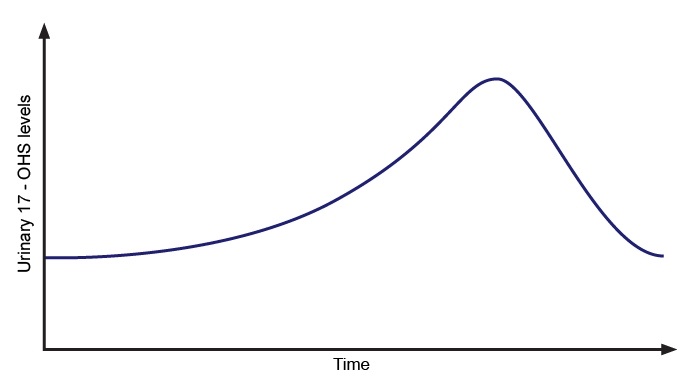 Which of the following mechanisms is most likely responsible for the findings seen in the graph?
 (Multiple Choice)
4.9/5 (78)
(78) A 56-year-old man comes to the clinic due to recent-onset headache and dyspnea. The patient says he has had a puffy face for 2 weeks along with a persistent dry cough. He does not have any neck or shoulder pain. He has no other medical problems. Physical examination shows symmetrical facial swelling and conjunctival edema. The pupils are equal, round, and reactive to light. Dilated veins are noted over his neck and upper trunk. Heart and lung sounds are normal. Peripheral strength and sensation are intact. Which of the following is the most likely cause of this patient's condition?
(Multiple Choice)
4.8/5 (76)
(76) A 55-year-old man with a history of chronic pancreatitis and alcohol abuse is investigated for recent onset weight loss, decreased appetite, and worsening of chronic abdominal pain. Physical examination is significant for diffuse muscle atrophy, temporal wasting, and a mildly enlarged liver without ascites. Serum lipase and amylase are normal, and aspartate aminotransferase (AST) is mildly elevated. Abdominal imaging shows a malignant mass in the pancreas. The patient subsequently undergoes an uncomplicated subtotal pancreatectomy and returns for a postoperative nutritional assessment following hospital discharge. Which of the following tests will most likely be normal in this patient after surgery?
(Multiple Choice)
4.8/5 (71)
(71) A 22-year-old man comes to the office for evaluation of a neck mass. He first noticed a small nodule in his lower neck 6 months ago, and it has progressively enlarged since that time. The patient has had no changes in weight and otherwise feels well. Medical history is notable only for seasonal allergies, and he takes no medications. Physical examination shows a 2-cm nodule in the right lobe of the thyroid. There are multiple 4- to 8-mm soft papules on the lips and tongue. The arm span exceeds his height and the patient has long fingers. Serum calcitonin levels are elevated. Which of the following is most likely to develop in this patient?
(Multiple Choice)
4.8/5 (89)
(89) A 45-year-old woman comes to the clinic with a 3-month history of persistent shoulder and back pain and easy fatigability. She also has pain and stiffness in all her muscles that worsens in the morning and evening. She does not participate in any regular exercise because her pain is exacerbated with activity. She works as a computer programmer and reports some difficulty concentrating on her job. Past medical history is significant for depression and gastroesophageal reflux disease, but she is not currently taking any medications. Physical examination shows normal range of motion and 5/5 muscle strength in both upper and lower extremities. Soft tissue tenderness is present at several locations bilaterally above and below the waist. Which of the following is the most likely diagnosis?
(Multiple Choice)
4.9/5 (70)
(70) A 28-year-old man is found unresponsive by his roommate and is brought to the emergency department. He has a history of injection drug use. On physical examination, the patient is obtunded and hypopneic. The pupils are pinpoint. Lung auscultation reveals decreased breath sounds bilaterally. Endotracheal intubation is planned for airway protection and arterial blood gas analysis is performed prior to the procedure while the patient is breathing room air. This patient's current acid-base status is best represented by which of the following points on the below graph? 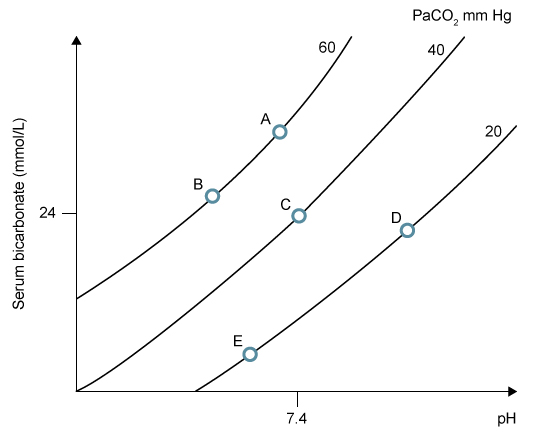
(Multiple Choice)
4.8/5 (74)
(74) A newborn is transferred to the neonatal intensive care unit 4 hours after delivery due to cyanosis. The infant was born via a spontaneous vaginal delivery at 41 weeks gestation to a 22-year-old gravida 2 para 2 woman. The pregnancy and delivery were uncomplicated. Three hours after delivery, circumoral cyanosis was noted after the infant was breastfed. Pulse oximetry readings were 98% in the right hand and 83% in the left foot. On physical examination, the patient has subcostal retractions and grunting. Cardiac examination reveals a 2/6 systolic murmur at the left lower sternal border. Femoral pulses are strong bilaterally. Which of the following is the most likely cause of this infant's cyanosis?
(Multiple Choice)
4.9/5 (66)
(66) A 55-year-old man comes to the emergency department due to sudden-onset dyspnea. Medical history is significant for hypertension, hyperlipidemia, type 2 diabetes mellitus, and chronic kidney disease. The patient takes multiple medications and has no drug allergies. He works for an international bank and returned from a business trip in Australia a day ago. Blood pressure is 110/70 mm Hg and pulse is 110/min. Physical examination shows a moderately overweight man with tachypnea. The lungs are clear on auscultation. ECG shows sinus tachycardia. Ventilation/perfusion scanning is ordered. Which of the following findings would help confirm the suspected diagnosis in this patient?
(Multiple Choice)
4.7/5 (75)
(75) A 67-year-old man is brought to the emergency department due to progressive shortness of breath. He has had decreasing exercise tolerance for several months, and over the last week he could barely walk to the bathroom without becoming short of breath. The patient has been sleeping in a semirecumbent position recently. Medical history includes type 2 diabetes mellitus, hyperlipidemia, and a myocardial infarction 3 years ago. He takes no medications. The patient does not drink alcohol or use tobacco products. BMI is 30 kg/m2. Oxygen saturation is 92% on room air. The apical impulse is palpated in the 6th intercostal space along the anterior axillary line. There is 3+ bilateral pitting edema in the legs. Which of the following is most likely increased in this patient?
(Multiple Choice)
4.9/5 (79)
(79) A 6-month-old girl is brought to the office for her first visit after being adopted from another country a week ago. The parents notice that she often seems to breathe hard and fast, particularly after feeding or crying. Her lips sometimes turn blue, as well. On examination, height and weight are at the 15th and 2nd percentiles, respectively. The patient has a 4/6, harsh systolic, crescendo-decrescendo murmur best heard at the left upper sternal border. Complete blood count shows: 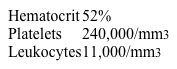 Which of the following is the most likely explanation for this patient's elevated hematocrit?
 (Multiple Choice)
4.9/5 (75)
(75) A 72-year-old man comes to the emergency department due to sudden-onset, severe abdominal pain accompanied by nausea. He has a history of coronary artery disease and recently underwent cardiac angiography. The patient is a current smoker with a 30-pack-year history. After initial evaluation, he undergoes emergency laparotomy. A segment of small intestine is resected. On microscopic examination, there are several large-caliber vessels with needle-shaped cholesterol clefts in their lumens, as shown in the image below. 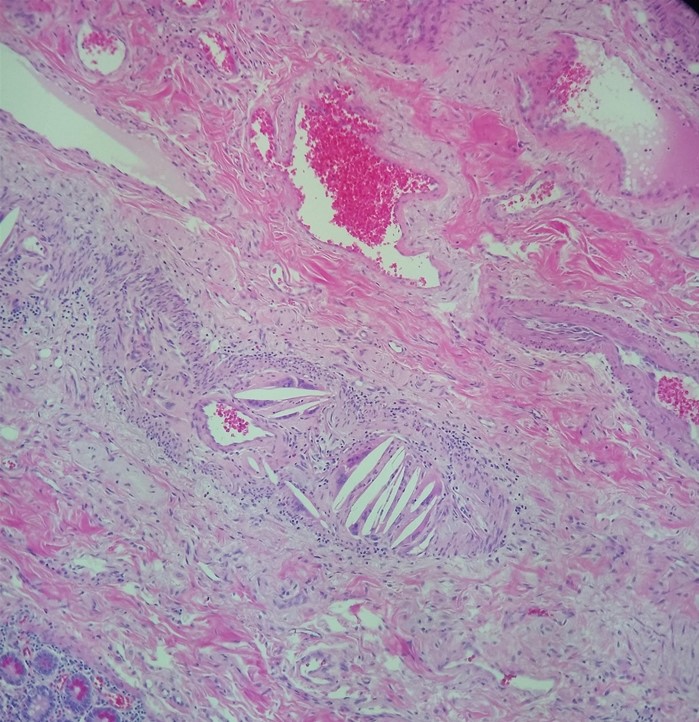 Given these findings, the patient is at highest risk for which of the following complications?
 (Multiple Choice)
4.9/5 (73)
(73) A 51-year-old man comes to the emergency department with sudden-onset, sharp, left flank pain; nausea; and vomiting. He has had no dysuria or hematuria. The patient has no past medical conditions and takes no daily medications. He does not use tobacco, alcohol, or illicit drugs. Temperature is normal. On examination, the patient appears to be in severe pain and cannot find a comfortable position on the bed. There is no abdominal rigidity or rebound, and no masses are palpable. Cardiopulmonary examination is normal. There is no peripheral edema. Imaging shows a 1-cm calculus in the left proximal ureter at the level of the L3 vertebra; the renal pelvis and proximal ureter are dilated, as shown in the exhibit.
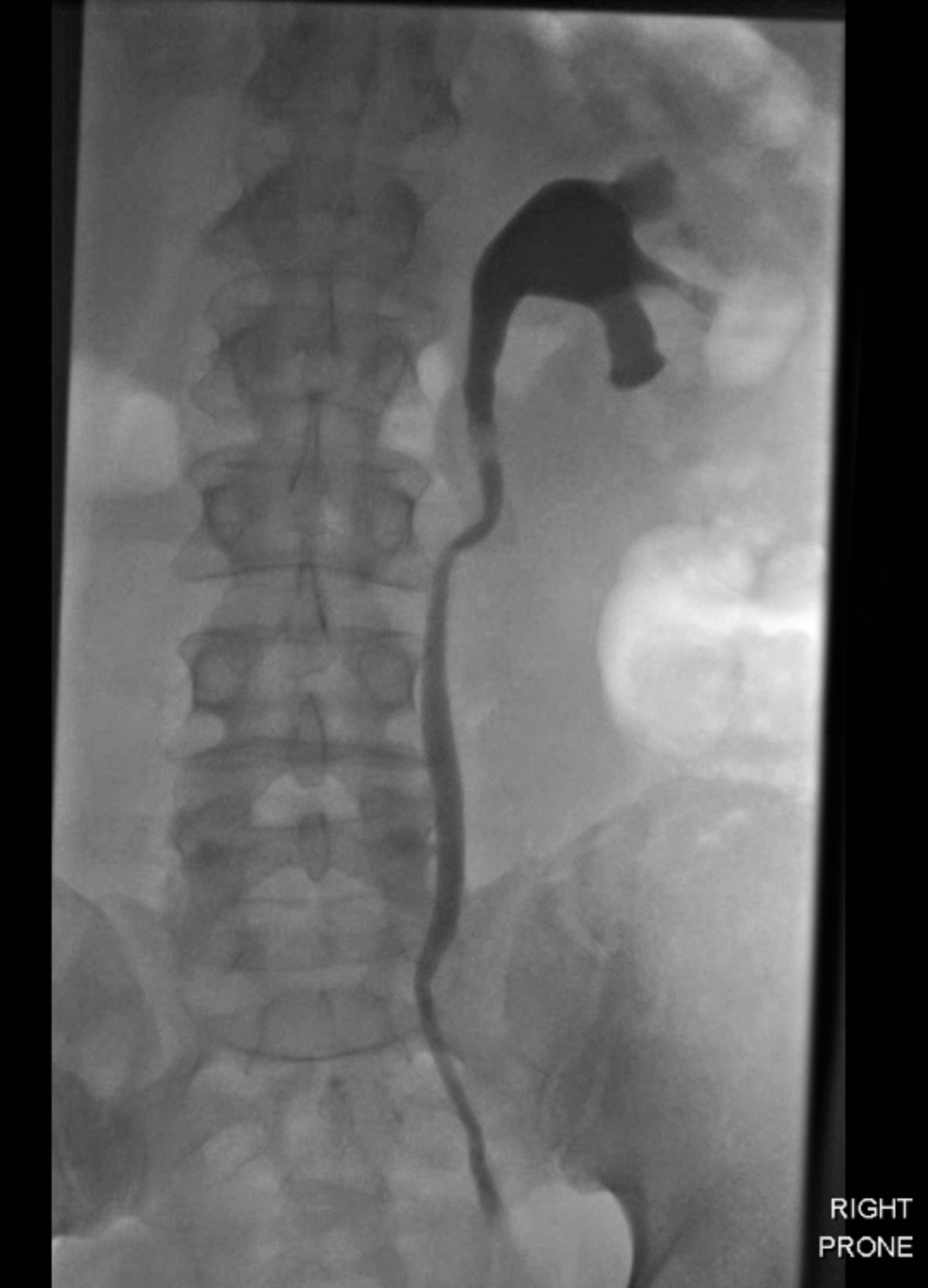 Which of the following is most likely increased in this patient's left kidney?
 (Multiple Choice)
4.8/5 (92)
(92) 
Filters
- Essay(0)
- Multiple Choice(0)
- Short Answer(0)
- True False(0)
- Matching(0)