



 Chat with AI
Exam 11: Pathophysiology

Exam 1: Anatomy291 Questions
Exam 2: Behavioral science240 Questions
Exam 3: Biochemistry156 Questions
Exam 4: Biostatistics117 Questions
Exam 5: Embryology52 Questions
Exam 6: Genetics103 Questions
Exam 7: Histology24 Questions
Exam 8: Immunology129 Questions
Exam 9: Microbiology336 Questions
Exam 10: Pathology816 Questions
Exam 11: Pathophysiology464 Questions
Exam 12: Pharmacology538 Questions
Exam 13: Physiology272 Questions
Select questions type


A 50-year-old woman comes to the physician due to periodic reddening of her skin that is starting to become bothersome. The redness involves mainly her face and neck and is accompanied by mild warmth. The episodes initially lasted only a few minutes, but now they sometimes exceed 20 minutes. The patient has also had persistent watery diarrhea and associated abdominal cramping for the last several months. Physical examination shows several, purple vascular lesions surrounding her nose. Urinary excretion of 5-hydroxyindoleacetic acid (5-HIAA) over 24 hours is increased. Abdominal imaging shows a tumor in the small intestine. Which of the following is most likely responsible for this patient's condition?
(Multiple Choice)
4.8/5  (72)
(72) A 60-year-old woman, gravida 1, para 1, comes to the office with abdominal distension and decreased appetite. She also has lost 10 pounds (4.5 kg) unintentionally over the past few months. She takes no medications and has received all recommended vaccinations except for the human papilloma vaccine. The patient's mother had BRCA-positive ovarian cancer and died at the age of 55. BMI is 30kg/m2. Imaging studies reveal a right-sided ovarian mass and an accumulation of free peritoneal fluid. Her blood work shows a marked elevation of CA-125. Which of the following most likely would have reduced the risk of this patient's condition?
(Multiple Choice)
4.9/5 (74)
(74) A 65-year-old male complains of bilateral visual difficulty that has progressed over the last year. Funduscopy reveals small yellow retinal lesions clustered in the macula. Which of the following would you expect most on visual field examination?
(Multiple Choice)
4.7/5 (72)
(72) A 78-year-old woman comes to the emergency department due to a 3-day history of intermittent but progressive substernal chest pain. Medical history includes hypertension and hyperlipidemia, but the patient has had poor adherence with her medication and outpatient follow-up. She has a 30 pack-year smoking history. On admission, ECG reveals normal sinus rhythm with ST-segment elevation and pathologic Q waves in leads I, aVL, and V2 to V5. The patient refuses percutaneous coronary intervention and is treated medically. On the fifth day of hospitalization, she experiences severe dyspnea, sweating, and hypotension. Physical examination shows raised jugular venous pressure, no heart murmurs, and clear lungs. She rapidly loses consciousness and becomes pulseless, and the subsequent resuscitation attempt is ineffective. Which of the following most likely contributed to this patient's death?
(Multiple Choice)
4.9/5 (87)
(87) A 66-year-old man comes to the office due to several weeks of back and lower extremity pain. The pain feels dull and achy and is worsened by movement, causing him to have difficulty bearing weight and ambulating. He has had no bladder or bowel dysfunction, extremity weakness, or numbness. The patient takes metformin for type 2 diabetes mellitus. He drinks 2 alcoholic beverages daily. Physical examination shows no gross abnormality or deformity of the back or extremities. There is no swelling or redness of the legs, and neurological examination is normal. A radiograph of the right lower extremity is shown in the exhibit. 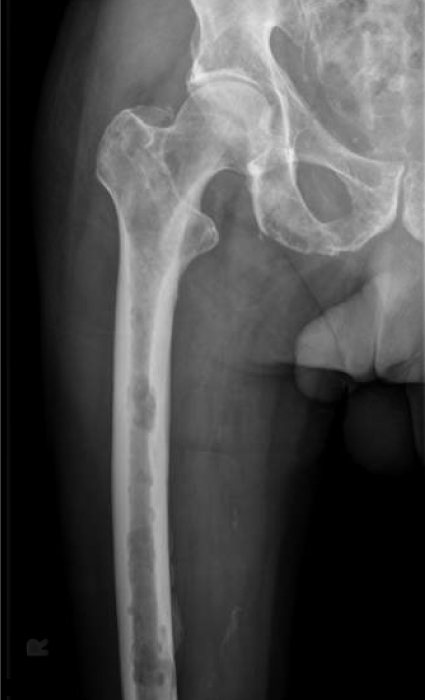 Laboratory results are as follows:
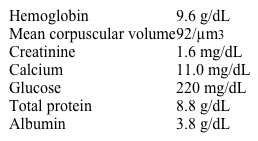 Which of the following is the most likely explanation for this patient's bone changes?
Laboratory results are as follows: Which of the following is the most likely explanation for this patient's bone changes? (Multiple Choice)
4.7/5 (77)
(77) A 34-year-old woman comes to the office with several months of vision problems, difficulty chewing, and trouble speaking. The symptoms fluctuate, but the patient has noticed that they are worse after a long day. She works as a telemarketer and has been putting in increasingly long hours to meet her quotas. Regarding her symptoms, she says, "It's probably just exhaustion; an ice pack to my face seems to help." During physical examination, the patient is asked to keep her eyes focused on a spot on the ceiling, and after 2 minutes, her vision becomes blurry. The remainder of the examination is normal. Further evaluation shows that the patient's symptoms are reversible on administration of an acetylcholinesterase inhibitor. The pathogenesis of this patient's disease is most similar to which of the following conditions?
(Multiple Choice)
4.9/5 (77)
(77) A 64-year-old man comes to the emergency department due to chest discomfort and shortness of breath. Medical history includes hypertension, type 2 diabetes mellitus, and severe osteoarthritis of the left knee. The patient is an active smoker with a 20-pack-year smoking history. He undergoes dobutamine infusion with simultaneous cardiac imaging. The following is seen:Before infusion: normal left ventricular contractility, ejection fraction 60%During infusion: decreased apical contractility, ejection fraction 45%Five minutes after infusion: normal left ventricular contractility, ejection fraction 60%Which of the following best explains the observed findings?
(Multiple Choice)
4.8/5 (68)
(68) A 16-year-old boy is evaluated for progressive gait instability, dysmetria, and dysarthria for the past several years. The patient enjoys basketball but can no longer play due to his worsening symptoms. He is worried as his brother died of a neurologic disease at age 21. Physical examination of the lower extremities reveals bilateral motor weakness and loss of deep tendon reflexes, joint position, and vibration sense. MRI of the brain and spine shows degeneration of the posterior columns and spinocerebellar tracts. Which of the following conditions has clinical manifestations that closely resemble this patient's disease?
(Multiple Choice)
4.9/5 (73)
(73) A 28-year-old previously healthy man comes to the urgent care clinic due to shortness of breath. The patient is on a ski vacation in Breckenridge, Colorado, which is situated at an altitude of 2926 m (9600 ft). On arrival 4 days ago, he experienced mild headache and nausea that resolved spontaneously, but since yesterday, he has had worsening dyspnea and cough. The patient now feels short of breath even with minimal exertion. Temperature is 37.3 C (99.1) F, blood pressure is 134/82 mm Hg, pulse is 98/min, and respirations are 22/min. Oxygen saturation is 86% on ambient air, which rapidly improves to 95% with supplemental oxygen. Physical examination shows pink mucous membranes, flat neck veins, bilateral inspiratory crackles, and no heart murmurs or pedal edema. Chest x-ray reveals patchy alveolar infiltrates. Which of the following is the most likely cause of this patient's current condition?
(Multiple Choice)
4.8/5 (75)
(75) A 13-year-old boy is evaluated for abnormal growth. His mother says that he has grown rapidly over the past 10 months and is much taller than his older brother and other children his age. During this time, she has had a hard time finding clothes that fit him and has had to buy new shoes for him each month due to increasing foot size. The patient says that he feels well except for excessive sweating. He has no history of major medical illness and takes no medications. Both parents are of average height and have normally proportioned limbs. The patient is above the 99th percentile for height and at the 90th percentile for weight. On physical examination, he has long extremities with large hands and feet; the lower jaw is protruding. Heart sounds are normal. Sexual development is Tanner stage 4. Which of the following is the most likely underlying cause of this patient's condition?
(Multiple Choice)
4.7/5 (79)
(79) At autopsy, the heart of an 80-year-old man has a small left ventricular cavity and thickening of the left ventricle walls, which measure 1.7 cm (normal: 0.7-1.1) at the posterior and septal wall locations. Microscopic examination shows diffusely enlarged cardiomyocytes, with prominent nuclei evident at low power. Increased expression of which of the following substances most likely contributed to these pathologic findings?
(Multiple Choice)
5.0/5 (71)
(71) A 53-year-old woman comes to the office due to aching pain in her legs. She is a hair stylist and has cut down on her work hours due to the discomfort. The patient has a history of migraine and untreated chronic hepatitis C. She smokes a pack of cigarettes daily but does not use alcohol or illicit drugs. Physical examination findings are shown in the image below. 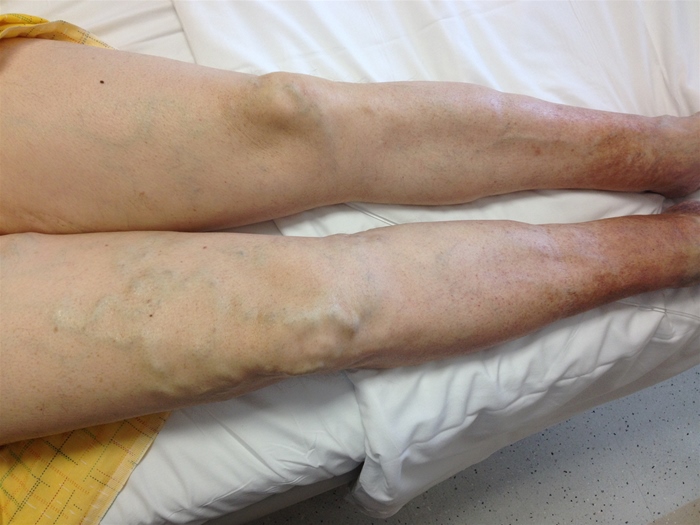 An abnormality of which of the following is the most likely cause of this patient's symptoms?
 (Multiple Choice)
4.9/5 (87)
(87) A 31-year-old man comes to the office due to progressive dyspnea over the past several months. The patient states that the shortness of breath improved initially with supine positioning, but lately, it is present even on recumbency and during minimal exertion. He reports recurrent episodes of nosebleeds since childhood but has no other medical conditions. Temperature is 36.7 C (98.1 F), blood pressure is 110/50 mm Hg, pulse is 102/min, and respirations are 20/min. Oxygen saturation is 96% on room air. Cardiac examination reveals an accentuated S2 over the upper left sternal border. The lungs are clear to auscultation. There is digital clubbing. Skin examination findings are shown in the exhibit. 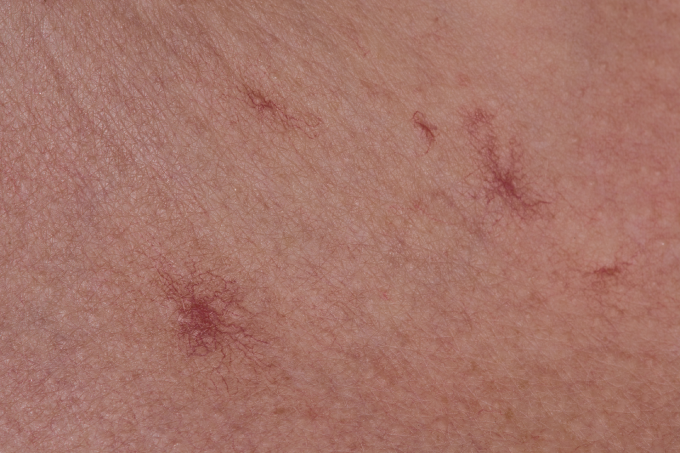 Which of the following is the most likely underlying cause of this patient's dyspnea?
 (Multiple Choice)
4.8/5 (86)
(86) A 32-year-old male with anorexia and fatigue is found to have persistently elevated serum alanine aminotransferase (ALT) and aspartate aminotransferase (AST) levels. He is also positive for HBsAg. Which of the following best describes the mechanism of liver injury in this patient?
(Multiple Choice)
4.8/5 (82)
(82) A 24-year-old man is evaluated due to a syncopal episode that occurred immediately after he completed a 13-mile half-marathon. The patient felt light-headed and then passed out. He was immediately placed in a supine position and regained consciousness after 2-3 minutes. The patient has no chest pain, palpitations, or shortness of breath. He has never had a similar episode. There is no family history of sudden death. The patient does not use alcohol or illicit drugs. Temperature is 37 C (98.6 F), blood pressure is 98/56 mm Hg, pulse is 80/min, and respirations are 14/min. Complete physical examination and ECG show no abnormalities. Which of the following is the most likely mechanism of this patient's syncope?
(Multiple Choice)
4.9/5 (96)
(96) A 32-year-old man comes to the emergency department due to sudden onset of severe right flank pain that radiates toward the groin. He also has gross hematuria but no fever or dysuria. The patient has no significant medical conditions and has never experienced similar symptoms. He takes no medications. Temperature is 36.7 C (98.1 F), blood pressure is 120/80 mm Hg, and pulse is 88/min. The right flank is tender to palpation. There is no costovertebral angle tenderness. Imaging shows a stone in the middle of the right ureter. Which of the following is most likely to be seen on laboratory evaluation of this patient?
(Multiple Choice)
4.8/5 (84)
(84) A 1-year-old boy is brought to the office for a health maintenance visit. He has had no significant health issues and is growing well. The patient is up to date with recommended vaccinations and has had no prior vaccine-related adverse events. He has no known allergies. Physical examination shows no abnormalities. The patient receives the first dose of the subcutaneous measles-mumps-rubella vaccine. The next day, his mother calls the office because the patient has a temperature of 38 C (100.4 F) and has been irritable since the vaccination. The immunization site is mildly red, swollen, and tender; there is no other skin rash. Which of the following cells and effector mechanisms is most likely involved in pathogenesis of this patient's current condition?
(Multiple Choice)
4.8/5 (78)
(78) A 52-year-old woman comes to the emergency department due to increasing dyspnea and chest tightness over the past 2 weeks. She has a history of stage 4 chronic kidney disease due to chronic glomerulonephritis. Temperature is 36.6 C (97.8 F), blood pressure is 106/82 mm Hg, and pulse is 98/min. Systolic blood pressure decreases by 12 mm Hg during inspiration. Physical examination shows distant heart sounds and clear lungs. Echocardiography in this patient is most likely to reveal which of the following findings?
(Multiple Choice)
4.8/5 (85)
(85) A previously healthy 15-year-old girl is brought to the emergency department due to respiratory distress and continuous cough after eating at a buffet in a local restaurant. Blood pressure is 80/40 mm Hg, pulse is 130/min, and respirations are 32/min. She is in marked respiratory distress but is able to speak. Diffuse wheezing and erythematous skin rash are present. Which of the following hemodynamic changes are most likely present in this patient?
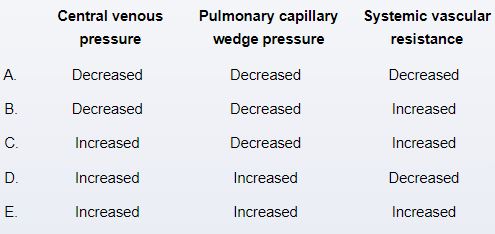
(Multiple Choice)
4.8/5 (87)
(87) An 86-year-old man is hospitalized for a complicated hip fracture requiring surgical repair following a fall. His medical problems include prostate cancer, gout, and osteoarthritis. An indwelling urinary catheter is placed due to initial urinary retention and immobilization following the surgery. On the eighth day of hospitalization, the patient develops fever and altered mental status. After evaluation and laboratory testing, a urinary tract infection is diagnosed. Which of the following is the most effective strategy for preventing this complication?
(Multiple Choice)
4.8/5 (76)
(76) 
Filters
- Essay(0)
- Multiple Choice(0)
- Short Answer(0)
- True False(0)
- Matching(0)