



 Chat with AI
Exam 11: Pathophysiology

Exam 1: Anatomy291 Questions
Exam 2: Behavioral science240 Questions
Exam 3: Biochemistry156 Questions
Exam 4: Biostatistics117 Questions
Exam 5: Embryology52 Questions
Exam 6: Genetics103 Questions
Exam 7: Histology24 Questions
Exam 8: Immunology129 Questions
Exam 9: Microbiology336 Questions
Exam 10: Pathology816 Questions
Exam 11: Pathophysiology464 Questions
Exam 12: Pharmacology538 Questions
Exam 13: Physiology272 Questions
Select questions type


A 54-year-old woman comes to the emergency department due to a 2-day history of fevers, chills, and severe fatigue. She has no chronic medical problems and takes no medication. Temperature is 38.9 C (102 F), blood pressure is 80/50 mm Hg, pulse is 130/min, and respirations are 20/min. The patient's left flank is tender to palpation. Cardiovascular examination reveals tachycardia, decreased capillary refill, and an estimated jugular venous pressure of 3 cm H2O above the sternal notch. Laboratory results are as follows: 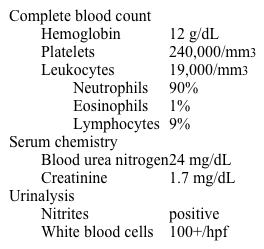 Which of the following is most likely decreased in this patient?
 (Multiple Choice)
4.8/5  (78)
(78) A 25-year-old woman comes to the office due to excessive facial hair growth that has worsened over the past several years. The patient is very concerned and says it makes her feel self-conscious in public. She has tried several cosmetic measures, including laser removal and waxing, but the results have been unsatisfactory. Her past medical history is insignificant, and she takes no medications. The patient's last menstrual period was 6 weeks ago, but she regularly has long cycles and otherwise feels well. She is sexually active with her boyfriend and uses condoms for contraception. Examination shows moderate obesity with mild hirsutism on the face and chest. The patient is initiated on a combination oral contraceptive. Which of the following describes the primary mechanism by which this agent reduces hirsutism?
(Multiple Choice)
5.0/5 (70)
(70) A 72-year-old woman is brought to the emergency department due to exertional chest pain. The patient is on vacation with her family and her symptoms began after arriving in the Colorado mountains. She has a history of coronary artery disease but has had no ischemic symptoms over the past several years. The patient is a lifetime nonsmoker and has no history of lung disease. Physical examination shows mild hypoxemia, clear lungs, an S4, and no extremity edema. ECG shows T-wave inversion in the lateral leads. Serum troponin and D-dimer levels are within normal limits. It is determined that decreased oxygen levels at high altitude in combination with age-related pulmonary changes lead to an exacerbation of this patient's preexisting heart condition. Which of the following respiratory changes most likely contributed to this patient's increased susceptibility?
(Multiple Choice)
4.9/5 (80)
(80) A 17-year-old girl is brought to the clinic due to irregular menses. Menarche was at age 12 and her cycles since then have been irregular, often with multiple months between menstrual periods. The patient also has had an increase in hair growth along her chest and face. Temperature is 37.3 C (99.1 F), blood pressure is 110/70 mm Hg, and pulse is 80/min. There are dark, terminal hairs above the patient's upper lip and nodulocystic acne across her forehead. Cardiopulmonary examination is normal. Sexual maturity rating (Tanner stage) is 5. Ultrasound examination of the pelvis reveals a normal uterus and ovaries. Electrolytes are normal; other laboratory results are as follows:  Which of the following enzyme reaction steps is most likely to be disrupted in this patient?
 (Multiple Choice)
4.9/5 (84)
(84) A 45-year-old previously healthy man comes to the office due to worsening muscle pain and weakness over the past 6 months. Carrying heavy items such as groceries has become increasingly difficult, and any prolonged activity causes diffuse muscle cramps. He has also had a 4.5-kg (10-lb) weight gain over this time. The patient takes no medications and does not use tobacco, alcohol, or illicit drugs. Blood pressure is 140/90 mm Hg and pulse is 56/min. BMI is 26 kg/m2. Physical examination shows muscle weakness, predominantly of the shoulder and hip girdles. When the knee reflex is elicited, the quadriceps muscle contracts briskly but relaxation takes longer than normal. There are splitting and peeling of the nails. Serum creatine kinase is elevated. Which of the following tests is most likely to identify the cause of this patient's muscle weakness?
(Multiple Choice)
4.9/5 (91)
(91) A 30-year-old man comes to the office due to a 4-month history of fatigue that is worse at the end of the day. The patient has also had abdominal bloating and intermittent loose stools after meals. His appetite is normal, and he has had no weight loss. Vital signs are normal. Examination shows pale mucosa. The abdomen is mildly distended and tympanic; there is no tenderness or organomegaly. Rectal examination reveals brown stool that is negative for fecal occult blood. Laboratory results are as follows: 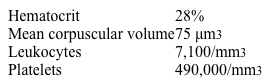 C-reactive protein level is normal. Which of the following pathologic gastrointestinal tract findings is most likely to be present in this patient?
 (Multiple Choice)
4.9/5 (64)
(64) A 44-year-old man with a history of intravenous drug use came to the emergency department due to fever and chills. Multiple blood culture sets were positive for Staphylococcus aureus, and the patient was diagnosed with infective endocarditis. He was successfully treated with a long course of antibiotics. Six months later, he returns to the clinic for a follow-up evaluation. The patient has no symptoms and reports good exercise tolerance. He is afebrile, blood pressure is 140/62 mm Hg, pulse is 82/min, and respirations are 16/min. Chest auscultation reveals a decrescendo diastolic murmur over the third intercostal space along the left sternal border. Echocardiogram shows severe aortic regurgitation, likely as a sequela to the prior infection. Which of the following changes is most responsible for maintaining cardiac output in the setting of this valvular abnormality?
(Multiple Choice)
4.7/5 (96)
(96) A 65-year-old man comes to the office due to several months of severe fatigue that limits his ability to do daily activities. He has also had upper abdominal fullness, early satiety, and unintentional weight loss but no fever, night sweats, cough, or rash. The patient has not seen a physician for many years. He does not use tobacco, alcohol, or illicit drugs and is a retired chemical engineer. Physical examination shows mucosal pallor with no scleral icterus. The lungs are clear on auscultation, and heart sounds are normal. There is mild hepatomegaly, and the spleen tip is palpable close to the midline of the abdomen. Laboratory evaluation reveals pancytopenia. Peripheral blood smear shows immature granulocytes, nucleated erythrocytes, and teardrop cells. Bone marrow aspiration is attempted but yields no marrow. Which of the following histopathological features is most likely to be present in this patient's spleen?
(Multiple Choice)
4.9/5 (87)
(87) A 5-year-old boy is brought to the office due to concerns about his speech and motor skills. The patient has a history of speech delay, and his parents say that his speech has become more slurred lately. He also has an unsteady, staggering gait that has progressively worsened over the past year. In addition, the mother states that the patient's eyes and head "do not move smoothly" when he looks at moving objects. Medical history is significant for recurrent ear and pulmonary infections. Vital signs are normal. Physical examination reveals numerous superficial nests of distended capillaries on the face and ears that blanch with pressure. This patient's condition is most likely due to a genetic defect affecting which of the following processes?
(Multiple Choice)
4.9/5 (77)
(77) An 82-year-old woman comes to the office due to fatigue, abdominal discomfort, and lower extremity swelling. She also occasionally feels an uncomfortable pulsation in her neck. Six weeks ago, the patient underwent pacemaker implantation due to sick sinus syndrome. Episodes of lightheadedness that she had experienced before the procedure have now resolved. The patient is afebrile, and other vital signs are normal. Physical examination reveals bilateral, lower extremity edema and a tender, pulsatile liver. The lungs are clear on auscultation. The pacemaker implantation site has healed normally. Complete blood count is normal. What is the most likely diagnosis?
(Multiple Choice)
4.9/5 (89)
(89) A 54-year-old man comes to the office for evaluation of chronic diarrhea and weight loss. He has had bulky, foul-smelling stools for the past 8 months, which usually occur shortly after eating. There have been no nocturnal bowel movements, and he denies fecal incontinence. The patient also experiences dull, epigastric abdominal pain that is exacerbated by eating and unrelieved by antacids. He drinks 6 or 7 beers a day but denies tobacco or illicit drug use. Vital signs are within normal limits. The abdomen is tender to palpation in the epigastrium without distension, rebound, or guarding. Sudan staining of a fecal specimen is positive, and fecal occult blood testing is negative. Blood testing reveals normal hemoglobin. Which of the following pathophysiologic changes are most likely present in this patient?
(Multiple Choice)
4.8/5 (78)
(78) A 40-year-old man comes to the emergency department 30 minutes after experiencing a seizure. Over the past 3 months, the patient has had several episodes of brief twitching of the right hand, but today the abnormal movement gradually progressed to involve the entire right upper extremity, followed by shaking of the whole body for about a minute. He also lost consciousness and urinated involuntarily during the event. The patient feels groggy and has a mild headache. He has no other medical conditions but reports several concussions from playing football in college. Vital signs are within normal limits. Physical examination shows mild weakness of right hand grip but is otherwise normal. This patient's seizure presentation is most suggestive of which of the following etiologic processes?
(Multiple Choice)
4.8/5 (91)
(91) A 28-year-old man is found unresponsive by his roommate. The roommate states the patient returned late last night after a party, and this morning he was unable to wake the patient up. Paramedics find the patient without respirations and pulse and declare him dead. Autopsy examination shows hemorrhage in the basal ganglia and midbrain that extends into the third ventricle. There is no arteriosclerosis or fibrinoid necrosis of the arterioles. Scattered areas of infarcted subendocardial myocardium are also seen. A substance with which of the following synaptic effects most likely predisposed this patient to death?
(Multiple Choice)
4.9/5 (76)
(76) A 71-year-old man comes to the office due to a 2-month history of progressive exertional dyspnea. The patient is unable to walk half a block without resting and can no longer climb stairs without stopping every few steps. He also has had difficulty sleeping due to repeatedly waking up at night feeling like he is suffocating. Physical examination shows bilateral lower extremity edema and distended neck veins. Cardiac auscultation findings over the apex are given below. This patient's auscultatory findings most likely reflect which of the following?
(Multiple Choice)
5.0/5 (85)
(85) A 45-year-old previously healthy man is brought to the emergency department after being hit by a car while cycling. The patient is hypotensive and tachycardic on arrival and has comminuted fractures of the pelvis and lower extremities. Volume resuscitation is performed with intravenous fluids and multiple units of packed red blood cells and plasma. Several hours later, the patient develops worsening dyspnea and hypoxia. Chest imaging reveals new bilateral infiltrates. Endotracheal intubation is performed for respiratory support. Despite aggressive resuscitation, the patient dies 24 hours later. Autopsy examination of the lungs shows protein-rich fluid within the alveolar airspaces. Breakdown of the barrier formed by which of the following cells most likely contributed to this patient's pulmonary pathology?
(Multiple Choice)
5.0/5 (74)
(74) An 8-year-old boy is brought to the office for rapid and irregular movements of his hands for one week. His parents say that he is also making unintentional "funny faces" and has trouble controlling the volume of his voice. His temperature is 38.9 C (102 F). On physical examination, the boy moves his hands frequently and erratically. He has a new III/VI systolic murmur and several circular, faintly erythematous lesions on his abdomen. Which of the following is the most likely mechanism for this patient's condition?
(Multiple Choice)
4.8/5 (91)
(91) A 30-year-old woman comes to the office for evaluation of irregular menses. The patient has had increasingly irregular menses over the past 6 months, and hot flashes and unintentional weight loss for the past few months. She has also had intermittent lower abdominal pain that is usually worse after increased physical activity. The patient has no chronic medical conditions and takes no daily medications. On examination, the abdomen is nontender. A pelvic examination shows a left adnexal mass and a small uterus. TSH is low and a urine pregnancy test is negative. Pelvic ultrasound reveals a 6-cm left ovarian mass. The mass is surgically removed, and gross examination of the specimen shows a cystic lesion with an oily substance. Which of the following cell types is the most likely source of the neoplasm in this patient?
(Multiple Choice)
4.9/5 (71)
(71) A 46-year-old man with a 30-pack-year smoking history develops right leg pain and swelling after returning from an overseas trip. He is diagnosed with a lower extremity deep venous thrombosis and is started on intravenous heparin. Shortly after being hospitalized, he develops right-sided weakness and facial droop. CT scan of the head reveals a left middle cerebral artery stroke. Which of the following physical examination findings is most likely to be present in this patient?
(Multiple Choice)
4.9/5 (76)
(76) A 1-week-old boy is brought to the emergency department due to recurrent vomiting and poor feeding. The infant was born at term via spontaneous vaginal delivery with no complications. Temperature is 36.7 C (98 F), blood pressure is 58/30 mm Hg, pulse is 180/min, and respirations are 40/min. On examination, the patient is tired appearing with a sunken anterior fontanelle and dry mucous membranes. The remainder of the examination is unremarkable. Laboratory results are as follows: 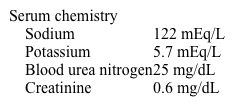 Which of the following additional laboratory findings are most likely to be seen in this patient?
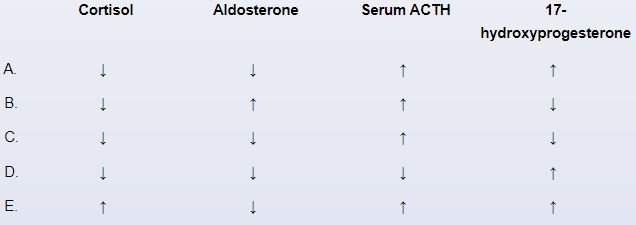
Which of the following additional laboratory findings are most likely to be seen in this patient?
(Multiple Choice)
4.9/5 (78)
(78) A 53-year-old woman is admitted to the hospital due to a 3-day history of worsening dyspnea. On examination, the patient is tachypneic; diffuse, wet, inspiratory crackles are present on pulmonary auscultation. Chest x-ray reveals bilateral patchy opacities. Arterial blood gas analysis shows that the patient's alveolar-arterial gradient (PAO2 − PaO2) is markedly increased. Although the patient receives 100% oxygen via a face mask, she has persistent hypoxemia and respiratory distress. Consequently, she is intubated and placed on mechanical ventilation with 100% oxygen and positive end-expiratory pressure (PEEP). Results of arterial oxygen measurements are as follows:  The patient's improved oxygenation following PEEP application is most likely due to a decrease in which of the following?
 (Multiple Choice)
4.7/5 (85)
(85) 
Filters
- Essay(0)
- Multiple Choice(0)
- Short Answer(0)
- True False(0)
- Matching(0)