



 Chat with AI
Exam 11: Pathophysiology

Exam 1: Anatomy291 Questions
Exam 2: Behavioral science240 Questions
Exam 3: Biochemistry156 Questions
Exam 4: Biostatistics117 Questions
Exam 5: Embryology52 Questions
Exam 6: Genetics103 Questions
Exam 7: Histology24 Questions
Exam 8: Immunology129 Questions
Exam 9: Microbiology336 Questions
Exam 10: Pathology816 Questions
Exam 11: Pathophysiology464 Questions
Exam 12: Pharmacology538 Questions
Exam 13: Physiology272 Questions
Select questions type


A 1-month-old boy is brought to the office on a hot summer day due to vomiting and excessive sleepiness. He had been exclusively breastfeeding with normal feeding patterns until this afternoon, when he had 2 episodes of emesis and appeared much sleepier than usual. The infant was born at 41 weeks gestation after an unremarkable pregnancy. Newborn screening was positive for a homozygous ΔF508 mutation affecting an epithelial transmembrane protein; further confirmatory testing is pending. Physical examination shows a somnolent boy with a sunken fontanelle and dry mucous membranes. Which of the following electrolyte disturbances is most likely responsible for this patient's current symptoms?
(Multiple Choice)
4.9/5  (77)
(77) A 72-year-old man comes to the office due to palpitations, fatigue, and dyspnea for the past 2 weeks. The patient experienced an episode of atrial fibrillation 4 years ago during hospitalization for pneumonia; the episode spontaneously resolved 2 days later. Since then, he has had 3 episodes of symptomatic atrial fibrillation that self-terminated within a week. Other medical history includes hypertension, type 2 diabetes mellitus, and chronic heart failure. Blood pressure is 130/84 mm Hg and pulse is 110/min. The lungs are clear to auscultation. Cardiac examination demonstrates tachycardia with irregularly irregular heartbeats. ECG confirms atrial fibrillation. The patient's ventricular rate is controlled with beta blocker therapy, but the arrhythmia fails to resolve as in previous episodes. Which of the following factors is most likely involved in the progression of this patient's arrhythmia?
(Multiple Choice)
4.8/5 (78)
(78) A newborn girl is evaluated in the nursery for a heart murmur. The infant was born at 39 weeks gestation via spontaneous vaginal delivery following an uncomplicated pregnancy. She has been breastfeeding well and has urinated 3 times and stooled once. Approximately 1 hour after delivery, a 2/6 systolic murmur could be heard at the left upper sternal border. At age 8 hours, the murmur could be heard during both systole and diastole. Examination at age 24 hours revealed no murmur. Which of the following is most likely responsible for the disappearance of this patient's murmur?
(Multiple Choice)
5.0/5 (71)
(71) A 25-year-old man comes to the hospital due to acute-onset shortness of breath. The patient has a history of cystic fibrosis and multiple hospitalizations for recurrent pneumonia. He has a frequent productive cough at baseline. He does not use tobacco. Blood pressure is 80/50 mm Hg, pulse is 110/min, and respirations are 24/min. Examination shows mild cyanosis and subcutaneous crepitus. Breath sounds are decreased on the left. Which of the following is most likely responsible for this patient's acute symptoms?
(Multiple Choice)
4.9/5 (86)
(86) A 25-year-old man comes to the emergency department due to chest heaviness and palpitations for the last 3 hours. Over the past year, he has had similar episodes that resolved with deep breathing, but none lasted as long as this one. The patient has no chronic medical conditions and takes no medications. He does not use tobacco, alcohol, caffeine, or illicit drugs. Blood pressure is 100/70 mm Hg, and pulse is 160/min and regular. The neck is supple, the thyroid is normal, and there is no lymphadenopathy. The lungs are clear to auscultation. ECG is shown in the exhibit.  Which of the following is the most likely cause of this patient's symptoms?
 (Multiple Choice)
4.8/5 (74)
(74) A 35-year-old woman, gravida 1 para 0, at 40 weeks gestation has a protracted labor course for which a cesarean delivery is performed under epidural anesthesia. Shortly after delivery, the patient has chest pain and difficulty breathing. She becomes hypotensive, bradycardic, hypoxic, and unresponsive, and undergoes emergency intubation. The surgical incisions begin to bleed profusely and the patient goes into cardiorespiratory arrest. She is declared dead after 30 minutes of cardiopulmonary resuscitation. The family agrees to an autopsy. Which of the following is the most likely finding during histologic evaluation of her lungs?
(Multiple Choice)
4.7/5 (86)
(86) A 66-year-old woman is brought to the emergency department due to left leg pain. Five days ago, the patient underwent elective right hip arthroplasty for advanced osteoarthritis. She had been recovering well at an acute rehabilitation facility until she woke today with severe left calf pain and swelling. The patient has taken daily subcutaneous, low-molecular-weight heparin and as-needed acetaminophen since the surgery. She has no other medical conditions. Temperature is 37 C (98.6 F), blood pressure is 130/70 mm Hg, and pulse is 92/min. The surgical incision over her right hip is healing well. Her left posterior calf is tender and swollen to the knee. Three days ago, complete blood count was normal, but platelet count is now 70,000/mm3. Peripheral blood smear shows decreased platelet number but no other abnormalities. Which of the following is the most likely cause of this patient's thrombocytopenia?
(Multiple Choice)
4.9/5 (74)
(74) A 54-year-old man with a history of hepatitis C infection is brought to the emergency department by his wife after several episodes of vomiting bright red blood. He is admitted to the hospital and the appropriate treatment is initiated. During morning rounds the next day, the patient is disoriented and cannot identify the month or his current location. Physical examination shows significant abdominal distention and gynecomastia. Repetitive flicking motions of the hands are seen when the patient is asked to outstretch his arms and dorsiflex his wrists. Which of the following is most likely contributing to this patient's altered mental status?
(Multiple Choice)
4.9/5 (73)
(73) A 10-day-old boy born at home is brought to the emergency department due to difficulty breathing and sweating with feeds. He was born at 38 weeks gestation via spontaneous vaginal delivery. The patient has been breastfeeding every 2 hours for 5-10 minutes per side. The mother notes that he sweats while he feeds, and his lips turn blue. Weight is at the 5th percentile and length is at the 50th percentile. On examination, the patient is currently not cyanotic. There is a III/VI systolic crescendo-decrescendo murmur best heard along the left upper sternal border. Chest x-ray is shown below: 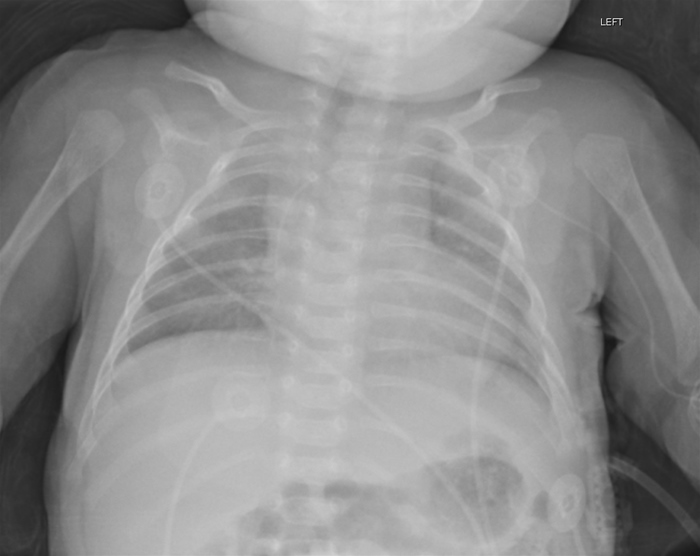 Which of the following most likely represents the pressure changes that take place in this patient during feedings?
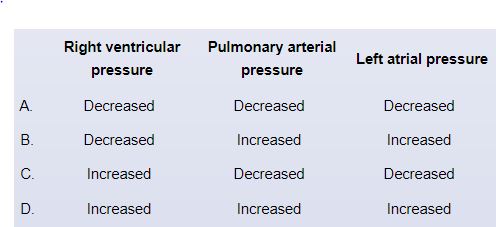
Which of the following most likely represents the pressure changes that take place in this patient during feedings?
(Multiple Choice)
4.8/5 (87)
(87) An apparently healthy 6-year-old boy is enrolled in a research study designed to assess the amino acid absorptive capacity of the intestine. As part of the investigation, he is administered an oral solution containing free amino acids. Blood samples are then obtained at 15 minute intervals for the next 2 hours. The boy is found to have significantly decreased intestinal absorption of lysine, arginine, ornithine, and cysteine as compared to the other study participants. If his condition is left untreated, which of the following complications is this patient at greatest risk of developing?
(Multiple Choice)
4.7/5 (85)
(85) A 56-year-old woman comes to the office due to progressive weight gain and fatigue over the last 4 months. She also has had increasing difficulty in lifting heavy objects and climbing stairs. The patient has moderate, persistent bronchial asthma for which she uses inhaled corticosteroids and beta-2 agonists. Family history is significant for colon cancer in her father. Blood pressure is 160/90 mm Hg and pulse is 80/min. On physical examination, there is symmetric proximal muscle weakness of the upper and lower extremities. Fasting plasma glucose level is 135 mg/dL and 24-hour urinary cortisol is increased. Further evaluation reveals that high-dose, but not low-dose, dexamethasone suppresses serum cortisol levels. Serum ACTH levels are high-normal. Which of the following is the most likely cause of this patient's symptoms?
(Multiple Choice)
4.9/5 (81)
(81) A newborn is being evaluated in the nursery. The patient was born at term via spontaneous vaginal delivery to a 23-year-old woman. The mother developed dark terminal facial hair and a deepened voice during the pregnancy. The delivery was unremarkable, and the patient's vital signs are within normal limits. Examination shows ambiguous genitalia and clitoromegaly. Laboratory studies reveal elevated serum levels of testosterone and androstenedione. Karyotype testing shows a 46,XX genotype. Ultrasound of the pelvis shows a normal-sized uterus. This infant's presentation is most likely due to deficiency of which of the following enzymes?
(Multiple Choice)
4.9/5 (71)
(71) A 35-year-old man comes to the office with progressive fatigue, dyspnea on exertion, and lower extremity edema over the last 2 weeks. Preceding these symptoms, he had an episode of fever, runny nose, and myalgias that resolved after several days. The patient has no other medical history, takes no medications, and has no significant family history. He occasionally drinks alcohol and does not use tobacco. Blood pressure is 112/74 mm Hg, and pulse is 98/min and regular. Physical examination reveals jugular venous distension, bibasilar crackles on lung auscultation, and 2+ pitting edema involving the lower extremities. Which of the following echocardiographic findings is most likely to be seen in this patient?
(Multiple Choice)
4.8/5 (77)
(77) A 45-year-old woman diagnosed with Crohn disease 3 years ago comes to the office due to recurrent right upper quadrant abdominal pain. The pain is graded 5/10 in intensity, is characterized as dull, and occasionally radiates to the right shoulder. It typically occurs after eating fatty meals and is associated with nausea. The patient has no fever, vomiting, melena, or hematochezia. She currently takes infliximab for Crohn disease and atorvastatin for hyperlipidemia. Vital signs and abdominal examination are normal. Abdominal ultrasonography reveals multiple mobile calculi within the gallbladder. Which of the following processes is most likely responsible for the development of gallstones in this patient?
(Multiple Choice)
4.8/5 (71)
(71) A 38-year-old woman comes to the office due to intermittent abdominal pain and bloating since childhood. The patient does not drink milk because she does not like the taste and adds, "I eat ice cream, cheese, and yogurt, but they upset my stomach sometimes." There is no associated weight loss, abnormal bleeding, or joint pain. Past medical history is otherwise unremarkable, though the patient has not seen a physician for many years. Vital signs and physical examination are normal. Laboratory studies show normal hemoglobin, iron, and vitamin D levels. A biopsy sample of this patient's small bowel mucosa would most likely show which of the following?
(Multiple Choice)
4.8/5 (89)
(89) A 65-year-old Caucasian male presents to the ER with sudden onset of right-sided calf and foot pain. His past medical history is significant for hypertension, type II diabetes mellitus, atrial fibrillation and stable angina. Physical examination reveals paleness of the right leg and diminished right popliteal pulse. Immediate angiography is ordered that reveals an obstructive thrombus in the right common femoral artery. The thrombus extraction is followed by a rapid surge of serum creatine kinase level, which is best explained by:
(Multiple Choice)
4.8/5 (85)
(85) A 12-year-old girl is brought to the office by her mother due to unusual nighttime behavior. The mother reports that once or twice a month over the past year she has found her daughter walking around the house between the hours of midnight and 2 AM. The mother says, "Although her eyes are open, she appears to be in a daze and doesn't respond to me. I guide her back to bed and she goes back to sleep, but I worry that she could get hurt or fall down the stairs if I'm not there." The girl has no recollection of the events. Which of the following EEG patterns is characteristic of the sleep stage associated with this behavior?
(Multiple Choice)
4.7/5 (67)
(67) A 25-year-old primigravida at 37 weeks gestation is brought to the emergency department with constant, excruciating abdominal pain and sudden vaginal bleeding for the past 3 hours. The patient is Rh negative and received Rh(D) immunoglobulin at 28 weeks gestation. She has no chronic medical conditions and takes no medications. Blood pressure is 160/100 mm Hg and pulse is 118/min. Physical examination shows a firm and tender uterus. Speculum examination reveals a moderate amount of bleeding coming from an open cervical os. Fetal heart tracing shows a baseline of 105/min and no variability. Which of the following is the most likely cause of this patient's bleeding?
(Multiple Choice)
4.9/5 (76)
(76) A 29-year-old woman, gravida 2 para 1, at 32 weeks gestation comes to the emergency department due to heavy vaginal bleeding. The bleeding started an hour ago. It was light initially and associated with only mild abdominal pain, but both the bleeding and the pain have increased, and now the pain is constant and severe. The patient has no chronic medical conditions. Her prior pregnancy was a term vaginal delivery complicated by preeclampsia with severe features. Blood pressure is 156/98 mm Hg, and pulse is 112/min. The uterus is firm and tender. Pelvic examination reveals heavy bleeding from the cervical os. Which of the following is the most likely cause of this patient's current presentation?
(Multiple Choice)
4.9/5 (67)
(67) A 24-year-old man comes to the physician due to excessive daytime sleepiness. The patient is a college student whose symptoms started around age 12, when he began needing more sleep than his peers to feel refreshed. Two years later, he started having daily episodes of sudden weakness, consistently triggered by laughter or crying, in which his head would nod or his knees would buckle for about 30 seconds. The patient also describes times when he was unable to move for several minutes after awakening from sleep. He mentions nightly dreams that seem very real, often featuring activities that he had been engaged in during the preceding day. If measured, which of the following compounds is most likely to be abnormal in this patient's cerebrospinal fluid?
(Multiple Choice)
4.9/5 (86)
(86) 
Filters
- Essay(0)
- Multiple Choice(0)
- Short Answer(0)
- True False(0)
- Matching(0)