



 Chat with AI
Exam 11: Pathophysiology

Exam 1: Anatomy291 Questions
Exam 2: Behavioral science240 Questions
Exam 3: Biochemistry156 Questions
Exam 4: Biostatistics117 Questions
Exam 5: Embryology52 Questions
Exam 6: Genetics103 Questions
Exam 7: Histology24 Questions
Exam 8: Immunology129 Questions
Exam 9: Microbiology336 Questions
Exam 10: Pathology816 Questions
Exam 11: Pathophysiology464 Questions
Exam 12: Pharmacology538 Questions
Exam 13: Physiology272 Questions
Select questions type


A 4-year-old boy is brought to the emergency department by his parents following a seizure. The patient has had an upper respiratory illness for the last 2 days but has no previous history of seizures. Today, he suddenly became unresponsive and his arms and legs started shaking for approximately 40 seconds. The patient was alert when the paramedics arrived at his house. In the emergency department, temperature is 40 C (104 F) and pulse is 110/min. The patient appears tired but is alert and cooperative. Physical examination shows clear nasal discharge and mild pharyngeal erythema but no nuchal rigidity or other neurologic deficits. Which of the following is the most likely underlying cause of this patient's seizure?
(Multiple Choice)
4.9/5  (93)
(93) A 56-year-old woman is brought to the emergency department due to several days of progressive dyspnea, productive cough, and fever. Today, her son found her very short of breath and obtunded. The patient has a history of hypertension, type 2 diabetes mellitus, and long-standing rheumatoid arthritis. Examination reveals bilateral pneumonia and severe respiratory distress. The patient is lethargic without focal neurologic deficits. Urgent endotracheal intubation is performed for mechanical ventilation, and the patient is started on broad-spectrum antibiotics. Repeat examination 2 hours later shows that she has developed areflexic, flaccid paralysis of all extremities. Which of the following is the most likely cause of the neurologic deficits in this patient?
(Multiple Choice)
5.0/5 (97)
(97) A 60-year-old man comes to the office due to persistent cough for the past several weeks. He reports producing minimal sputum that recently has contained occasional specks of blood. The patient also has anorexia and has lost 7 kg (15.4 lb) over the past 2 months. He has no previous medical conditions and takes no medications. The patient has smoked a pack of cigarettes daily for 40 years and drinks alcohol on social occasions. Temperature is 37.1 C (98.7 F), blood pressure is 130/80 mm Hg, pulse is 72/min, and respirations are 16/min. On physical examination, respirations are unlabored, and there are occasional wheezes on the left side. The remainder of the examination shows no abnormalities. A chest x-ray reveals a hilar mass with adenopathy on the left side. Laboratory results demonstrate a decreased serum sodium level. Which of the following additional laboratory abnormalities are most likely to be present in this patient?
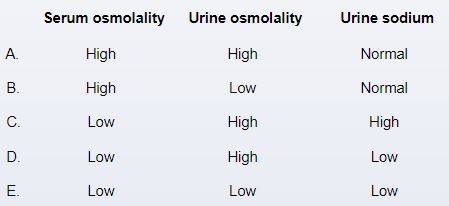
(Multiple Choice)
4.9/5 (73)
(73) A 75-year-old man comes to the office due to a 2-year history of slowly worsening vision in both eyes. The symptoms are worse at night and the patient has stopped driving at night due to excessive glare from oncoming headlights. He has worked his entire life as a farmer and continues to drive tractors and other farm equipment during the day without difficulty. Medical history is unremarkable. Ocular examination shows loss of the red reflex and poor visualization of retinal detail. Acuity testing shows 20/100 vision in both eyes; visual field testing is normal. Which of the following is the most likely etiologic factor for this patient's eye condition?
(Multiple Choice)
4.9/5 (92)
(92) A researcher is exploring various methods to decrease neuronal loss after ischemic injury. During an experiment, the researcher induces focal cerebral ischemia in rodents; after a short time, there is ATP depletion and subsequent ionic derangements in cells within the infarction core. Increased release and impaired clearance of extracellular neurotransmitters is also noted. One particular neurotransmitter leads to sustained calcium influx in exposed neurons, initiating a toxic cascade that result in rapid cell death. Blockade of a receptor for which of the following neurotransmitters is most likely to decrease this type of neuronal injury?
(Multiple Choice)
4.9/5 (74)
(74) A 67-year-old man is brought to the hospital after he developed sudden-onset altered mental status. The patient was taking care of some yardwork alongside his 17-year-old grandson during a hot summer day. The grandson does not have any symptoms. On examination, the patient's temperature is 41 C (105.8 F), blood pressure is 90/60 mm Hg, pulse is 120/min, and respirations are 24/min. Examination shows warm and dry skin. The patient is not oriented to time, place, or person. Deep tendon reflexes and muscle tone are normal. Which of the following findings in this patient most likely explains why the patient developed symptoms while his grandson remained asymptomatic?
(Multiple Choice)
4.9/5 (76)
(76) A 33-year-old man with a 2-year history of Crohn ileocolitis comes to the clinic with left-sided flank pain that started in the morning. The pain is 8 on a scale of 0-10 in intensity and is characterized as sharp. The pain is also colicky and radiates to the left groin. The patient has no nausea or vomiting. He is in moderate distress and has trouble lying still during the examination. Urinalysis shows hematuria. A day later, the patient passes a urinary stone. Abdominal imaging reveals several additional kidney stones. Which of the following is the most likely underlying cause of this patient's kidney stones?
(Multiple Choice)
4.7/5 (69)
(69) A 2-year-old boy with no chronic medical conditions is brought to the emergency department after he was found unresponsive with vomitus in his mouth. The patient has had muscle aches, cough, rhinorrhea, diarrhea, vomiting, and fever for the past 3 days. His parents gave him aspirin twice daily for symptom control. Vital signs are within normal limits. On examination, the patient is somnolent but withdraws from pain. Pupils are equal in size and reactive to light. Cardiopulmonary examination shows no abnormalities. Hepatomegaly is present. Extremities are well perfused. Laboratory results are as follows: 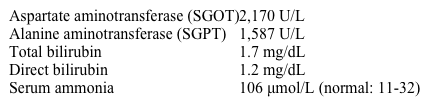 Over the next day, the patient's condition deteriorates and he dies despite supportive care. Examination of the brain would most likely reveal which of the following findings?
 (Multiple Choice)
4.7/5 (82)
(82) A 60-year-old woman is brought to the hospital due to progressive shortness of breath and cough for 2 weeks. The patient was diagnosed with right breast cancer and completed radiation therapy 6 weeks ago. Temperature is 37.3 C (99.1 F), blood pressure is 110/70 mm Hg, pulse is 90/min, and respirations are 22/min. Oxygen saturation is 93% on room air. Examination reveals inspiratory crackles over the right lung anteriorly; the lungs are otherwise clear to auscultation. Chest radiograph shows ground-glass opacities in the right lung where radiation was delivered. Laboratory studies reveal no significant changes. Acute radiation-induced lung injury is suspected. Histopathologic examination would most likely reveal formation of which of the following?
(Multiple Choice)
4.8/5 (62)
(62) A 62-year-old man comes to the office for evaluation of progressive exertional dyspnea. His medical history is significant for pneumonia and hypertension. He has a 45-pack-year smoking history. On physical examination, breath sounds are decreased bilaterally and wheezes are heard. A CT scan of the chest is shown below. 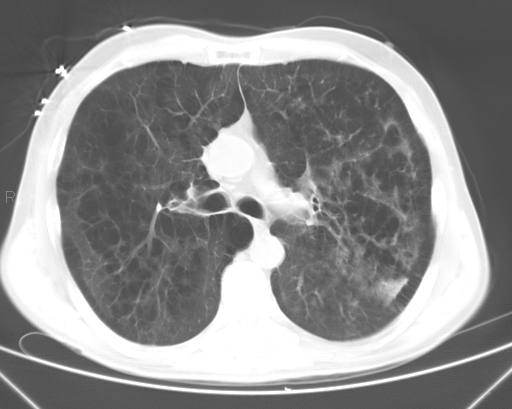 Which of the following cells are most responsible for the development of this patient's lung condition?
 (Multiple Choice)
4.9/5 (88)
(88) A 54-year-old man comes to the office due to light-headedness when walking his dog in the morning. He has had no chest pain, shortness of breath, weakness, or headaches. Cardiac auscultation findings at the right sternal border are heard in the exhibit.
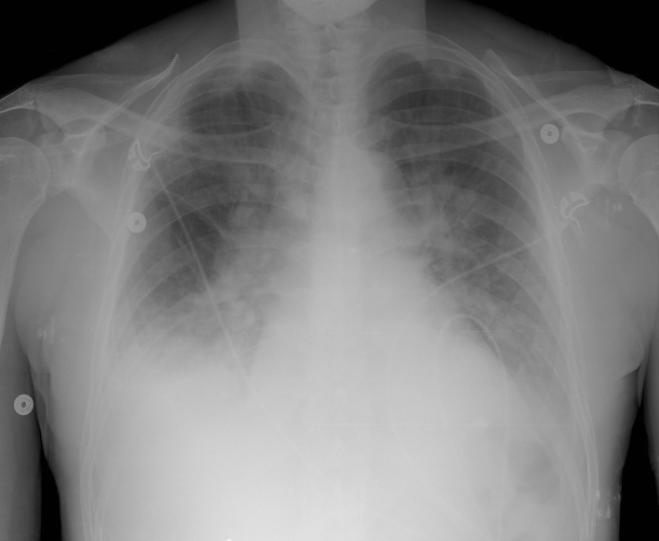 Which of the following is the most likely cause of this patient's symptoms?
 (Multiple Choice)
5.0/5 (95)
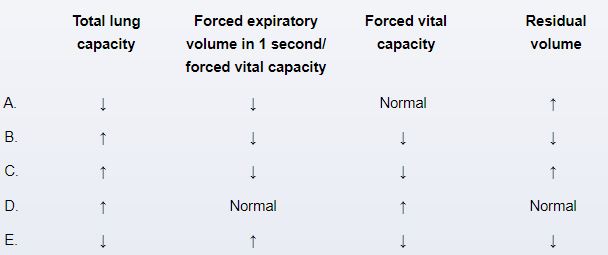
(95) A 65-year-old man comes to the office due to worsening exertional dyspnea over the past 3 months. This past year, he has had 4 respiratory infections that improved with medical therapy. The patient does not use alcohol or illicit drugs and has smoked 1½ packs of cigarettes daily for 30 years. Temperature is 36.7 C (98.1 F), pulse is 76/min, and respirations are 18/min. On physical examination, breath sounds are diffusely decreased. Chest radiography reveals flattened hemidiaphragms, increased radiolucency of the lungs, and a long, narrow heart shadow. This patient's pulmonary function testing will most likely show which of the following patterns of findings?
(Multiple Choice)
4.9/5 (87)
(87) An 8-year-old girl is brought to the emergency department due to "not feeling well." The patient was at an outdoor picnic and began experiencing nausea, vomiting, abdominal cramps, and watery diarrhea 30 minutes ago. She also reports feeling dizzy. The patient has no prior medical conditions and takes no medications. Temperature is 37 C (98.6 F), blood pressure is 60/30 mm Hg, pulse is 140/min, and respirations are 28/min. On physical examination, the patient appears pale and listless. There is faint bilateral wheezing. The abdomen is soft and nontender. Scattered wheals are present. Which of the following is most responsible for this patient's current condition?
(Multiple Choice)
5.0/5 (82)
(82) A 42-year-old man comes to the emergency department due to several hours of dyspnea. He is a long-haul truck driver who became acutely short of breath during a 36-hour trip but previously had been healthy. The patient smokes a pack of cigarettes daily and drinks a 6-pack of beer on weekends. Pulmonary examination reveals vesicular breath sounds bilaterally with the overlying areas resonant to percussion. CT pulmonary angiogram shows a right lower lobe pulmonary artery occlusion consistent with pulmonary embolism but no evidence of pulmonary infarction. Which of the following is the most likely reason for the lack of lung tissue necrosis in this patient?
(Multiple Choice)
4.8/5 (70)
(70) An 8-year-old girl is brought to the emergency department due to worsening shortness of breath and chest tightness for the past 2 hours. On physical examination, the patient speaks in short sentences. Lung auscultation reveals diffuse wheezing. During the evaluation, the patient is instructed to take a deep breath and blow as hard as possible into the mouthpiece of a hand-held device. The measured airflow rate is significantly lower than expected. Treatment with an inhaled medication is begun. A repeat evaluation several minutes later shows an increase in the airflow rate. The administered medication most likely affected which of the following to produce the observed finding in this patient?
(Multiple Choice)
4.8/5 (72)
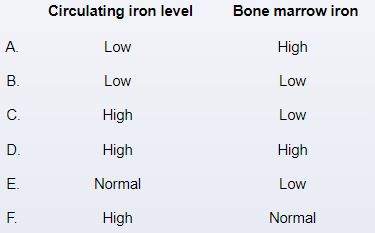
(72) A 54-year-old woman comes to the office due to 3 months of progressive pain and prolonged morning stiffness in her hand joints. She has tried over-the-counter naproxen without significant relief. Review of systems is positive for fatigue. The patient has no other chronic medical conditions and takes no other medications regularly. Vital signs are normal. Swelling and tenderness of the proximal interphalangeal joints and metacarpophalangeal joints are present in both hands. Laboratory studies reveal a hemoglobin of 9.8 g/dL and MCV of 86. The patient is prescribed methotrexate therapy. Laboratory results 6 months later reveal that hemoglobin has increased to 12 g/dL. If measured, which of the following changes were most likely present in this patient before the start of methotrexate therapy?
(Multiple Choice)
4.9/5 (88)
(88) An infant is born at 39 weeks gestation to a 26-year-old woman. The delivery was uncomplicated, and Apgar scores were 8 and 9 at 1 and 5 minutes, respectively. The mother had gestational diabetes during pregnancy, which was controlled by diet alone. Physical examination of the infant shows clitoromegaly and partial fusion of the labioscrotal folds. Cytogenetic analysis reveals a 46,XX karyotype. Abdominal imaging shows bilateral adrenal hyperplasia. This patient is most likely deficient for an enzyme normally responsible for which of the following reactions?
(Multiple Choice)
4.9/5 (83)
(83) A 34-year-old man comes to the office due to progressive low back pain for several years. The patient reports that the stiffness and pain are worst in the morning but gradually improve during the day. Lately, he has been taking over-the-counter ibuprofen, which provides some relief. Laboratory evaluation shows a positive HLA-B27 antigen. X-ray imaging reveals fusion of the sacroiliac joints. Which of the following is most helpful to monitor disease progression in this patient?
(Multiple Choice)
4.9/5 (90)
(90) A 72-year-old man is evaluated due to a scaly lesion behind his right ear. A diagnosis of squamous cell carcinoma is confirmed on biopsy, and the patient undergoes excision of the lesion with clear margins. The wound is left to heal by secondary intention. Three weeks later, the patient returns to the office with a 2.5-cm raised, soft, granular lesion at the excision site. Biopsy of a representative lesion is shown in the image below: 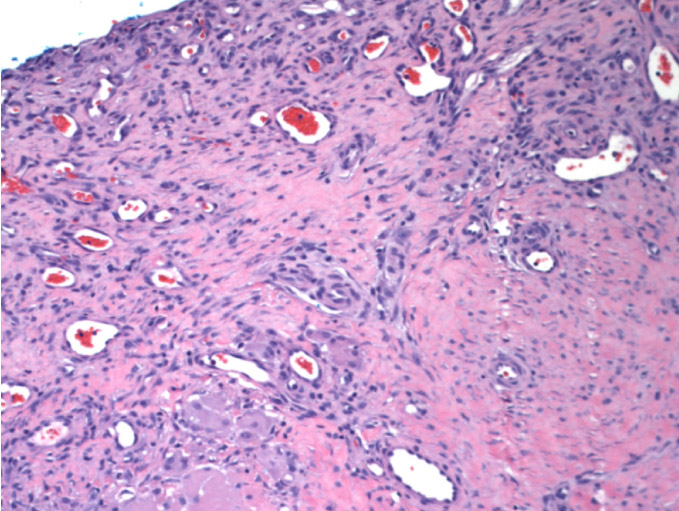 Which of the following is most likely responsible for this patient's postoperative changes?
 (Multiple Choice)
4.8/5 (80)
(80) A 68-year-old woman comes to the emergency department for evaluation of stroke-like symptoms. The patient says her face appeared "twisted" this morning but was normal when she went to bed last night. Her brother recently had a stroke, and she was worried that she may also be having a stroke. The patient has a history of hypertension, hyperlipidemia, and type 2 diabetes mellitus. Vital signs are within normal limits. Physical examination shows facial asymmetry with drooping of the left corner of the mouth and loss of the left nasolabial fold. Which of the following additional examination findings on the affected side would be most suggestive of central nervous system involvement?
(Multiple Choice)
4.9/5 (87)
(87) 
Filters
- Essay(0)
- Multiple Choice(0)
- Short Answer(0)
- True False(0)
- Matching(0)