



 Chat with AI
Exam 11: Pathophysiology

Exam 1: Anatomy291 Questions
Exam 2: Behavioral science240 Questions
Exam 3: Biochemistry156 Questions
Exam 4: Biostatistics117 Questions
Exam 5: Embryology52 Questions
Exam 6: Genetics103 Questions
Exam 7: Histology24 Questions
Exam 8: Immunology129 Questions
Exam 9: Microbiology336 Questions
Exam 10: Pathology816 Questions
Exam 11: Pathophysiology464 Questions
Exam 12: Pharmacology538 Questions
Exam 13: Physiology272 Questions
Select questions type


A 52-year-old man comes to the office due to a 2-week history of progressive fatigue and exertional dyspnea. The patient is a postal delivery worker and reports that he gets short of breath after walking a few blocks. He has not had chest pain or palpitations. The patient does not use tobacco, alcohol, or illicit drugs. Cardiac auscultation reveals a murmur that is best heard when the patient sits up and leans forward. He brings to the office the report from a recent cardiac catheterization (graph shown below). This patient's murmur would most likely be loudest at which of the following time points on the graph? 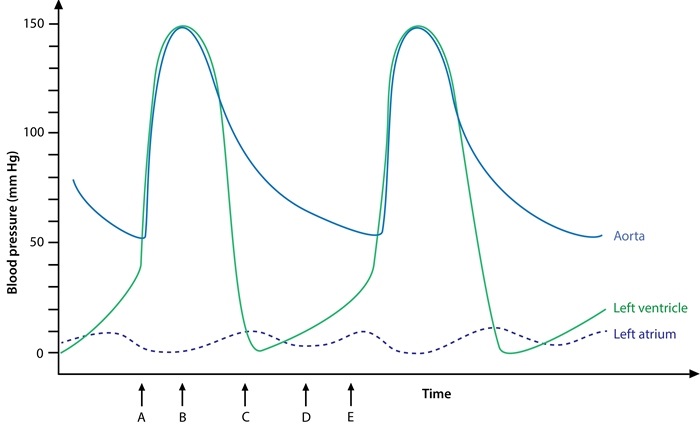
(Multiple Choice)
4.8/5  (79)
(79) A 20-year-old woman comes to the office due to 6 hours of right lower quadrant pain. The pain came on suddenly and has become intense and constant. She has been unable to eat or drink today due to nausea and frequent vomiting. The patient has had 2 sexual partners in the last year and has a history of chlamydial cervicitis. She takes ibuprofen for dysmenorrhea on the first day of her menses. The patient has a 6-cm, right ovarian cyst, which was noted on ultrasound last year. Her last menstrual period was 3 weeks ago. Temperature is 37.2 C (99 F), blood pressure is 110/80 mm Hg, and pulse is 104/min. Abdominal examination shows tenderness to deep palpation in the right lower quadrant. Urine pregnancy test is negative. Leukocyte count is 8,000/mm3. Which of the following is the most likely diagnosis?
(Multiple Choice)
4.8/5 (85)
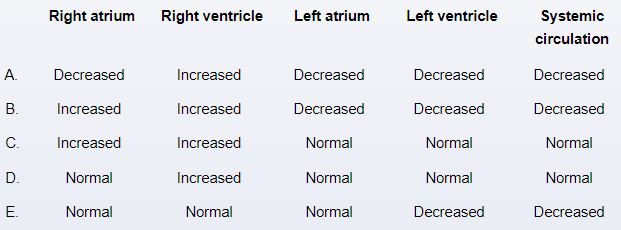
(85) A 4-year-old boy is brought to the office for routine evaluation of a heart murmur. The patient has no fatigue, shortness of breath, or exercise intolerance. He has no other medical conditions and has had no surgeries. Vital signs are within normal limits. On examination, the patient has no cyanosis or clubbing of the fingers. There is a 2/6 holosystolic murmur best heard at the left lower sternal border. There are no rubs or gallops. Pulses are 2+ in the upper and lower extremities. Compared to an unaffected child, which of the following changes in oxygen saturation would be expected in this patient?
(Multiple Choice)
5.0/5 (80)
(80) A 42-year-old man comes to the emergency department due to worsening jaw pain and stiffness. His symptoms began 2 days ago and have limited his ability to eat. Today the patient also developed painful stiffness in his neck. He has had no fever, chills, headache, focal weakness, or numbness. The patient is a farmer in rural Pennsylvania and sustained a wooden splinter injury to his forearm while working in a barn a week ago. He has no chronic medical conditions but has not had medical care for many years. On examination, the patient is not able to open his mouth. The muscles of the neck are tense, and neck range of motion is impaired. Which of the following is the best approach to establishing diagnosis in this patient?
(Multiple Choice)
4.7/5 (82)
(82) A 76-year-old man is brought to the emergency department after being involved in a motor vehicle collision. He is found to have a laceration of the spleen and is taken for emergent laparotomy. During surgery, the patient goes into cardiac arrest and dies, despite aggressive resuscitation efforts. Autopsy examination is performed and shows areas of thickening inside the chest wall as shown below. 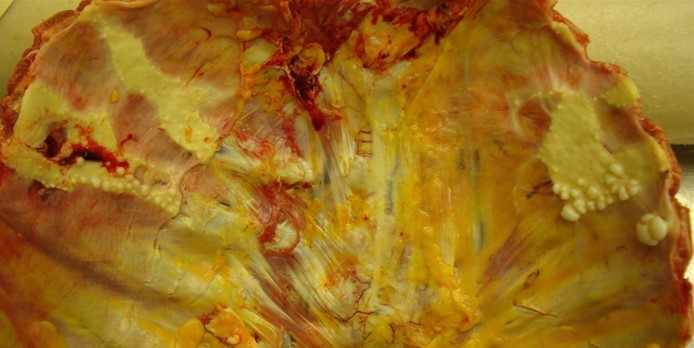 Lung examination shows fibrosis of the lower lobes. Pathologic examination of these fibrotic areas is most likely to reveal which of the following findings?
 (Multiple Choice)
4.8/5 (80)
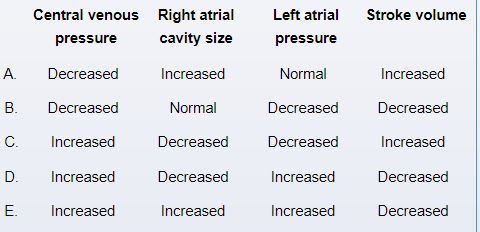
(80) A 64-year-old man comes to the emergency department due to worsening dizziness and shortness of breath for the past several days. The patient was diagnosed with advanced stage lung cancer 6 months ago and is receiving palliative care. The patient has no other medical history. Blood pressure is 85/45 mm Hg, pulse is 122/min and regular, and respirations are 22/min. Pulse oximetry is 94% on room air. There are undulations in blood pressure at different phases of respiration. On physical examination, the point of maximal impulse is not palpable, and heart sounds are distant. Chest x-ray reveals diffuse pulmonary metastatic disease and new enlargement of the cardiac silhouette. Which of the following hemodynamic changes are most likely present in this patient due to his current cardiac condition?
(Multiple Choice)
4.8/5 (79)
(79) A 63-year-old man comes to the office due to intermittent rectal bleeding. The bleeding worsens with defecation and is associated with itchiness. Ten years ago, he had a kidney transplant for diabetic nephropathy and reports compliance with posttransplant immunosuppression medications. Vital signs are normal. Physical examination reveals a 2-cm ulcerated mass extending from the anal verge into the rectum. Biopsy shows large, eosinophilic squamous epithelial cells arranged in islands; cells have hyperchromatic, irregular nuclei, and scant cytoplasm. Significant keratinization is present. Which of the following factors is most likely responsible for the development of this patient's anal lesion?
(Multiple Choice)
4.9/5 (71)
(71) A 24-year-old woman comes to the emergency department due to lower abdominal cramping and vaginal bleeding. The patient started to have vaginal spotting a few days ago but has had slightly increased bleeding with painful lower abdominal cramping since this morning. She is sexually active, and her last menstrual period was 5 weeks ago. Blood pressure is 130/80 mm Hg and pulse is 100/min. Diffuse tenderness to palpation is present over the lower abdomen. On speculum examination, the cervix is closed and there is dark red blood coming from the cervical os. Bimanual examination reveals a small uterus and a 3-cm mass in the left adnexa. Quantitative serum β-hCG level is 1,200 mIU/mL (normal: <5). Which of the following is the most likely underlying cause of this patient's presentation?
(Multiple Choice)
4.9/5 (83)
(83) A 2-year-old boy is brought to the office due to fever. For the past 6 days, he has had a fever of 39 C (102.2 F) to 40 C (104 F) that subsides minimally with acetaminophen. Yesterday, his mother noted a rash on his diaper area. Temperature is 39.2 C (102.6 F), pulse is 140/min, and respirations are 30/min. Physical examination shows an irritable boy. The patient's neck is supple with full range of motion. Both hands and feet are slightly erythematous and edematous, and a peeling rash is present over the perineal area. His eyes and lips appear as shown. The remainder of the examination is unremarkable. Which of the following is the most likely diagnosis?
(Multiple Choice)
4.7/5 (62)
(62) A 72-year-old man is hospitalized due to fatigue, orthopnea, and exertional dyspnea. The patient takes no medications and has not seen a physician in many years. He is a lifelong nonsmoker. His blood pressure is 110/60 mm Hg and pulse is 64/min. Examination reveals bibasilar crackles, elevated jugular venous pressure, and bilateral lower extremity pitting edema. His left ventricular end-diastolic pressure-volume is shown in the graph below (purple curve). 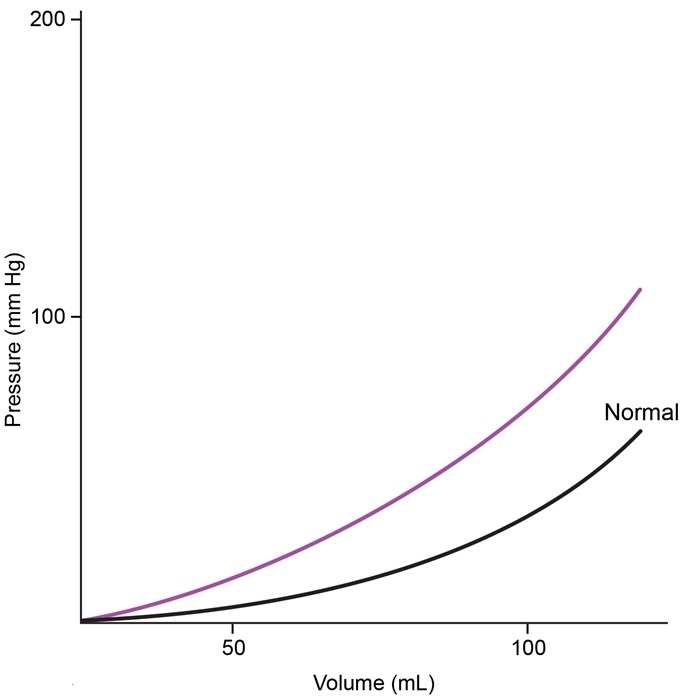 Which of the following is the most likely cause of this patient's condition?
 (Multiple Choice)
4.8/5 (71)
(71) An infant is born with facial dysmorphia and a cleft palate. Further evaluation reveals a heart condition with a right-to-left shunt and the absence of a thymic shadow on x-ray. The infant experiences frequent and recurrent sinopulmonary infections. Examination of this patient's lymph nodes will most likely show poor development of which of the following structures?
(Multiple Choice)
4.9/5 (87)
(87) A 77-year-old woman is brought to the emergency department with severe lightheadedness and near-syncope that began earlier in the day. Over the past several months, she has experienced occasional episodes of lightheadedness and feeling unsteady, which she attributed to "old age." The patient has not had chest pain, shortness of breath, or lower extremity swelling. She was diagnosed with hypertension 10 years ago and has been taking losartan. The patient does not take any other medications. She lives alone and is independent in her daily activities. An ECG obtained in the emergency department is shown in the exhibit.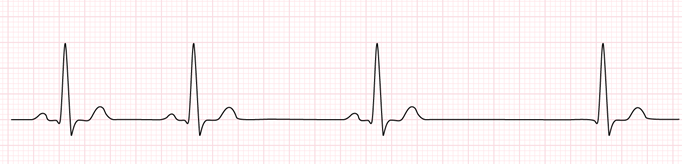 Cell degeneration in which of the following locations is most likely responsible for this patient's current condition?
 (Multiple Choice)
4.7/5 (81)
(81) A 34-year-old man is being evaluated for acute hypoxemic respiratory failure. Two days ago, the patient was brought to the emergency department due to opioid and alcohol intoxication. While unconscious, he vomited profusely and then rapidly developed hypoxia and shortness of breath that has continued to worsen. Today, temperature is 38.4 C (101.1 F), blood pressure is 108/74 mm Hg, pulse is 120/min, and respirations are 26/min. Diffuse crackles are heard on auscultation. The extremities are warm, well perfused, and without edema. Chest x-ray reveals bilateral alveolar opacities. The results of arterial blood gas analysis on room air are as follows:  Which of the following pathologic processes is the primary contributor to this patient's lung findings?
 (Multiple Choice)
4.9/5 (79)
(79) A 53-year-old man is being evaluated for dyspnea. The graph on the right shows how the patient's work of breathing varies with respiratory rate, whereas the graph on left represents the work of breathing versus respiratory rate in a normal individual. The minute ventilation is constant and equal in both graphs. 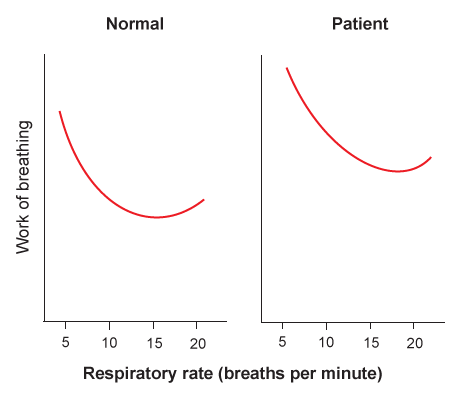 Which of the following is the most likely diagnosis in this patient?
 (Multiple Choice)
4.9/5 (72)
(72) A 12-month-old boy is brought to the office by his father due to prolonged bleeding from mouth after slipping and hitting his face on a coffee table. He was born at term, and his mother died shortly after his birth due to bleeding complications following a home delivery. Vital signs are normal. He is awake and alert. There is blood oozing from his gums and marked bruises along his trunk and thighs. The remainder of the physical examination is normal. Laboratory evaluation shows decreased von Willebrand Factor antigen levels and activity, measured via the ristocetin cofactor assay. Which of the following sets of laboratory values is most likely present in this patient?
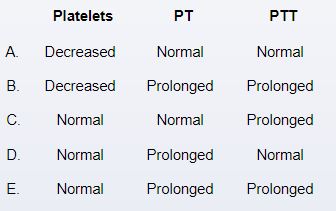
(Multiple Choice)
5.0/5 (72)
(72) A 63-year-old man comes to the emergency department due to a 1-week history of progressively worsening shortness of breath and cough. The shortness of breath is exacerbated when the patient lies flat in bed; he has to prop himself up with 3 pillows to sleep well at night. He was treated for a myocardial infarction 2 weeks ago and had 2 stents placed in the left anterior descending artery. The patient's other medical conditions include long-standing hypertension and type 2 diabetes mellitus. Blood pressure is 120/80 mm Hg, pulse is 92/min, and respirations are 22/min. Pulse oximetry is 89% on room air. Physical examination reveals bilateral crackles at the lung bases and an S3. Which of the following is most likely present in this patient?
(Multiple Choice)
4.9/5 (83)
(83) A 19-year-old woman comes to the office due to exertional dyspnea and intermittent lightheadedness. On examination, mucosal pallor is present. Laboratory studies reveal a red blood cell count of 3.5 million/mm3 and a hemoglobin concentration of 8.5 g/dL. Peripheral smear is shown in the image below: 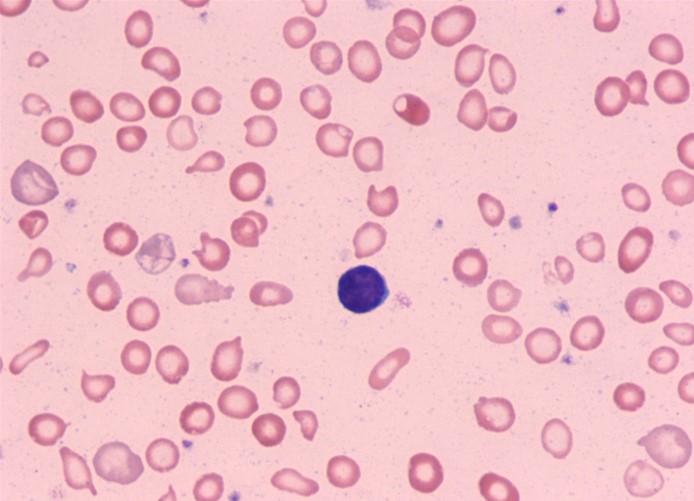 Which of the following findings are most likely present in this patient?
 (Multiple Choice)
4.8/5 (86)
(86) A 28-year-old woman, gravida 2 para 2, comes to the office with worsening shortness of breath over the past week. She had a recent episode of hemoptysis. The patient has also had ongoing vaginal bleeding after an uncomplicated vaginal delivery of her son 9 weeks ago. She has no bleeding elsewhere, and she has not resumed sexual intercourse. On physical examination, the patient's uterus is enlarged and the adnexa are normal. Laboratory studies show markedly increased β-hCG levels. Chest radiograph shows multiple bilateral lung nodules. Which of the following would most likely be found on endometrial curettage in this patient?
(Multiple Choice)
4.7/5 (82)
(82) A 66-year-old man with poorly controlled type 2 diabetes is admitted to the hospital due to a 2-day history of fever and confusion. Blood pressure is 110/50 mm Hg. Pulse oximetry shows an oxygen saturation of 97% on room air. Examination reveals warm extremities with full peripheral pulses, an infected neuropathic foot ulcer with surrounding cellulitis, and normal lung sounds. A central venous catheter terminating in the superior vena cava is placed. Blood aspirated from the catheter appears red. Blood gas analysis of this venous sample reveals an oxygen saturation of 87% (normal: 65%-70%), and lactate is moderately elevated. Which of the following is the most likely cause of this patient's abnormal blood gas findings?
(Multiple Choice)
4.9/5 (80)
(80) A 25-year-old woman is brought to the emergency department 40 minutes after being stung by several wasps. She reports throat tightness and dizziness. She has no chronic medical conditions and takes no medication. Blood pressure is 80/40 mm Hg, pulse is 120/min, and respirations are 32/min. Examination shows diffuse erythematous plaques over the trunk and 1+ pitting edema of the ankles. Which of the following is the most likely cause of this patient's hypotension?
(Multiple Choice)
4.9/5 (81)
(81) 
Filters
- Essay(0)
- Multiple Choice(0)
- Short Answer(0)
- True False(0)
- Matching(0)