



 Chat with AI
Exam 11: Pathophysiology

Exam 1: Anatomy291 Questions
Exam 2: Behavioral science240 Questions
Exam 3: Biochemistry156 Questions
Exam 4: Biostatistics117 Questions
Exam 5: Embryology52 Questions
Exam 6: Genetics103 Questions
Exam 7: Histology24 Questions
Exam 8: Immunology129 Questions
Exam 9: Microbiology336 Questions
Exam 10: Pathology816 Questions
Exam 11: Pathophysiology464 Questions
Exam 12: Pharmacology538 Questions
Exam 13: Physiology272 Questions
Select questions type


A 34-year-old man comes to the physician due to painful urination. Physical examination shows a watery penile discharge. Urethral swabs obtained from the patient are negative for gonococcal infection. He is treated appropriately and his symptoms resolve. Two weeks later, he develops acute conjunctivitis, right knee pain, and vesicular rash on his palms and soles. This patient's condition is most likely associated with which of the following?
(Multiple Choice)
4.9/5  (80)
(80) A 65-year-old man comes to the office due to a few weeks of progressive exertional dyspnea and fatigue. He has had no chest pain, fever, or cough. The patient has a history of mild aortic stenosis, gastroesophageal reflux disease, obesity, hypertension, and hypercholesterolemia. Temperature is 36.7 C (98 F), blood pressure is 130/78 mm Hg, pulse is 82/min, and respirations are 16/min. BMI is 28 kg/m2. Pulse oximetry shows 96% on room air. Mucosal pallor is present, but there is no jaundice, lymphadenopathy, or jugular venous distension. Cardiopulmonary examination reveals a 2/6 systolic ejection murmur at the second right intercostal area. The abdomen is soft and nontender; there is no palpable hepatosplenomegaly. Peripheral pulses are normal. Laboratory results are as follows: 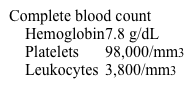 Peripheral blood smear is shown below:
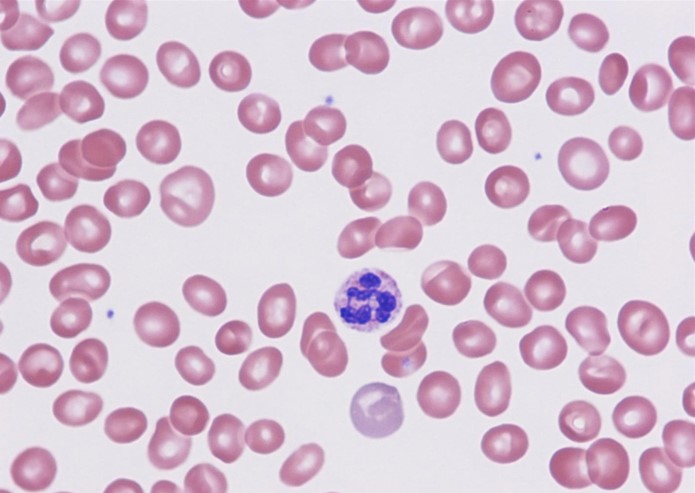 Which of the following is most likely responsible for this patient's current condition?
Peripheral blood smear is shown below: Which of the following is most likely responsible for this patient's current condition? (Multiple Choice)
4.8/5 (86)
(86) A 54-year-old man comes to the office due to daytime sleepiness and lack of energy. The symptoms began 6 months ago and have progressively worsened so that he feels "completely drained" by the end of the day. The patient's wife mentions that he snores loudly. His past medical history is unremarkable, although he has not seen a physician in over 10 years. The patient does not use tobacco or alcohol, and he works in the warehouse of an agricultural supply company. BMI is 34 kg/m2. Physical examination shows a narrow oropharynx and a large neck circumference. The patient is at increased risk of developing which of the following?
(Multiple Choice)
4.7/5 (79)
(79) A 52-year-old woman is evaluated for a 6-month history of progressive fatigue and generalized pruritus. She has had no significant prior medical conditions or surgery and takes no medications. The patient does not use tobacco, alcohol, or illicit drugs. Her sister has Sjögren syndrome. Physical examination shows skin excoriations and mild hepatomegaly. Laboratory results are as follows. 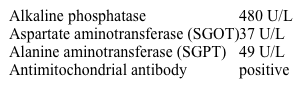 The pathogenesis of this patient's disease process most closely resembles that of which of the following conditions?
 (Multiple Choice)
4.9/5 (82)
(82) A 63-year-old man comes to the emergency department due to progressive dyspnea and fatigue. Over the last week, he has not been able to lie flat due to difficulty breathing and has had to sleep in a sitting position. He had an anterior myocardial infarction 6 months ago and has not been compliant with his medication regimen since that time. Medical history is also significant for hypertension. The patient is an ex-smoker with a 30-pack-year history. He does not drink alcohol. His father died of a heart attack at age 60. Blood pressure is 170/100 mm Hg, and pulse is 100/min and regular. Oxygen saturation is 90% on room air. He is afebrile. Auscultation reveals crackles at the lung bases, an S3 gallop, and a II/VI holosystolic murmur over the apex. The patient is admitted to the hospital, and after treatment with diuretics and vasodilators his condition improves significantly. Three days later there are no appreciable gallops or murmurs on cardiac examination. Which of the following best explains the murmur heard at the time of the initial examination?
(Multiple Choice)
4.8/5 (83)
(83) A 63-year-old woman dies of congestive heart failure. Autopsy shows a dilated heart with brownish pigmentation of the myocardium. Light microscopy of her liver after Prussian blue staining is shown in the image below: 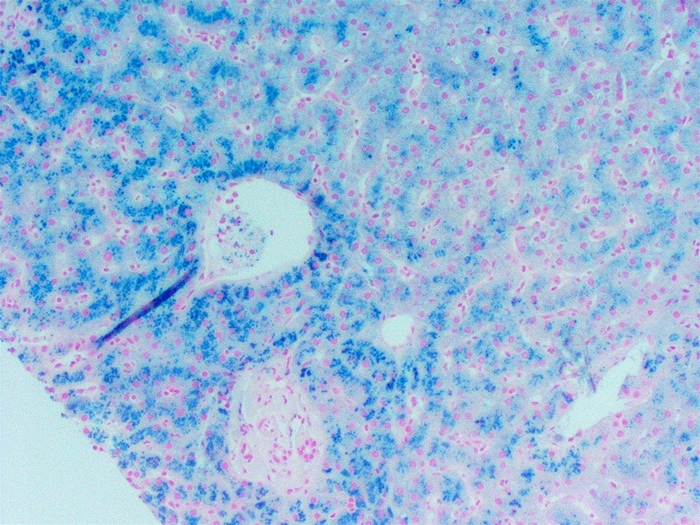 The patient's brother died of profuse upper gastrointestinal bleeding at age 43. Assuming this patient's disorder is hereditary, which of the following most likely contributed to the delayed onset of her disease compared to her brother?
 (Multiple Choice)
4.9/5 (67)
(67) A 55-year-old woman, gravida 3 para 3, comes to the office due to constipation. For the past 6 months, the patient has had increasing constipation associated with mild, crampy abdominal pain and fatigue. She has only 1 or 2 bowel movements every week. Medical history is notable for nephrolithiasis, for which the patient was briefly hospitalized a year ago. She has not undergone colonoscopy. Vital signs are normal. The abdomen is soft. Rectal tone is normal. Deep tendon reflexes are 2+. The remainder of the examination shows no abnormalities. Laboratory results are as follows: 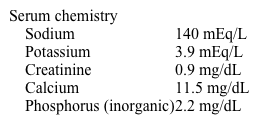 Which of the following is the most likely underlying cause of constipation in this patient?
 (Multiple Choice)
4.8/5 (83)
(83) A 52-year-old man comes to the physician because of increasing fatigue over the last 2 weeks. He has also been experiencing exertional dyspnea and occasional headaches. Cardiac auscultation findings at the left sternal border are shown below. Which of the following is most consistent with this patient's auscultatory findings?
(Multiple Choice)
4.8/5 (74)
(74) A 64-year-old man comes to the emergency department due to painless loss of vision in the right eye. The patient's symptoms started suddenly several hours ago and have persisted. He has had no trauma or any similar episode in the past. He has a history of coronary artery disease, atrial fibrillation, and type 2 diabetes mellitus. Blood pressure is 144/86 mm Hg and pulse is 92/min. Cardiovascular examination reveals irregularly irregular rhythm with no murmurs, no peripheral edema, and slightly diminished pedal pulses in both feet symmetrically. Visual acuity in the right eye is hand motion only and normal in the left eye. Funduscopic examination of the right eye is shown in the image below. 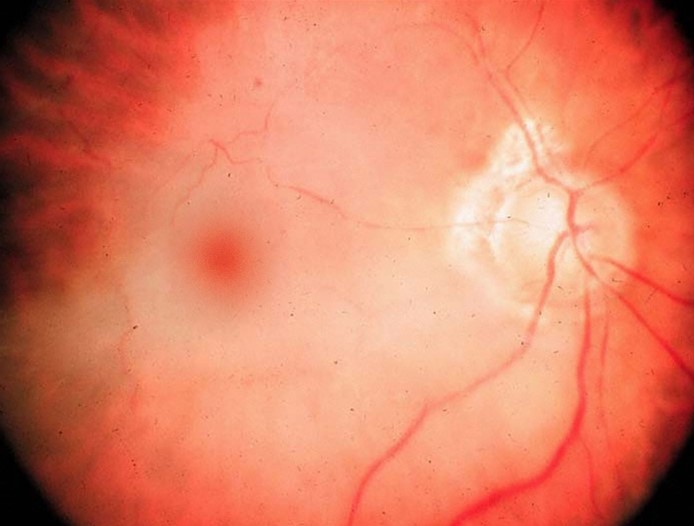 Which of the following is the most likely cause of this patient's loss of vision?
 (Multiple Choice)
4.7/5 (87)
(87) A 76-year-old man comes to the hospital due to acute, bright red blood from the rectum. The patient had 3 large bloody bowel movements this morning, and he has felt light-headed and dizzy since. He has a history of sigmoid diverticulosis and, 2 years ago, had a similar episode of bleeding that resolved spontaneously. Temperature is 36.9 C (98.4 F), blood pressure is 90/50 mm Hg, and pulse is 110/min. Examination shows mild lethargy and delayed capillary refill. Abdominal examination shows no abnormalities. Which of the following physiologic changes in kidney function would be most likely in this patient?
(Multiple Choice)
4.7/5 (61)
(61) A 62-year-old woman has double vision, especially when reading at bedtime. The problem first started several months ago and was intermittent but has worsened over the last 2 weeks and now bothers her constantly. The patient has also developed difficulty chewing and swallowing foods. She usually feels better in the mornings. She has no extremity weakness or sensory symptoms. The patient has no other medical problems and takes no medications. She does not use tobacco, alcohol, or illicit drugs. Vital signs are normal. BMI is 27 kg/m2. Examination shows bilateral ptosis; there is weakness of adduction of the right eye and abduction of the left eye. Muscle strength is 4/5 in proximal muscles in the upper and lower extremities. Deep tendon reflexes are 2+ throughout. Which of the following changes involving the postsynaptic muscle cell most likely explains this patient's symptoms?
(Multiple Choice)
4.7/5 (71)
(71) A 3-week-old boy is brought to the emergency department due to lethargy for a day. The patient was breastfeeding well until this morning, when he became increasingly difficult to arouse. He was born full-term to a 35-year-old mother who had a spontaneous vaginal delivery at home. She took prenatal vitamins throughout pregnancy and received routine prenatal care. However, the boy did not receive any vaccinations or medications after birth due to parental preference for a "natural" newborn period. Family history is unremarkable. Head circumference is at the 99th percentile. Weight and length are at the 25th percentile. Physical examination shows a large, bulging anterior fontanel. The eyes appear driven downward and the patient is not able to track upward. No scalp swelling is present. Intracranial hemorrhage is confirmed on head CT scan. Which of the following is the most likely cause of this infant's condition?
(Multiple Choice)
4.8/5 (88)
(88) A 45-year-old man comes to the office due to 3 months of exertional fatigue and weight loss. He is sexually active with multiple male partners. Temperature is 37.9 C (100.2 F), blood pressure is 110/70 mm Hg, pulse is 84/min, and respirations are 13/min. BMI is 20 kg/m2. The patient appears chronically ill and has mucosal pallor. There are thick, white plaques over the buccal mucosa and soft palate. Anterior and posterior cervical lymphadenopathy is present. The lungs are clear to auscultation. The abdomen is soft and nontender. There is no organomegaly. Laboratory results are as follows: 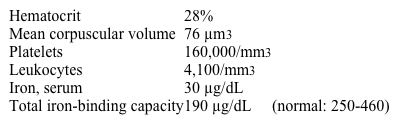 Which of the following is the most likely underlying cause of this patient's anemia?
 (Multiple Choice)
4.9/5 (72)
(72) A 34-year-old woman comes to the clinic due to dizziness and mild confusion over the last week. The patient has a history of seizures beginning in childhood and was recently started on carbamazepine by her neurologist. Her temperature is 36.7 C (98 F), blood pressure is 121/72 mm Hg, pulse is 68/min, and respirations are 13/min. Physical examination is within normal limits. Laboratory studies show a low serum sodium concentration. It is determined that the patient's condition is caused by increased release of a hormone that is co-secreted with neurophysins. This hormone is most likely secreted into the circulation at which of the following sites? 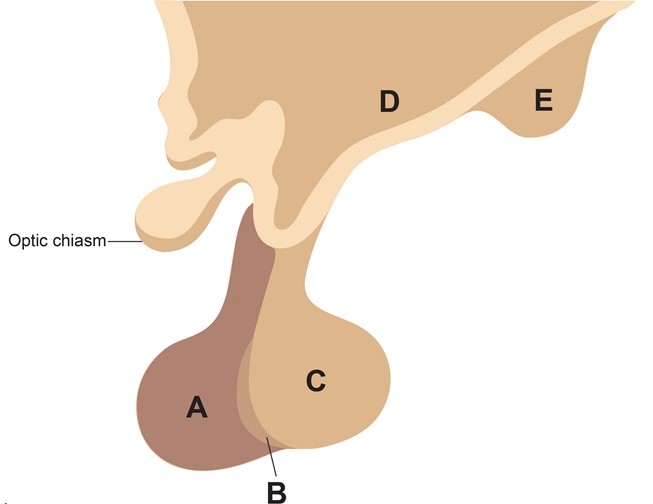
(Multiple Choice)
4.7/5 (62)
(62) A 54-year-old man comes to the emergency department due to fevers, shaking chills, and cough productive of copious sputum. He began having fever, cough, and sharp chest pains 10 days ago and was prescribed oral antibiotics by his primary care physician after a chest x-ray revealed a right lower lobe infiltrate. The patient has not been taking the medication as advised, and his symptoms have progressively worsened. Temperature is 39 C (102.2 F), blood pressure is 114/62 mm Hg, and pulse is 116/min. Physical examination reveals crackles in the right lower lung. Repeat chest x-ray reveals a round density with an air-fluid level in the lower lobe of the right lung. Which of the following is the most important contributor to the observed lung lesion in this patient?
(Multiple Choice)
4.9/5 (64)
(64) A 56-year-old man comes to the emergency department due to progressively worsening dyspnea. The patient can walk only a few blocks before becoming short of breath. He also finds it difficult to sleep lying flat and requires 3 pillows to prop himself upright when sleeping. Other medical problems include long-standing hypertension, for which he occasionally takes his prescribed antihypertensive medication. The patient does not use tobacco, alcohol, or illicit drugs. Blood pressure is 170/100 mm Hg, and pulse is 80/min and regular. Physical examination reveals bilateral basilar lung crackles, jugular venous distension, and bilateral lower extremity edema. Chest x-ray reveals cardiomegaly and hilar prominence. ECG shows left ventricular hypertrophy. Echocardiogram shows elevated pressures in the pulmonary artery. Which of the following is the most likely underlying cause of the observed echocardiographic finding in this patient?
(Multiple Choice)
5.0/5 (81)
(81) A 54-year-old man comes to the emergency department with pain and swelling in the right leg. The patient has no other medical problems and takes no medications. He has smoked a pack of cigarettes daily for the past 30 years. He is a business executive and just returned from an overseas trip. Physical examination shows pitting edema of the right leg and tenderness on deep palpation of the calf muscles. Peripheral pulses are symmetric and full. He is started on a medication that prolongs activated partial thromboplastin time and prothrombin time in a dose-dependent manner but has no effect on thrombin time. Which of the following agents was this patient most likely administered?
(Multiple Choice)
4.8/5 (89)
(89) A 41-year-old man comes to the emergency department due to 3 days of fever, chills, and nonproductive cough. The patient has also felt tired and weak during this period. He has a history of injection drug use and has been hospitalized several times for injection site cellulitis. Temperature is 38.3 C (101 F), blood pressure is 125/72 mm Hg, and pulse is 112/min and regular. Cardiopulmonary auscultation reveals scattered rhonchi and a cardiac murmur, which were not previously present. Laboratory evaluation shows leukocytosis, and chest x-ray reveals nodular opacities. Echocardiography of this patient is most likely to reveal which of the following findings?
(Multiple Choice)
4.8/5 (86)
(86) A 27-year-old man comes to the office for an infertility evaluation. He and his wife have been trying to conceive for the last 16 months. A previous evaluation of his wife showed no abnormalities. The patient has no prior medical conditions and takes no medications. Height is 188 cm (6' 2") and weight is 75 kg (165.3 lb). BMI is 21 kg/m2. On physical examination, heart and lung sounds are normal. There is bilateral gynecomastia, and genital examination shows small, firm testes. The lower extremities appear abnormally long. Further evaluation will most likely show which of the following sets of findings in this patient?
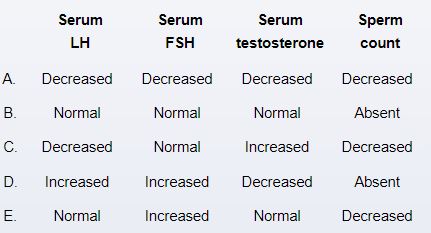
(Multiple Choice)
4.9/5 (78)
(78) A 42-year-old woman comes to the office to discuss dizziness. She has a 6-month history of episodic bouts of a "spinning sensation" associated with nausea and ringing in her left ear. The patient also has difficulty hearing while holding her phone to the left ear, although hearing in her right ear is normal. The dizziness improves spontaneously and she feels "fine" between episodes. Past medical history is notable for hypothyroidism, for which she is on thyroid replacement therapy, and endometriosis, which led to a hysterectomy at age 38. The patient works as a supermarket manager. She does not use tobacco or drink alcohol. The patient's condition is most likely the result of which of the following?
(Multiple Choice)
4.8/5 (81)
(81) 
Filters
- Essay(0)
- Multiple Choice(0)
- Short Answer(0)
- True False(0)
- Matching(0)