



 Chat with AI
Exam 11: Pathophysiology

Exam 1: Anatomy291 Questions
Exam 2: Behavioral science240 Questions
Exam 3: Biochemistry156 Questions
Exam 4: Biostatistics117 Questions
Exam 5: Embryology52 Questions
Exam 6: Genetics103 Questions
Exam 7: Histology24 Questions
Exam 8: Immunology129 Questions
Exam 9: Microbiology336 Questions
Exam 10: Pathology816 Questions
Exam 11: Pathophysiology464 Questions
Exam 12: Pharmacology538 Questions
Exam 13: Physiology272 Questions
Select questions type


A 27-year-old woman, gravida 1 para 0, at 37 weeks gestation comes to the emergency department after spontaneous rupture of membranes with leakage of blood mixed with fluid. Emergency cesarean delivery is performed due to severe fetal bradycardia. On delivery, the neonate is apneic and hypotonic. Resuscitation with endotracheal intubation and assisted ventilation is performed, which improves bradycardia. Apgar scores are <5 at 5 and 10 minutes. Umbilical cord blood analysis shows high anion gap metabolic acidosis. Controlled hypothermia to maintain body temperature at 33-35 C (91.4-95 F) is begun. This therapy is most likely to provide benefit via which of the following mechanisms?
(Multiple Choice)
5.0/5  (81)
(81) A 62-year-old man comes to the office due to shortness of breath. His symptoms have progressed over the last few months and have begun to limit his daily activities. He has no other medical problems and takes no medications. The patient drinks 3 or 4 alcoholic beverages a week and has a 50-pack-year smoking history. Physical examination reveals decreased breath sounds and scattered wheezes bilaterally. Chest x-ray is shown below. 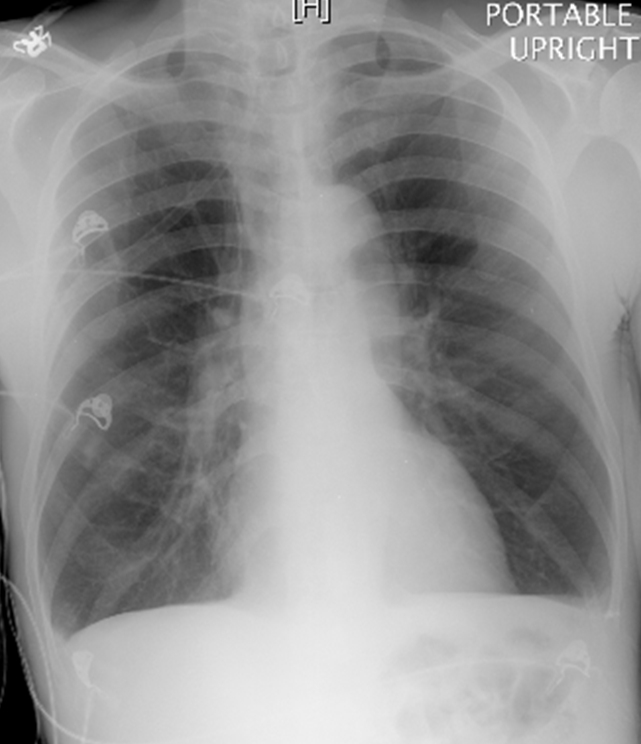 Which of the following parameters is most likely to be increased in this patient?
 (Multiple Choice)
4.8/5 (80)
(80) A 35-year-old woman comes to the office for evaluation of fatigue and exertional dyspnea. She has a history of systemic lupus erythematosus and is noncompliant with therapy. The patient takes naproxen as needed for joint pains. Vital signs are within normal limits. Examination shows mild pallor. The remainder of the examination shows no abnormalities. Laboratory results are as follows: 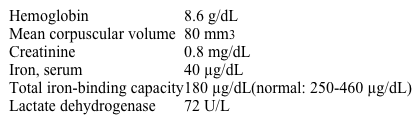 Which of the following is the most likely underlying cause of her current condition?
 (Multiple Choice)
4.9/5 (73)
(73) A 50-year-old man with a long history of alcohol use disorder is admitted to the hospital with difficulty breathing. Blood pressure is 90/40 mm Hg, pulse is 114/min, respirations are 22/min, and pulse oximetry is 92% on room air. Physical examination shows bilateral basal crackles, increased jugular venous pressure, hepatomegaly, ascites, and peripheral pitting edema. Chest x-ray demonstrates cardiomegaly. Scattered ecchymoses are present across each extremity. Laboratory results are as follows:  The patient is given intramuscular vitamin K. Two days later, his laboratory results are unchanged. Which of the following is the most likely cause of this patient's laboratory abnormality?
 (Multiple Choice)
4.8/5 (82)
(82) A 32-year-old woman comes to the emergency department with lightheadedness and shortness of breath, which started while shopping at a supermarket. During the last 6 months, she had increasing shortness of breath and had to adjust her daily activities. The patient has no other medical problems and does not use tobacco, alcohol, or illicit drugs. There is no family history of heart disease, stroke, or blood clots. Her BMI is 25 kg/m2. After initial assessment, the patient reports that she feels "fine," refuses further evaluation, and insists on being discharged. She dies a month later. At autopsy, her heart has the following appearance (RV, right ventricle; LV, left ventricle): 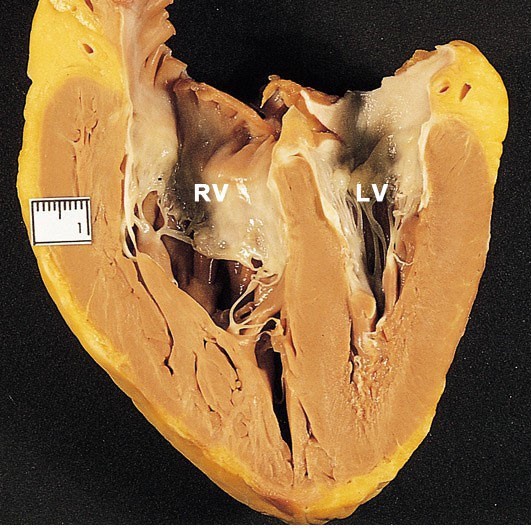 Which of the following is the most likely diagnosis?
 (Multiple Choice)
5.0/5 (80)
(80) A 46-year-old woman comes to the emergency department due to progressive dyspnea over the last 2 days. The patient's exercise tolerance has decreased dramatically and she had to sleep in a sitting position last night. She has no history of cardiovascular disease. The patient does not use tobacco or alcohol. Family history is unremarkable. Blood pressure is 110/65 mm Hg and pulse is 105/min and regular. The apical impulse is hyperdynamic. Cardiac auscultation reveals a diminished S1 and an apical holosystolic murmur radiating to the axilla. Diffuse pulmonary crackles are heard bilaterally. There is no peripheral edema. ECG shows sinus tachycardia but is otherwise unremarkable. Which of the following would most likely increase the ratio of forward flow volume to regurgitant flow volume in this patient?
(Multiple Choice)
4.8/5 (79)
(79) A 56-year-old, previously healthy man has worsening fatigue and recurrent epistaxis. Evaluation shows anemia, thrombocytopenia, and abnormal circulating leukocytes. Bone marrow biopsy establishes a diagnosis of acute myeloid leukemia. The patient is initially treated with induction chemotherapy, and an allogeneic hematopoietic stem cell transplant is recommended. A nonrelated, HLA-matched donor is not found, so the patient's adult son volunteers to be the donor. The plan is for the patient to receive conditioning chemotherapy and radiotherapy followed by bone marrow transplant. Prior to transplant, a procedure is performed to deplete CD3+ cells in the marrow graft. This pretransplant procedure would be most helpful in decreasing this patient's risk for which of the following?
(Multiple Choice)
4.8/5 (68)
(68) A 12-month-old boy is brought to the pediatrician by his parents for an upper respiratory infection. Temperature is 38.3 C (101 F), blood pressure is 92/45 mm Hg, pulse is 110/min, and respirations are 25/min. Physical examination shows erythema and swelling of the nasal mucosa and nasal discharge. Cardiac auscultation findings at the left sternal border are given below. Pulses are equal in all 4 extremities. The remainder of the examination is unremarkable. Which of the following is the most likely diagnosis?
(Multiple Choice)
4.8/5 (83)
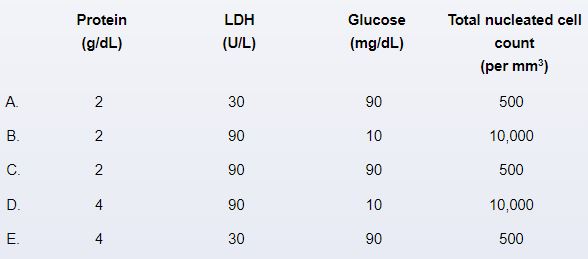
(83) A 62-year-old man comes to the emergency department due to a 2-week history of worsening shortness of breath. The patient reports feeling dyspneic while lying flat and has been sleeping upright in his recliner. Temperature is 36.7 C (98.1 F), blood pressure is 110/70 mm Hg, pulse is 88/min, and respirations are 20/min. On physical examination, jugular venous distension is present. Heart sounds are normal. Decreased breath sounds and dullness to percussion can be heard at the bilateral bases. Pitting edema is present in the bilateral lower extremities. Chest x-ray shows cardiomegaly and bilateral pleural effusions. Serum protein is 6 g/dL and serum lactate dehydrogenase (LDH) is 60 U/L. Which of the following sets of pleural fluid findings is most likely to be seen in this patient?
(Multiple Choice)
4.9/5 (80)
(80) A newborn boy who was born at 39 weeks gestation by normal vaginal delivery has a serum TSH above the normal range and serum thyroxine (T4) below the normal range for his age. His mother has no medical conditions. On examination, the patient's length and weight are normal, and he has no apparent congenital malformations. Which of the following is the most likely cause of this patient's condition?
(Multiple Choice)
4.8/5 (89)
(89) A 32-year-old woman comes to the office due to exertional dyspnea that has progressed over the last year. She can hardly walk a block without stopping to rest. The patient's mother died of "heart failure" at age 40. During auscultation, the pulmonary component of S2 is louder than the aortic component in the right and left second intercostal space. An accentuated impulse can also be palpated along the left upper sternal border. Chest x-ray shows clear lungs. Which of the following is the most likely cause of this patient's findings?
(Multiple Choice)
4.8/5 (75)
(75) A 72-year-old man comes to the office due to progressive shortness of breath. Over the past year, the patient has been unable to perform many of his usual outdoor activities, including afternoon walks and working in the yard. During the last several weeks, he has frequently become easily fatigued and short of breath, and at night he needs several pillows to sleep comfortably. He has also had ankle swelling. The patient has had no chest pain, syncope, abdominal pain, or cough. He is a lifetime nonsmoker. Bibasilar crackles are heard on physical examination. Echocardiography reveals no valvular disease and a nondilated left ventricle with an ejection fraction of 55%. Which of the following is most strongly associated with this patient's current condition?
(Multiple Choice)
4.9/5 (87)
(87) A 34-year-old woman experiences nausea, abdominal pain, and dizziness after undergoing open reduction and internal fixation of a femur fracture. One year ago, she was diagnosed with systemic lupus erythematosus with significant renal involvement, and she has since been on chronic glucocorticoid therapy with prednisone. The patient was maintained on her usual daily dose of prednisone throughout the perioperative period. Blood pressure is 90/60 mm Hg and pulse is 120/min. Compared to the normal physiologic response to surgery, this patient most likely has which of the following patterns of hypothalamic-pituitary-adrenal axis activity?
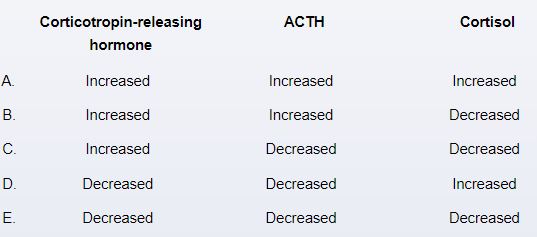
(Multiple Choice)
4.9/5 (72)
(72) A 45-year-old man comes to the emergency department due to severe dyspnea and chest discomfort that began earlier in the day. The dyspnea has been worsening throughout the day and has been present at rest. He reports no inciting trauma. The patient has no other medical conditions and takes no medications. He has a 20-pack-year smoking history and does not use alcohol or illicit drugs. Temperature is 36.7 C (98 F), blood pressure is 110/60 mm Hg, and pulse is 96/min. Arterial blood gas drawn on room air shows an arterial partial pressure of oxygen (PaO2) of 54 mm Hg and an arterial partial pressure of carbon dioxide (PaCO2) of 26 mm Hg. Which of the following processes is most likely occurring in this patient?
(Multiple Choice)
4.9/5 (70)
(70) A 20-year-old man is evaluated in the clinic due to intermittent episodes of self-resolving jaundice. His symptoms are not provoked by any particular circumstances or events. The patient otherwise feels healthy and has no other symptoms. He does not use tobacco, alcohol, or illicit drugs. Complete blood count is within normal limits. Liver function studies are as follows: 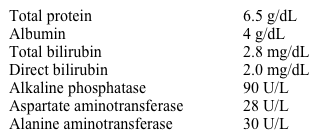 Liver biopsy shows abundant pigment inclusions in the lysosomes of the otherwise normal hepatocytes. Electron spin resonance spectroscopy reveals that the pigment is composed of polymers of epinephrine metabolites. Which of the following is the most likely cause of this patient's jaundice?
 (Multiple Choice)
4.7/5 (70)
(70) A 14-year-old girl is brought to the office for evaluation of a bump on her chest just below the right breast. The bump has been there for as long as she can remember, but it became a little larger 2-3 years ago. The bump also becomes tender just before she starts her menses. Menarche was at age 12. Her menses occur every 28 days and last 4-5 days. Examination shows Tanner stage 5 breasts. Both breasts and axillae appear normal. There is a soft, raised, hyperpigmented, 0.5-cm nontender lesion inferior to the right breast. Which of the following is the cause of this patient's presentation?
(Multiple Choice)
4.8/5 (79)
(79) A 46-year-old hospitalized man experiences worsening dyspnea and hypoxemia. The patient was admitted 2 days ago due to alcohol-induced acute pancreatitis. He has no history of cardiopulmonary disorders. Chest x-ray reveals new bilateral infiltrates. His respiratory condition progressively deteriorates and endotracheal intubation is performed. Mechanical ventilation with a lung-protective strategy is begun and a positive end-expiratory pressure of 10 cm H2O is applied. Which of the following is the most likely effect of this latter intervention?
(Multiple Choice)
4.7/5 (78)
(78) A 42-year-old man with a long history of type 1 diabetes mellitus comes to the office due to frequent involuntary loss of urine. For the past several months, he has been having difficulty starting and maintaining a urinary stream. In the last 3 weeks, he has had 2 episodes of nocturnal enuresis and multiple daytime episodes of uncontrolled voiding without any sensation of a full bladder. His other medical problems include chronic kidney disease and gastroparesis. He does not use tobacco or alcohol. Which of the following additional findings would most likely be present in this patient?
(Multiple Choice)
4.8/5 (74)
(74) A 34-year-old woman is brought to the emergency department by ambulance due to nausea, dizziness, and confusion. Her boyfriend arrives with her and says that he found her lying on the bed next to an empty bottle of aspirin tablets. When asked about the potential ingestion, the patient admits to swallowing a "bunch of aspirin pills a little more than 12 hours ago" after coming home from work. She also describes hearing "an annoying buzzing sound that won't stop." Temperature is 38.3 C (101 F) and pulse is 102/min. She appears agitated and confused. Which of the following sets of laboratory results is most likely to be found in this patient?
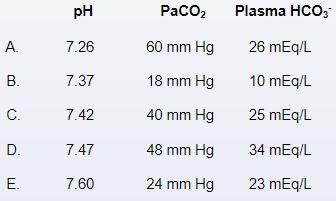
(Multiple Choice)
4.8/5 (77)
(77) A 34-year-old male who is being treated for acute leukemia develops oliguria. His serum creatinine level is 2.7 mg/dL. Renal biopsy reveals multiple uric acid crystals obstructing renal tubular lumen. The principal site of uric acid precipitation would be which of the following?
(Multiple Choice)
4.9/5 (80)
(80) 
Filters
- Essay(0)
- Multiple Choice(0)
- Short Answer(0)
- True False(0)
- Matching(0)