



 Chat with AI
Exam 11: Pathophysiology

Exam 1: Anatomy291 Questions
Exam 2: Behavioral science240 Questions
Exam 3: Biochemistry156 Questions
Exam 4: Biostatistics117 Questions
Exam 5: Embryology52 Questions
Exam 6: Genetics103 Questions
Exam 7: Histology24 Questions
Exam 8: Immunology129 Questions
Exam 9: Microbiology336 Questions
Exam 10: Pathology816 Questions
Exam 11: Pathophysiology464 Questions
Exam 12: Pharmacology538 Questions
Exam 13: Physiology272 Questions
Select questions type


A 63-year-old woman comes to the office for a routine preventive examination. She has no significant medical problems and takes no medications. The patient consumes a balanced diet; gets regular exercise; and does not use tobacco, alcohol, or illicit drugs. She is up to date on breast, colon, cervical, and lipid screenings. Her physical examination findings are unremarkable. The patient expresses concern about wrinkles around her eyes that make her "look old." A decrease in which of the following is most likely responsible for this patient's complaint?
(Multiple Choice)
4.8/5  (71)
(71) A 38-year-old man comes to the office with abdominal discomfort and loose stools over the past year. He has also lost 10 kg (22 lb) despite having a normal appetite. The patient eats a balanced diet that includes a variety of fruits and vegetables, meats, whole grains, and dairy products. He has had no international travel, works indoors as an office manager, and has no sick contacts. Medical history is insignificant and the patient takes no medications. The patient drinks alcohol socially and does not use tobacco. Vital signs and physical examination are normal. Serum chemistry panel, complete blood count, and thyroid function tests are normal. Which of the following is the best next step for assessing for impaired nutrient absorption in this patient?
(Multiple Choice)
4.8/5 (95)
(95) A 45-year-old woman who recently immigrated to the United States is hospitalized with exertional dyspnea and fatigue. She has no significant past medical history and takes no medications. The patient's blood pressure is 110/80 mm Hg and heart rate is 90/min and regular. After cardiopulmonary examination, the physician suspects mitral stenosis. Which of the following is the most useful measure for assessing the degree of mitral stenosis?
(Multiple Choice)
4.8/5 (76)
(76) A 1-year-old African American boy is brought to the emergency department by his parents with a 3-hour history of severe swelling and tenderness of the hands and feet. They do not know what caused the swelling and say that the boy cries when his hands or feet are touched. The patient has no history of recent illness and is up to date on all immunizations. The boy attends day care, but his parents are unsure about any sick contacts. His family history is significant for an older brother who died of pneumococcal sepsis at age 6. Physical examination shows bilateral, severe swelling of the hands and feet. Which of the following is most likely abnormal in this patient?
(Multiple Choice)
4.8/5 (80)
(80) A 28-year-old woman comes to the emergency department with acute-onset abdominal pain, nausea, and confusion. She has no significant past medical history and does not use tobacco or alcohol as they have made her feel sick in the past. Serum lipase and liver function tests are within normal limits. CT scan of the abdomen shows no abnormalities. A sample of her urine is reddish in color and darkens on standing for 24 hours. Intravenous dextrose is administered and her symptoms improve significantly. Dextrose infusion most likely improved this patient's condition by affecting which of the following pathways?
(Multiple Choice)
4.8/5 (75)
(75) A 21-year-old man comes to the office due to recent weight loss and fatigue. The patient is a college athlete and states, "My coach wants me to put on more weight, but I can't seem to do it. It doesn't matter how much I eat, I keep losing weight. I've been really thirsty and drinking lots of water lately too, and it's causing me to use the bathroom frequently during practice. I'm worried that I'm going to get dropped from the team if I don't get myself together." He is sexually active and has 1 lifetime partner. The patient's father was diagnosed with colon cancer at age 64. Which of the following studies would be the best next step to establish the diagnosis in this patient?
(Multiple Choice)
4.8/5 (77)
(77) A 62-year-old man with a long history of hypertension comes to the clinic for a routine physical examination. Blood pressure is 150/90 mm Hg and pulse is 74/min and regular. Cardiac auscultation reveals a low-frequency, presystolic sound that immediately precedes S1 and is best heard during expiration when the patient is lying on his left side. Chest x-ray reveals extensive calcification around the mitral and aortic valves. Which of the following is the most likely explanation for the additional heart sound?
(Multiple Choice)
4.9/5 (81)
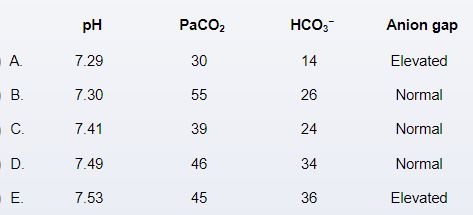
(81) A 4-week-old, full-term boy is brought to the emergency department due to vomiting. His parents describe the emesis as undigested formula without blood or bile. The vomiting occurs after feeds and has increased in frequency and force over the past 3 days. He is afebrile. Blood pressure is normal, pulse is 182/min, and oxygen saturation of 98% on room air. Examination shows a sunken anterior fontanelle and dry mucous membranes. Cardiac examination reveals tachycardia but no murmurs or gallops. The abdomen is soft, nontender, and nondistended. Arterial blood gas analysis is most likely to reveal which of the following sets of values?
(Multiple Choice)
4.8/5 (87)
(87) A 4-hour-old girl is evaluated in the neonatal intensive care unit. The patient was born at 30 weeks gestation via spontaneous vaginal delivery after 3 hours of labor. Membranes ruptured at the onset of labor and amniotic fluid appeared clear. Immediately after birth, the child was placed on continuous positive airway pressure by nasal prongs due to signs of breathing difficulty. Temperature is 36.7 C (98 F), pulse is 158/min, and respirations are 54/min. Pulse oximetry is 92% on 60% oxygen. Examination shows audible grunting and subcostal chest wall retractions. Cardiac examination shows no murmurs. A chest x-ray is obtained: 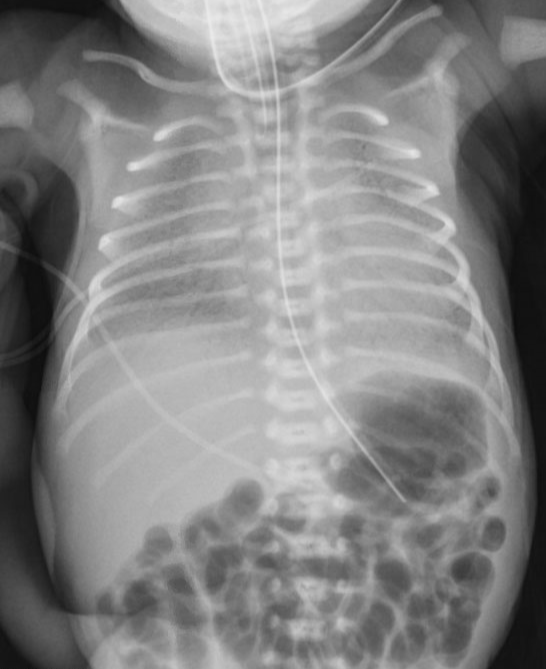 The radiographic findings in this patient most likely represent which of the following?
 (Multiple Choice)
4.7/5 (85)
(85) A 45-year-old woman calls 911 due to severe chest pain and dyspnea. The emergency medical team finds the patient unresponsive with no pulse, and she does not revive despite extensive cardiopulmonary resuscitation efforts. She had a prolonged history of systemic lupus erythematosus treated with multiple medications and was recently evaluated for progressive muscle weakness. Records from the patient's most recent office visit show an elevated blood pressure and examination findings of facial plethora, truncal obesity, and skin ecchymoses. She was also found to have mild hyperglycemia. Medical history included a left hip replacement for osteonecrosis of the femoral head 1 year ago. At autopsy, she is found to have an occluding thrombus in the left main coronary artery, which likely led to sudden cardiac death. Examination of this patient's adrenal glands is most likely to reveal which of the following findings?
(Multiple Choice)
4.8/5 (85)
(85) A 62-year-old hospitalized woman is evaluated for muscle weakness. The patient was admitted 2 weeks ago due to septic shock from acute pyelonephritis. She was treated in the intensive care unit with intravenous fluids, vasopressors, and broad-spectrum antibiotics. The patient was also mechanically ventilated due to respiratory failure. Her hemodynamic status and infection gradually improved, but she has had difficulty being taken off the ventilator due to respiratory muscle weakness. She is also noted to have significant extremity weakness. Physical examination shows diffuse mild atrophy of the extremity muscles. Bilateral upper and lower extremity deep tendon reflexes are decreased. Which of the following is the most likely cause of this patient's current condition?
(Multiple Choice)
4.8/5 (86)
(86) A 43-year-old man comes to the emergency department due to painful muscle cramps. He also has had a tingling sensation around his mouth since earlier in the day and an intermittent sensation of choking in the throat. The patient reports a history of "high blood pressure and a thyroid disorder." On physical examination, he appears comfortable but anxious. Heart and lung sounds are normal. Light tapping anterior to the ear elicits twitching of the perioral muscles. Further discussion with this patient is most likely to reveal which of the following?
(Multiple Choice)
4.9/5 (81)
(81) A 20-year-old man comes to the office due to occasional palpitations. He describes them as "skipped beats." He has no chest pain or shortness of breath. Medical history is unremarkable. On physical examination, he has wide, fixed splitting of the second heart sound (S2). No murmurs are heard. Chest x-ray reveals enlargement of the right heart contour. Echocardiogram is consistent with a congenital heart defect. Repair of this patient's congenital disease is aimed at preventing irreversible changes to which of the following?
(Multiple Choice)
5.0/5 (93)
(93) A 16-year-old girl comes to the office for a pre-participatory school sports examination. She plays on her high school soccer team and also frequently competes in local beauty pageants. The patient follows strict dietary limitations and exercises strenuously 2 hours a day. Onset of menses was at age 13, but her last menstrual period was 8 months ago. She otherwise feels well. Her height is 165 cm (5 ft 5 in) and her weight is 45.3 kg (100 lb), with a BMI of 16.6 kg/m2. Physical examination shows a pale and thin girl with fine hair around her trunk, but the remainder is otherwise normal. Urine pregnancy test is negative. Which of the following is the most likely mechanism of her amenorrhea?
(Multiple Choice)
4.9/5 (82)
(82) A 12-year-old boy experiences excessive bleeding following a tooth extraction. His past medical history includes episodes of painful joint swelling from minor trauma. Physical examination shows a soft and nontender abdomen with a liver span of 10 cm. The spleen is not palpable. Laboratory results are as follows:  This patient most likely has a deficiency involving which of the following factors?
 (Multiple Choice)
4.9/5 (95)
(95) A 48-year-old previously healthy woman comes to the office due to progressively worsening muscle weakness for the past 2 months. The patient has difficulty with activities such as climbing stairs, getting up from chairs, and placing dishes in overhead cabinets. She also reports a 4.5-kg (10-lb) unintentional weight loss and occasional abdominal discomfort over the same interval. Physical examination shows weakness of the shoulder and hip girdle muscles. Other examination findings are shown in the image below. 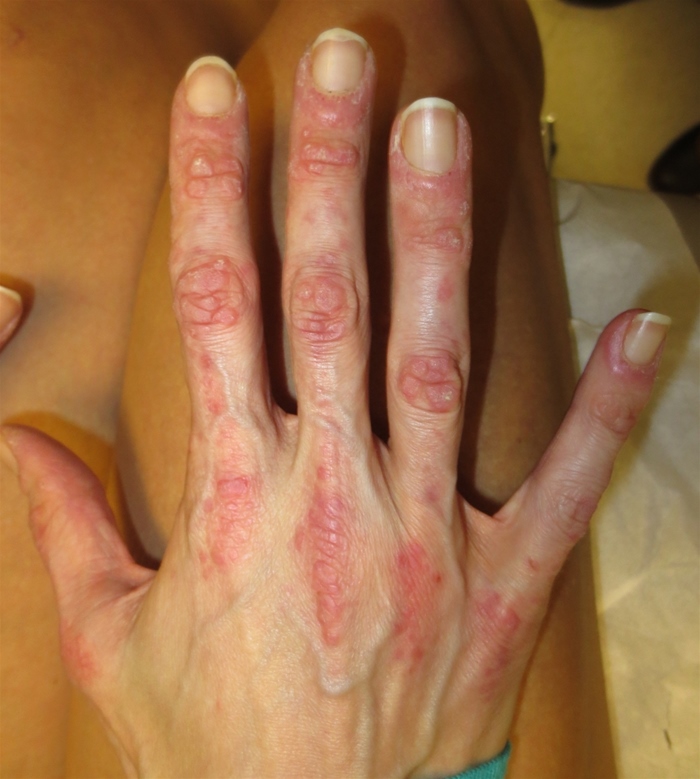 Further evaluation of this patient is most likely to reveal which of the following associated conditions?
 (Multiple Choice)
4.7/5 (70)
(70) A group of investigators is studying osteoprotegerin function in patients with postmenopausal osteoporosis. Using an engineered mouse strain, they develop a chimeric monoclonal antibody that blocks binding of receptor activator of nuclear factor kappa B (RANK) to RANK ligand (RANK-L). The investigators inject this monoclonal antibody into human subjects. Eight weeks later, a bone biopsy is obtained from all subjects. Which of the following is the most likely observed finding?
(Multiple Choice)
4.8/5 (92)
(92) A 17-year-old boy comes to the office for evaluation of gynecomastia. Examination shows sparse facial and pubic hair. Laboratory studies show: 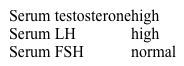 Semen analysis reveals severe oligospermia. Which of the following mechanisms is the most likely cause of this patient's condition?
 (Multiple Choice)
4.8/5 (76)
(76) A 32-year-old man is started on infliximab for treatment of refractory Crohn disease. Ten days later, he develops joint pain and a pruritic skin rash. Skin biopsy shows scattered areas of fibrinoid necrosis and neutrophil infiltration involving his small blood vessels. Which of the following findings is most likely to accompany this patient's condition?
(Multiple Choice)
4.9/5 (72)
(72) A 38-year-old man comes to the emergency department with severe abdominal pain and vomiting. The pain radiates to his back and improves by bending forward. Physical examination shows tenderness over the epigastrium and decreased bowel sounds. The patient is admitted to the hospital and treated with intravenous fluids and pain medication, but his condition fails to improve. An abdominal CT scan reveals diffuse pancreatic enlargement with areas of necrosis. The inappropriate activation of which of the following most likely initiated this patient's condition?
(Multiple Choice)
5.0/5 (74)
(74) 
Filters
- Essay(0)
- Multiple Choice(0)
- Short Answer(0)
- True False(0)
- Matching(0)