



 Chat with AI
Exam 11: Pathophysiology

Exam 1: Anatomy291 Questions
Exam 2: Behavioral science240 Questions
Exam 3: Biochemistry156 Questions
Exam 4: Biostatistics117 Questions
Exam 5: Embryology52 Questions
Exam 6: Genetics103 Questions
Exam 7: Histology24 Questions
Exam 8: Immunology129 Questions
Exam 9: Microbiology336 Questions
Exam 10: Pathology816 Questions
Exam 11: Pathophysiology464 Questions
Exam 12: Pharmacology538 Questions
Exam 13: Physiology272 Questions
Select questions type


A 43-year-old man is evaluated for retrosternal discomfort and dysphagia for the past several months. He smokes a pack of cigarettes daily and drinks alcohol on weekends. His BMI is 32.8 kg/m2. Physical examination is unremarkable. Esophageal manometry is performed; after a single swallow of 5 mL of water, the tracings appear as shown in the image below. 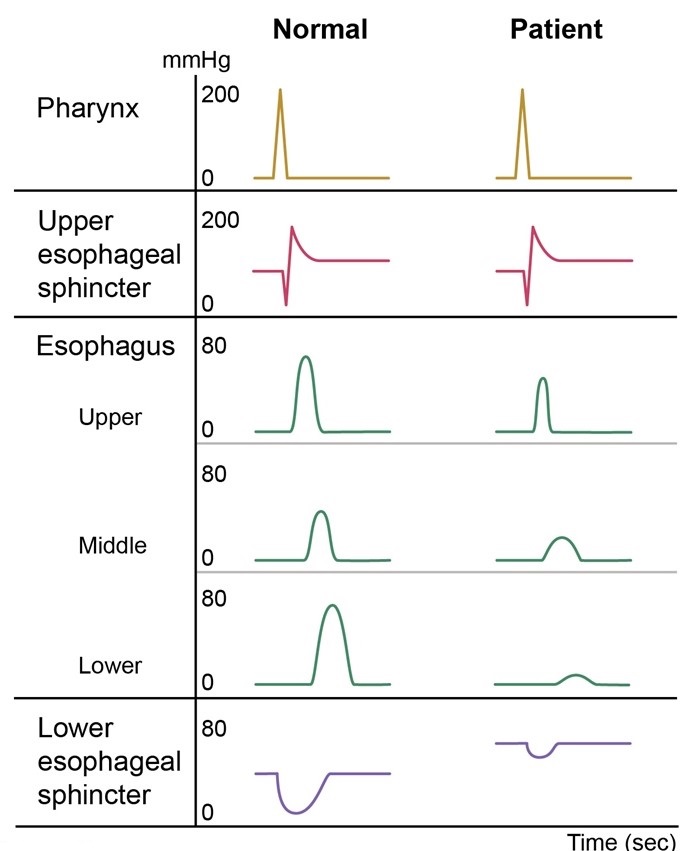 Which of the following is the most likely diagnosis in this patient?
 (Multiple Choice)
4.9/5  (84)
(84) An 11-year-old boy is brought to the office for a routine checkup prior to enrollment at summer camp. The patient and his mother report no health concerns. Family history is significant for his father passing away suddenly from a heart condition 2 years ago. The patient is at the 75th and 80th percentiles for height and weight, respectively. Vital signs are normal. Physical examination shows a well-appearing child. The lungs are clear to auscultation. Cardiac auscultation findings at the left lower sternal border are given below. The auscultatory abnormality intensifies with the handgrip exercise. Which of the following is the most likely diagnosis?
(Multiple Choice)
4.8/5 (60)
(60) A 5-month-old boy with chronic diarrhea and failure to thrive is found to have a low blood T-lymphocyte count and severely decreased serum immunoglobulin. After thorough evaluation, an experimental treatment is proposed to his parents. The therapy consists of infecting the patient's cells with a retroviral vector containing the gene for a protein that is deficient in this patient. Which of the following proteins is most likely coded by this gene?
(Multiple Choice)
4.8/5 (92)
(92) A 25-year-old man with an insignificant medical history was playing soccer when he suddenly collapsed. Despite all attempts to save his life, he died. Autopsy is performed. Gross examination of the heart reveals a weight of 580 g (normal: <350). The cut surface of the heart is shown in the image. 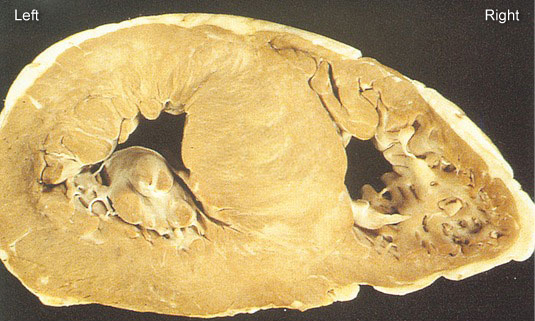 If this patient had a preparticipation sports screening, cardiac auscultation would have likely revealed a murmur that increases in intensity after which of the following?
 (Multiple Choice)
5.0/5 (81)
(81) A 24-year-old man comes to the office for an exercise evaluation. He is an avid long-distance runner. One of his team members recently died suddenly in his sleep, which made the patient worried about his health. He has no medical history, takes no medications, and does not use illicit drugs. His maternal grandfather had a heart attack at age 40 and underwent coronary artery bypass surgery. Blood pressure is 122/70 mm Hg and pulse is 49/min. Transthoracic echocardiogram shows the following: 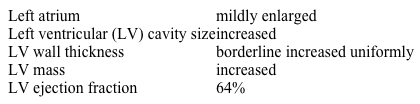 The right ventricular cavity is slightly enlarged and there are no valvular lesions. Which of the following best explains this patient's echocardiogram findings?
 (Multiple Choice)
4.8/5 (91)
(91) A 32-year-old man comes to the office due to vision problems. Over the last 6 weeks, he has had several "near-misses" while driving, having been nearly hit by cars coming from both the right and left sides. He also reports frequent headaches. The patient has no prior medical conditions and takes no medications. He does not use tobacco, alcohol, or illicit drugs. Physical examination reveals deficits in the bilateral temporal visual fields. Extraocular movements are bilaterally intact, and the remainder of the neurological examination shows no abnormalities. Which of the following additional findings is most likely to be present in this patient?
(Multiple Choice)
4.7/5 (59)
(59) A 47-year-old woman comes to the office with a red rash on her breast that has been present for approximately 2 months. The rash is itchy, and the skin feels rough to the touch. The itching has worsened in the past few weeks, and moisturizers have provided no relief. The patient has a history of surgery for bilateral silicone breast implants 10 years ago. Temperature is 37 C (98.6 F). Physical examination shows redness and swelling of the right breast without any discrete masses. The overlying skin is indurated with a dimpled texture, and several enlarged, hard lymph nodes are palpated in the right axilla. The left breast is normal. Which of the following is the most likely cause of this patient's skin changes?
(Multiple Choice)
4.9/5 (85)
(85) A 53-year-old man comes to the physician due to weight loss, fatigue, and anorexia. He reports no dietary changes but has lost 6.8 kg (15 lb) in the past 2 months. Endoscopy shows an early invasive gastric cancer. The patient undergoes an uncomplicated total gastrectomy without any postoperative complications. The physician counsels the patient that he must receive lifelong administration of which of the following substances?
(Multiple Choice)
4.8/5 (83)
(83) A 33-year-old woman comes to the office due to worsening exertional dyspnea. She previously jogged frequently, but now becomes short of breath while walking her dog in the park. The patient has no other significant medical history and takes no medications. She smokes a pack of cigarettes daily and does not use alcohol or illicit drugs. Blood pressure is 124/76 mm Hg, pulse is 78/min, and respirations are 20/min. BMI is 27 kg/m2. Cardiac examination is unremarkable. Laboratory studies reveal markedly decreased serum alpha-1 antitrypsin levels. Which of the following pulmonary function test patterns is most likely to be present in this patient?
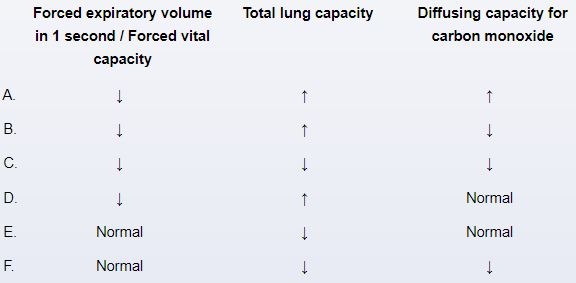
(Multiple Choice)
5.0/5 (87)
(87) A 38-year-old woman is being evaluated for intermittent tingling and numbness of the left hand for the past several months. Her symptoms predominantly involve the fourth and fifth digits and are often brought on by driving a car. Physical examination shows no abnormalities. An electrodiagnostic study is performed, during which a nerve stimulator is placed on the left fifth digit and a surface recorder is placed over the ulnar nerve above the elbow. Electrical stimulus is applied, and the graph obtained is shown below. Results from the asymptomatic contralateral extremity are also shown. Which of the following is primarily affected in this patient? 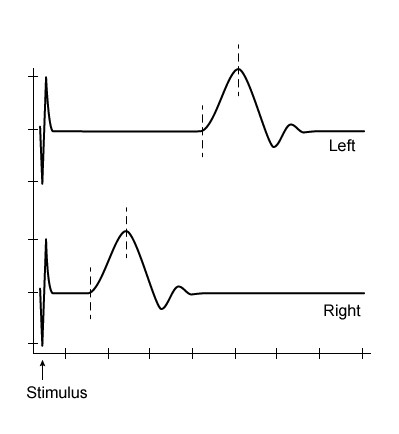
(Multiple Choice)
4.7/5 (79)
(79) A 27-year-old woman comes to the office due to exertional dyspnea over the past 3 months. The patient initially had shortness of breath during exercise but now becomes dyspneic with routine activities. She has had no cough, fever, or leg swelling but has noticed increased fatigue over this time. The patient does not use tobacco, alcohol, or illicit drugs. Vital signs are within normal limits. Physical examination reveals a loud pulmonic component of S2 but is otherwise unremarkable. Chest x-ray is normal. Echocardiography shows elevated pulmonary artery systolic pressure and right ventricular hypertrophy. Left ventricular structure and function are normal. Which of the following patterns of chemical mediators is most likely present in this patient's pulmonary arteries?
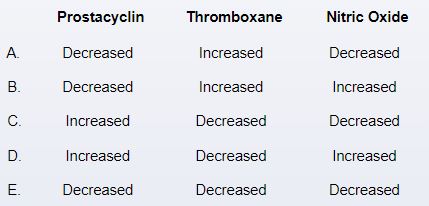
(Multiple Choice)
4.9/5 (69)
(69) A 25-year-old woman comes to the office due to amenorrhea. The patient's last menstrual period was 8 weeks ago, and she normally has regular, monthly menses. The patient has no chronic medical conditions and has had no surgeries. She takes no daily medications. Blood pressure is 100/60 mm Hg and pulse is 92/min. BMI is 24 kg/m2. Abdominal examination shows a soft, nontender abdomen with no palpable masses. Pelvic examination shows an 8-week-sized, nontender uterus. Serum β-hCG level is elevated. Which of the following is the most important direct role of hCG in this patient?
(Multiple Choice)
4.9/5 (78)
(78) A 48-year-old woman comes to the office due to an intermittent ear discharge over the last 2 years. She has also noticed decreased hearing in the right ear recently. Past medical history is significant for obesity, hyperlipidemia, seasonal allergies, and diet-controlled diabetes mellitus. Otoscopy shows a small perforation in the right tympanic membrane and a pearly mass behind the membrane. Conduction hearing loss is noted in the right ear. The remainder of the ear, nose, and throat examination is normal. Which of the following is the most likely cause of this patient's aural mass?
(Multiple Choice)
4.8/5 (74)
(74) A 55-year-old woman with a history of Crohn disease is admitted to the hospital due to perforated appendicitis. The patient quickly develops respiratory difficulty, and acute respiratory distress syndrome is diagnosed. She is intubated and mechanically ventilated with positive pressure ventilation. Despite the use of high positive end-expiratory pressure, the patient's condition continues to deteriorate. She is intermittently placed in the prone position while mechanically ventilated. Which of the following is most likely to occur due to this position change?
(Multiple Choice)
4.8/5 (82)
(82) A 34-year-old man is evaluated in the clinic due to easy bruising. The patient says that even minor trauma causes a bruise and that he sometimes has spontaneous bruising over his legs. He has also been experiencing generalized fatigue, poor appetite, and dull pain and stiffness in his lower back and joints at night. The patient has a history of Crohn disease that required a partial bowel resection a year ago. Three months ago, he was treated with oral antibiotics for a perianal fistula. His mother died of colon cancer when she was 56. Physical examination shows several large ecchymoses on his lower extremities. Which of the following is the most likely diagnosis?
(Multiple Choice)
4.9/5 (82)
(82) A 62-year-old man comes to the office with his wife due to behavioral changes. The patient has become increasingly impulsive and irritable over the past 1-2 years. He recently lost his job after making inappropriate comments and touching female coworkers. The patient has also lost interest in his hobbies and appears withdrawn during social gatherings. His other medical problems are hypertension and hyperlipidemia. A thorough neuropsychological assessment is conducted. Inability to perform which of the following tasks would be most indicative of frontal lobe dysfunction?
(Multiple Choice)
4.8/5 (91)
(91) A 28-year-old woman comes to the office due to pain at a previous surgery site. The patient underwent cesarean delivery a year ago and had no issues with wound healing. However, over the past 2 months, she has had intermittent sharp and burning pain at the incision site. Physical examination reveals a well-healed, low, transverse scar. There is a small knot palpable at the left end of the scar, light touch of which elicits severe pain. Cutaneous sensory nerve injury and abnormal axonal regeneration are suspected. Which of the following ion channels is most likely upregulated within the affected axons?
(Multiple Choice)
4.9/5 (68)
(68) A 15-year-old boy comes to the office for evaluation of a neck mass. The patient first noticed the mass a month ago and it has progressively enlarged. He has had no neck pain, fever, or difficulty swallowing or breathing. Examination shows a firm, nontender mass affecting the left thyroid lobe. TSH is within normal limits. Ultrasonography reveals a hypoechoic 2-cm nodule in the upper portion of the left thyroid lobe. Fine-needle biopsy reveals a cluster of large cells with abundant cytoplasm that stain positive for calcitonin. The patient is also found to be positive for a germline RET mutation. A total thyroidectomy is planned. Prior to the surgery, additional testing should be performed to evaluate for an abnormality in which of the following organs?
(Multiple Choice)
4.7/5 (81)
(81) A 14-year-old boy is brought to the clinic by his mother due to changes in vision. For the last few weeks, the patient has been squinting when trying to read the interactive whiteboard in class and has had to sit closer to the front of the room. He has also developed headaches. The patient has no chronic medical conditions and takes no medications. Temperature is 37.2 C (99 F), blood pressure is 116/76 mm Hg, and pulse is 70/min. Examination of the eyes shows equal and reactive pupils. Extraocular muscles are intact, and visual field testing reveals no defects. Visual acuity shows 20/70 in both eyes. His ability to read close text is normal. Which of the following is the most likely cause of this patient's symptoms?
(Multiple Choice)
4.8/5 (73)
(73) A 69-year-old man comes to the office due to progressive pain beneath his right scapula and in his right arm for the last several months. He has taken over-the-counter analgesics, which provide short-term relief, but the pain has become more severe and awakens him at night. The pain is associated with numbness in his right forearm extending up to the tips of the fourth and fifth fingers. The patient has also had persistent nonproductive cough and lately has been coughing up streaks of blood. He has a history of hypertension, gastroesophageal reflux disease, and osteoarthritis. He has smoked 2 packs of cigarettes daily for more than 40 years but recently cut down to 4 or 5 cigarettes a day. Which of the following is the most likely cause of this patient's symptoms?
(Multiple Choice)
4.8/5 (81)
(81) 
Filters
- Essay(0)
- Multiple Choice(0)
- Short Answer(0)
- True False(0)
- Matching(0)