



 Chat with AI
Exam 11: Pathophysiology

Exam 1: Anatomy291 Questions
Exam 2: Behavioral science240 Questions
Exam 3: Biochemistry156 Questions
Exam 4: Biostatistics117 Questions
Exam 5: Embryology52 Questions
Exam 6: Genetics103 Questions
Exam 7: Histology24 Questions
Exam 8: Immunology129 Questions
Exam 9: Microbiology336 Questions
Exam 10: Pathology816 Questions
Exam 11: Pathophysiology464 Questions
Exam 12: Pharmacology538 Questions
Exam 13: Physiology272 Questions
Select questions type


A 32-year-old woman comes to the clinic due to 6 weeks of bloating and diarrhea. She has multiple watery bowel movements a day without visible blood. The patient underwent Roux-en-Y gastric bypass surgery for morbid obesity 3 years ago and has no other medical conditions. Vital signs are within normal limits. Physical examination is unremarkable. A jejunal aspirate shows a bacterial count of >105/mL, consistent with small intestinal bacterial overgrowth. Which of the following serum levels is most likely to be increased in this patient?
(Multiple Choice)
4.8/5  (76)
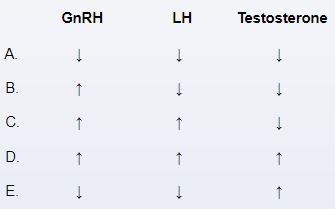
(76) A 34-year-old man comes to the office due to a 6-month history of progressively worsening headaches. He has also noticed blurring of his peripheral vision while driving. The patient has no history of head injuries and has had no associated dizziness, weight change, diplopia, or polyuria. Medical history is unremarkable, and he takes no medications. He does not use tobacco, alcohol, or illicit drugs. Physical examination shows a bitemporal visual field deficit. Laboratory studies show a serum prolactin level >20 times the upper limit of normal. Cranial imaging reveals a large pituitary mass. Which of the following changes in serum GnRH, LH, and testosterone are most likely to be found in this patient?
(Multiple Choice)
4.9/5 (76)
(76) An 18-year-old man is evaluated for recurrent episodes of shortness of breath, wheezing, runny nose, and watery eyes. The patient reports that his symptoms have recently worsened since he started training outdoors for an upcoming marathon. He does not use tobacco, alcohol, or illicit drugs. Skin testing is performed to determine symptom triggers. A pricking device is used to apply allergen extract underneath the skin. After 15 minutes, the patient develops raised, erythematous plaques with surrounding erythema at the application site. Which of the following mediators is the first to be released during the pathogenesis of this patient's skin findings?
(Multiple Choice)
4.9/5 (76)
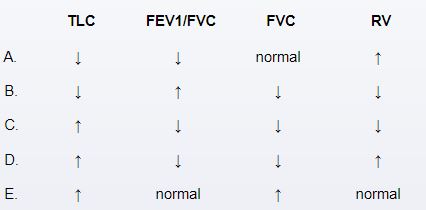
(76) A 25-year-old man with cystic fibrosis comes to the clinic for a routine follow-up appointment. The patient has had multiple hospital admissions over the last few years for pulmonary exacerbations. Pulmonary function testing today will most likely reveal which of the following results?
(Multiple Choice)
4.8/5 (84)
(84) A 34-year-old woman comes to the hospital with a 4-day history of abdominal cramps, nausea, and watery diarrhea. Today she developed dizziness on standing. Her child has had similar symptoms recently. The patient has no prior medical conditions and takes no medications on a regular basis. Blood pressure is 124/82 mm Hg while supine and 100/70 on standing; pulse is 98/min. Examination shows dry mucous membranes. The abdomen is soft and nontender. Laboratory results are as follows: 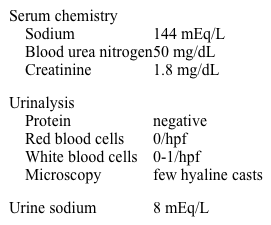 Which of the following changes are most likely to be seen in this patient?
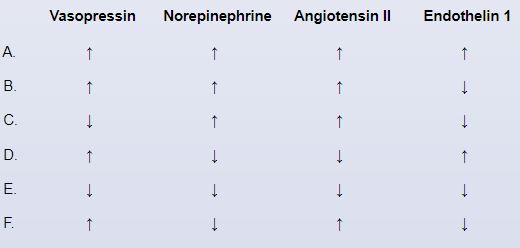
Which of the following changes are most likely to be seen in this patient?
(Multiple Choice)
4.8/5 (87)
(87) A 2-month-old boy is found unresponsive in his crib. He had previously been well and had a normal physical examination at his 2-month visit approximately 1 week earlier. An autopsy is performed to determine the cause of death. The pathologist concludes that the infant likely died of sudden infant death syndrome. The autopsy also shows an incidental finding of bicuspid aortic valve. If this patient had survived, he would have been at greatest risk for which of the following events?
(Multiple Choice)
4.9/5 (90)
(90) A 36-year-old woman, gravida 2 para 1, at 30 weeks gestation comes to the office for a prenatal visit. The patient has noticed some ankle swelling at the end of the day that is relieved with elevating her legs, but she has no other concerns. The pregnancy has been uncomplicated, and her only medications are a prenatal vitamin and iron supplement. The patient has no chronic medical conditions. She does not use tobacco or alcohol. Blood pressure is 118/78 mm Hg and pulse is 72/min. BMI is 30 kg/m2. Fetal heart tones are normal. There is trace bilateral pedal edema to the shins. Physical examination is otherwise unremarkable. Urinalysis shows no protein. Compared to a nonpregnant state, which of the following cardiac changes are most likely to be found in this patient?
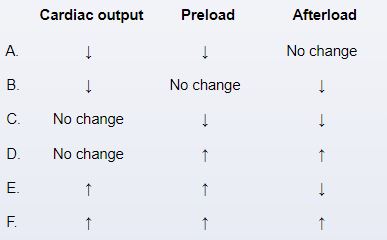
(Multiple Choice)
4.9/5 (89)
(89) A 32-year-old woman comes to the office due to several days of fatigue and malaise. She has no significant medical history and has had no recent sick contacts. The patient does not appear to be in acute distress. Evaluation reveals severe thrombocytopenia. Thrombotic thrombocytopenic purpura is suspected. Which of the following findings is required to make the diagnosis?
(Multiple Choice)
4.8/5 (82)
(82) A 54-year-old woman comes to the office due to exertional dyspnea and fatigue. The patient gets short of breath while walking to a store 2 blocks away from her home. She also has trouble breathing at night and sleeps with 2 or 3 pillows to prop her up. She has had occasional palpitations but no chest pain. The patient takes no medications on a regular basis, and does not use tobacco, alcohol, or illicit drugs. After initial evaluation, she is scheduled for a left heart catheterization, the findings of which are shown below. 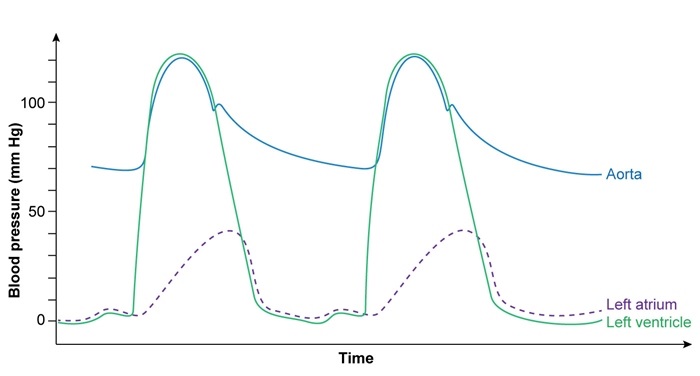 Which of the following is the most likely diagnosis?
 (Multiple Choice)
4.8/5 (89)
(89) A 44-year-old man comes to the clinic due to increasing fatigue, trouble sleeping, and palpitations. He has lost 9 kg (20 lb) over the last year despite eating well. The patient says he is under a lot of pressure at work but cannot think of any other precipitating factors for his insomnia. He has no other medical problems and takes no medications. The patient does not use tobacco, alcohol, or illicit drugs. His mother has a history of a thyroid problem. Blood pressure is 140/80 mm Hg and pulse is 108/min. On physical examination, the thyroid is diffusely enlarged. His serum free thyroxine level is elevated and TSH level is decreased. He is found to have a positive assay for thyrotropin receptor antibodies. If present, which of the following additional findings would be most specific to the underlying cause of this patient's hyperthyroidism?
(Multiple Choice)
4.9/5 (93)
(93) A 45-year-old man comes to the office due to progressive dyspnea on exertion and cough for the past several weeks. He has had no fever, chills, chest pain, or leg swelling. The patient is a former smoker with 5-pack-year history. Temperature is 37.2 C (99 F), blood pressure is 120/70 mm Hg, pulse is 82/min, and respirations are 16/min. The patient is hypoxemic at rest, with an oxygen saturation of 88% on room air. Jugular venous pressure is normal. Lung auscultation shows scattered crackles. Heart sounds are normal. Chest x-ray reveals bilateral midalveolar and lower alveolar opacities. Transbronchial lung biopsy reveals lipoproteinaceous material that is positive on periodic acid-Schiff stain and fills up the terminal bronchioles and alveoli. Electron microscopy of the substance shows lamellar bodies. Impaired function of which of the following most likely caused excessive accumulation of the substance in this patient's alveoli?
(Multiple Choice)
4.8/5 (79)
(79) A 20-year-old man comes to the office for evaluation of abnormal behavior. Over the past 4 months, the patient has had several episodes of unresponsiveness, during which he would stare blankly while smacking his lips. He spontaneously becomes responsive after about 2 minutes and has no recollection of the event. The patient says these episodes are often preceded by an uneasy sensation in his upper abdomen and the pungent smell of something burning. He has had no falls or jerky movements of the extremities. The patient has no history of recent fever, headaches, head trauma, nausea, vomiting, or focal neurologic deficit. He had seizures in early childhood precipitated by high fevers but has had none since then and reports no other medical conditions. Cranial nerve examination reveals no abnormalities. Motor strength, sensation, and deep tendon reflexes are normal throughout. Neuroimaging is most likely to reveal an abnormality in which of the following locations in the brain?
(Multiple Choice)
4.8/5 (74)
(74) A 45-year-old woman is brought to the hospital after she collapsed during an airshow on a hot summer day. The patient has a history of fibromyalgia and takes amitriptyline. Temperature is 40.5 C (104.9 F), blood pressure is 90/60 mm Hg, pulse is 110/min, and respirations are 22/min. The skin is warm and red. She is disoriented. Neurologic examination shows no focal findings. If this patient's medication contributed to her current condition, which of the following mechanisms is most likely responsible?
(Multiple Choice)
4.9/5 (79)
(79) A 15-year-old girl is hospitalized due to confusion and hematemesis for 2 days. Medical history is notable for depression over the past year. Temperature is 37.2 C (99 F), blood pressure is 86/56 mm Hg, pulse is 112/min, and respirations are 20/min; BMI is 23 kg/m2. She is oriented to person but disoriented to time and place. The patient quickly deteriorates and dies during hospitalization. Autopsy examination reveals a nodular liver, esophageal varices, splenomegaly, and atrophy of the basal ganglia with increased copper content. The most likely cause of this patient's condition is an abnormality in which of the following physiologic processes?
(Multiple Choice)
4.8/5 (73)
(73) A 13-year-old boy is admitted to the hospital due to fever and fatigue for the past week. The patient recently received a cadaveric renal transplant for glomerulonephritis, and his immunosuppressive medication regimen was increased a month ago due to early evidence of rejection. Temperature is 37.7 C (99.9 F). Heart and lung examinations are unremarkable. The liver is mildly enlarged, and the spleen tip is palpable. There is notable adenopathy of the bilateral inguinal and axillary regions. A complete blood count shows mild leukopenia. Histopathology findings from biopsy of one of the enlarged lymph nodes are shown in the image below. 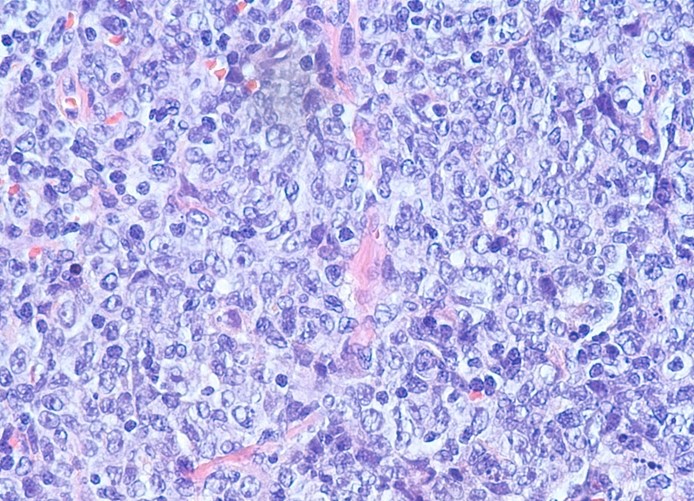 Which of the following is the most likely cause of this patient's presentation?
 (Multiple Choice)
4.9/5 (98)
(98) A 70-year-old man comes to the emergency department due to severe right-sided chest pain and shortness of breath after a fall. While doing yard work, the patient fell off of a ladder, striking his back on several large stones. Immediately afterward, he felt sharp pain over his posterior chest and had trouble catching his breath. Blood pressure is 120/80 mm Hg, pulse is 88/min, and respirations are 24/min. Chest x-ray is shown in the exhibit. 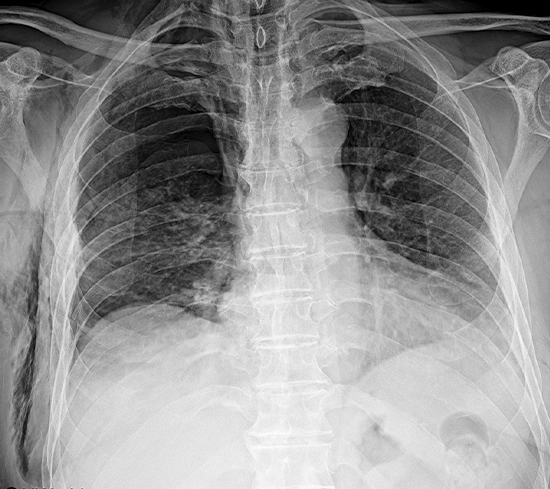 Physical examination of the right side of the chest would most likely reveal which of the following?
 (Multiple Choice)
4.8/5 (84)
(84) A 65-year-old man with a long history of hypertension and type 2 diabetes mellitus comes to the office for a routine checkup. The patient is a former smoker with a 15-pack-year history. He jogs 3 miles per day. BMI is 28.5 kg/m2. Family history is unremarkable. Auscultation findings over the cardiac apex are given below. The auscultation findings are best explained by which of the following?
(Multiple Choice)
4.8/5 (75)
(75) A 37-year-old woman, gravida 2 para 1, at 28 weeks gestation comes to the office due to leakage of urine. The patient has had intermittent leakage with cough but no dysuria or hematuria. She reports normal fetal movement and has had an uncomplicated pregnancy. Four years ago, the patient had a spontaneous vaginal delivery of a 3500 g (7 lb 11 oz) neonate. The patient has no chronic medical conditions or prior surgeries. Vital signs are normal. Prepregnancy BMI was 32 kg/m2. She has gained 15.8 kg (34.8 lb) during this pregnancy. The abdomen is gravid, and there is no suprapubic tenderness. Urinalysis is negative for blood, leukocyte esterase, and nitrite. Which of the following is the most likely mechanism for this patient's urinary incontinence?
(Multiple Choice)
4.8/5 (75)
(75) A 20-year-old woman is brought to the emergency department due to intractable vomiting and abdominal pain. She has a several-week history of anorexia and weight loss. The patient has well-controlled primary hypothyroidism treated with levothyroxine but has not taken her medication for 2 days because of vomiting. Temperature is 37.6 C (99.7 F), blood pressure is 80/40 mm Hg, pulse is 120/min, and respirations are 18/min. On physical examination, she is mildly lethargic but oriented. Generalized hyperpigmentation is present and is most conspicuous over the face, neck, and dorsal surface of the hands. Urinalysis and chest x-ray are within normal limits. Finger-stick blood glucose is 60 mg/dL. A 1-L bolus of normal saline is rapidly infused, and high-flow intravenous fluids are continued. This patient also requires immediate treatment with which of the following medications?
(Multiple Choice)
4.8/5 (81)
(81) A 50-year-old woman comes to the office to discuss weight gain. She has gained about 13.6 kg (30 lb) over the last 2 years, which she attributes to excessive eating and not exercising. The patient is otherwise feeling well, and her past medical history is unremarkable. However, she has a strong family history of type 2 diabetes mellitus. Blood pressure is 150/90 mm Hg and pulse is 75/min. BMI is 30.3 kg/m2. Hyperpigmentation in skinfolds is noted at the neck as shown in the image below. 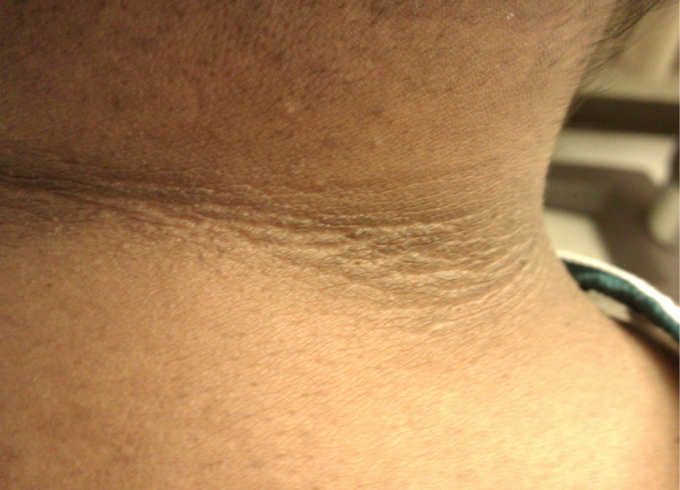 Laboratory testing shows a fasting blood glucose of 150 mg/dL and HbA1c of 8.0%. Elevated serum levels of which of the following substances are most likely contributing to this patient's disease process?
 (Multiple Choice)
4.9/5 (79)
(79) 
Filters
- Essay(0)
- Multiple Choice(0)
- Short Answer(0)
- True False(0)
- Matching(0)