



 Chat with AI
Exam 11: Pathophysiology

Exam 1: Anatomy291 Questions
Exam 2: Behavioral science240 Questions
Exam 3: Biochemistry156 Questions
Exam 4: Biostatistics117 Questions
Exam 5: Embryology52 Questions
Exam 6: Genetics103 Questions
Exam 7: Histology24 Questions
Exam 8: Immunology129 Questions
Exam 9: Microbiology336 Questions
Exam 10: Pathology816 Questions
Exam 11: Pathophysiology464 Questions
Exam 12: Pharmacology538 Questions
Exam 13: Physiology272 Questions
Select questions type


A 23-year-old man is brought to the emergency department by his roommate due to progressive weakness and confusion. The roommate says that the patient has been "drinking water all of the time and using the bathroom constantly" since he got sick with a cold 2 days ago. Temperature is 37.8 C (100 F), blood pressure is 96/58 mm Hg, and pulse is 112/min. Physical examination shows dry mucous membranes and his urine has a strong, fruity odor. Laboratory results are as follows: 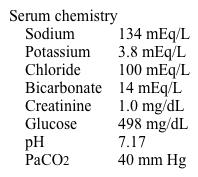 Based on the current laboratory findings, which of the following is most likely occurring in this patient?
 (Multiple Choice)
4.9/5  (65)
(65) A 23-year-old woman comes to the office due to exertional dyspnea. She occasionally has a dry cough but has had no chest pain, palpitations, or syncope. The patient emigrated from Cambodia 3 years ago. She had bilateral knee swelling as a child. Cardiac auscultation findings over the cardiac apex are given below. Which of the following is the most likely cause of this patient's symptoms?
(Multiple Choice)
4.8/5 (78)
(78) A 34-year-old man comes to the emergency department with fatigue and lightheadedness. The patient had an upper respiratory infection last week, and since then his energy level has been low with shortness of breath on mild exertion. Otherwise, his medical history is insignificant. He is a lifetime nonsmoker. The patient's temperature is 37 C (98.6 F), blood pressure is 80/60 mm Hg, and pulse is 120/min and regular. His pulse becomes undetectable to palpation during inspiration. The lungs are clear to auscultation, but the jugular veins are distended. Which of the following is the most likely diagnosis?
(Multiple Choice)
4.8/5 (94)
(94) A 17-year-old girl is brought to the office due to yellow eyes for the past day. The patient has no other symptoms, including fever, rash, abdominal pain, vomiting, or diarrhea. She has been preparing for her high school exit examination and has been quite stressed. Temperature is 37.1 C (98.8 F), blood pressure is 110/78 mm Hg, pulse is 80/min, and respirations are 14/min. Mild scleral icterus is present. The abdomen is soft with no hepatosplenomegaly. Serum laboratory results are as follows: 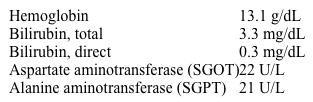 Two weeks after her examination, the patient's symptoms resolve. Repeat testing shows a total bilirubin concentration of 1.5 mg/dL. Which of the following changes most likely contributed to this patient's hyperbilirubinemia?
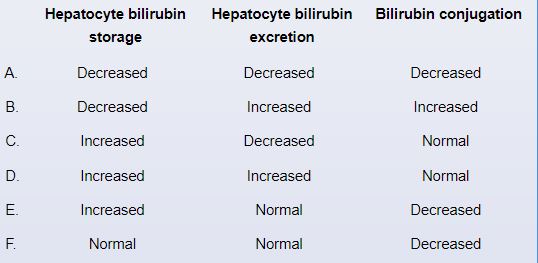
Two weeks after her examination, the patient's symptoms resolve. Repeat testing shows a total bilirubin concentration of 1.5 mg/dL. Which of the following changes most likely contributed to this patient's hyperbilirubinemia?
(Multiple Choice)
4.9/5 (70)
(70) A 29-year-old man comes to the office due to progressive headaches, fatigue, and visual disturbances for the past 6 weeks. He was diagnosed with sarcoidosis a year ago after having a dry cough and hypercalcemia. The patient's condition was treated with oral glucocorticoid therapy, which was discontinued after 6 months due to improvement in symptoms. Physical examination reveals bitemporal defects on visual field testing but is otherwise normal. Laboratory studies again show mild hypercalcemia, but the remainder of the values, including complete blood count, serum glucose, creatinine, and electrolytes, are within normal reference ranges. MRI of the brain reveals a soft tissue mass involving the hypothalamus and pituitary stalk. Which of the following pituitary hormones is most likely elevated in this patient?
(Multiple Choice)
4.8/5 (72)
(72) A 34-year-old man with upper gastrointestinal bleeding is brought to the local emergency department by ambulance. He was found in front of a grocery store after customers called emergency medical services. The patient is unable to provide any information, but his medical records show a history of alcohol use disorder. After undergoing emergency evaluation and appropriate resuscitation, his condition stabilizes. Gastric lavage fluid initially contained blood but cleared quickly. Upper endoscopy shows a linear mucosal tear at the gastroesophageal junction. The process directly responsible for causing this patient's mucosal tear will most likely result in which of the following acid-base disturbances?
(Multiple Choice)
4.9/5 (69)
(69) A 30-year-old woman comes to the emergency department with sudden-onset abdominal pain and ascites. Laboratory studies show anemia, reticulocytosis, leukopenia, and thrombocytopenia. Flow cytometry of the patient's peripheral blood cells using the appropriate monoclonal antibodies shows CD55 and CD59 deficiency. CT scan of the abdomen shows hepatic vein thrombosis. Which of the following is the most likely cause of this patient's anemia?
(Multiple Choice)
4.9/5 (69)
(69) A 34-year-old man comes to the clinic due to frequent clumsiness. For the last 6 months, he has had repeated minor injuries from walking into doorways and stationary objects. The patient was also reprimanded at work for causing his supervisor to spill coffee when he bumped into her in the hallway. Medical history is notable for recurrent renal stones; following a subsequent diagnostic evaluation, the patient underwent definitive treatment with neck surgery 3 years ago. Family history is unavailable as the patient was adopted. Physical examination reveals bitemporal visual field defects. Cranial nerves, motor strength, and deep-tendon reflexes are otherwise normal. In addition to brain imaging, this patient should also be screened for which of the following tumors?
(Multiple Choice)
4.9/5 (74)
(74) A 4-year-old boy is brought to the emergency department with dehydration. He has had several days of decreased oral intake, and today his parents could not get him to drink anything. The patient has received no vaccinations due to parental beliefs. Vital signs are normal except for mild tachycardia. Physical examination shows decreased skin turgor and sunken eyes. His jaw muscles are tight. Neurologic examination shows increased tone throughout and 3+ patellar reflexes. There is a small, healed puncture wound on his lower leg. The father says that the boy fell on a piece of chain-link fence in their backyard last week. Release of which of the following neurotransmitters is most likely to be directly impaired in this patient?
(Multiple Choice)
4.8/5 (66)
(66) A 15-year-old boy is brought to the emergency department with fever, purulent nasal discharge, and epistaxis. The patient has had fever and persistent nasal discharge for the past 10 days. He developed intermittent epistaxis 2 days ago that has been difficult to control. The patient has also had easy bruising for the past 2 months. Medical history is significant for cystic fibrosis, and he has not been taking his prescribed medications. Results of coagulation studies are as follows: 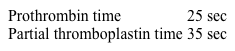 Which of the following coagulation factors is most likely to be abnormal in this patient?
 (Multiple Choice)
4.8/5 (81)
(81) A 16-year-old previously healthy boy is brought to the office due to palpitations. He was watching a documentary at a movie theater when his heart suddenly began to race and he became lightheaded. The patient says that he has felt "rapid heartbeats" in the past and thought that they were due to stress from school exams, but he has never had associated lightheadedness before. He has no chest pain or dyspnea. Physical examination is within normal limits. ECG strip is shown in the exhibit. 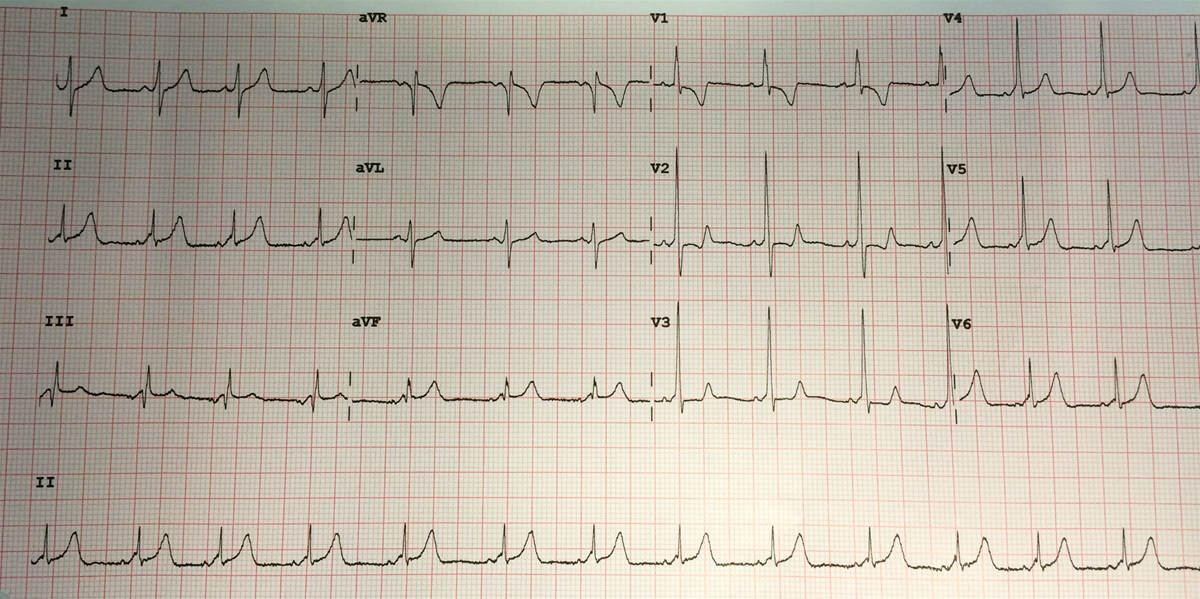 Which of the following is most likely to be seen in this patient?
 (Multiple Choice)
4.9/5 (80)
(80) A 23-year-old woman comes to the office due to sharp, right-sided chest pain, fatigue, and fever for the past week. The chest pain is worsened with deep breathing. She has had no associated expectoration or shortness of breath. For the past 6 months, the patient also has had intermittent joint pains, predominantly in the knees and hands. She is sexually active with one male partner and uses an intrauterine device for contraception. Temperature is 38.3 C (100.9 F), blood pressure is 120/70 mm Hg, pulse is 89/min, and respirations are 18/min. BMI is 24 kg/m2. Examination shows mild erythema over the cheeks and a scratching sound over the right lower lung with breathing. Heart sounds are normal. There is no joint swelling. Which of the following tests is most useful in confirming the diagnosis?
(Multiple Choice)
4.8/5 (86)
(86) A 35-year-old woman comes to the office with malaise and generalized weakness. Her other medical problems include type 1 diabetes mellitus and hypothyroidism for which she takes insulin and levothyroxine. She eats a balanced, diabetic diet and exercises 5 times per week. Physical examination shows mild conjunctival pallor.Laboratory results are as follows: 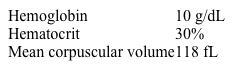 Further evaluation shows a very low vitamin B12 level and a normal folate level. Which of the following sets of physiologic alterations is most likely to be present in this patient?
 (Multiple Choice)
4.7/5 (88)
(88) A 46-year-old woman is hospitalized for recurrent renal colic. She has passed 2 urinary stones during the last 2 years. The most recent stone contained 80% calcium phosphate and 20% calcium oxalate. The patient also has diffuse aches and pains and has a history of peptic ulcer disease, for which she takes famotidine daily. Laboratory results are as follows: 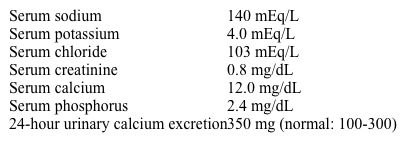 Which of the following changes in bone structure is most likely associated with this patient's condition?
 (Multiple Choice)
5.0/5 (81)
(81) A 54-year-old man comes to the office for evaluation of hypertension. He was diagnosed with hypertension 2 years ago but has had inconsistent follow-up and has not seen a physician in the last 6 months. The patient is not currently taking any medications but feels well and has good exercise tolerance. He has a family history of hypertension and ischemic stroke. His BMI is 26 kg/m2. Physical examination is unremarkable. Serum creatinine level is normal. The patient is started on valsartan and hydrochlorothiazide, and the following values were measured at baseline (before starting treatment) and after 3 weeks of therapy:  Which of the following best explains the observed findings in this patient?
 (Multiple Choice)
4.8/5 (77)
(77) A 44-year-old man comes to the emergency department with a 3-day history of fever, chills, malaise, dyspnea, and a cough productive of "greenish" sputum. The patient has no prior medical problems and has never been hospitalized. He has a 25-pack-year smoking history and drinks 4-5 beers a week. His temperature is 39.4 C (103 F), blood pressure is 130/80 mm Hg, pulse is 98/min, and respirations are 20/min. On examination, dullness to percussion, crackles, and egophony are present at the right lung base. The remainder of the examination is normal. Chest x-ray shows a dense infiltrate occupying the entire right lower lobe. Which of the following most likely accounts for the color of this patient's sputum?
(Multiple Choice)
5.0/5 (86)
(86) A 35-year-old nulliparous, mildly obese woman is diagnosed with cervical intraepithelial neoplasia III. She has been sexually active for 15 years and has had 4 lifetime partners. She has been monogamous with her current partner for several months and takes oral contraceptives consistently. The patient does not use condoms and douches regularly to "stay fresh." Menarche occurred at age 9, and her menses recur every 28 days and last 6 days. She had a plantar wart a few years ago but otherwise has no medical problems. She drinks 1-2 glasses of wine every night but does not use tobacco or illicit drugs. The patient's mother had breast cancer at age 42. Which of the following is the most significant factor that predisposed this patient to cervical abnormalities?
(Multiple Choice)
4.8/5 (77)
(77) A 60-year-old man is brought to the emergency department due to altered mental status. His wife says that he had a nagging cough that seemed to worsen over the past several months and that he began experiencing occasional dizziness earlier this week. Over the last couple of days, the patient has become increasingly confused, and today he "does not make any sense at all." He has no significant past medical history but has smoked a pack of cigarettes daily for the last 40 years. On physical examination, the patient is incoherent but has an otherwise normal neurologic examination.Laboratory results are as follows: 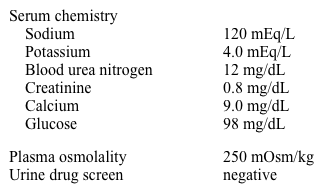 Chest x-ray reveals a mass in the right lung. Which of the following additional findings is most likely to be present in this patient?
 (Multiple Choice)
4.8/5 (90)
(90) An 18-year-old woman collapsed while practicing for a marathon in hot, humid weather. The patient subsequently vomited 3 times and had a tonic-clonic seizure. She has no chronic medical conditions and takes no medications. The patient does not use alcohol or illicit drugs. Temperature is 40.8 C (105.4 F), blood pressure is 90/60 mm Hg, pulse is 130/min, and respirations are 22/min. The patient is profusely sweating and is confused. Pupils are sluggishly reactive to light. Cardiopulmonary examination reveals clear lungs and normal heart sounds. Laboratory results are as follows: 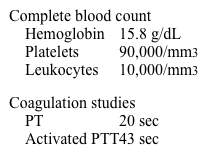 Which of the following sets of hematologic findings is most likely to be present in this patient?
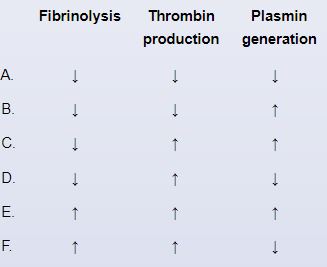
Which of the following sets of hematologic findings is most likely to be present in this patient?
(Multiple Choice)
5.0/5 (90)
(90) A 55-year-old woman comes to the office due to increasing fatigability and a 4.54-kg (10-lb) weight gain over the last few months. The patient used to swim daily but now does so only once or twice a week due to fatigue. She takes a daily multivitamin and an over-the-counter medication for constipation. Blood pressure is 140/96 mm Hg and pulse is 55/min. Physical examination shows hair loss involving the lateral third of the eyebrows. There is delayed relaxation of the deep tendon reflexes of the knee and ankle. Which of the following laboratory tests is the most appropriate next step in evaluation of this patient's symptoms?
(Multiple Choice)
4.9/5 (77)
(77) 
Filters
- Essay(0)
- Multiple Choice(0)
- Short Answer(0)
- True False(0)
- Matching(0)