



 Chat with AI
Exam 11: Pathophysiology

Exam 1: Anatomy291 Questions
Exam 2: Behavioral science240 Questions
Exam 3: Biochemistry156 Questions
Exam 4: Biostatistics117 Questions
Exam 5: Embryology52 Questions
Exam 6: Genetics103 Questions
Exam 7: Histology24 Questions
Exam 8: Immunology129 Questions
Exam 9: Microbiology336 Questions
Exam 10: Pathology816 Questions
Exam 11: Pathophysiology464 Questions
Exam 12: Pharmacology538 Questions
Exam 13: Physiology272 Questions
Select questions type


A 4-year-old girl is brought to the emergency department by her parents due to difficulty breathing. The patient was in her usual state of health until this morning when she developed a fever. Over the past 8 hours, her breathing has become more rapid and strained. Temperature is 39.8 C (103.6 F), blood pressure is 88/64 mm Hg, pulse is 134/min, and respirations are 34/min. On examination, the patient appears scared. She is sitting up on the bed leaning forward while supported by her arms with her head extended. Cardiac examination reveals tachycardia and a normal rhythm without rubs or murmurs. The abdomen is soft and nondistended. Which of the following additional signs is most likely to be found on examination?
(Multiple Choice)
4.9/5  (85)
(85) An 18-year-old, previously healthy man comes to the emergency department after being stabbed in the chest. The patient reports shortness of breath. Blood pressure is 136/84 mm Hg, pulse is 96/min, and respirations are 20/min. Oxygen saturation is 96%. Physical examination reveals a 2.5-cm stab wound on the right lateral chest wall. Breath sounds are decreased on the right side. Chest x-ray is shown in the exhibit. Which of the following changes have most likely occurred in this patient's right hemithorax and right lung compared to his preinjury state?
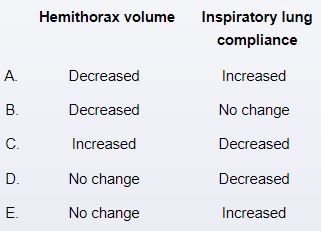 A)A
B)B
C)C
D)D
E)E
A)A
B)B
C)C
D)D
E)E (Short Answer)
4.9/5 (65)
(65) A 26-year-old woman comes to the office for a follow-up appointment. She has a history of immune thrombocytopenia that failed to improve with glucocorticoid therapy. The patient underwent splenectomy 6 months ago, which resulted in improved platelet counts. She received the recommended vaccinations after her surgery and currently feels well. Physical examination shows no abnormalities. A peripheral blood smear reveals many red blood cells of a specific morphology as indicated by the arrow below. 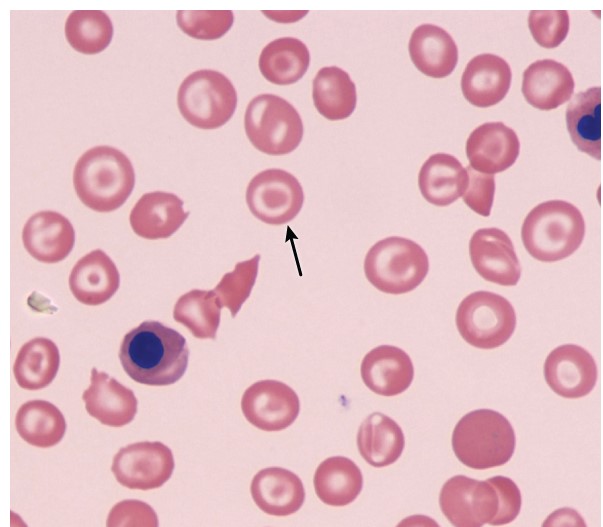 An increase in which of the following features best explains the presence of these abnormal cells?
 (Multiple Choice)
4.8/5 (71)
(71) A 6-year-old girl is brought to the office by her mother due to abdominal pain. The pain is diffuse and began this morning; it waxes and wanes in intensity. The patient has had 2 episodes of nonbilious emesis. She has had no fevers, sore throat, diarrhea, or bloody stools. Two days ago, the patient developed an erythematous, macular rash over her legs and back that has become darker and more confluent today. Blood pressure is 95/60 mm Hg. The abdomen is soft and there is diffuse, mild tenderness on palpation with no rebound, guarding, or appreciable masses. A raised, nonblanching rash is noted over the legs and back. Urinalysis results are as follows: 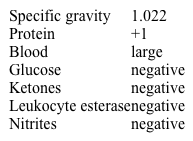 Which of the following renal abnormalities is most likely present in this patient?
 (Multiple Choice)
4.9/5 (85)
(85) A 43-year-old man comes to the office with muscle weakness. His symptoms began 6 weeks ago and are worst in the hips and shoulders. The weakness has had a progressive course so that he is now having difficulty rising from chairs and combing his hair. The patient has had to reduce his regular exercise regimen due to weakness and has requested a modified work schedule for his job as a building maintenance manager. He has no history of spinal injury and no neck pain. Past medical history is insignificant, and the patient takes no medications. Muscle biopsy reveals major histocompatibility complex class I molecule overexpression on the sarcolemma with CD8+ lymphocyte infiltration. Which of the following is the most likely cause of this patient's condition?
(Multiple Choice)
4.8/5 (83)
(83) A 50-year-old woman comes to the emergency department due to a large, painful skin lesion. She does not remember sustaining any trauma. She was recently diagnosed with atrial fibrillation and started on treatment with warfarin. The patient noticed the lesion about a day and a half after starting the medication. Temperature is 36.7 C (98 F), blood pressure is 130/82 mm Hg, and pulse is 88/min and irregularly irregular. Physical examination findings are shown in the image below. 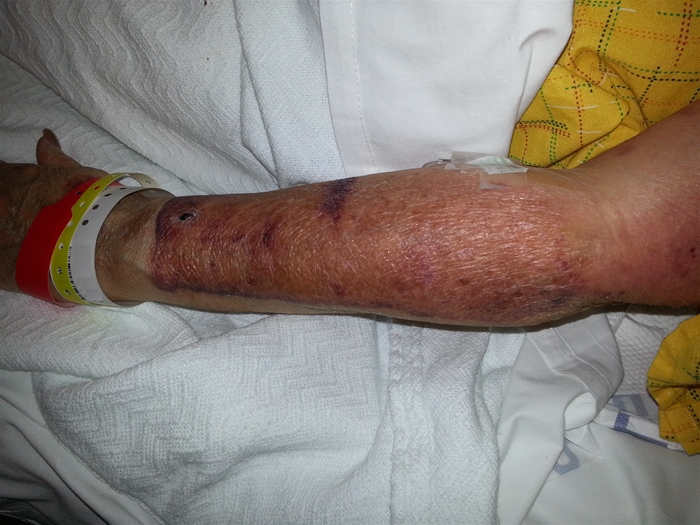 The remainder of the skin examination is normal. Which of the following is the most likely cause of this patient's skin lesion?
 (Multiple Choice)
4.7/5 (76)
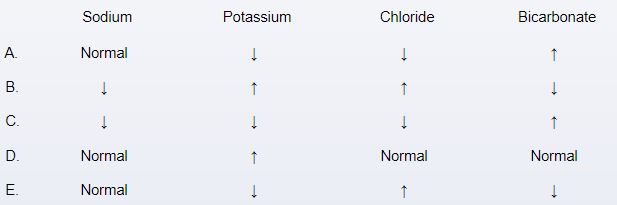
(76) A 30-year-old woman is evaluated for a 3-month history of progressive fatigue, decreased appetite, and 10-lb (4.5-kg) weight loss. The patient has type 1 diabetes mellitus and has noticed decreased insulin requirements over this time. She has no other medical conditions and does not use tobacco, alcohol, or illicit drugs. Physical examination shows a generalized increase in pigmentation of the skin, especially involving the palmar creases. Measurement of serum cortisol before and after administration of exogenous adrenocorticotropic hormone (ACTH) shows no difference in the levels. Which of the following changes in serum laboratory values is most likely present in this patient?
(Multiple Choice)
4.9/5 (78)
(78) A 16-year-old girl comes to the emergency department with vaginal bleeding. Her last menstrual period was 12 weeks ago. She is sexually active and does not use contraception. The patient had a miscarriage last year that required a dilation and curettage. Urine pregnancy test is positive. Transvaginal ultrasound demonstrates an intrauterine gestational sac without fetal cardiac activity, and a dilation and curettage is performed. Pathology shows fetal tissue, focal trophoblastic hyperplasia, and some enlarged villi interspersed with normal villi. Which of the following is the most likely diagnosis?
(Multiple Choice)
5.0/5 (77)
(77) A 67-year-old man has recurrent witnessed episodes of loss of consciousness while shaving. The episodes are characterized by a feeling of faintness followed by loss of consciousness, and each episode resolves after less than a minute. Blood pressure is 130/80 mm Hg and pulse is 80/min and regular; there are no significant changes in blood pressure or heart rate with supine and standing positions. Cardiac auscultation is normal with no murmurs or extra sounds. There are no neck bruits and the lungs are clear to auscultation. Which of the following factors is most likely contributing to this patient's symptomatic episodes?
(Multiple Choice)
4.9/5 (81)
(81) A 65-year-old man is being evaluated in the hospital. The patient was admitted 5 days ago for increasing lower extremity edema and dyspnea. Medical history is significant for obesity hypoventilation syndrome, pulmonary hypertension, and chronic lower extremity edema. Current temperature is 37.2 C (99 F), blood pressure is 110/70 mm Hg, pulse is 90/min, and respirations are 16/min. BMI is 50 kg/m2. Laboratory results are as follows: 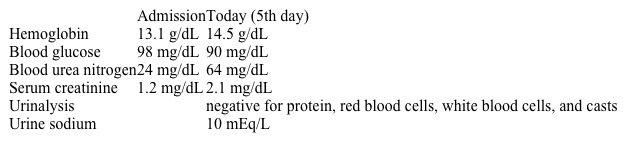 Which of the following is the most likely cause of the laboratory abnormalities in this patient?
 (Multiple Choice)
4.8/5 (82)
(82) A 48-year-old, previously healthy woman is seen in the clinic for community-onset bacterial pneumonia. Chest x-ray reveals dense consolidation of the right middle lobe. Her pulse oximetry is 90% on room air. The patient is treated with appropriate antibiotics. Two days later, the patient feels well overall and her pulse oximetry is improved to 98% on room air. Examination reveals unchanged crackles and egophony from her previous visit. Which of the following processes best explains this patient's improved oxygenation?
(Multiple Choice)
4.7/5 (79)
(79) A 50-year-old woman comes to the emergency department with severe upper abdominal pain. The pain started suddenly and is sharp and colicky. She has also vomited several times throughout the day, including once while in the emergency department. The patient describes several prior episodes of similar abdominal pain that resolved spontaneously without treatment. Her other medical problems include complicated appendicitis when she was 22 years old. Her temperature is 37.8 C (100 F) and pulse is 112/min. Abdominal examination shows cessation of inspiration with deep palpation of the right upper quadrant. Laboratory assessment shows a serum bilirubin of 0.8 mg/dL and a serum alkaline phosphatase of 100 U/L. Initial imaging studies are equivocal. Which of the following diagnostic test results would be most specific for acute cholecystitis?
(Multiple Choice)
4.8/5 (77)
(77) A 42-year-old man comes to the emergency department due to acute-onset shortness of breath. He has no medical conditions and does not use alcohol, tobacco, or illicit drugs. The patient works as a box handler at a warehouse and has excellent exercise tolerance. Family history is insignificant. Blood pressure is 98/60 mm Hg and pulse is 112/min and regular. A short systolic murmur is heard at the apex. Bilateral crackles are present on lung auscultation. Bedside echocardiography reveals a flail posterior mitral leaflet due to chordal rupture and severe mitral regurgitation. Which of the following best reflects this patient's left ventricular hemodynamics compared to the normal heart?
(Multiple Choice)
5.0/5 (83)
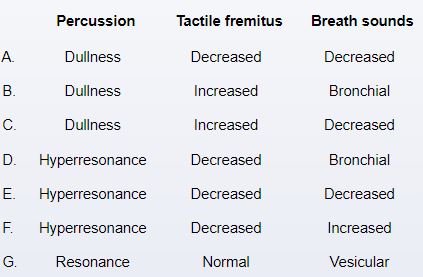
(83) A 71-year-old man with a long history of smoking is found to have a new, 4-cm, irregular, spiculated, rounded mass in the right upper lobe. CT-guided biopsy is performed. Follow-up chest x-ray after the procedure is shown in the exhibit. Physical examination of the right lung would most likely show which of the following findings?
 A)A
B)B
C)C
D)D
E)E
F)F
G)G
A)A
B)B
C)C
D)D
E)E
F)F
G)G (Short Answer)
4.7/5 (81)
(81) A 55-year-old woman comes to the emergency department with nausea, fever, fatigue, and anorexia. She returned a week ago from a trip to Mexico, where she underwent an emergency cholecystectomy without complications. Her temperature is 38.3 C (101 F), blood pressure is 100/60 mm Hg, pulse is 90/min, and respirations are 12/min. The patient is alert and answers questions but appears extremely weak and slightly icteric. She has no other medical problems and takes no medications. She does not use tobacco, alcohol, or illicit drugs. The patient is admitted to the hospital, but her condition worsens and she dies 2 days later. Postmortem viral serologies are negative. Gross examination of the liver on autopsy is shown in the image below. 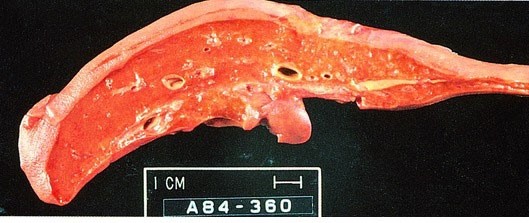 Which of the following additional findings would have most likely been found in this patient?
 (Multiple Choice)
4.8/5 (68)
(68) A 27-year-old man comes to the office due to recurrent episodes of muscle weakness. He has no other significant past medical history. The patient's weight has been stable for the past few years, and his current BMI is 23 kg/m2. His blood pressure is 190/110 mm Hg supine and 195/110 mm Hg standing. His heart rate is 70/min supine and 72/min standing. The rest of the physical examination is unremarkable. Laboratory evaluation shows very low plasma renin activity. Overactivity of which of the following structures is most likely responsible for this patient's symptoms?
(Multiple Choice)
4.9/5 (92)
(92) A research study is conducted to evaluate the effects of various serum proteins in health and disease states. Healthy volunteers and patients with various medical conditions are recruited. In an experiment, purified insoluble elastin is exposed to stimulated neutrophils, which results in the degradation of the elastin molecules into smaller peptides. This process can be inhibited by adding serum from healthy volunteers but not from a specific patient population. Which of the following is the strongest recommendation for patients in this specific population?
(Multiple Choice)
4.8/5 (73)
(73) A 20-year-old woman with cystic fibrosis comes to the clinic for routine follow-up. She has no concerns since her last visit 3 months ago. Vital signs are normal. Examination shows a hyperexpanded chest with equal aeration bilaterally. Fasting glucose level is 90 mg/dL. Plasma glucose level 2 hours after oral glucose tolerance testing is 185 mg/dL (normal: <140). Which of the following is the primary mechanism responsible for this patient's abnormal test result?
(Multiple Choice)
4.9/5 (73)
(73) A 35-year-old Caucasian primigravida is found to have gallstones at 38 weeks of an uncomplicated pregnancy. Ultrasonography performed one year ago failed to demonstrate any abnormalities. Which of the following pathogenetic components most likely contributed to this patient's condition?
(Multiple Choice)
4.8/5 (74)
(74) A 34-year-old woman comes to the office due to progressive exertional dyspnea for the past 6 months. She has no chest pain, lightheadedness, or syncope. Medical history is unremarkable and the patient takes no medications. She does not use tobacco, alcohol, or illicit drugs. The patient's mother died of pulmonary arterial hypertension at age 32. Blood pressure is 125/74 mm Hg and pulse is 75/min. BMI is 23 kg/m2. On physical examination, breath sounds are clear without wheezes or crackles. There is a loud S2 at the left upper sternal border. Chest x-ray reveals clear lungs. ECG shows right axis deviation. If this patient's condition is inherited, which of the following is the most likely direct cause of her disease?
(Multiple Choice)
4.9/5 (77)
(77) 
Filters
- Essay(0)
- Multiple Choice(0)
- Short Answer(0)
- True False(0)
- Matching(0)