



 Chat with AI
Exam 11: Pathophysiology

Exam 1: Anatomy291 Questions
Exam 2: Behavioral science240 Questions
Exam 3: Biochemistry156 Questions
Exam 4: Biostatistics117 Questions
Exam 5: Embryology52 Questions
Exam 6: Genetics103 Questions
Exam 7: Histology24 Questions
Exam 8: Immunology129 Questions
Exam 9: Microbiology336 Questions
Exam 10: Pathology816 Questions
Exam 11: Pathophysiology464 Questions
Exam 12: Pharmacology538 Questions
Exam 13: Physiology272 Questions
Select questions type


A 35-year-old man comes to the clinic with acute right knee pain and swelling. His symptoms have been present for a week and have moderately worsened over this period. The patient is able to bear weight but has significant pain when climbing stairs or walking for extended distances. He attempted treatment with ibuprofen, which provided prompt but only temporary relief. Past medical history is unremarkable, though the patient was seen by his primary care provider for a diarrheal illness 2 weeks before onset of the current symptoms. Examination shows a moderate-sized effusion at the right knee. Cultures of a joint aspirate reveal no bacteria. Which of the following is most likely associated with this patient's joint symptoms?
(Multiple Choice)
4.8/5  (78)
(78) A 74-year-old woman comes to the office due to progressive forgetfulness over the past 2 years. Her family states that the patient asks the same questions repeatedly over the course of a day and often forgets what she is doing in the middle of chores. The patient has also been more irritable but has had no movement or gait abnormalities, feelings of depression, hallucinations, or delusions. Medical conditions include hypertension and renal artery stenosis. Vital signs are within normal limits. Mini-Mental State Examination score is 21 out of 30 and she recalls 1 out of 3 objects after 5 minutes. There are no focal neurologic deficits. Which of the following is most likely involved in the pathogenesis of this patient's condition?
(Multiple Choice)
5.0/5 (75)
(75) A 76-year-old man has had worsening shortness of breath, cough, and weight loss for the past several months. He is a lifelong nonsmoker. Chest imaging reveals irregular pleural thickening. A surgical biopsy is planned, but the patient refuses, choosing to receive hospice care instead. He dies several weeks later. Autopsy examination is performed, and a photograph of the cut lung section is shown below. 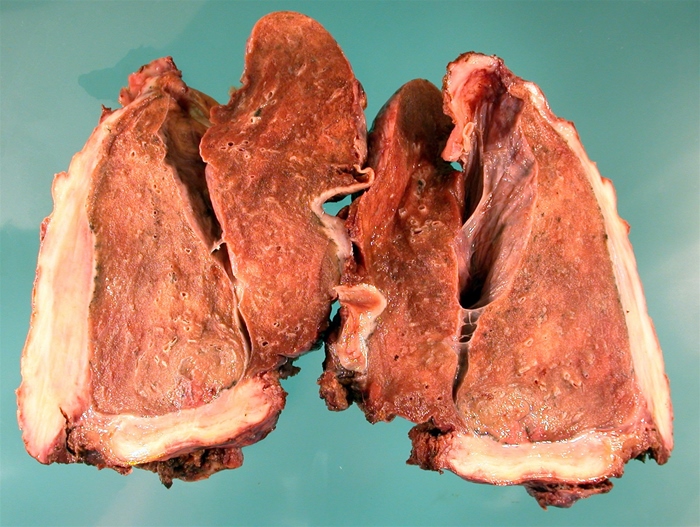 Histopathological examination of the abnormal tissue is most likely to reveal which of the following findings?
 (Multiple Choice)
4.8/5 (83)
(83) A 35-year-old man who works as a nurse at a local hospital is brought to the emergency department due to confusion and lethargy. His temperature is 36.7 C (98 F), blood pressure is 86/48 mm Hg, pulse is 120/min, and respirations are 12/min. Arterial blood gas results show pH 7.54, PaCO2 49 mm Hg, and PaO2 85 mm Hg. Which of the following laboratory studies would be the most useful in determining the cause of this patient's acid-base abnormality?
(Multiple Choice)
4.9/5 (84)
(84) A 72-year-old man with long-standing dyspnea was seen in the clinic after experiencing an episode of syncope. Physical examination showed weak and slowly rising arterial pulses. Cardiac auscultation showed a harsh midsystolic murmur best heard at the second right intercostal space with decreased intensity of the second heart sound. Electrocardiogram and echocardiogram confirmed the diagnosis of severe aortic stenosis. Two months later, the patient comes to the emergency department with palpitations and increased shortness of breath. His blood pressure is 90/60 mm Hg and his heart rate is 130/min with an irregularly irregular rhythm. Electrocardiogram shows new-onset atrial fibrillation without significant ST-segment or T-wave changes. Chest x-ray shows bilateral pulmonary edema. Which of the following hemodynamic changes is most likely associated with this patient's current presentation?
(Multiple Choice)
4.8/5 (82)
(82) A 32-year-old woman comes to the office due to progressive exertional dyspnea and easy fatigability. She immigrated to the United States from India several years ago and reports a history of rheumatic fever during her childhood. Cardiac auscultation reveals a diastolic high-frequency sound and a rumbling diastolic murmur heard best in the left fifth intercostal space at the midclavicular line. Cardiac catheterization is performed for hemodynamic evaluation, and the results are represented below. Timing of the high-frequency sound heard during cardiac auscultation of this patient best corresponds to which of the following letters? 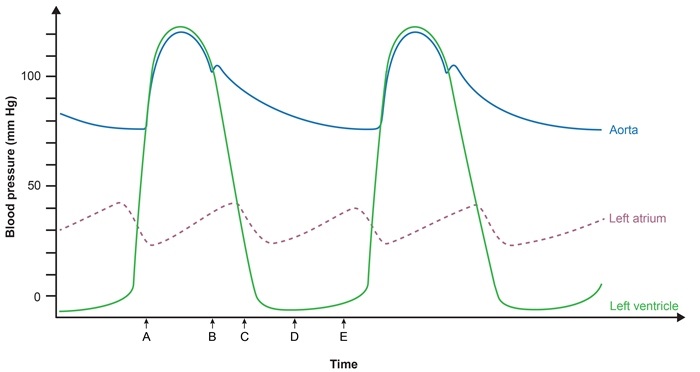
(Multiple Choice)
4.8/5 (74)
(74) A 44-year-old man is brought to the hospital with fatigue, shortness of breath, and lethargy. The patient had a brief upper respiratory illness about a month ago but began experiencing progressive dyspnea on exertion 2 weeks ago. He has no significant medical history and takes no medications. Blood pressure is 100/70 mm Hg; pulse is 95/min and regular. The apical impulse is palpated in the sixth intercostal space along the left anterior axillary line. An S3 is heard on cardiac auscultation. Bibasilar crackles are present. Distal extremities are cold to touch and there is 1+ peripheral edema. Laboratory results are as follows: 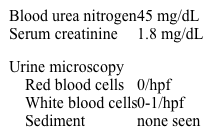 Which of the following is likely to be present in this patient compared to the normal state?
 (Multiple Choice)
4.9/5 (79)
(79) A 1-hour-old boy in the newborn nursery has jitteriness and irritability. His serum glucose is 21 mg/dL. The infant was born by cesarean delivery for macrosomia and failure to progress. The infant has not yet breastfed as his mother is still recovering from surgery. He weighs 4.5 kg (9 lb 15 oz). His mother was prescribed insulin for gestational diabetes but has not taken it regularly. She also has a history of depression and intravenous drug use. She denies use of illicit drugs during the pregnancy and tested negative for HIV and hepatitis B and C in her third trimester. Which of the following factors is the most likely cause of this neonate's hypoglycemia?
(Multiple Choice)
5.0/5 (78)
(78) A 48-year-old man is evaluated for shortness of breath and dry cough for 1 week. The patient has never had similar symptoms in the past and takes no medications. He has a 5-pack-year smoking history and does not use alcohol or illicit drugs. The patient is a pig farmer in Ohio and has not traveled recently. Temperature is 37.8 C (100 F), blood pressure is 128/85 mm Hg, pulse is 95/min, and respirations are 16/min. Lung auscultation reveals scattered wheezing and crackles. Peripheral blood smear is shown below. 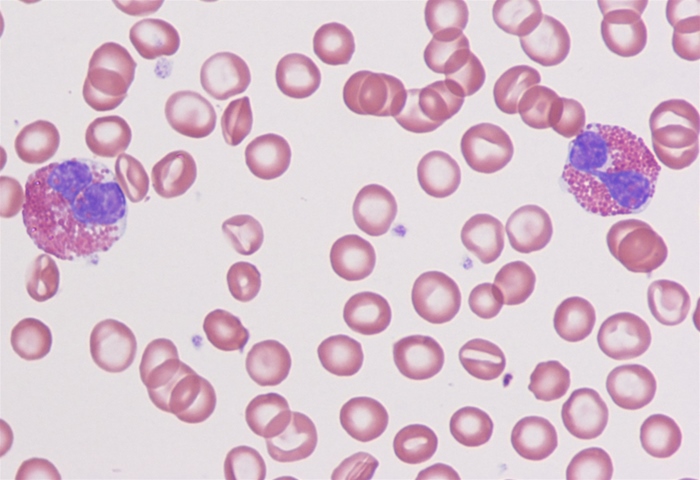 The nucleated cells seen on this patient's peripheral smear most likely perform which of the following functions?
 (Multiple Choice)
4.8/5 (71)
(71) A 68-year-old man comes to the office due to increased abdominal distension. The patient was discharged from the hospital last week after an acute pulmonary embolism. He also has a history of emphysema caused by extensive tobacco use. The patient has no other medical conditions and does not use alcohol or illicit drugs. Temperature is 37.6 C (99.7 F), blood pressure is 112/78 mm Hg, pulse is 85/min, and respirations are 18/min. BMI is 27 kg/m2. Examination shows increased jugular venous pressure and lower extremity edema. The abdomen is distended, and a fluid wave is present. This patient's ascites most likely developed due to which of the following changes in portal capillary exchange parameters?
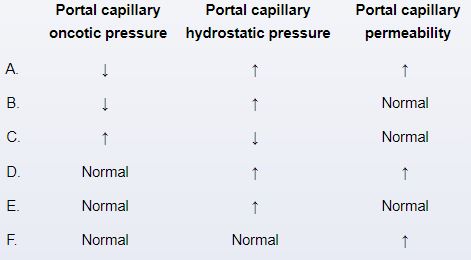
(Multiple Choice)
4.9/5 (64)
(64) A 3-year-old boy is brought to the physician with jaundice and pallor. He was adopted and his family history is unknown. Laboratory studies show anemia, reticulocytosis, and increased indirect bilirubin. A peripheral blood smear shows red blood cells without central pallor. This patient is most likely to have which of the following additional findings?
(Multiple Choice)
4.9/5 (72)
(72) A 43-year-old man comes to the office with a several-month history of fatigue, rash, flushing, and abdominal cramps. His rash is worse with rubbing or scratching, and he has diffuse itching after hot showers. The patient is frequently dizzy and light-headed after prolonged standing and had an episode of syncope while working in the hot sun. He used to be healthy and physically active but has had to reduce his normal activity. The patient does not use tobacco, alcohol, or illicit drugs. Vital signs are normal. Skin examination shows a maculopapular rash. Skin biopsy shows large clusters of mast cells that are positive for KIT (CD 117). Which of the following additional findings are most likely present in this patient?
(Multiple Choice)
5.0/5 (84)
(84) A 64-year-old man is evaluated for a 1-month history of worsening fatigue and low back pain exacerbated by movement. He has no prior medical history and takes no medications. Vital signs are normal. Physical examination shows mucosal pallor and bony tenderness. Radiographs reveal lytic bone lesions. Laboratory studies show that hemoglobin is 8.8 g/dL, serum creatinine is 3.0 g/dL, and serum calcium is 10.8 g/dL. Urine dipstick is negative for protein, but quantitative measurement reveals elevated 24-hour urinary protein excretion. Urine electrophoresis is most likely to detect which of the following?
(Multiple Choice)
4.8/5 (81)
(81) A 6-month-old girl is brought to the clinic for routine care. She has not had any illnesses, although the mother says that the girl has trouble latching when breast feeding. She can roll over when prone but cannot roll from the supine position or sit unsupported. The infant was born vaginally after an uncomplicated pregnancy. Vital signs are within normal limits. On physical examination, the girl has a head circumference above the 97th percentile for her age and a full anterior fontanelle. The remainder of her physical examination is unremarkable. At birth, the girl's head circumference was at the 50th percentile. CT scan of the head reveals significant dilation of the lateral ventricles. If this condition is left uncorrected, which of the following is the most likely complication that will be seen in this patient?
(Multiple Choice)
4.9/5 (78)
(78) A 64-year-old woman who was discharged from the hospital 4 days ago comes to the emergency department due to chest tightness and severe shortness of breath. During evaluation, the patient becomes unresponsive and goes into cardiac arrest. Despite appropriate lifesaving measures, there is no return of spontaneous circulation and she is pronounced dead. Autopsy examination is performed, and the myocardial findings are shown in the image below. 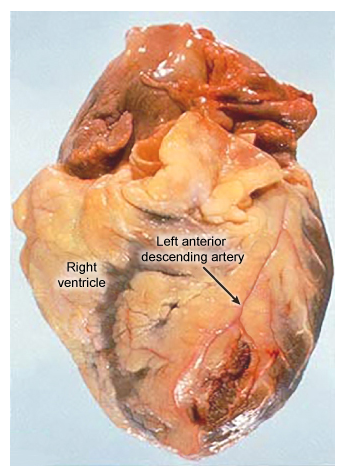 Which of the following most likely predisposed this patient to the observed cardiac findings?
 (Multiple Choice)
4.8/5 (83)
(83) A 24-year-old man comes to the office due to severe pain in the posterior aspect of the right foot that interferes with walking. For the last several months, the patient has also experienced a dull backache and morning stiffness that is relieved by over-the-counter ibuprofen. Family history is insignificant, and he does not use tobacco, alcohol, or illicit drugs. Which of the following is the most probable location of the pathologic process responsible for this patient's foot pain?
(Multiple Choice)
4.7/5 (74)
(74) A 16-year-old girl is brought to the office by her mother due to concern about excessive weight loss. The patient has lost 4.5 kg (10 lb) over the past 2 months, but thinks she still appears overweight, and is worried about gaining weight. She does not use tobacco, alcohol, or illicit drugs. Her mother has hypothyroidism. Blood pressure is 130/70 mm Hg, and pulse is 105/min and regular. There are no orthostatic changes. BMI is 22 kg/m2. On examination, the patient appears anxious. The thyroid is small and without palpable nodules. There is a fine tremor seen in the fingers when the arms are outstretched. Deep tendon reflexes are 3+ diffusely. The skin is warm and moist. Laboratory results show decreased TSH, elevated free thyroxine (T4), and undetectable thyroglobulin levels. Which of the following is most likely to be seen on thyroid biopsy of this patient?
(Multiple Choice)
4.8/5 (98)
(98) A 75-year-old man is found unresponsive in his home. Emergency medical services are called by the neighbor, but the patient is pronounced dead at the scene. The patient had a history of hypertension, type 2 diabetes mellitus, and coronary artery disease, as well as a 25-pack-year smoking history. He worked at a coal mine in the remote past and retired as an auto mechanic 15 years ago. Autopsy is performed; a section of lung tissue stained with hematoxylin and eosin is shown below. 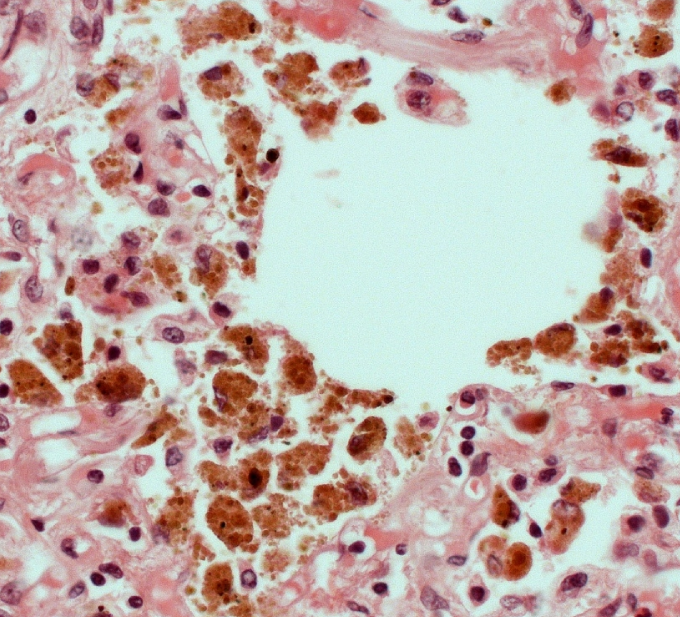 Which of the following is the most likely cause of this patient's abnormal histopathology findings?
 (Multiple Choice)
4.8/5 (71)
(71) A 6-year-old Caucasian boy is brought to the office by his mother due to recurrent episodes of sinusitis. He also has a chronic cough that never seems to go away. The mother says that his previous pediatrician performed a "sweat test" to help determine the cause of his frequent infections, but results were normal. DNA testing was inconclusive. Despite these results, the new physician suspects that the patient has an inherited disorder and orders nasal transepithelial potential difference measurements. In this test, an isotonic solution of sodium chloride is applied to the nasal mucosal surface, and the electrical potential overlying the mucosa is compared with that of the interstitial fluid. The results show a transepithelial potential difference that is more negative than normal. This patient's nasal mucosa is most likely to demonstrate which of the following physiologic changes?
(Multiple Choice)
4.8/5 (84)
(84) An 81-year-old woman undergoes transcatheter aortic valve implantation through femoral access. She was diagnosed with severe calcific aortic stenosis 2 months ago after she began having shortness of breath with mild exertion. The vascular access is gained without complication, and the transcatheter valve is deployed under fluoroscopic guidance. The following hemodynamic changes are observed:  Which of the following complications should be suspected in this patient?
 (Multiple Choice)
4.8/5 (91)
(91) 
Filters
- Essay(0)
- Multiple Choice(0)
- Short Answer(0)
- True False(0)
- Matching(0)