



 Chat with AI
Exam 11: Pathophysiology

Exam 1: Anatomy291 Questions
Exam 2: Behavioral science240 Questions
Exam 3: Biochemistry156 Questions
Exam 4: Biostatistics117 Questions
Exam 5: Embryology52 Questions
Exam 6: Genetics103 Questions
Exam 7: Histology24 Questions
Exam 8: Immunology129 Questions
Exam 9: Microbiology336 Questions
Exam 10: Pathology816 Questions
Exam 11: Pathophysiology464 Questions
Exam 12: Pharmacology538 Questions
Exam 13: Physiology272 Questions
Select questions type


A 6-year-old boy is brought to the emergency department due to abrupt-onset vomiting, lethargy, and altered mental status. For 4 days, the patient has had a fever, cough, and rhinorrhea, which were treated symptomatically with aspirin. He has no prior medical conditions, and his family history is unremarkable. Vital signs are normal. The patient is stuporous and does not respond to verbal commands. Hepatomegaly is present. There is no jaundice. Laboratory results are as follows: 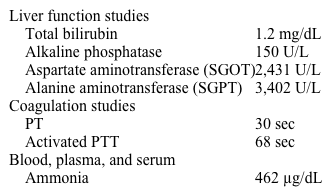 Which of the following is the most likely cause of this patient's presentation?
 (Multiple Choice)
4.8/5  (93)
(93) A 1-hour-old neonate with prenatally diagnosed tetralogy of Fallot is admitted to the neonatal intensive care unit with cyanosis. The mother is a 28-year-old gravida 3 para 2 who received routine prenatal care. The patient was born via spontaneous vaginal delivery at 35 weeks gestation. Initial Apgar scores are 5 and 7 at 1 and 5 minutes after birth, respectively. The neonate's lips, fingers, and toes appear cyanotic. This patient should be immediately treated with a medication producing which of the following effects?
(Multiple Choice)
4.8/5 (75)
(75) A 64-year-old man comes to the emergency department due to acute knee pain. He developed redness, swelling, and severe pain affecting the right knee the day before his arrival. The patient has had 3 similar episodes in the past year that resolved quickly with over-the-counter analgesics. He has a history of polycythemia vera but has been noncompliant with phlebotomy treatments. Vital signs and cardiopulmonary examinations are normal. The right knee is red and warm. There is severe pain with movement at the joint; the other joints are grossly normal. Needle aspiration of the joint is performed. Which of the following is the most likely finding on analysis of this patient's synovial fluid?
(Multiple Choice)
4.7/5 (74)
(74) A 17-year-old boy is brought to the clinic due to poor vision at night. The patient developed mild difficulty seeing at night about 4 months ago, and it has slowly worsened. Visual field examination shows visual loss in the midperiphery. External eye examination reveals normal tear formation. Funduscopic examination shows bilateral optic disc pallor, attenuation of retinal vessels, and areas of dark discoloration in the retina. Which of the following is the most likely mechanism of this patient's visual impairment?
(Multiple Choice)
4.7/5 (69)
(69) A 5-year-old boy is brought to the emergency department due to 2 days of dark, low-volume urine and decreased energy. The parents say that the boy had abdominal pain, fever, and bloody diarrhea for 4 days, which resolved about 3 days ago without treatment. The day before the onset of symptoms, the patient swam in a lake and ate hamburgers at a family picnic. His vital signs are within normal limits. Physical examination shows pallor but is otherwise normal. He has no peripheral edema or rashes. Laboratory evaluation shows anemia, thrombocytopenia, and elevated blood urea nitrogen and serum creatinine. Which of the following findings is most likely to be seen in this patient?
(Multiple Choice)
4.9/5 (76)
(76) A 60-year-old woman comes to the office with intermittent flatulence, crampy abdominal pain, and watery diarrhea. Her symptoms started 2 months ago after she recovered from an episode of acute gastroenteritis associated with nausea, vomiting, and diarrhea. The patient's symptoms are worse after drinking "too much milk." She usually has 1 or 2 glasses of wine every evening with dinner. Physical examination is unremarkable. Initial laboratory evaluation, including serum chemistries, blood counts, stool cultures, and studies for ova and parasites, is negative. Which of the following is most likely decreased in this patient?
(Multiple Choice)
4.8/5 (85)
(85) A 4-month-old girl is brought to the clinic by her parents for a well-child check. She was evaluated 2 weeks ago for a rash in the diaper area. At that visit, the patient was found to have erythematous papules in the diaper area that spared the skin folds. Her symptoms improved with use of a petrolatum barrier ointment with every diaper change. Today, vital signs and physical examination are normal. Which of the following most likely contributed to this patient's prior skin findings?
(Multiple Choice)
4.9/5 (83)
(83) A 12-year-old boy is brought to the clinic for a follow-up examination. The patient was admitted to the hospital 3 months ago after a nonfatal drowning event that resulted in severe acute respiratory distress syndrome. He was intubated and mechanically ventilated for 1 week and then discharged 2 weeks later. The patient currently feels well and reports mild dyspnea with exertion. Which of the following parameters is most likely increased in this patient compared to a child with normal cardiopulmonary function?
(Multiple Choice)
4.9/5 (74)
(74) A 24-year-old man diagnosed with diabetes mellitus 2 years ago is brought to the emergency department after a temporary loss of consciousness. He was getting ready to eat and administered a preprandial insulin injection, but he was distracted by a phone call from work and ended up skipping the meal. His girlfriend found him passed out in his bedroom and administered glucagon immediately. The patient recovered consciousness within 15 minutes. Metabolic changes in which of the following organs are most likely responsible for this patient's recovery?
(Multiple Choice)
4.8/5 (74)
(74) A 14-year-old, previously healthy girl is brought to the office due to recurrent headaches. The patient has had 4 episodes of severe, throbbing pain on the right side of her head over the last 2 months, with the most recent occurring a week ago. The headaches are often associated with nausea, and the patient has had occasional vomiting. Lying in a dark room and taking acetaminophen improve the pain. The episodes resolve after 4-5 hours. The patient has had no visual disturbances or focal weakness but has tingling and numbness on the right upper extremity prior to the headaches. Vital signs are within normal limits. Physical examination, including funduscopic and neurologic examination, shows no abnormalities. Which of the following is most likely involved in the pathogenesis of this patient's current condition?
(Multiple Choice)
4.9/5 (82)
(82) A 29-year-old woman comes to the office due to unintentional weight loss, fatigue, and sweating. The patient has had no neck pain. Two months ago, she delivered a healthy boy with no perinatal complications. The patient does not breastfeed the infant. She has no chronic medical conditions and takes no medications. Blood pressure is 140/70 mm Hg, pulse is 110/min, and respirations are 16/min. Oxygen saturation is 98% on room air. Neck examination shows mild, diffuse enlargement of the thyroid gland with no tenderness. The remainder of the physical examination, including pelvic examination, is normal. Laboratory evaluation reveals low serum TSH, elevated serum thyroxine (T4), and elevated serum triiodothyronine (T3). Thyrotropin receptor antibodies are negative. Which of the following is the most likely cause of this patient's symptoms?
(Multiple Choice)
4.9/5 (83)
(83) A 68-year-old Caucasian woman comes to the emergency department due to several hours of severe upper back pain. The patient developed the pain after experiencing a sudden jolt while driving over a pothole. She has no previous history of back pain or major trauma and has not seen a doctor in many years. The patient is retired and lives a sedentary lifestyle. She drinks a glass of wine daily and eats a healthy, balanced diet. BMI is 18.4 kg/m2. On examination, there is point tenderness over the T10 vertebra. Neurologic examination is unremarkable. X-ray of the spine reveals a T10 compression fracture. On the graph, area C represent the normal serum concentrations of calcium and parathyroid hormone. 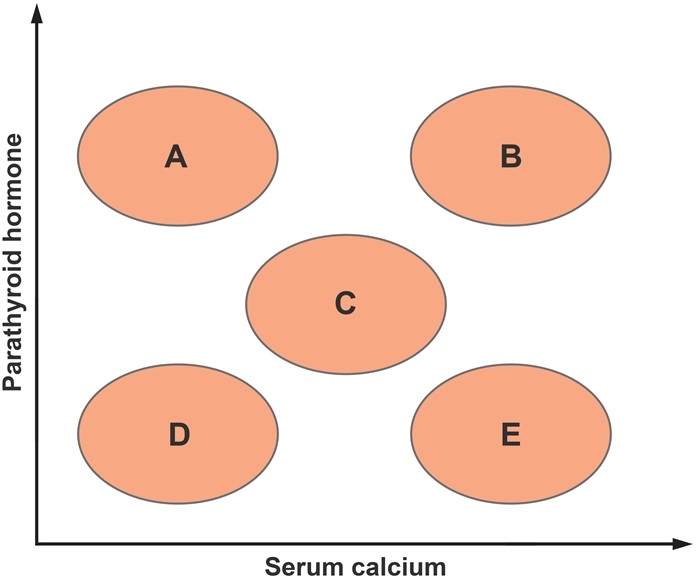 Which of the following areas most likely corresponds to this patient's current metabolic state?
 (Multiple Choice)
4.9/5 (74)
(74) A 55-year-old man comes to the office for follow-up. The patient was diagnosed with hypertension 3 weeks ago, and an ECG performed at that time showed features of left ventricular hypertrophy. He was subsequently referred for echocardiography. The patient feels well and has had no shortness of breath, fatigue, or leg swelling. He has no other medical conditions, takes no medications, and does not use tobacco, alcohol, or illicit drugs. Blood pressure is 155/90 mm Hg and pulse is 80/min. BMI is 35 kg/m2. Physical examination shows normal jugular venous pressure. There are no lung crackles, heart gallops, or lower extremity edema. Echocardiography reveals a left ventricular ejection fraction of 30%. Which of the following patterns of chemical mediators is most likely present in this patient?
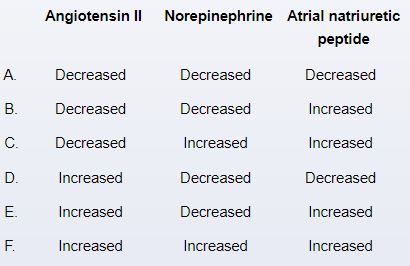
(Multiple Choice)
4.8/5 (74)
(74) A 24-year-old woman comes to the office for an infertility evaluation. The patient has had irregular menstrual cycles for the past 5 years, with menstrual periods every 2-3 months. Medical history is notable for an appendectomy 8 years ago but is otherwise not significant. The patient takes no medications. Blood pressure is 125/86 mm Hg and pulse is 72/min. BMI is 33 kg/m2. Physical examination shows facial acne and excessive hair growth on the upper lip and chin. Which of the following pathologic findings is most likely to be seen in this patient?
(Multiple Choice)
4.8/5 (81)
(81) A 24-year-old man comes to the office due to paroxysmal episodes of breathlessness and wheezing for the past 6 months. He does not recognize any triggers for these episodes and reports they are not associated with exercise or stress. The patient has no history of recent illness. He had eczema as a child. The patient has no other medical conditions and takes no medications. Vital signs are within normal limits. Lung examination shows good air movement and no wheezing. Sputum microscopy reveals many granule-containing cells and crystalloid masses. The sputum findings in this patient are a direct result of which of the following cytokines?
(Multiple Choice)
4.9/5 (81)
(81) A 32-year-old man with a history of bipolar disorder is brought to the emergency department by his wife. He has been unable to sleep for more than 3 hours a night for the past week. Over the past several weeks, the patient has been irritable at home and has argued constantly with his wife. He has racing thoughts and speaks rapidly. The patient has stopped going to his job as a plumber, having decided to stay home and "unravel the secrets of the universe." He has been drawing shapes and equations on the walls, and he has accused his wife of working for the police and trying to steal his secrets. Prior to examination, the patient becomes increasingly agitated and is hospitalized against his will. He has no other medical conditions. Vital signs, physical examination, and laboratory findings are normal. He is prescribed multiple medications to address his symptoms. Five days later, the patient is calm but has difficulty moving spontaneously or getting out of bed. He does not respond appropriately to questions and appears newly disoriented and confused. Temperature is 39.4 C (102.9 F), blood pressure is 162/98 mm Hg, pulse is 98/min, and respirations are 20/min. Dysregulation of which of the following neurotransmitters is most likely to be the primary cause of this patient's new symptoms?
(Multiple Choice)
4.7/5 (72)
(72) A 42-year-old man comes to his primary care physician due to daytime sleepiness. He often falls asleep during meetings and while watching television and has even fallen asleep while driving. The patient does not feel refreshed when waking and has occasional morning headaches. He has not had abnormal dreams or visual hallucinations when falling asleep or on waking. The patient has no significant past medical history and is a lifetime non-smoker. He drinks 2 or 3 beers on Friday nights. Blood pressure is 148/100 mm Hg and pulse is 78/min and regular; BMI is 32 kg/m2. Cardiopulmonary examination shows no abnormalities. Arterial blood gas analysis is normal. What is this patient's most likely diagnosis?
(Multiple Choice)
4.9/5 (81)
(81) A 62-year-old woman with no significant medical history is brought to the emergency department due to fatigue and substernal chest pain that began 6 hours ago. On arrival, ECG is consistent with ST-segment elevation myocardial infarction. Coronary angiography shows right-dominant coronary circulation and a thrombotic occlusion of the proximal right coronary artery, which supplies blood to the patient's right ventricle and the inferior and posterior portions of the left ventricle. A drug-eluting stent is placed, and she is discharged 2 days later without complication. After 6 weeks, the patient follows up in the clinic and undergoes echocardiography that shows left ventricular contractile dysfunction with normal right ventricular function. Which of the following characteristics of the right ventricle compared to the left ventricle best explains these echocardiography findings?
(Multiple Choice)
4.8/5 (81)
(81) A 58-year-old man comes to the emergency room due to headache. Medical history is significant for long-standing hypertension and medication nonadherence. Blood pressure on arrival is 231/135 mm Hg. Twenty minutes after intravenous hydralazine is administered, blood pressure is 145/95 mm Hg. Over the following 24 hours, serum creatinine increases from 1.1 to 1.6 mg/dL. Urine sediment demonstrates abundant granular casts. Which of the following processes best explains this patient's acute kidney injury?
(Multiple Choice)
4.8/5 (81)
(81) A 6-month-old boy is brought to the emergency department due to lethargy for several hours. His mother says he is usually a "very active baby," and she is afraid that he is "coming down with something." The patient's birth history is unremarkable, and he was born at 38 weeks gestation. He is afebrile. Blood pressure is 70/44 mm Hg, pulse is 240 beats/min, and respirations are 52/min. The patient appears pale and is perspiring. Capillary refill time is less than 2 seconds. The lungs are clear to auscultation. No murmurs are heard. An ECG shows a regular heart rate of 240/min with narrow QRS complexes and no identifiable P waves. Which of the following is the most likely cause of this patient's hypotension?
(Multiple Choice)
4.8/5 (76)
(76) 
Filters
- Essay(0)
- Multiple Choice(0)
- Short Answer(0)
- True False(0)
- Matching(0)