



 Chat with AI
Exam 11: Pathophysiology

Exam 1: Anatomy291 Questions
Exam 2: Behavioral science240 Questions
Exam 3: Biochemistry156 Questions
Exam 4: Biostatistics117 Questions
Exam 5: Embryology52 Questions
Exam 6: Genetics103 Questions
Exam 7: Histology24 Questions
Exam 8: Immunology129 Questions
Exam 9: Microbiology336 Questions
Exam 10: Pathology816 Questions
Exam 11: Pathophysiology464 Questions
Exam 12: Pharmacology538 Questions
Exam 13: Physiology272 Questions
Select questions type


A 5-year-old girl is brought to the emergency department after having a seizure at home. Approximately an hour ago, the patient collapsed at the dinner table and developed full body shaking and urinary incontinence. Her mother says that the girl has had a mild headache and fatigue for the past few days. On examination, the patient is sleepy and difficult to rouse. Vital signs are normal. Cardiopulmonary examination is unremarkable. CT scan of the head is shown in the image below: 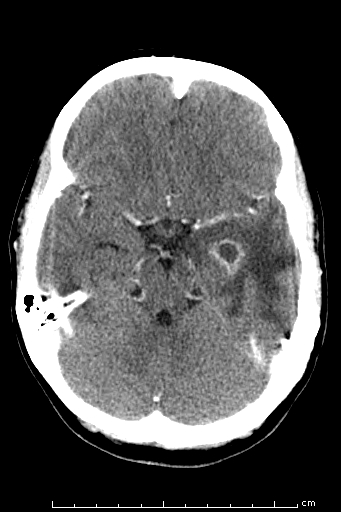 Which of the following historical details is most relevant in establishing this patient's diagnosis?
 (Multiple Choice)
4.7/5  (81)
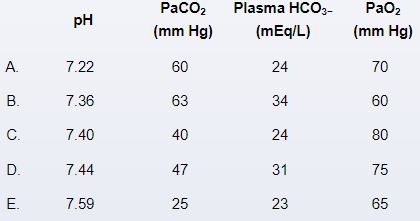
(81) A 58-year-old woman comes to the office due to gradually worsening shortness of breath. She has a history of emphysema secondary to alpha-1 antitrypsin deficiency and uses inhaled bronchodilators and glucocorticoids. Lately the patient has been feeling short of breath even with minimal exertion. She has no other medical conditions. The patient is a former smoker with a 5-pack-year history. Blood pressure is 130/80 mm Hg, pulse is 82/min, and respirations are 18/min. Physical examination shows increased anteroposterior chest diameter, prolonged expiratory phase, and decreased breath sounds bilaterally. The heart sounds are distant. Chest x-ray reveals hyperinflated lungs with no consolidation, pleural effusion, or pneumothorax. Which of the following sets of arterial blood gas findings on room air is most likely to be seen in this patient?
(Multiple Choice)
4.8/5 (70)
(70) A 29-year-old woman comes to the office due to increased hair loss. She delivered a healthy baby boy 8 months ago and has not felt the same since. The patient has fatigue and decreased libido, and her menstrual cycles have not returned. She has no prior medical problems and no drug allergies. The patient takes a multivitamin and does not use tobacco, alcohol, or illicit drugs. There is no significant family history. Blood pressure is 110/70 mm Hg and pulse is 58/min. Physical examination shows diffuse alopecia and thickened, brittle nails. The thyroid is nontender. Laboratory results show decreased serum TSH and free thyroxine (T4) levels. Which of the following is the most likely diagnosis in this patient?
(Multiple Choice)
4.8/5 (69)
(69) A 44-year-old woman comes to the clinic after several "near collisions" over the past month while driving at night. She also has generalized pruritus. The patient has not seen a physician for several years and has missed several scheduled appointments. She takes no medications. On physical examination, her skin is diffusely coarse and dry. Which of the following processes is most likely responsible for these findings?
(Multiple Choice)
4.9/5 (77)
(77) 
Filters
- Essay(0)
- Multiple Choice(0)
- Short Answer(0)
- True False(0)
- Matching(0)