Multiple Choice
A 48-year-old man comes to the office for an initial visit. He says that he feels well and has no medical problems. The patient has a 20-pack-year smoking history and does not use alcohol or illicit drugs. He is counseled on smoking cessation. To explain how smoking affects lung function, the patient is shown a graph of the expected change in forced expiratory volume in 1 second (FEV1) over time if he continues to smoke at the same rate (curve D in image) . Which of the following curves most likely demonstrates the expected FEV1 over time if this patient were to stop smoking now? 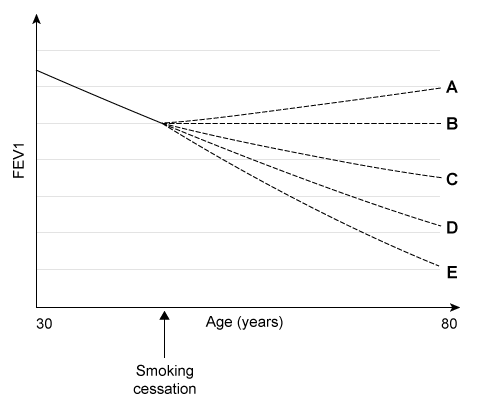
A) A
B) B
C) C
D) D
E) E
Correct Answer:

Verified
Correct Answer:
Verified
Q362: A 28-year-old woman, gravida 3 para 2,
Q363: A 72-year-old man comes to the office
Q364: A 58-year-old man comes to the office
Q365: A 41-year-old woman comes to the office
Q366: A 62-year-old man comes to the office
Q368: A 52-year-old man comes to the office
Q369: A 64-year-old man is brought to the
Q370: A 33-year-old woman comes to a fertility
Q371: A 23-year-old woman is being evaluated for
Q372: A 64-year-old woman comes to the emergency