Multiple Choice
A 45-year-old woman is evaluated 2 weeks after she fractured her left radius during a fall from standing height. Two months previously, she passed a renal stone. There is no family history of osteoporosis or hypercalcemia. Physical examination is unremarkable. Serum laboratory results are as follows: 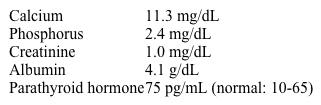 Bone density testing performed using dual-energy x-ray absorptiometry reveals osteoporosis. Which of the following is the major contributor to bone loss in this patient?
A) Decreased bone formation due to decreased conversion of calcidiol to calcitriol
B) Decreased bone formation due to excessive loss of calcium in urine
C) Decreased bone formation due to inhibition of osteoblast differentiation
D) Increased bone resorption due to decreased intestinal calcium absorption
E) Increased bone resorption due to paracrine stimulation of osteoclasts
Correct Answer:

Verified
Correct Answer:
Verified
Q15: A 54-year-old hospitalized man develops new-onset slurring
Q16: A 66-year-old man with diabetes mellitus is
Q17: A 29-year-old woman is brought to the
Q18: A 19-year-old man comes to the emergency
Q19: A full-term newborn is evaluated in the
Q21: A 54-year-old woman comes to the emergency
Q22: A 25-year-old woman comes to the office
Q23: A 72-year-old woman is brought to the
Q24: A 17-year-old girl is brought to the
Q25: A 45-year-old previously healthy man comes to