



 Chat with AI
Exam 8: Immunology

Exam 1: Anatomy291 Questions
Exam 2: Behavioral science240 Questions
Exam 3: Biochemistry156 Questions
Exam 4: Biostatistics117 Questions
Exam 5: Embryology52 Questions
Exam 6: Genetics103 Questions
Exam 7: Histology24 Questions
Exam 8: Immunology129 Questions
Exam 9: Microbiology336 Questions
Exam 10: Pathology816 Questions
Exam 11: Pathophysiology464 Questions
Exam 12: Pharmacology538 Questions
Exam 13: Physiology272 Questions
Select questions type


Pharmacology researchers are developing a new antivenom to treat coral snakebites. They immunize horses with snake venom, extract IgG-containing plasma, and then administer the plasma to humans who have been bitten by a coral snake. This therapy neutralizes the venom and improves the patient's symptoms. In order to produce venom-selective antibodies, the researchers select a single venom-specific plasma cell from the immunized horse and induce it to proliferate and produce large amounts of venom-specific IgG. However, they find that the antibody produced by the single plasma cell is less effective at neutralizing the venom than the IgG-containing plasma. A decrease in which of the following best explains the reduced efficacy of the immunoglobulin produced by the single plasma cell?
(Multiple Choice)
5.0/5  (73)
(73) A 24-year-old woman comes to the office with a pruritic rash on her arms and legs; it has been present on and off for most of her life. Examination of the posterior left leg reveals erythematous patches and papules, as shown in the exhibit. 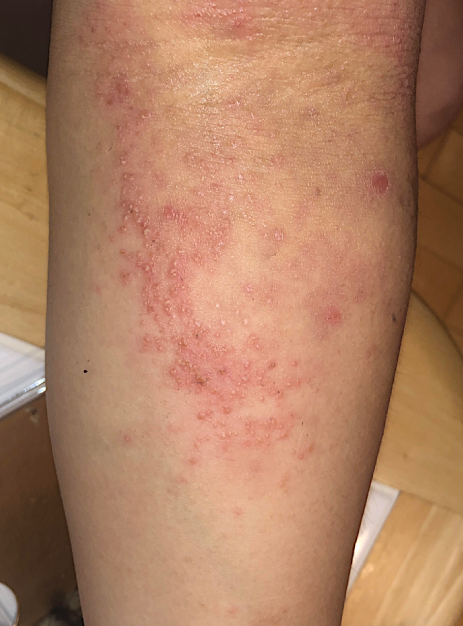 A similar rash is present on the right leg and bilateral antecubital fossae. Which of the following cytokines primarily initiated her current exacerbation?
 (Multiple Choice)
4.9/5 (81)
(81) The immune response in a healthy 12-year-old boy is observed after a recurrent bacterial infection. It is characterized by a rapid increase in pathogen-specific immunoglobulin levels. The immunoglobulins bound to the bacteria also attach to phagocytic cells (eg, macrophages, neutrophils) to enhance phagocytosis. Which of the following immunoglobulin regions is most likely involved in interacting with these phagocytic cells?
(Multiple Choice)
4.8/5 (79)
(79) A 44-year-old man with diabetic nephropathy undergoes a renal transplant. One week later, he develops low-grade fever, body aches, and decreased urine output. Temperature is 37.2 C (99 F), blood pressure is 124/76 mm Hg, and pulse is 88/min. Physical examination shows mild tenderness over the graft on palpation. Serum creatinine is 2.2 mg/dL, an increase from 1.2 mg/dL two days ago. Arterial and venous Doppler studies reveal adequate graft perfusion. Graft biopsy demonstrates dense interstitial infiltration by mononuclear cells. Which of the following is the most likely cause of this patient's current condition?
(Multiple Choice)
4.8/5 (64)
(64) A 10-month-old boy is brought to the office due to recurrent sinopulmonary infections for the last several months. The infections were caused by encapsulated bacteria, and the patient was also recently hospitalized due to Pneumocystis jiroveci pneumonia. He was born at full term after an uneventful pregnancy. Family history is significant for a maternal uncle's early childhood death due to severe infection. Genetic testing of the patient reveals missense mutation of the CD40 ligand gene. Interaction between which of the following immune components is most likely impaired in this patient?
(Multiple Choice)
4.7/5 (68)
(68) A 15-month-old boy is brought to the emergency department due to fever and foot swelling. The patient first developed swelling of the right foot and fever 4 days ago. Today, swelling of the left foot also developed. Medical history is significant for a perianal abscess at 9 months of age. Imaging studies reveal osteomyelitis affecting the metatarsal bones of both feet. Intravenous antimicrobials are administered, but the patient still has fever and bilateral foot swelling 2 weeks later. Laboratory workup shows persistent neutrophilic leukocytosis. Bone biopsy culture grows Staphylococcus aureus. Evaluation for an underlying diagnosis is initiated; via use of a rhodamine derivative, the patient's peripheral blood is stimulated with phorbol myristate acetate (PMA) and compared with a control. Results of the test are shown in the image below: 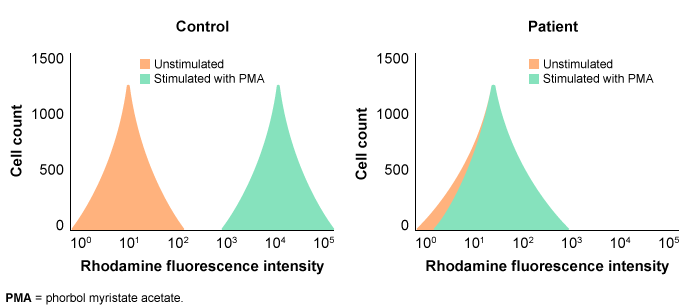 Which of the following processes is most likely impaired in this patient?
 (Multiple Choice)
4.9/5 (90)
(90) A 35-year-old woman comes to the office due to fever, headache, severe muscle aches, and sore throat for the last 4 days. Physical examination shows mild pharyngeal erythema and nasal congestion. A rapid influenza antigen test is positive. The patient's condition improves over the next several days despite receiving only symptomatic treatment. In response to the influenza virus, infected respiratory epithelial cells begin secreting increased quantities of interferons. The specific interferons secreted by these cells will most likely cause which of the following changes?
(Multiple Choice)
5.0/5 (87)
(87) A 37-year-old woman is evaluated for progressive shortness of breath and dry cough. The patient has seasonal allergies and takes no medications. There is no significant family history. On physical examination, the lungs are clear to auscultation. Chest imaging studies reveal pulmonary infiltrates and hilar adenopathy. The patient undergoes lung biopsy; the findings are shown below. 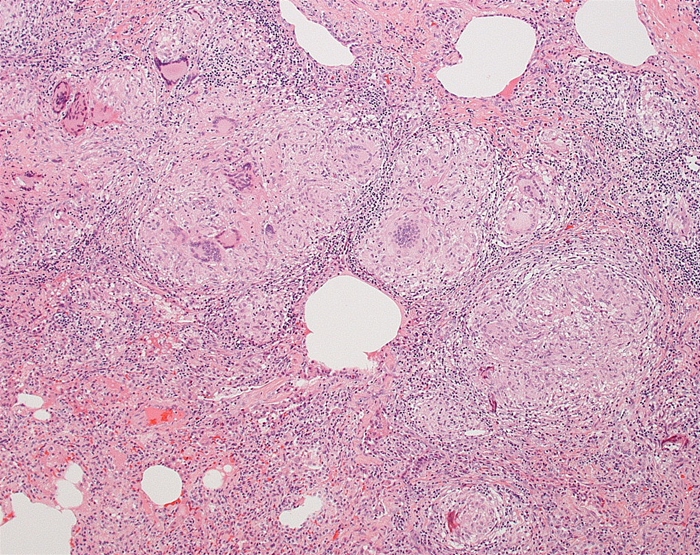 Which of the following sets of immune cells and cytokines is most likely responsible for the development of this patient's pathologic findings?
 (Multiple Choice)
4.7/5 (95)
(95) A newborn girl is admitted to the neonatal intensive care unit with jaundice, hepatomegaly, and generalized edema. She was born by vaginal delivery to a 32-year-old woman, gravida 2, para 2, who received minimal prenatal care. The infant's laboratory results show a hemoglobin level of 6 g/dL and a positive direct Coombs test. A peripheral blood smear shows many nucleated erythrocytes. The infant has significant respiratory distress due to pleural effusions and ascites and dies soon after birth. Autopsy shows areas of extramedullary hematopoiesis in many tissues. Which of the following is the most likely cause of this patient's condition?
(Multiple Choice)
4.9/5 (70)
(70) A 3-month-old girl is brought to the emergency department due to fever, irritability, and vomiting for the past 2 days. On examination, she is ill-looking, lethargic, and febrile. Blood cultures grow Mycobacterium tuberculosis. One of her brothers died from disseminated mycobacterial infection during infancy. Impairment of which of the following protective mechanisms is most likely contributing to this patient's infection?
(Multiple Choice)
4.7/5 (73)
(73) On flow cytometric analysis of a sample of fetal thymus, a certain population of cells is identified that is positive for both CD4 and CD8 cell surface antigens. These cells are best characterized as which of the following cells?
(Multiple Choice)
4.9/5 (65)
(65) A 45-year-old woman comes to the office due to a long history of joint pain, swelling, and stiffness. She recently immigrated to the United States and had little access to medical care in her original country. On physical examination, her proximal interphalangeal and metacarpophalangeal joints are tender and swollen bilaterally, and her fingers appear significantly deformed. Subcutaneous nodules are palpated near the elbow. Laboratory studies are obtained to confirm the diagnosis. This patient's serum is most likely to contain IgM antibodies against which of the following substances?
(Multiple Choice)
4.8/5 (96)
(96) An 18-month-old boy is evaluated for recurrent infections. He has been hospitalized 3 times with pneumonia since age 3 months. He has also had multiple skin infections requiring treatment with antibacterial and antifungal agents. During his last episode of pneumonia, he developed a large pleural effusion, which was drained. The pleural fluid revealed numerous neutrophils containing a large number of intact gram-positive cocci. The microorganisms responsible for this patient's recurrent infections most likely produce which of the following virulence factors?
(Multiple Choice)
4.8/5 (73)
(73) A 55-year-old man with end-stage hepatitis C virus infection undergoes orthotopic liver transplantation from a deceased donor. The patient has no perioperative complications and is discharged from the hospital on appropriate immunosuppressant medications. One week after the surgery, he develops nausea, vomiting, abdominal pain, and bloody diarrhea. Physical examination shows a painful maculopapular rash over his neck, back, and extremities that extends to the palms and soles. Endoscopic evaluation reveals multiple ulcerations of the intestinal mucosa. Which of the following is the most likely cause of this patient's current condition?
(Multiple Choice)
4.8/5 (92)
(92) A 57-year-old woman with autosomal dominant polycystic kidney disease develops end-stage renal disease and undergoes deceased-donor kidney transplantation. During the operation, the surgeon notices that the graft becomes cyanotic and mottled soon after its blood vessels are connected with those of the recipient. Blood flow to the graft ceases, and no urine is produced. Which of the following best explains the findings observed by the surgeon?
(Multiple Choice)
4.9/5 (80)
(80) A 19-year-old man comes to the office due to eye pain and blurry vision in both eyes for the last several days. He sustained an open globe injury to the right eye 3 months ago after being struck during an altercation and was treated with surgical repair and prophylactic antibiotics. The left eye was unaffected. At the patient's last follow-up appointment, visual acuity in the right eye had improved from 20/400 to 20/80. He is otherwise healthy. Temperature is 37.1 C (98.8 F). Examination is unremarkable apart from bilateral conjunctival injection and decreased visual acuity in both eyes. Analysis of vitreous samples from both eyes demonstrates multinucleated giant cells. Which of the following mechanisms is most likely causing this patient's current manifestations?
(Multiple Choice)
4.8/5 (81)
(81) A 7-year-old boy is brought to the emergency department by his parents for arthralgias. He had a cough and runny nose last week but otherwise has been in good health. Temperature is 37 C (98.6 F), blood pressure is 95/65 mm Hg, pulse is 92/min, and respirations are 20/min. Physical examination shows raised, red-purple papules, some of which have coalesced, over the patient's buttocks and thighs. Auscultation of the lungs and heart is normal. The abdomen is soft with normal bowel sounds. The knees are tender but do not appear warm or swollen. Urinalysis results are as follows: 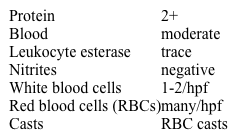 Which of the following mechanisms is the most likely underlying cause of this patient's renal findings?
 (Multiple Choice)
4.9/5 (79)
(79) A 75-year-old man is hospitalized due to respiratory distress. The patient developed fever, cough, and muscle aches 4 days prior to admission. He is otherwise healthy and has no chronic medical conditions. The patient has received all recommended vaccinations, including a yearly flu vaccine. Temperature is 39 C (102.2 F), blood pressure is 110/65 mm Hg, pulse is 115/min, and respirations are 29/min. Chest x-ray shows bilateral infiltrates. Reverse transcriptase PCR of a specimen from a nasopharyngeal swab reveals a strain of influenza A virus that was included in the seasonal trivalent flu vaccine. The patient lives with his 50-year-old son, who received the same vaccine but did not develop the infection. Which of the following factors most likely increased this patient's risk of vaccine failure compared with that of his son?
(Multiple Choice)
4.8/5 (70)
(70) A 3-year-old boy experiences recurrent sinusitis and an episode of severe pneumonia. As part of his evaluation, Candida extract is injected intradermally. Forty-eight hours later, he returns to the clinic with a firm nodule measuring 16 mm in diameter where the extract was injected. Which of the following cell types is most likely responsible for the reaction observed in this patient?
(Multiple Choice)
5.0/5 (77)
(77) A 68-year-old man comes to the emergency department with a 2-day history of fever, chills, and productive cough. His temperature is 38.9 C (102 F), blood pressure is 108/52 mm Hg, pulse is 102/min, and respirations are 26/min. Crackles and bronchial breath sounds are heard over the right lower lung. There is dullness to percussion over the same area. Chest x-ray reveals right lower lobe consolidation and a right-sided pleural effusion. The patient is started on the appropriate treatment, and a diagnostic thoracentesis is performed that shows an uncomplicated parapneumonic effusion. When a sterile sample of the inflammatory exudate is experimentally introduced into normal human tissue, rapid neutrophil locomotion is observed. Which of the following components of the exudate is most likely responsible for this observed effect?
(Multiple Choice)
4.8/5 (80)
(80) 
Filters
- Essay(0)
- Multiple Choice(0)
- Short Answer(0)
- True False(0)
- Matching(0)