



 Chat with AI
Exam 8: Immunology

Exam 1: Anatomy291 Questions
Exam 2: Behavioral science240 Questions
Exam 3: Biochemistry156 Questions
Exam 4: Biostatistics117 Questions
Exam 5: Embryology52 Questions
Exam 6: Genetics103 Questions
Exam 7: Histology24 Questions
Exam 8: Immunology129 Questions
Exam 9: Microbiology336 Questions
Exam 10: Pathology816 Questions
Exam 11: Pathophysiology464 Questions
Exam 12: Pharmacology538 Questions
Exam 13: Physiology272 Questions
Select questions type


A 50-year-old woman comes to the office for evaluation of a mole on her back. The mole has been present for several years, but her daughter is concerned that it might have grown larger lately. The patient has no other medical conditions but had frequent sunburns during childhood. Dermoscopic examination of the lesion is shown in the image below. 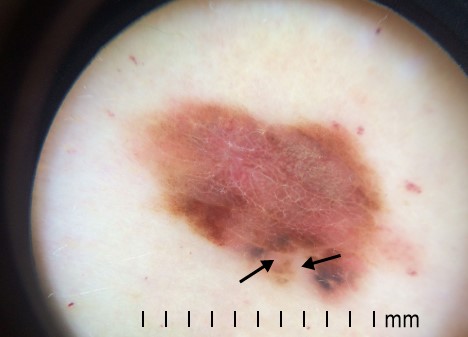 The lesion has multiple color variations, including dark brown, pink, red, and whitish areas. Excisional biopsy of the lesion is performed. The whitish areas (arrows) seen on histologic examination most likely represent which of the following underlying processes?
 (Multiple Choice)
4.9/5  (76)
(76) A 28-year-old woman, gravida 2 para 2, brings her healthy 6-day-old girl to the office for her first well-baby checkup. The infant was born full-term, with a birth weight of 4.2 kg (9.3 lb) and a length of 51 cm (20 in). She was discharged from the nursery with no concerns. Physical examination is normal. The infant's blood type is A negative, whereas the mother's is B negative. High circulating levels of anti-A antibodies are found in the mother's blood. Hemolysis did not occur in the infant because these maternal antibodies are most likely of which class?
(Multiple Choice)
4.8/5 (62)
(62) A 34-year-old woman comes to the physician for a follow-up visit. She was diagnosed with rheumatoid arthritis 3 months ago and started on methotrexate therapy. Despite treatment, she continues to have several hours of morning stiffness daily and frequently awakens at night due to joint pain. Physical examination shows swelling and tenderness in the joints of her hands and wrists. Etanercept is subsequently added to her treatment regimen. This medication is best characterized as which of the following?
(Multiple Choice)
4.9/5 (93)
(93) A 23-year-old woman comes to the physician with migratory joint pains involving her hands and knees. Physical examination shows bilateral tenderness in her wrists and proximal interphalangeal joints. There is also a malar skin rash and generalized lymphadenopathy. A urinalysis reveals proteinuria. Further evaluation shows that the patient's lymphocytes contain a mutated and functionally defective Fas gene product. Which of the following immunologic mechanisms is most likely impaired in this patient as a result of this molecular defect?
(Multiple Choice)
4.9/5 (81)
(81) A 56-year-old woman with a history of heart failure is admitted to the hospital for orthotopic cardiac transplantation. The patient developed biventricular failure due to idiopathic myocarditis. She has had persistent New York Heart Association class IV symptoms refractory to maximal medical therapy and was placed on the transplant waiting list. An ABO-compatible cadaveric heart is available for transplant with partial human leukocyte antigen (HLA) mismatch. Cardiac transplantation is performed and the patient's T lymphocytes quickly recognize the foreign HLA molecules of the transplant cells. Inhibition of which of the following substances would specifically reduce the proliferation and differentiation of these T lymphocytes?
(Multiple Choice)
4.9/5 (90)
(90) A 22-year-old woman comes to the office because of a 6-month history of increasing neck and low back pain that is most severe in the morning. Her pain improves as the day passes. The patient has no history of trauma, rashes, or urinary symptoms. Vital signs are within normal limits. Examination shows tenderness over the lumbosacral area and at the insertion site of the Achilles tendon. Forward flexion is reduced. This patient's symptoms are most likely attributable to upregulation of which of the following cytokines?
(Multiple Choice)
4.9/5 (78)
(78) A 23-year-old man is referred to the gastroenterology clinic due to a 3-year history of recurring abdominal pain accompanied by cramps and diarrhea. The patient has noticed an increased frequency of episodes lately with worsening pain. He also says that his urine occasionally appears dark brown and his urine stream sometimes sputters. Imaging studies reveal a colovesical fistula. Biopsy obtained during colonoscopy shows chronic ileocolitis with discontinuous transmural inflammation and noncaseating granulomas. When given the diagnosis of Crohn disease, the patient becomes skeptical and says, "There's no way I'm getting a colostomy bag." He then refuses treatment and pursues a second opinion once his symptoms subside. A second biopsy demonstrates reduced inflammation in regions of previously active ileocolitis. An increase in which of the following cytokines is most likely responsible for this patient's clinical regression?
(Multiple Choice)
4.8/5 (73)
(73) A 28-year-old primigravid woman comes to the office for a routine prenatal checkup at 28 weeks gestation. The patient has no concerns and has had an uneventful pregnancy to date. Physical examination shows a uterine size concordant with ultrasound dates, and fetal cardiac activity is in the normal range. After reviewing the results of her laboratory evaluations, the physician administers an injection of anti-Rh(D) immunoglobulin. The administered antibodies most likely belong to which of the following immunoglobulin classes?
(Multiple Choice)
4.9/5 (80)
(80) An autopsy is performed on an 8-month-old infant after his unexpected death. Prior to death, the patient had a 1-month history of poor feeding and intermittent fever, which progressed to severe lethargy and coma. The infant was adopted soon after birth, and there is limited information about his family history beyond documentation of an uncomplicated pregnancy and delivery at term gestation. Brain biopsy reveals leptomeningeal inflammation and is positive for Enterovirus by PCR. This patient would have been most likely to have which of the following laboratory findings?
(Multiple Choice)
4.7/5 (60)
(60) A 64-year-old man comes to the clinic due to several weeks of persistent cough, fever, and weight loss. He smokes a pack of cigarettes daily and drinks 10-12 beers on weekends. Chest x-ray reveals an infiltrate in the left upper lobe. The patient is prescribed broad-spectrum antibiotic therapy for both aspiration and community-acquired pneumonia, but his symptoms worsen despite taking the medication as prescribed. Sputum Gram stain does not reveal any organisms. Lung biopsy findings are shown in the image below: 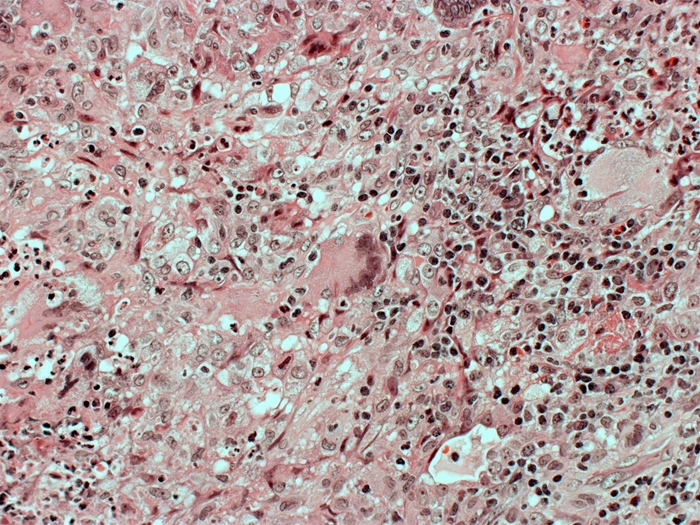 Which of the following substances is most important for driving the development of this patient's observed microscopic lesion?
 (Multiple Choice)
5.0/5 (78)
(78) Pharmacology researchers develop a novel immunotherapy to treat malignancies. In this therapy, T lymphocytes are harvested from patients with a malignancy and genetically modified to express a chimeric antigen receptor composed of an extracellular antigen recognition domain linked with an intracellular T-cell signaling domain. These modified T cells are expanded ex vivo and then infused back into the patient, where they destroy the cancer cells. In one of the experiments, they modify the chimeric antigen receptor to recognize CD19. Use of this treatment is most likely to have which of the following potential complications?
(Multiple Choice)
4.8/5 (71)
(71) An 8-year-old boy is brought to the pediatrician with fever, runny nose, and malaise. After examining the child, the pediatrician determines that he has a viral infection and does not require any specific treatment. The mother asks why an antibiotic is not necessary, and the physician explains the differences between bacterial and viral infections. The immune system is composed of both cellular and humoral components, which are able to mount an effective response against many types of viral and bacterial infections. A section of a normal lymph node is shown in the image below. 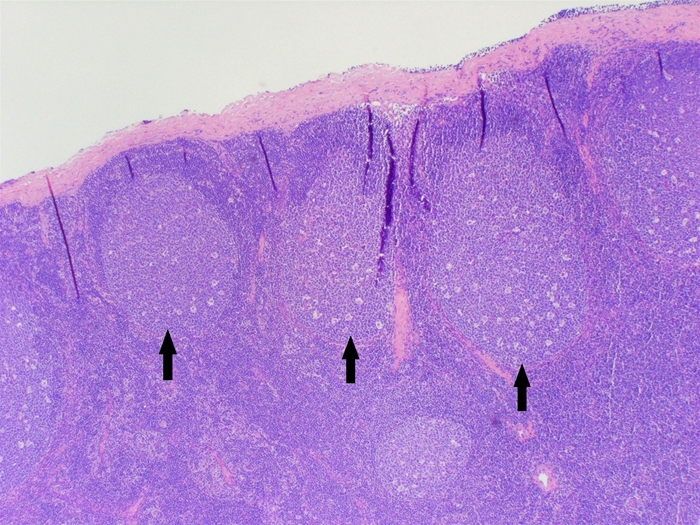 The structures indicated by the arrows are most likely to contain cells undergoing which of the following processes?
 (Multiple Choice)
4.8/5 (69)
(69) A 13-month-old boy is brought to the emergency department due to cough and increased work of breathing. The patient's parents immigrated to the United States when he was 6 months old. He has a history of recurrent otitis media, pneumonia, and thrush as well as chronic diarrhea and failure to thrive. On physical examination, he is tachypneic and has perioral cyanosis. A chest radiograph shows bilateral interstitial opacities. The patient is admitted to the hospital and undergoes bronchoscopy. Analysis of the bronchoalveolar lavage fluid reveals Pneumocystis jirovecii. Which of the following is the most likely underlying diagnosis?
(Multiple Choice)
4.9/5 (77)
(77) A 3-year-old boy is being evaluated for persistent diarrhea. Although the patient seemed healthy at his 12-month well child visit, since then he has experienced 4 episodes of otitis media and 3 episodes of pneumococcal pneumonia. He was at the 50th percentile for weight and height at 12 months but is now at the 25th percentile for height and 10th percentile for weight. The patient is referred for upper gastrointestinal endoscopy, and Giardia lamblia is isolated from duodenal aspirates. Further workup shows very low serum levels of all immunoglobulin types. Flow cytometry of this patient's peripheral blood is most likely to show a near absence of cells bearing which of the following markers?
(Multiple Choice)
4.7/5 (88)
(88) A 7-year-old boy is brought to the clinic by his parents after developing red urine earlier in the day. The patient has asthma, allergic rhinitis, and atopic dermatitis. He was recently treated for a skin infection. Blood pressure is 140/90 mm Hg. On physical examination, there is periorbital edema as well as pitting edema on both feet. Laboratory results are as follows: 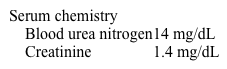 Which of the following is most likely responsible for this patient's renal injury?
 (Multiple Choice)
4.8/5 (78)
(78) A 4-year-old boy is brought to the emergency department for difficulty breathing and a productive cough. He has a past medical history of recurrent episodes of sinusitis and otitis media. The respiratory infections typically have a protracted course but respond to high-dose antibiotic therapy. Pulmonary auscultation shows crackles and wheezing. Cardiovascular examination shows a cardiac point of maximal impulse that is palpated at the right 5th intercostal space. Which of the following is most likely to be dysfunctional in this patient?
(Multiple Choice)
4.9/5 (81)
(81) A 5-year-old boy with severe, recurrent respiratory infections is undergoing evaluation. Sputum studies reveal intracellular bacteria. Further testing shows that the patient's T cells lack the IL-12 receptor. Supplementation with which of the following substances would most likely improve this patient's condition?
(Multiple Choice)
4.9/5 (80)
(80) A 2-month-old girl is brought to the office for a well-child visit. The patient was born at term with no complications. She is exclusively formula fed and gaining weight well. Examination is unremarkable today. The mother is informed that several vaccinations are due at this visit. She becomes upset and mentions that her older son, who did follow a standard vaccine schedule, had a "bad reaction" to his last set of shots and had a cough for weeks. She wants to defer immunizations for her daughter at this time. The mother says, "I know you won't agree with me, but I have been reading that these reactions are actually very harmful to the immune system." Which of the following is the most appropriate response?
(Multiple Choice)
4.8/5 (71)
(71) A 67-year-old man comes to the office after he noticed several nodules in his left axilla. He has a history of malignant melanoma on his upper back, which was treated with wide surgical excision 4 years ago. The patient undergoes biopsy of an axillary lesion, and histopathology reveals melanoma recurrence. Subsequent whole-body positron emission scan shows diffuse metastatic disease involving the lungs, liver, and left axillary nodes. Checkpoint inhibitor therapy with pembrolizumab is initiated, which leads to significant reduction in the size of the axillary nodules and metastatic lesions. Which of the following best correlates with the treatment response in this patient?
(Multiple Choice)
4.8/5 (78)
(78) A 25-year-old woman comes to the office due to arthralgias in her hands for the last several months. The pain frequently involves her wrists and proximal finger joints bilaterally, and alternates between being worse in the wrists versus in the hands. The patient has no other medical problems and takes no medications. Complete blood count results are as follows: 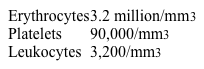 Further evaluation reveals proteinuria and red blood cell casts. Which of the following is the most likely diagnosis?
 (Multiple Choice)
4.8/5 (77)
(77) 
Filters
- Essay(0)
- Multiple Choice(0)
- Short Answer(0)
- True False(0)
- Matching(0)