



 Chat with AI
Exam 8: Immunology

Exam 1: Anatomy291 Questions
Exam 2: Behavioral science240 Questions
Exam 3: Biochemistry156 Questions
Exam 4: Biostatistics117 Questions
Exam 5: Embryology52 Questions
Exam 6: Genetics103 Questions
Exam 7: Histology24 Questions
Exam 8: Immunology129 Questions
Exam 9: Microbiology336 Questions
Exam 10: Pathology816 Questions
Exam 11: Pathophysiology464 Questions
Exam 12: Pharmacology538 Questions
Exam 13: Physiology272 Questions
Select questions type


A scientist is interested in the mechanisms by which leukocytes traffic to sites of inflammation and infection. She finds that endothelial cells increase the expression of certain cell surface molecules in response to cytokines to allow for leukocyte trafficking. She subsequently creates a knockout mouse that has a deletion in the platelet endothelial cell adhesion molecule 1 (PECAM-1) gene. The protein product of this gene is mainly localized to specific areas on the endothelial cells. Absent expression of this gene will most likely affect which of the following neutrophil functions?
(Multiple Choice)
4.9/5  (81)
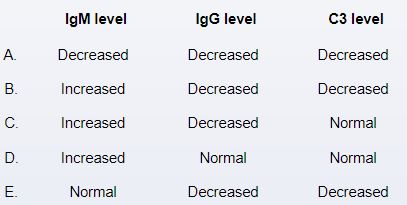
(81) A 6-year-old boy is being evaluated in the office due to a history of recurrent infections and failure to thrive. He has been hospitalized for pneumococcal pneumonia twice and has had 5 episodes of otitis media. The patient also has a history of prolonged diarrhea caused by Giardia intestinalis. Physical examination shows a lack of tonsillar tissue, as well as minimally palpable cervical, axillary, and inguinal lymph nodes. Further evaluation shows that the patient has defective signaling between activated CD4 T cells and B cells. Which of the following laboratory findings are most likely to be found in this patient?
(Multiple Choice)
4.7/5 (87)
(87) An 18-year-old college student is hospitalized due to a high fever and confusion. According to the patient's roommate, the symptoms started about 6 hours ago. The patient was feeling well this morning except for some nausea. She has had several episodes of pneumonia in the past and had bacterial meningitis a year ago, which was treated with ceftriaxone. Temperature is 39.1 C (102.4 F), blood pressure is 104/70 mm Hg, and pulse is 110/min. The patient is lethargic but is able to follow simple commands and give single-word answers with prompting. Physical examination reveals a petechial rash on the trunk and extremities, including the palms and soles. Neck stiffness and photophobia are also noted. Which of the following primary immune system impairments is most likely responsible for this patient's recurrent infections?
(Multiple Choice)
4.8/5 (75)
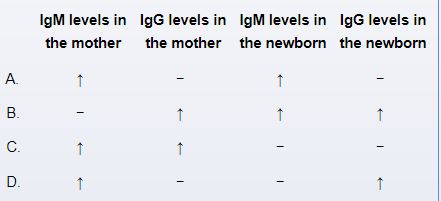
(75) A neonate is born at 38 weeks gestation age via spontaneous vaginal delivery to a 40-year-old woman. The mother was working in South America when she discovered that she was pregnant. She had 2 days of fever associated with cough and swollen cervical glands, which resolved spontaneously at 12 weeks gestation prior to returning to the United States. The mother has no current symptoms. Neonatal examination shows weight and length at the 8th percentile, and head circumference below the 3rd percentile for age. Heart and lung sounds are normal. There is moderate hepatosplenomegaly. Skin examination shows diffuse, dark-blue papules and nodules. Serology from the mother and infant are attained. Which of the following serology patterns is most consistent with a suspected congenital infection?
(Multiple Choice)
4.9/5 (79)
(79) A 62-year-old man comes to the office due to an intensely pruritic facial rash for the past 3 days. The patient uses no facial cosmetic products but has frequently dyed his hair during the past year; he last dyed his hair 5 days ago and also recalls developing a similar rash the previous time he used hair dye. The patient has a history of asthma, hypertension, and diabetes mellitus. He does not use tobacco, alcohol, or illicit drugs. Vital signs are within normal limits. Physical examination findings are shown in the exhibit.
 Which of the following are primarily involved in the pathogenesis of this patient's rash?
 (Multiple Choice)
4.9/5 (74)
(74) Researchers are studying various cellular processes in normal and diseased states to find new anticancer drug targets. They develop a medication that inhibits an intracellular enzyme that converts adenosine to inosine. With drug use, accumulation of enzyme substrates in the neoplastic cells leads to DNA strand breaks and subsequent apoptosis. Which of the following malignancies is likely to be most responsive to this medication?
(Multiple Choice)
4.7/5 (75)
(75) A 13-month-old boy is admitted to the hospital due to diarrhea and dehydration. Over the past week, the patient has developed severe, watery diarrhea and has had poor oral intake. Medical history includes multiple episodes of bronchiolitis and, at age 8 months, an intensive care unit admission due to pneumococcal pneumonia requiring a brief period of mechanical intubation and chest tube placement. The parents say that he has been growing poorly over the past 6 months despite feeding well and supplemention with high-calorie formulas. On examination, the patient appears lethargic with sunken eyes and poor skin turgor, as well as moderate tachycardia and tachypnea. As part of the laboratory evaluation, flow cytometry of in vitro-stimulated CD4+ T cells reveals a near absence of CD40 ligand. Which of the following additional findings is most likely associated with this patient's condition?
(Multiple Choice)
4.8/5 (97)
(97) A 4-year-old girl is brought to the clinic for her routine yearly visit. She has no chronic medical conditions and has received all previously recommended vaccinations. The patient is due to receive several vaccinations today including a second measles vaccine. Which of the following IgM and IgG trends is expected to occur after initial and subsequent measles vaccinations?
(Multiple Choice)
4.8/5 (77)
(77) A 9-year-old girl is brought to the office due to persistent nasal drainage. Over the past 2 weeks, the patient has had increasing nasal congestion and drainage. The discharge was initially clear but has become dark and foul smelling over the past few days. The patient has a history of multiple skin abscesses that developed when she was an infant, but they typically do not cause discomfort. She has also had atopic dermatitis since infancy. Temperature is 37.1 C (98.8 F). On examination, the patient is interactive and talkative. Thick nasal discharge appears from both nares. Cardiopulmonary examination is normal. There are several diffuse areas of dry, excoriated skin along the trunk and upper extremities. Results of a complete blood count are as follows: 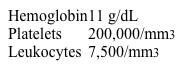 Which of the following patterns of immunoglobulin production is most likely to be seen in this patient?
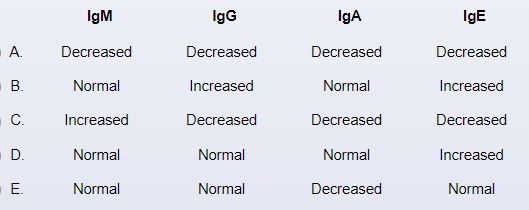
Which of the following patterns of immunoglobulin production is most likely to be seen in this patient?
(Multiple Choice)
4.8/5 (86)
(86) 
Filters
- Essay(0)
- Multiple Choice(0)
- Short Answer(0)
- True False(0)
- Matching(0)