



 Chat with AI
Exam 9: Microbiology

Exam 1: Anatomy291 Questions
Exam 2: Behavioral science240 Questions
Exam 3: Biochemistry156 Questions
Exam 4: Biostatistics117 Questions
Exam 5: Embryology52 Questions
Exam 6: Genetics103 Questions
Exam 7: Histology24 Questions
Exam 8: Immunology129 Questions
Exam 9: Microbiology336 Questions
Exam 10: Pathology816 Questions
Exam 11: Pathophysiology464 Questions
Exam 12: Pharmacology538 Questions
Exam 13: Physiology272 Questions
Select questions type


A 34-year-old man comes to the emergency department due to 5 days of progressive anorexia, nausea, and abdominal pain. The patient is a known hepatitis B carrier. He admits to using IV drugs and has shared needles with other drug users on several occasions. His temperature is 37.7 C (99.9 F). Examination shows scleral icterus and mild, tender hepatomegaly. Laboratory studies are notable for highly elevated levels of liver aminotransferases and serum bilirubin and also show the following results: 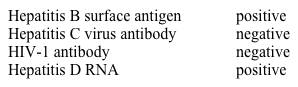 This patient's chronic infection assists which of the following life cycle aspects of the current infectious agent?
 (Multiple Choice)
4.9/5  (76)
(76) A 6-year-old boy is brought to the emergency department by his parents with a 2-day history of fever and headaches. The parents report that he vomited once this afternoon. All of his vaccinations are up-to-date and he has no significant past medical history. His temperature is 38.7 C (102 F). Examination shows mild pharyngeal erythema in addition to neck stiffness. Cerebrospinal fluid analysis reveals the following: 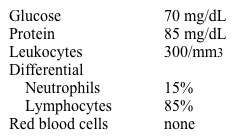 Which of the following infectious agents is most likely to have caused this patient's illness?
 (Multiple Choice)
4.8/5 (80)
(80) A 63-year-old woman comes to the emergency department with fever and a cough. A new medical student rotating in the emergency department is sent to interview and examine the patient. The patient reports 3 months of fevers, night sweats, and a productive cough, and is subsequently placed in an isolation room. A chest x-ray demonstrates a right apical lung lesion. The medical student has never been exposed to Mycobacterium tuberculosis and reports that he was in close contact with the patient, who coughed frequently during their interaction. Which of the following would most likely happen during the first week after exposure?
(Multiple Choice)
4.9/5 (90)
(90) A 37-year-old man is brought to the emergency department following a motor vehicle accident in which he was the unrestrained driver. Paramedics report that his breath smelled of alcohol at the scene. En route to the hospital, the patient receives 2 L intravenous normal saline. In the emergency department, his blood pressure is 100/60 mm Hg, pulse is 130/min, and respirations are 44/min. He is admitted directly to the intensive care unit, where he is intubated and placed on mechanical ventilation. A decision is made to insert a central venous catheter. In addition to sterile draping during the procedure, which of the following actions would be most likely to prevent intravascular catheter-related infections?
(Multiple Choice)
4.8/5 (69)
(69) A 9-month-old girl is brought to the emergency department after a 2-minute generalized seizure. The patient has had a fever for the past 12 hours and has been very fussy. She takes no medications and has no allergies. Her temperature is 39.4 C (103 F). Examination shows no abnormalities, and the patient is discharged home. Three days later, she is afebrile but develops a maculopapular rash on her trunk. Infection with which of the following is the most likely cause of this patient's condition?
(Multiple Choice)
4.9/5 (82)
(82) A 55-year-old man comes to the emergency department with fever and chills. He has a history of acute myeloid leukemia for which he is receiving chemotherapy. His temperature is 38.3 C (101 F), blood pressure is 90/50 mm Hg, pulse is 124/min, and respirations are 22/min. Physical examination is notable for multiple skin patches with necrotic centers and occasional ulcerations, as shown in the image below. 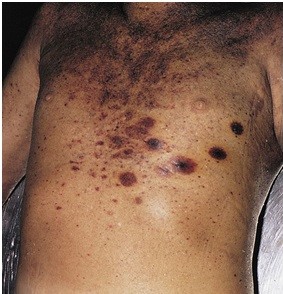 Laboratory results are as follows:
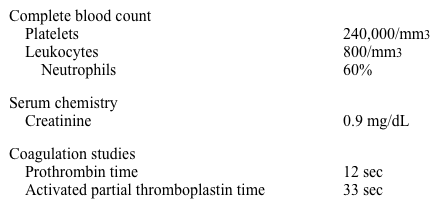 Blood cultures are drawn. Which of the following organisms is most likely responsible for this patient's symptoms?
Laboratory results are as follows: Blood cultures are drawn. Which of the following organisms is most likely responsible for this patient's symptoms? (Multiple Choice)
4.8/5 (67)
(67) A 6-year-old previously healthy girl is brought to the emergency department due to a day of fever, abdominal pain, and diarrhea. The symptoms began abruptly with high fever and cramping, periumbilical abdominal pain and were quickly followed by low-volume diarrhea mixed with blood and mucus. The patient has had no sick contacts and has not traveled recently; the family had dinner at a buffet restaurant 3 days ago. Temperature is 38.9 C (102 F). Physical examination reveals mild diffuse abdominal tenderness with no guarding or rebound tenderness. Bowel sounds are hyperactive. Stool occult blood testing is positive, and there are numerous leukocytes in the stool. Culture of the stool yields gram-negative, oxidase-positive, curved rods. Which of the following is the most likely pathogen responsible for this patient's symptoms?
(Multiple Choice)
4.9/5 (83)
(83) A 15-year-old boy is evaluated for fever, headache, malaise, and cough 3 weeks after returning from summer camp. Lung auscultation is unremarkable. Chest x-ray reveals nodular infiltrates. The patient's blood samples are collected for analysis in anticoagulated tubes, which are transported submerged in ice; when taken out several minutes later, turbidity and clumping are noted. Warming the tube to body temperature leads to rapid dissolution of the clumps. Which of the following organisms is most likely responsible for this patient's condition?
(Multiple Choice)
4.9/5 (86)
(86) A 32-year-old man was referred to a hematologist 6 months ago with complaints of fatigue, night sweats, and difficulty breathing while lying supine. He also reported a 20 lb (9 kg) weight loss over the last 6 weeks, although he denied any alterations in his diet. On physical examination, enlarged lymph nodes were palpated in his neck and groin and a complete diagnostic work-up was ordered. Pathology slides revealed Reed Sternberg cells and a diagnosis of Hodgkin's lymphoma was made. The patient then began an aggressive chemotherapy regimen. During one of his treatment cycles, the patient experiences fever, dyspnea, and malaise. Blood cultures incubated for 3 hours at 37 C (98.6 F) reveal the following findings: 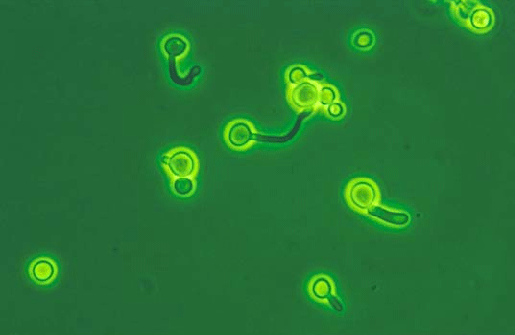 Which of the following is the most likely cause of this patient's condition?
 (Multiple Choice)
4.9/5 (94)
(94) A 65-year-old man is admitted to the intensive care unit with second- and third-degree burns over 25% of his total body surface area. Intravenous fluids and analgesics are administered, and his wounds are cleaned and debrided. After 7 days, the patient develops a fever and his leukocyte count rises to 16,000 cells/µL. Examination of the burns on his left leg shows surrounding warmth, erythema, and induration. Gram stain of his wound tissue is shown in the image below. 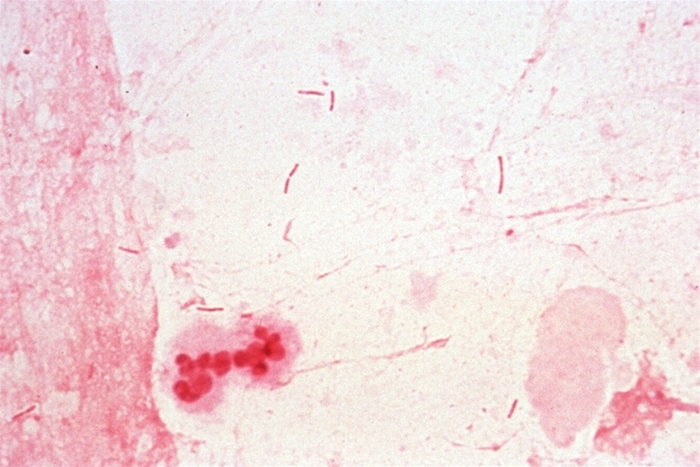 Culture on MacConkey agar grows oxidase-positive colonies that do not ferment lactose. Which of the following is the best initial treatment for this patient?
 (Multiple Choice)
5.0/5 (77)
(77) A 24-year-old woman comes to the office due to 2 days of burning during urination and increased urinary frequency and urgency. The patient has had no fever, chills, nausea, vomiting, flank pain, or vaginal discharge, but reports darkening of the urine. She has no other medical conditions and does not use tobacco, alcohol, or drugs. The patient is sexually active with her boyfriend and takes an oral contraceptive for birth control. Vital signs are within normal limits. Physical examination shows mild suprapubic tenderness. There is no costovertebral angle tenderness. Which of the following pathogens is most likely responsible for this patient's symptoms?
(Multiple Choice)
4.8/5 (66)
(66) A 21-year-old man is brought to the emergency department in a stuporous condition. He returned from a family visit to Mexico 2 weeks ago. One week ago, the patient began developing high-grade fever, headaches, severe myalgias, and joint pains. He had similar symptoms following a trip to Mexico 5 years ago, but at that time the symptoms did not progress and instead resolved spontaneously within a few days. Temperature is 38.3 C (101 F), blood pressure is 80/50 mm Hg, and pulse is 128/min. Examination shows a diffuse maculopapular rash, multiple purpuric lesions, and hepatomegaly. Laboratory studies show marked thrombocytopenia, leukopenia, and elevated liver aminotransferases. Which of the following is the most likely mechanism for this patient's current severe illness?
(Multiple Choice)
4.9/5 (89)
(89) A 34-year-old woman comes to the office with recent onset of malaise. The patient reports feeling "run down and under the weather" but otherwise has no symptoms. She is an avid cyclist and is concerned about her ability to participate in a charity race in 3 days. The patient works as a nurse at a local hospital and lives at home with her husband and 2-year-old son. She occasionally smokes when she goes out, but since she began feeling ill, she no longer has the desire to smoke. Physical examination is notable for hepatomegaly. Laboratory results are as follows: 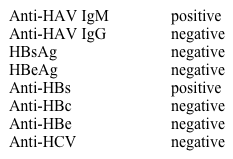 Which of the following is most likely to be elicited on further history taking?
 (Multiple Choice)
4.8/5 (73)
(73) A 58-year-old man comes to the emergency department with a 1-day history of fever, headache, and vomiting. He underwent kidney transplantation last year. His temperature is 39.4 C (103 F), blood pressure is 130/80 mm Hg, pulse is 98/min, and respirations are 16/min. Neck stiffness is present on physical examination. Cerebrospinal fluid (CSF) results are as follows: 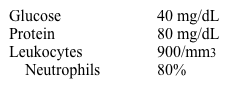 Gram-positive rods with tumbling motility at room temperature are seen on CSF microscopy. How was this patient's infection most likely transmitted?
 (Multiple Choice)
4.9/5 (96)
(96) An 8-year-old boy with acute lymphoblastic leukemia receiving maintenance chemotherapy is hospitalized due to fever and neutropenia. Treatment with broad spectrum intravenous antibiotics is begun and the patient's fever resolves. His neutrophil count increases with granulocyte colony-stimulating factor therapy and blood cultures remain negative. On day 5 of hospitalization, the patient experiences nausea, abdominal cramping, and 6-8 episodes of watery diarrhea. Temperature is 37.7 C (100 F). Physical examination shows mild lower abdominal tenderness without guarding or rebound tenderness. Stool testing for occult blood is negative. Which of the following is the single best stool test to establish the cause of this patient's diarrhea?
(Multiple Choice)
4.9/5 (71)
(71) A 25-year-old man is hospitalized with fever, anorexia, and fatigue. He admits to IV drug abuse and many episodes of unprotected sex over the past few years. His condition is treated and he is discharged from the hospital. The patient follows up with his physician regularly over the next 8 months, and the following serologic marker dynamics are obtained (see the graph below). 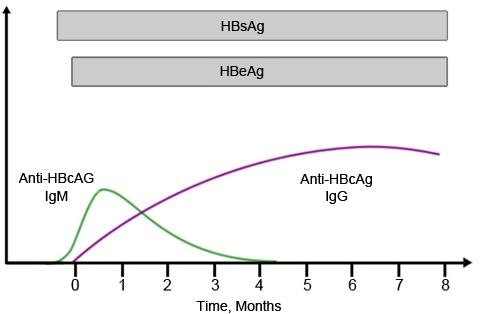 *Grey bars indicate the detectable presence of the specified serum marker.This patient most likely:
 (Multiple Choice)
4.9/5 (83)
(83) A 19-year-old man comes to the physician due to diarrhea for the last 4 months. He visited a student health clinic at his university a month ago and was prescribed a course of antibiotics, but his diarrhea failed to improve. He also has persistent nausea, a bloating sensation, and a 6.8-kg (15-lb) weight loss. Microscopic examination of his stool for ova and parasites following trichrome staining is shown in the exhibit. 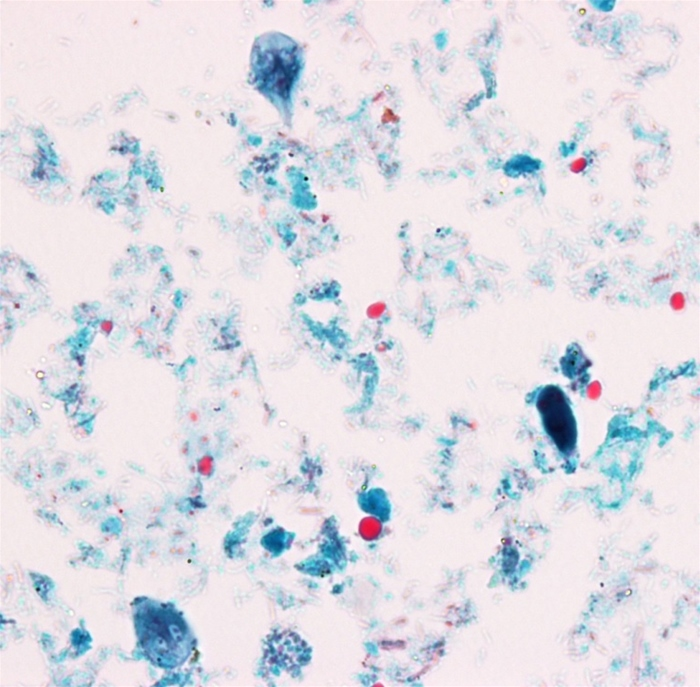 Impairment of which of the following immune functions would most likely predispose to this patient's infection?
 (Multiple Choice)
4.8/5 (76)
(76) A 16-year-old previously healthy adolescent developed nonproductive cough, dyspnea, and wheezing after traveling abroad. The patient has no history of allergies and has had no recent upper respiratory illness. The symptoms spontaneously resolved after several days, but soon after, she began having abdominal discomfort, anorexia, and nausea. Stool microscopy results are shown in the following image: 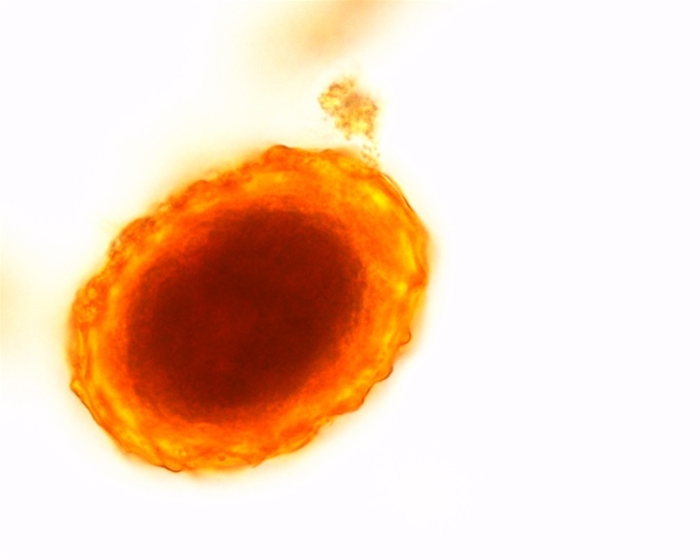 Which of the following was the most likely cause of this patient's pulmonary symptoms?
 (Multiple Choice)
4.9/5 (99)
(99) A 68-year-old woman comes to the office for evaluation of a skin rash. The patient says that red, painful papules erupted on her right chest 5 days ago and quickly turned into vesicles containing clear fluid. The lesions are now beginning to crust and are less painful. She has never had similar lesions and does not recall coming into contact with a person having a similar illness. Medical history is significant only for well-controlled hypertension. Physical examination shows a grouped vesicular rash involving the right T4 dermatome that is beginning to heal with crusting. The rash does not cross the midline. Lightly touching the skin elicits sharp pain. The remainder of the examination shows no abnormalities. This patient is at greatest risk of developing which of the following complications as a result of her current condition?
(Multiple Choice)
4.9/5 (73)
(73) A 6-hour-old boy is evaluated in the newborn nursery due to temperature instability, grunting, and lethargy. The patient was born at full term to a 21-year-old woman who came to the emergency department in active labor with ruptured membranes; she had not received adequate prenatal care. On physical examination, the boy is hypothermic, tachycardic, and tachypneic, and he has mottled skin. Blood samples are obtained, and empiric antibiotics are initiated for the treatment of sepsis. Cultures on blood agar grow bacterial colonies with a narrow zone of clear hemolysis. When these bacteria are grown in the presence of Staphylococcus aureus, the zone of hemolysis is enhanced around the staphylococcal colonies. Which of the following is the most likely pathogen infecting this patient?
(Multiple Choice)
4.8/5 (72)
(72) 
Filters
- Essay(0)
- Multiple Choice(0)
- Short Answer(0)
- True False(0)
- Matching(0)