



 Chat with AI
Exam 9: Microbiology

Exam 1: Anatomy291 Questions
Exam 2: Behavioral science240 Questions
Exam 3: Biochemistry156 Questions
Exam 4: Biostatistics117 Questions
Exam 5: Embryology52 Questions
Exam 6: Genetics103 Questions
Exam 7: Histology24 Questions
Exam 8: Immunology129 Questions
Exam 9: Microbiology336 Questions
Exam 10: Pathology816 Questions
Exam 11: Pathophysiology464 Questions
Exam 12: Pharmacology538 Questions
Exam 13: Physiology272 Questions
Select questions type


A 35-year-old woman comes to the emergency department due to a 4-day history of fever, abdominal pain, and profuse, watery diarrhea. The patient also has nausea and vomiting. She prepares her own food and frequently tastes it while cooking. The patient has no chronic medical conditions and takes no medication. Temperature is 38.8 C (101.8 F), blood pressure is 110/70 mm Hg, and pulse is 100/min. Abdominal examination shows mild, diffuse tenderness. Bowel sounds are increased. Examination of the stool shows numerous leukocytes. Which of the following is the most likely pathogen?
(Multiple Choice)
5.0/5  (74)
(74) A 65-year-old man comes to the office after his wife insisted he get a checkup. The patient feels well and has no chronic medical conditions but has not seen a physician in many years. He received blood transfusions after a motor vehicle trauma in his 20s. The patient does not use tobacco or illicit drugs but drinks 2 or 3 alcoholic beverages daily. Physical examination reveals no hepatomegaly, ascites, or dilation of the superficial abdominal veins. The remainder of the examination shows no abnormalities. Serology is positive for hepatitis C antibodies. Chronic hepatitis C infection is confirmed with positive HCV RNA testing. After appropriate counseling is provided, combination therapy with sofosbuvir and ledipasvir is planned. This treatment is most likely to help clear the infection through which of the following mechanisms?
(Multiple Choice)
4.7/5 (72)
(72) A 22-year-old woman comes to the emergency department with fevers and arthralgias. She recently had unprotected sexual intercourse with a new male partner. Her temperature is 38.4 C (101.1 F), blood pressure is 118/76 mm Hg, pulse is 102/min, and respirations are 16/min. Examination shows several pustules on the dorsal aspects of her forearms. Her right wrist and ankle are tender on palpation. Gram-negative bacteria isolated from this patient's blood produce an enzyme that splits the IgA molecule at the hinge region. Which of the following is likely to be the most important role of this bacterial enzyme in the course of the infection?
(Multiple Choice)
4.8/5 (85)
(85) A 22-year-old woman comes to the emergency department due to intermittent fevers and chills over the past few days. Last week, she underwent routine dental cleaning with no complications. The patient has a history of mitral valve prolapse. Temperature is 38.2 C (100.8 F). Physical examination reveals a non-ejection mid-systolic click followed by a late-systolic murmur best heard at the cardiac apex. Blood cultures are drawn and grow gram-positive bacteria that synthesize dextrans from sucrose. Which of the following would be the most likely adherence site for these bacteria?
(Multiple Choice)
4.9/5 (70)
(70) A 24-year-old man comes to the emergency department due to bloody diarrhea. His symptoms began 10 days ago with episodic abdominal discomfort and loose stools. The symptoms have progressively worsened, and he has had 6-8 stools mixed with blood and mucus over the past 2 days. The patient recently returned from a 2-week trip to Egypt and felt well while traveling. Temperature is 38 C (100.4 F), blood pressure is 120/70 mm Hg, and pulse is 86/min. The abdomen is soft with mild tenderness on palpation of lower quadrants. There is no guarding or rebound tenderness, and bowel sounds are hyperactive. Stool testing is negative for C difficile toxin, and stool culture yields no bacteria. Sigmoidoscopy reveals colonic ulcers with undermining edges that contain trophozoites. The causative organism for this patient's current condition can also produce which of the following manifestations?
(Multiple Choice)
4.9/5 (72)
(72) Microbiologists are investigating sugar metabolism in wild-type and mutant strains of Escherichia coli. Both strains are found to grow viable colonies on lactose-containing media. Each strain is then cultured on a new growth medium containing only glucose. Representative colonies of each strain from the new media undergo Western blot processing using a fluorescently labeled probe specific for β-galactosidase. Wild-type bacterial colonies are found to contain only trace quantities of β-galactosidase. However, the mutant colonies express significant amounts of β-galactosidase. Further analysis reveals that the variant strain contains a mutation that inhibits the binding of a certain protein to its regulatory sequence. In which of the following locations did this mutation most likely occur?
(Multiple Choice)
4.9/5 (83)
(83) A 34-year-old man with HIV comes to the emergency department due to fever, chills, productive cough, and left-sided chest pain that worsens with deep breathing. His symptoms began 3 days ago and have progressively worsened. The patient was diagnosed with HIV 4 years ago during routine screening, and he takes antiretroviral therapy. His CD4 count was 480 cells/mm3 a month ago. Temperature is 38.8 C (102 F), blood pressure is 110/66 mm Hg, pulse is 110/min, and respirations are 22/min. Physical examination shows dullness to percussion, bronchial breath sounds, and crackles over the left lower lung. The right lung and cardiac auscultation findings are normal. Laboratory testing reveals an elevated leukocyte count with left shift. Which of the following organisms is most likely responsible for this patient's current symptoms?
(Multiple Choice)
4.9/5 (72)
(72) A 42-year-old man with HIV comes to the emergency department with 3 days of abdominal pain, decreased appetite, and diarrhea. Temperature is 38 C (100.4 F), blood pressure is 98/60 mm Hg, and pulse is 110/min. Abdominal examination shows tenderness over the left lower quadrant without guarding or rebound tenderness. CD4 count is 38/mm3. Colonoscopy shows erythematous, friable mucosa with superficial ulcerations in the sigmoid and descending colon. Biopsy from the ulcers reveals inflammatory infiltrate, mucosal necrosis, and enlarged endothelial cells with large, ovoid nuclei containing prominent basophilic deposits. Which of the following is the most likely cause of this patient's gastrointestinal symptoms?
(Multiple Choice)
4.7/5 (89)
(89) A 38-year-old man comes to the office due to worsening fever, chills, malaise, cough, and shortness of breath. The patient has no prior medical conditions and does not use tobacco, alcohol, or illicit drugs. He has not traveled recently or been exposed to sick contacts. Temperature is 39.4 C (103 F). There is dullness to percussion and crackles over the right lung. Leukocyte count is elevated, and chest x-ray reveals a right lung infiltrate. The underlying immune response to this patient's infection largely involves T helper (Th1) cells, interferon-gamma, and interleukin-2. Which of the following is the most likely pathogen responsible for this patient's pneumonia?
(Multiple Choice)
4.8/5 (88)
(88) A 23-year-old woman is evaluated due to 10 days of nonproductive cough, low-grade fever, headache, and malaise. The patient has no other medical problems and takes no medications. Lung examination reveals scattered rales. Chest x-ray reveals bilateral patchy areas of consolidation. She has mild anemia and an elevated serum lactate dehydrogenase level. The patient is treated for presumed Mycoplasma pneumonia with azithromycin. Two months later, her symptoms and the anemia have resolved. Which of the following best explains the resolution of this patient's anemia?
(Multiple Choice)
4.8/5 (74)
(74) A scientist is conducting research to discover novel drug targets for antiretroviral agents against HIV. An HIV-positive blood sample is analyzed in the laboratory, and purified CD4 T lymphocytes are extracted. Using molecular tracing techniques, the scientist follows a viral HIV protein that is synthesized in the blood sample's T cells. The protein becomes glycosylated before being proteolytically cleaved into 2 smaller proteins in the Golgi apparatus. Which of the following best describes the function of these 2 newly formed HIV proteins?
(Multiple Choice)
4.9/5 (74)
(74) A 34-year-old woman comes to the office due to skin changes. Blotches of skin on her arms appear to be of a different color, and she also has a tingling sensation in her hands. These symptoms have developed over the past several months. The patient has no other past medical history. She is a political refugee from East Africa. On examination, there are patchy areas of skin anesthesia and hypopigmentation on her upper extremities. Nerve biopsy evaluated under light microscopy shows many organisms invading Schwann cells. HIV testing is negative. Which of the following organisms is the most likely cause of this patient's condition?
(Multiple Choice)
4.7/5 (68)
(68) A 52-year-old man is brought to the emergency department due to worsening right leg pain, fever, and confusion. The patient injured his leg while operating a motorized watercraft on the ocean near Florida 2 days ago. Temperature is 38.9 C (102 F), blood pressure is 90/50 mm Hg, and pulse is 120/min. The patient is lethargic and diaphoretic. Physical examination reveals a small laceration on the dorsum of the right foot with surrounding edema, erythema, and several hemorrhagic bullae. Leukocyte count and serum lactic acid levels are elevated. Intravenous fluids and empiric antibiotics are administered, and surgical debridement of the wound is performed. Blood and wound cultures yield curved gram-negative rods. Which of the following is the greatest risk factor for this patient's infection?
(Multiple Choice)
4.7/5 (66)
(66) A 12-year-old boy is brought to the emergency department by paramedics after being found unresponsive at home. He had 24 hours of headache, nausea, and fever, which his parents were treating with acetaminophen. His temperature is 39.6 C (103.4 F). Physical examination reveals neck stiffness. Lumbar puncture is performed. Analysis of cerebrospinal fluid shows marked pleocytosis, and Gram stain shows gram-negative cocci in pairs. The parents are concerned about their younger son, who shares a bedroom with the patient. Which of the following is the most appropriate management of this patient's household contacts?
(Multiple Choice)
5.0/5 (84)
(84) A 65-year-old man comes to the emergency department with a sore on his right hand. The lesion began as a small, painless papule 3 days ago and rapidly enlarged and ulcerated. The patient has had no injury or insect bite, has no prior medical conditions, and takes no medications. He is in the wool business and recently returned from a tour of wool-processing plants in several Asian countries. Physical examination shows a necrotic ulcer with a black eschar on the dorsum of the right hand. There is extensive edema of surrounding tissues. The toxin causing edema around this patient's ulcer has a mechanism of action most similar to a different toxin produced by which of the following bacteria?
(Multiple Choice)
4.9/5 (84)
(84) A previously healthy 23-year-old man comes to the office due to abrupt-onset high fever, chills, headache, and weakness that developed during a hiking and camping trip in New Mexico. His initial symptoms were quickly followed by intensely painful swellings in the groin. Physical examination shows tender and enlarged inguinal lymph nodes with overlying erythematous skin. Blood cultures and fluid aspirated from the lymph nodes grow gram-negative coccobacilli, which resemble a closed safety pin on special staining. Which of the following are the most likely source of this patient's infection?
(Multiple Choice)
4.9/5 (83)
(83) Microbiology researchers conduct a series of experiments to determine how pathogenicity is transmitted among different strains of Streptococcus pneumoniae. In the first experiment, they inject nonvirulent strain A into the peritoneal cavity of laboratory mice and observe no ill effects. In the second experiment, researchers subject virulent strain B to a detergent agent that kills and lyses the bacterial cells. They then inject the lysate into the peritoneal cavity of a new group of mice and again observe no ill effects. During a third experiment, they inject live strain A bacteria in combination with the killed strain B lysate, resulting in death of the mice. Which of the following genetic processes most likely accounts for the observed findings of these experiments?
(Multiple Choice)
4.9/5 (94)
(94) A pharmaceutical researcher is trying to develop a vaccine against the hepatitis C virus. She infects a chimpanzee with hepatitis C virus of known genotype and subtype. Several weeks later, a liver sample is obtained, and viral RNAs are extracted from the hepatocytes. A genetic study of the viral genomes reveals that the extracted RNA sequences vary significantly from that of the original infecting virus. This genetic instability is most likely due to the lack of which of the following features during the viral replication process?
(Multiple Choice)
4.8/5 (87)
(87) A 26-year-old previously healthy man comes to the emergency department due to fever, malaise, anorexia, and painless swelling of the left eye. His symptoms began after a month-long anthropology trip to rural Bolivia. During his stay, he lived in an adobe house with a thatched roof and unnetted windows and doors. Temperature is 38.3 C (101 F). Physical examination shows left-sided periorbital swelling and conjunctival erythema with no discharge. The remainder of the physical examination, including right eye examination, shows no abnormalities. Giemsa-stained peripheral blood smear is shown below: 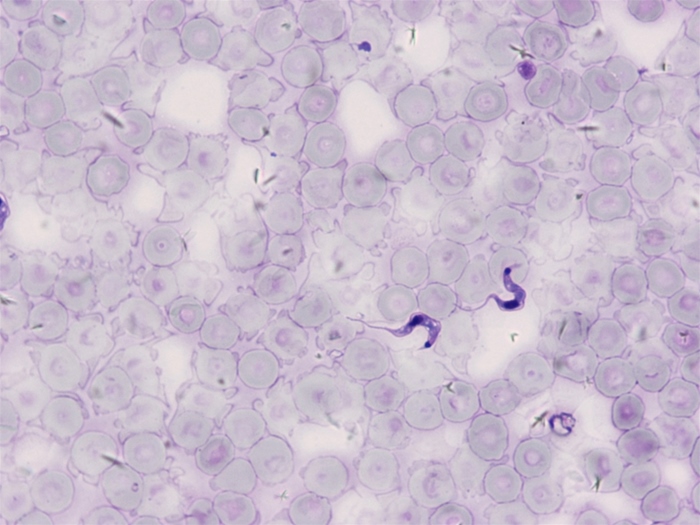 This patient is at greatest risk for which of the following complications if his condition is left untreated?
 (Multiple Choice)
5.0/5 (66)
(66) A 22-year-old woman comes to the emergency department with dysuria, vulvar pain, and pruritus. The patient has also felt feverish and fatigued for the last few days. She has a new sexual partner and has been using a hormonal vaginal ring for contraception. Physical examination reveals bilateral inguinal lymphadenopathy and tender vesicular lesions covering the labia majora and perineum. Which of the following conditions will most likely result as a sequela of this patient's infection?
(Multiple Choice)
4.8/5 (75)
(75) 
Filters
- Essay(0)
- Multiple Choice(0)
- Short Answer(0)
- True False(0)
- Matching(0)