



 Chat with AI
Exam 9: Microbiology

Exam 1: Anatomy291 Questions
Exam 2: Behavioral science240 Questions
Exam 3: Biochemistry156 Questions
Exam 4: Biostatistics117 Questions
Exam 5: Embryology52 Questions
Exam 6: Genetics103 Questions
Exam 7: Histology24 Questions
Exam 8: Immunology129 Questions
Exam 9: Microbiology336 Questions
Exam 10: Pathology816 Questions
Exam 11: Pathophysiology464 Questions
Exam 12: Pharmacology538 Questions
Exam 13: Physiology272 Questions
Select questions type


A 32-year-old man is being evaluated due to several weeks of watery diarrhea. He has also had intermittent, crampy abdominal pain and has lost 7 kg (15.4 lb) during this period. The patient has a history of HIV and was hospitalized 6 months ago for Pneumocystis pneumonia. On physical examination, the patient is afebrile, and the abdomen is soft and nontender with no organomegaly. Stool tests for leukocytes and occult blood are negative. Endoscopy is performed, and mucosal biopsy shows an inflammatory infiltrate in the lamina propria and pathogens lining the epithelium, as shown in the exhibit.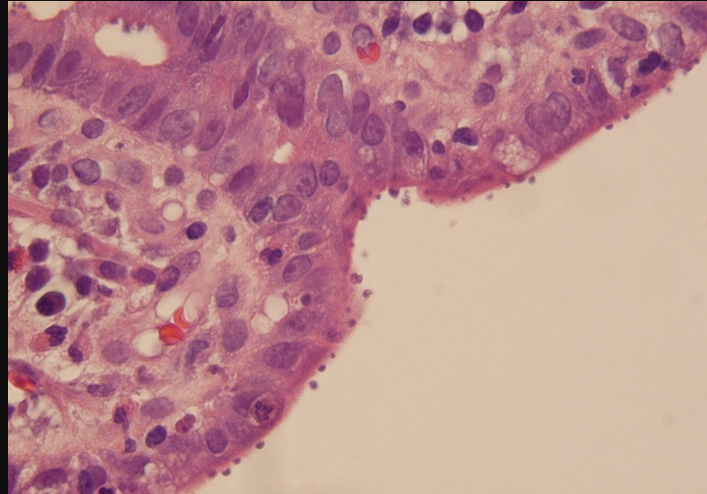 The organisms have a cystic appearance on modified acid-fast staining. Which of the following is the most likely cause of this patient's condition?
 (Multiple Choice)
4.8/5  (82)
(82) An 18-month-old boy is brought to the physician by his parents for fever, runny nose, and sore throat. The physician reassures the parents and recommends supportive care with plenty of fluids. He sends them home with instructions to follow up if the boy's symptoms worsen. Two days later, the infant is brought to the emergency department with persistent fever, brassy cough, and difficulty breathing. Physical examination reveals stridor. Which of the following pathogens is most likely responsible for this patient's condition?
(Multiple Choice)
4.8/5 (66)
(66) A previously healthy 43-year-old man comes to the office during the early fall due to a 4-week history of cough. He initially had a "bad cold" that lasted about 10 days. The sneezing, runny nose, and muscle aches that accompanied the cold have improved, but the cough has persisted and worsened. The patient has "bursts of coughing" for several minutes as he feels unable to clear the mucus. On at least 5 occasions, these attacks were so severe that he vomited afterward. The patient is a children's karate teacher. He received all of his childhood vaccinations but has not seen a physician in many years. There is no history of recent travel. Vital signs and physical examination are normal. Chest x-ray is unrevealing. Which of the following is the most likely cause of this patient's symptoms?
(Multiple Choice)
4.9/5 (82)
(82) A 56-year-old woman is brought to the emergency department due to a 2-day history of high fever, headache, mild confusion, and dry cough. She also has mild abdominal discomfort and watery diarrhea. The patient recently returned from a cruise to Hawaii. Her other medical problems include hypertension and hyperlipidemia. She has smoked 1 pack of cigarettes daily for over 20 years. Her temperature is 40 C (104 F), blood pressure is 104/63 mm Hg, pulse is 85/min, and respirations are 24/min. Lung examination reveals lower lobe crackles with no wheezing. Her abdomen is soft, non-distended, and non-tender. Chest x-ray shows bilateral lower lobe interstitial infiltrates. Which of the following additional findings is most likely to be present in this patient?
(Multiple Choice)
4.9/5 (71)
(71) A 10-year-old boy is brought to the emergency department due to respiratory distress. Over the past 6 hours, rapid, noisy breathing has progressively developed. Temperature is 40.1 C (104.2 F), blood pressure is 105/75 mm Hg, pulse is 120/min, and respirations are 32/min. Examination shows inspiratory stridor and supraclavicular retractions. Lateral neck x-ray is shown in the exhibit. 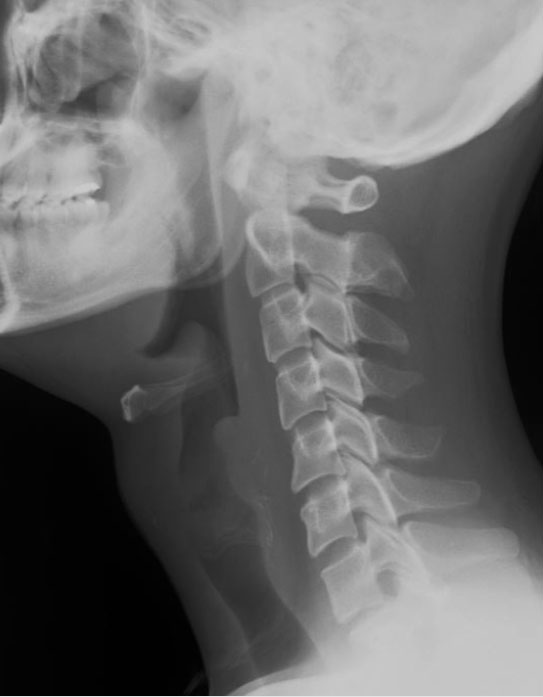 The patient is admitted to the hospital, and blood cultures are obtained. If blood cultures are positive, which of the following would most likely be seen on Gram stain?
 (Multiple Choice)
4.9/5 (91)
(91) A 34-year-old man comes to the office due to a painless penile ulcer, which he first noticed 3 days ago. He had unprotected sexual intercourse with a new partner a few weeks ago. The patient has no significant medical history and takes no medications. Temperature is 37.1 C (98.8 F). Examination reveals a 2-cm nontender ulcer close to the glans penis with a raised, indurated margin and a clean base. There are no surrounding lesions or vesicles. There are several bilateral enlarged inguinal lymph nodes, which are firm, nontender, and rubbery. Physical examination is otherwise unremarkable. Rapid plasma reagin and HIV testing are negative. Infection with which of the following is the most likely cause of this patient's symptoms?
(Multiple Choice)
4.8/5 (78)
(78) A 14-year-old girl comes to the physician with dark urine and facial puffiness. About 4 weeks before presentation, she had pustular skin lesions that broke down over a few days to form thick scabs in the lower extremities. Microscopic examination of the urine sediment shows red blood cell casts. The organism responsible for this patient's symptoms would most likely demonstrate which of the following?
(Multiple Choice)
4.7/5 (86)
(86) A 56-year-old woman comes to the emergency department due to 1 day of fever. She has a history of a hematologic malignancy and recently completed a cycle of chemotherapy through an indwelling central venous catheter. Temperature is 38.3 C (100.9 F). Laboratory studies are notable for neutropenia, with an absolute neutrophil count of 380/mm3. The patient is started on broad-spectrum antibiotics. Three days later, she continues to be febrile. Fungal cultures grow a species of Candida with a mutation in a gene coding an enzyme responsible for synthesizing a fungal cell wall polysaccharide. The organism is most likely to be resistant to which of the following antifungal agents as a result of this mutation?
(Multiple Choice)
4.8/5 (89)
(89) A 10-year-old boy is brought to the office due to abrupt onset fever and sore throat that began a day ago. He has had similar illnesses in the past, which were treated with oral antibiotics. The patient has no other medical conditions and has received all recommended vaccinations. Temperature is 38.3 C (101 F). Physical examination shows erythema of the posterior pharyngeal wall and enlarged tonsils, which are covered by white exudate. There are no enlarged cervical lymph nodes. Throat swab specimen is obtained. Which of the following would be most helpful in determining the need for antibiotic treatment in this patient?
(Multiple Choice)
4.8/5 (76)
(76) A 62-year-old man is brought to the emergency department from a homeless shelter due to alcohol intoxication. The patient has no other symptoms or history of significant medical conditions. Examination of the scalp reveals the findings shown in the exhibit. 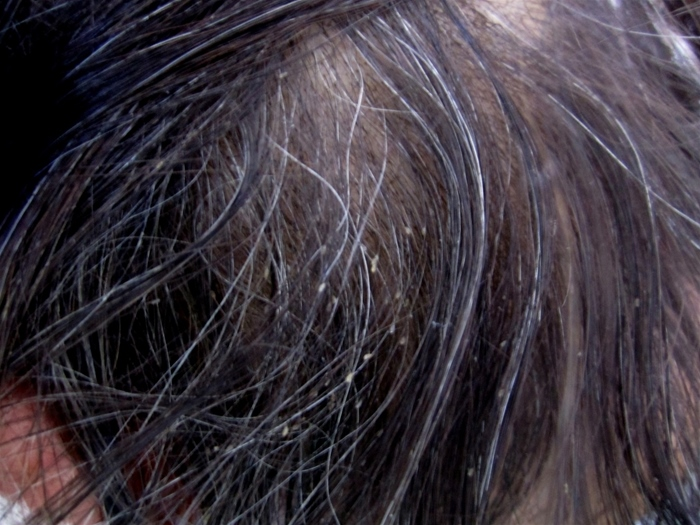 Which of the following organisms is most likely responsible for this patient's condition?
 (Multiple Choice)
4.7/5 (77)
(77) A 55-year-old man comes to the office due to malaise and cough over the past 2 months. He describes yellow sputum production with occasional streaks of blood. The patient smokes a pack of cigarettes daily and has a history of alcohol use disorder with prior episodes of binge drinking. Temperature is 37.1 C (98.8 F). Examination shows poor dentition with dental caries, gingivitis, and enlarged submandibular lymph nodes. Coarse rhonchi are heard during auscultation of the right lung. Chest CT scan reveals an extensive right lung consolidative process with air bronchograms. Bronchoscopy is performed, and a lung biopsy specimen shows the findings in the image below. 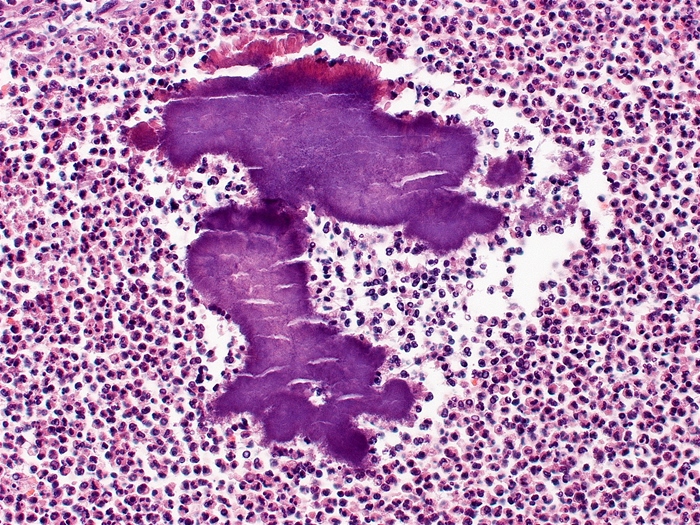 Which of the following is the most likely diagnosis?
 (Multiple Choice)
4.9/5 (90)
(90) A 21-year-old man is brought to the emergency department by his roommate due to worsening fever, headache, and confusion. The patient recently moved to a dormitory, and his prior medical problems and immunizations are unknown. Temperature is 39.2 C (102.6 F), blood pressure is 98/54 mm Hg, pulse is 112/min, and respirations are 24/min. The patient appears acutely ill. He is obtunded and has nuchal rigidity. Leukocyte count is 19,000/mm3 with 20% band neutrophils. Blood cultures are obtained and lumbar puncture is performed. Gram stain of cerebrospinal fluid reveals gram-negative cocci in pairs. Which of the following is the most likely way that this organism reached the meninges?
(Multiple Choice)
4.8/5 (83)
(83) A 25-year-old woman comes to the office due to a week of cough and dyspnea. She also reports intermittent, crampy abdominal pain and diarrhea. The patient has no history of respiratory illness or other chronic medical conditions but was recently diagnosed with immune thrombocytopenia that resolved with high-dose glucocorticoid therapy. She does not use tobacco, alcohol, or illicit drugs. She immigrated to the eastern United States from Myanmar 8 years ago, but has not travelled recently. Temperature is 37.2 C (99 F), blood pressure is 120/78 mm Hg, pulse is 88/min, and respirations are 18/min. Physical examination shows scattered wheezes and a nontender abdomen. Laboratory studies reveal eosinophilia, and sputum microscopy is shown in the image below: 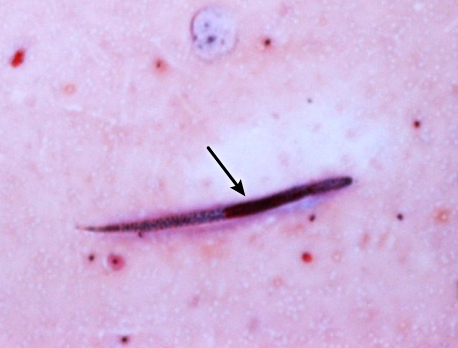 This patient most likely acquired the pathogen via which of the following modes of transmission?
 (Multiple Choice)
5.0/5 (73)
(73) A 3-year-old boy is brought to the clinic due to left ear pain over the past 3 days. Last week, the patient developed a runny nose and cough, which resolved 2 days prior to the development of ear pain. He has no chronic medical conditions. Temperature is 38.4 C (101.1 F). There is purulent drainage from the left ear. Otoscopic examination of the left ear reveals a normal-appearing external canal and an erythematous tympanic membrane with purulent fluid pooling within the distal external canal. Which of the following organisms is the most likely cause of this patient's diagnosis?
(Multiple Choice)
4.8/5 (64)
(64) A 43-year-old man comes to the office due to increasing discomfort and pain with sitting for the past several months. He also has had occasional perianal pruritus. Physical examination shows multiple, cauliflower-shaped, verrucous growths measuring 1 to 2 cm on the perianal skin. Histopathologic examination of one of the lesion reveals hyperplastic papillary squamous epithelium with parakeratosis, nuclear irregularity, and "perinuclear halos" of cytoplasmic vacuolization. Which of the following additional studies is most appropriate for this patient at this time?
(Multiple Choice)
4.9/5 (77)
(77) A 6-year-old previously healthy girl is brought to the office due to diarrhea and abdominal pain. She started having watery diarrhea after a barbeque dinner 4 days ago; her stools became grossly bloody 2 days later. Her mother also had similar symptoms. The patient's temperature is 37 C (98.7 F). The abdomen is soft with mild generalized tenderness. Stool culture is performed on sorbitol-MacConkey agar and reveals sorbitol-negative colonies with biochemical properties of Escherichia coli. Enzyme immunoassay detects a substance capable of inhibiting protein synthesis in human cells. The substance detected in this patient is most similar to the toxin produced by which of the following bacteria?
(Multiple Choice)
4.9/5 (82)
(82) A novel antimicrobial agent that inhibits bacterial glycosyltransferase enzyme is developed. Bacteria grown in a medium containing this antibiotic become spherical, cease to grow, and subsequently lyse. So that the activity of this antibiotic against various bacteria can be determined, disks enriched with the drug are placed on agar plates containing bacterial colonies. The plates are incubated alongside control plates with the same organisms but no antimicrobial disks. The control plates all show organism growth. In the plates with the diffusion disks, resistance to the drug is determined by measuring the zone of complete growth inhibition around the disk. Which of the following bacteria is most likely to be resistant to this drug?
(Multiple Choice)
4.9/5 (74)
(74) E. coli colonies grown on a lactose-containing medium up-regulate the production of the enzymes β-galactosidase and galactoside permease. Which of the following best explains the synchronous production of both enzymes in response to lactose?
(Multiple Choice)
4.9/5 (72)
(72) A 5-week-old girl is brought to the emergency department due to several hours of fever, irritability, and vomiting. This morning she was warm to the touch and refused to drink. Her temperature is 40.1 C (104.2 F). Lumbar puncture reveals cerebrospinal fluid pleocytosis; additional fluid is sent for Gram stain and culture. Empiric cefotaxime and vancomycin therapy is initiated. However, no clinical improvement is seen. Cerebrospinal fluid culture yields an organism that is resistant to cefotaxime. Which of the following organisms is most likely causing this patient's infection?
(Multiple Choice)
4.9/5 (81)
(81) A 79-year-old woman is brought to the emergency department from the nursing home due to explosive diarrhea. Laboratory studies show leukocytosis, and results from a stool specimen return positive for Clostridium difficile toxin genes by polymerase chain reaction. Three days later, one of the nurses who cared for the patient at the nursing home is admitted with diarrhea and is found to have C difficile infection. However, the other nurses who also took care of the patient are asymptomatic and do not develop the infection. If all the nurses were similarly exposed to C difficile, which of the following is the most likely reason that the asymptomatic nurses did not develop the infection?
(Multiple Choice)
4.8/5 (75)
(75) 
Filters
- Essay(0)
- Multiple Choice(0)
- Short Answer(0)
- True False(0)
- Matching(0)