



 Chat with AI
Exam 9: Microbiology

Exam 1: Anatomy291 Questions
Exam 2: Behavioral science240 Questions
Exam 3: Biochemistry156 Questions
Exam 4: Biostatistics117 Questions
Exam 5: Embryology52 Questions
Exam 6: Genetics103 Questions
Exam 7: Histology24 Questions
Exam 8: Immunology129 Questions
Exam 9: Microbiology336 Questions
Exam 10: Pathology816 Questions
Exam 11: Pathophysiology464 Questions
Exam 12: Pharmacology538 Questions
Exam 13: Physiology272 Questions
Select questions type


A 46-year-old woman is admitted for elective hysterectomy due to abnormal uterine bleeding. The patient has a history of diabetes mellitus and urinary incontinence, and she smoked cigarettes occasionally for years before quitting 5 years ago. She is prepared for surgery, and an indwelling urinary catheter is placed. The surgery is completed without complications and the patient is transferred to the hospital ward for recovery. The indwelling catheter is kept in place for the next 72 hours. The patient subsequently develops a fever of 39 C (102.2 F), along with suprapubic and costovertebral angle tenderness. Urine culture shows >105 colony-forming units/mL of extended-spectrum, beta-lactamase-producing Escherichia coli. Which of the following is the most important risk factor for this patient's infection?
(Multiple Choice)
5.0/5  (80)
(80) A 16-year-old, previously healthy girl comes to the office due to vaginal discharge that began 5 days ago. The discharge is grayish-white and fishy smelling. The patient is sexually active with a male partner and occasionally uses condoms. Temperature is 36.7 C (98.1 F), blood pressure is 106/52 mm Hg, and pulse is 78/min. Examination shows a small amount of grayish discharge in the vaginal vault. The cervix appears normal. Which of the following would most likely be seen on wet mount microscopy?
(Multiple Choice)
5.0/5 (84)
(84) A 22-year-old male presents to the emergency department complaining of fever, abdominal pain, and vomiting. He has had these symptoms for the past four days, but has not sought medical attention because of concerns over the cost of treatment. On examination, the patient appears acutely ill. There is right lower quadrant tenderness with rebound as well as a palpable mass. CT scan of the abdomen and pelvis demonstrates a periappendiceal fluid collection. Culture of this fluid would most likely isolate which of the following organisms?
(Multiple Choice)
4.9/5 (71)
(71) A 34-year-old man comes to the emergency department due to 2 weeks of slowly progressive global headache, malaise, and fevers. He has also had unintentional weight loss over the past several months. The patient has a history of injection drug use and was diagnosed with HIV 3 years ago. He has not been compliant with antiretroviral therapy. Temperature is 38.3 C (100.9 F). Examination shows white patches on the oropharyngeal mucosa and mild generalized lymphadenopathy. Brain imaging reveals no intracranial masses. India ink staining of cerebrospinal fluid demonstrates spherical yeast forms with thick capsules. Which of the following is the most likely site of primary infection in this patient?
(Multiple Choice)
4.8/5 (82)
(82) A 43-year-old, HIV-positive woman comes to the office due to lesions on her vulvar and perineal areas for the past 4 weeks. On examination, there are clusters of firm, shiny, round papules that are each 2-6 mm in diameter with central indentation. Microscopic examination of a lesion is shown in the image below: 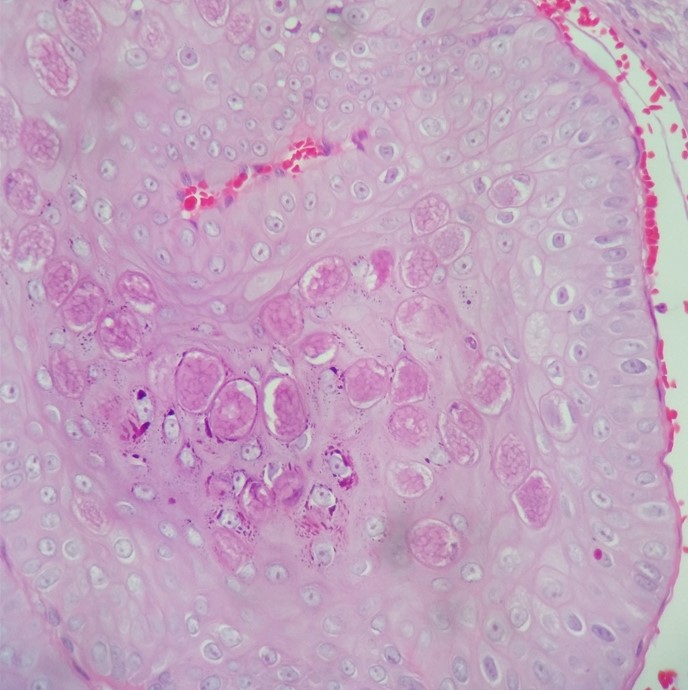 Which of the following is the most likely cause of this patient's presenting condition?
 (Multiple Choice)
4.9/5 (87)
(87) A 41-year-old woman comes to the emergency department due to 2 days of severe shortness of breath, high fevers, cough, and myalgias. The patient is a businesswoman who works in the poultry industry. She recently returned from a trip to China, where she visited several factories in different parts of the country. Her temperature is 39.1 C (102.4 F). The patient is in respiratory distress, and crackles and diffuse wheezes are present on pulmonary examination. Laboratory results show that she contracted an orthomyxovirus that was responsible for an upper respiratory infection epidemic in China. Transmission of the virus was originally thought to occur only through contact with poultry, but during the outbreak, sustained human-to-human transmission was observed. Which of the following is most likely responsible for the infectivity of this virus in humans?
(Multiple Choice)
4.9/5 (81)
(81) A 54-year-old man with HIV comes to the emergency department due to nonproductive cough, low-grade fevers, and worsening fatigue for the past month. He has also lost 3.6 kg (8 lb) over the same period. The patient does not take antiretroviral therapy consistently and has not followed up with his primary care physician for the past several months. Physical examination reveals hepatosplenomegaly. Laboratory testing shows pancytopenia and elevated liver aminotransferases. Bone marrow aspiration is performed, and light microscopy of the specimen is shown below. 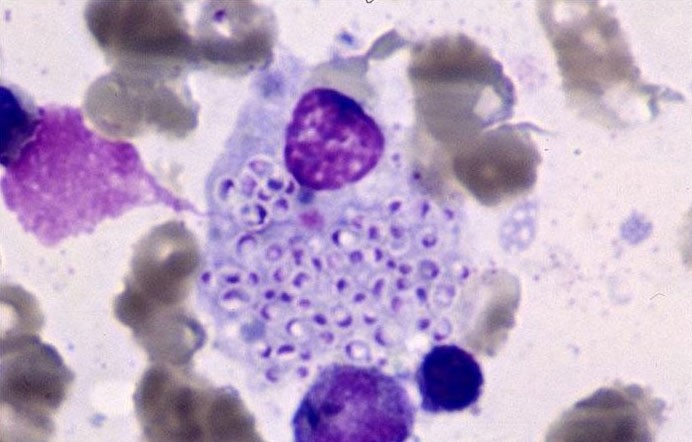 Which of the following is the most likely cause of this patient's current condition?
 (Multiple Choice)
4.9/5 (87)
(87) A 5-month-old boy is brought to the emergency department due to poor feeding, weakness, and complete loss of extremity muscle tone. Vaccinations are up to date, and there is no significant medical history. The patient receives formula as his sole source of nutrition except for occasional fruit juice and honey. Which of the following is most likely to confirm the diagnosis in this patient?
(Multiple Choice)
4.7/5 (69)
(69) A 3-month-old boy is brought to the emergency department due to 2 days of fever and irritation that progressed to lethargy. Temperature is 38.6 C (101.5 F). A lumbar puncture is performed, and the results of cerebrospinal fluid (CSF) analysis are as follows: 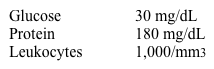 Gram-negative coccobacilli are isolated from the CSF. These organisms demonstrate little growth on 5% sheep blood agar but grow well when incubated on the same media alongside colonies of Staphylococcus aureus. Staphylococci promote the growth of these bacteria by supplementing which of the following substances?
 (Multiple Choice)
4.9/5 (67)
(67) A 53-year-old man comes to the emergency department due to progressively worsening shortness of breath, nonproductive cough, and low-grade fevers over the past 2 weeks. He has not had a runny nose or sore throat and does not recall any sick contacts. He received a lung transplant for idiopathic pulmonary fibrosis 4 months ago. His medications include immunosuppressants and trimethoprim-sulfamethoxazole. Temperature is 37.8 C (100 F). Chest x-ray reveals diffuse interstitial infiltrates bilaterally. A decrease in pulmonary function is noted on testing. A lung biopsy specimen is shown below. 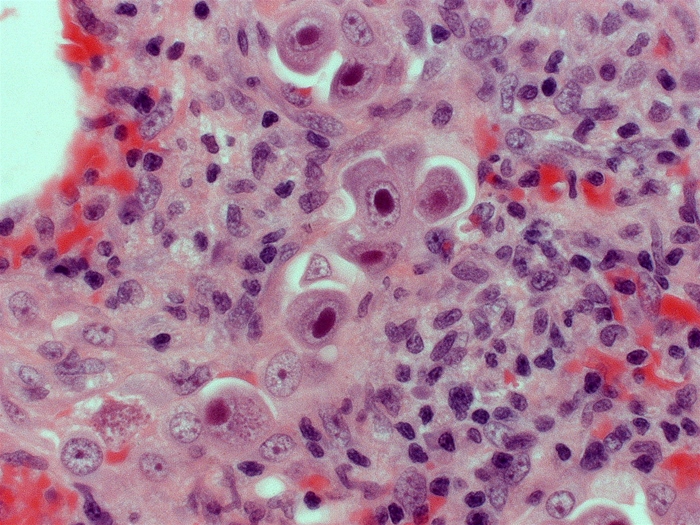 Which of the following best characterizes the organism most likely responsible for this patient's current condition?
 (Multiple Choice)
4.7/5 (76)
(76) A 24-year-old previously healthy man comes to the office due to a week of low-grade fever, malaise, sore throat, and persistent nonproductive cough. He does not use tobacco, alcohol, or illicit drugs. The patient takes no medications and has no drug allergies. He lives in Connecticut and has not traveled recently. Physical examination reveals mild pharyngeal erythema, no nasal congestion, and bilateral vesicular breath sounds with no crackles or wheezes. Chest x-ray shows patchy, interstitial infiltrates. Sputum Gram stain shows numerous leukocytes but no organisms. Which of the following agents is the best initial treatment for this patient?
(Multiple Choice)
4.9/5 (72)
(72) A 26-year-old man develops dysuria and purulent urethral discharge following unprotected sex with a new partner. Nucleic acid amplification testing is positive for Neisseria gonorrhoeae infection. The patient develops antibody against the bacterial pili that enhance attachment to host cells. His symptoms resolve with adequate treatment. His partner does not receive treatment. Several weeks later, the patient develops N gonorrhoeae reinfection after repeat exposure to the same partner. Which of the following is the most likely reason for the lack of long-lasting immunity against the bacteria despite antibody formation in this patient?
(Multiple Choice)
4.9/5 (86)
(86) A 24-year-old man comes to the physician with painful blisters on the shaft of his penis. The lesions erupted 2 days ago. The patient has had 5 lifetime sexual partners and is currently sexually active with one female partner; he uses condoms inconsistently. Examination shows multiple vesicular lesions on the penis, and Tzanck smear is positive for multinucleated giant cells. HIV testing is negative. The patient has had several similar episodes every year for the past 2 years but had been too embarrassed to seek treatment until now. Which of the following would most likely have prevented recurrence of this patient's condition?
(Multiple Choice)
4.8/5 (90)
(90) A 32-year-old woman comes to the emergency department due to 4 weeks of worsening cough, shortness of breath, and low-grade fevers. She also has had an unintentional weight loss of 4.5 kg (10 lb) over the past 3 months. Temperature is 37.1 C (98.8 F), blood pressure is 120/70 mm Hg, pulse is 102/min, and respirations are 22/min. Pulse oximetry shows 86% on ambient air. Lung auscultation reveals bilateral crackles. There are no heart murmurs, and jugular venous pressure is normal. Chest x-ray reveals diffuse interstitial infiltrates. The patient undergoes bronchoscopy; methenamine silver staining of the bronchoalveolar lavage specimen is shown in the image. 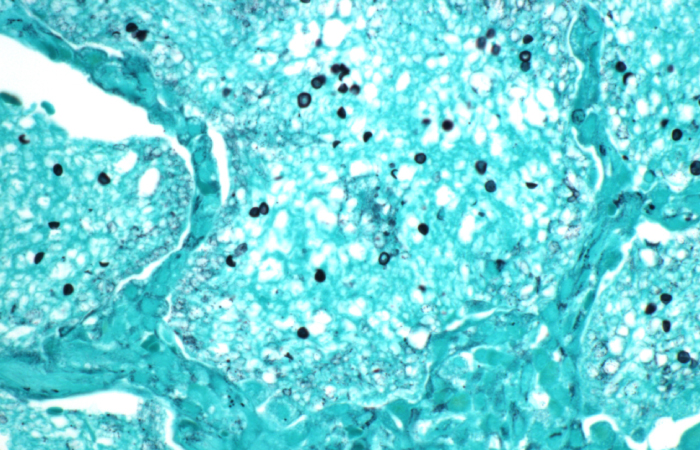 Which of the following is the most appropriate pharmacotherapy for this patient's current condition?
 (Multiple Choice)
4.7/5 (71)
(71) A previously healthy 27-year-old man comes to the clinic due to fever and rash. The patient is a missionary who recently immigrated from South Africa with his wife and 3 young children. Four days ago, he developed a high fever and malaise followed by the appearance of multiple discrete macules on his face, trunk, and extremities. The lesions are pruritic and evolved into pustules then vesicles. The patient has continued to develop new vesicles as other lesions crust over and heal. The remainder of the examination is unremarkable. This patient's symptoms are most likely due to an infection with which of the following pathogens?
(Multiple Choice)
4.8/5 (77)
(77) A 28-year-old man comes to the office due to a rash on the lower extremity. The patient noticed a pruritic papule on the dorsum of his right foot just prior to returning from a south Florida beach 2 days ago. He walked barefoot on the beach but does not recall any trauma. Since his return home, the rash and itching have progressively worsened. The patient has no other medical problems and takes no medications. Physical examination findings are shown below. 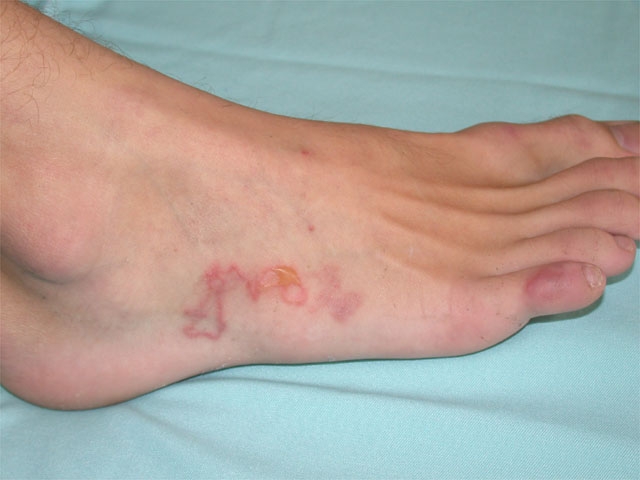 Which of the following is the most likely cause of this patient's current condition?
 (Multiple Choice)
4.9/5 (75)
(75) A 4-year-old boy is brought to the office with 3 days of fever, irritability, and oral lesions. His parents are concerned due to his refusal to eat or drink and lack of urination today. Physical examination demonstrates painful ulcers on the tongue and gingiva, swollen gums, and cervical lymphadenopathy. The remainder of his examination is unremarkable. Microscopic examination of an oral ulcer base scraping is shown in the image below. 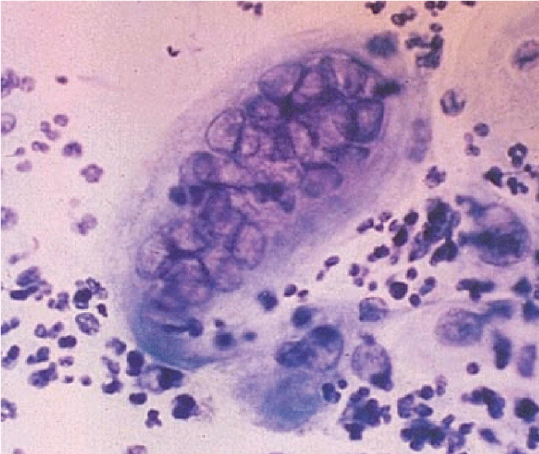 Which of the following is most likely the cause of this patient's condition?
 (Multiple Choice)
4.8/5 (78)
(78) A 24-year-old man comes to the emergency department with leg swelling. His dog, which is fully vaccinated and has lived with him for the past year, bit him on the left leg last night, leading to a break in the skin and bleeding. The patient irrigated the wound with bottled water and soap and managed his pain with acetaminophen. This morning, the wound area became warm, red, and swollen. On examination, temperature is 36.4 C (97.5 F). There is an open wound on the left leg, with surrounding erythema, warmth, and tenderness. No wound drainage or crepitus is present. The distal pulses are palpable. Wound cultures grow gram-negative coccobacilli; the culture has a mouse-like odor. Which of the following organisms is most likely responsible for this patient's current presentation?
(Multiple Choice)
4.9/5 (74)
(74) A 42-year-old man comes to the physician because of dysuria and blood in his urine at the end of urination. He returned to the United States 2 weeks ago after several months touring Africa. While there, he went spelunking, bathed in the beaches and lakes, and ate the local street food. Physical examination is unremarkable. Ultrasonography reveals mild bilateral hydronephrosis and bladder wall thickening. Which of the following animals is the most likely source of this patient's infection?
(Multiple Choice)
4.9/5 (80)
(80) A 35-year-old man comes to the office due to 3 months of progressive swelling under his left jaw. The swelling spontaneously opened and drained pus a month ago but has not improved or resolved. The patient has no medical conditions other than dental caries; he had a tooth extracted prior to symptom onset. Physical examination shows an indurated, nontender mass in the left submandibular area with a small opening on the overlying skin. Gentle pressure on the mass yields thick pus containing sand/grain-like particles. The microbial pathogen with which of the following characteristics is the most likely cause of this patient's condition?
(Multiple Choice)
4.9/5 (87)
(87) 
Filters
- Essay(0)
- Multiple Choice(0)
- Short Answer(0)
- True False(0)
- Matching(0)