



 Chat with AI
Exam 9: Microbiology

Exam 1: Anatomy291 Questions
Exam 2: Behavioral science240 Questions
Exam 3: Biochemistry156 Questions
Exam 4: Biostatistics117 Questions
Exam 5: Embryology52 Questions
Exam 6: Genetics103 Questions
Exam 7: Histology24 Questions
Exam 8: Immunology129 Questions
Exam 9: Microbiology336 Questions
Exam 10: Pathology816 Questions
Exam 11: Pathophysiology464 Questions
Exam 12: Pharmacology538 Questions
Exam 13: Physiology272 Questions
Select questions type


A 47-year-old man comes to the office due to persistent fever, night sweats, and fatigue. Thorough evaluation yields a diagnosis of chronic myeloid leukemia. While undergoing treatment for his malignancy, the patient experiences headaches, scant nasal discharge, and left eye symptoms. Physical examination reveals tenderness over the paranasal sinuses and left-sided orbital swelling and cellulitis. Mild proptosis and ptosis of the left eye are also present. Biopsy of the sinus mucosa is shown in the image below: 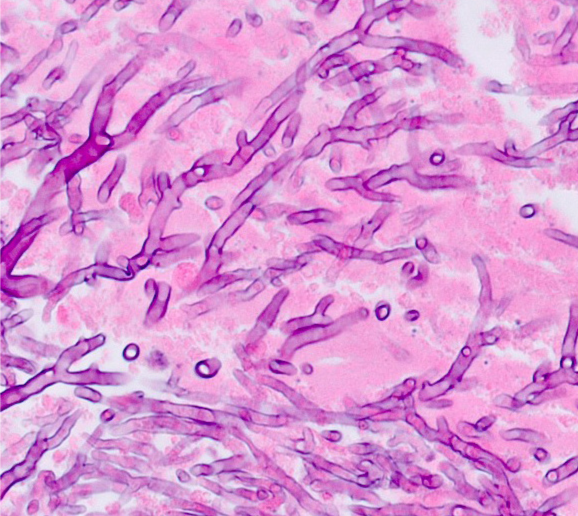 Which of the following is the most likely cause of this patient's condition?
 (Multiple Choice)
5.0/5  (75)
(75) A 34-year-old man came to the office due to white plaques on his buccal mucosa that he incidentally discovered while brushing his teeth. After appropriate workup, he was found to be HIV positive, with a CD4+ T lymphocyte count of 280/mm3. He was referred to an infectious diseases specialist for follow-up but was noncompliant with appointments. The patient returns 3 years later due to several months of pain and itching in the perirectal area. He also has intermittent rectal bleeding and often sees bright red blood on the tissue after wiping. The patient did not seek medical care because he thought he had hemorrhoids. On examination, a single, hard mass with superficial ulceration measuring approximately 2x2 cm is noted in the anal canal. No hemorrhoids are present. There is no palpable regional lymphadenopathy. Which of the following pathogens is most likely responsible for this patient's current anal pathology?
(Multiple Choice)
4.9/5 (93)
(93) A 34-year-old nulligravid woman comes to the office due to vulvar itching and vaginal discharge. She has no other concerns. The patient is sexually active with her fiancé and takes oral contraceptives daily. She does not use barrier contraception. She took antibiotics 2 weeks ago for sinusitis but has no other medical problems. Pelvic examination shows an erythematous vulva and a thick white discharge that adheres to the vaginal wall. The rest of the physical examination is normal. Microscopic examination reveals budding cells. Which of the following is the most likely underlying cause of her current condition?
(Multiple Choice)
4.9/5 (84)
(84) A 3-year-old boy is brought to the emergency department with breathing difficulty and drooling that have worsened rapidly over the last 8 hours. He has no chronic medical conditions. Temperature is 39.4 C (102.9 F). Examination shows a toxic-appearing patient leaning forward while sitting on the bed; he has inspiratory stridor and suprasternal retractions. There are pooled oral secretions, and the patient is unable to swallow. Which of the following is the greatest risk factor for this patient's condition?
(Multiple Choice)
4.9/5 (77)
(77) A 52-year-old woman is evaluated due to 2 weeks of fever, fatigue, nonproductive cough, and dyspnea, which began shortly after visiting her family in Ohio. She also lost 1.5 kg (3.3 lb) over the same period. The patient has a history of rheumatoid arthritis and has been taking adalimumab for the past 6 months. She had negative tuberculosis skin testing prior to beginning the drug. Temperature is 38 C (100.4 F), blood pressure is 130/70 mm Hg, pulse is 92/min, and respirations are 18/min. Physical examination reveals bilateral lung crackles, mild generalized lymphadenopathy, and hepatosplenomegaly. Chest x-ray shows bilateral nodular densities and hilar lymphadenopathy. Urine testing is positive for a fungal antigen. Which of the following pathogenic processes is most important during the development of this patient's infection?
(Multiple Choice)
4.9/5 (80)
(80) A 31-year-old man comes to the office due to oral lesions that cause occasional discomfort during eating. He also reports fatigue and unintentional weight loss. The patient has no prior medical problems and takes no medications. Oral examination findings are shown below. 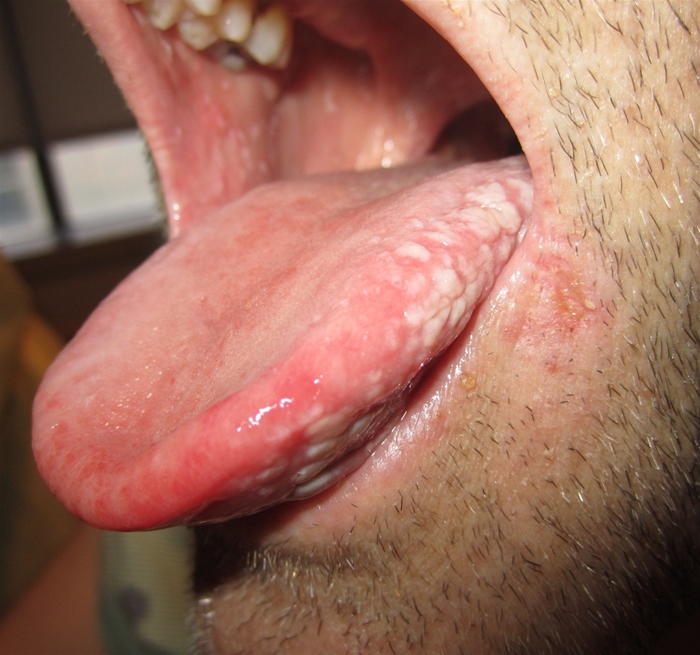 The lesions can be easily scraped off, revealing erythematous mucosa underneath. There are several enlarged cervical and axillary lymph nodes. Which of the following diagnostic tests is most appropriate during further workup of this patient?
 (Multiple Choice)
4.8/5 (72)
(72) A 54-year-old man comes to the emergency department after vomiting blood. He has also had melena, fatigue, and lethargy over the last 24 hours. The patient emigrated from sub-Saharan Africa 20 years ago and occasionally returns to visit friends and family. Temperature is 37.5 C (99.5 F), blood pressure is 90/60 mm Hg, and pulse is 115/min. Abdominal palpation reveals an enlarged liver and a spleen tip below the level of the umbilicus. Laboratory results are as follows: 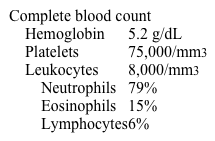 Upper endoscopy reveals bleeding esophageal varices. Which of the following is the most likely underlying cause of this patient's symptoms?
 (Multiple Choice)
4.7/5 (77)
(77) A 52-year-old man is hospitalized due to 2 weeks of low-grade fever, malaise, anorexia, and fatigue. The patient has a history of bicuspid aortic valve and underwent aortic valve replacement a year ago. Physical examination reveals a new regurgitation murmur. Blood cultures repeatedly grow gram-positive cocci in clusters, which are identified as Staphylococcus epidermidis. This pathogen most likely demonstrates which of the following characteristics?
(Multiple Choice)
4.9/5 (85)
(85) A 53-year-old man comes to the emergency department due to 2 weeks of intermittent low-grade fevers and fatigue. Temperature is 38.5 C (101.3 F), blood pressure is 120/80 mm Hg, pulse is 92/min, and respirations are 16/min. On cardiovascular examination, an early diastolic murmur is present and best heard at the left sternal edge. Subungual splinter hemorrhages are seen. Laboratory study results show leukocytosis and an elevated erythrocyte sedimentation rate. Blood cultures are drawn and grow gram-positive cocci that synthesize dextrans from sucrose. The organism contributing to this patient's current condition is also associated with which of the following?
(Multiple Choice)
4.8/5 (82)
(82) A 38-year-old man is undergoing treatment for acute myeloid leukemia. Initially, he had fevers and reported being lethargic and fatigued all the time. However, of late, he has noted increasingly severe right-sided headaches. He describes the pain to be throbbing in nature and located behind his right eye. He also has associated nasal stuffiness. The patient has no prior history of allergies. Physical examination reveals right-sided proptosis and periorbital tenderness. Biopsy of the right maxillary sinus mucosa reveals the following: 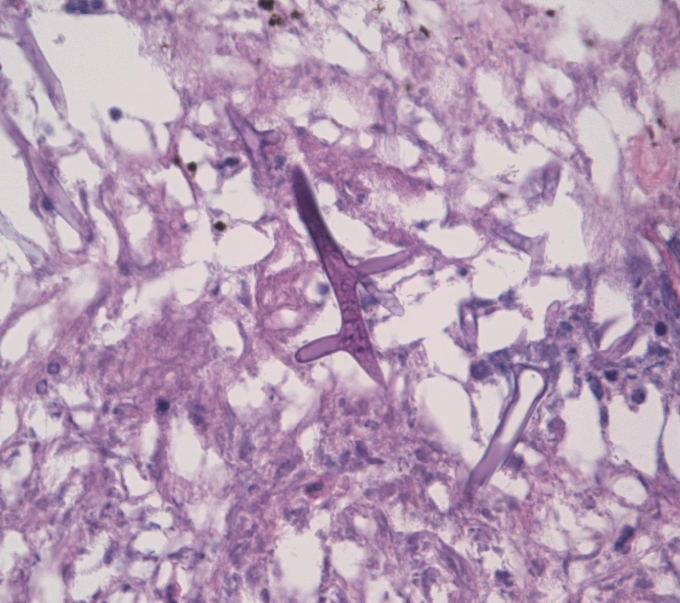 Which of the following is the most likely cause of this patient's condition?
 (Multiple Choice)
4.8/5 (86)
(86) A 64-year-old man comes to the office due to 3 days of diarrhea. He began to have nausea, vomiting, abdominal cramps, and diarrhea 24 hours after eating chicken salad at a fast-food restaurant. The patient continues to have 4-6 episodes of diarrhea per day with no blood in the stool. His wife, who ate the same food, had a few loose stools but felt well afterward. The patient takes a tumor necrosis factor inhibitor for psoriatic arthritis and a proton pump inhibitor for gastritis. Temperature is 38 C (100.4 F), blood pressure is 120/70 mm Hg, and pulse is 88/min. Abdominal examination reveals mild diffuse tenderness to palpation and increased bowel sounds. Cultures of the stool yield gram-negative bacilli that are non-lactose fermenting and oxidase negative. Which of the following is the most likely complication associated with this patient's current infection?
(Multiple Choice)
4.8/5 (80)
(80) A 12-year-old boy is brought to the office with fever, chills, and a rash that appeared this morning. Two days earlier, the child started complaining of a sore throat. His temperature is 38.3 C (101 F). Examination shows a diffuse erythematous rash on his chest and abdomen that blanches with pressure, along with numerous 1- to 2-mm papules. The throat is erythematous with gray-white tonsillar exudates and the tongue is bright red. Which of the following complications is most likely to develop in this patient?
(Multiple Choice)
4.8/5 (73)
(73) A 40-year-old woman comes to the emergency department due to malaise, fever, productive cough, and pleuritic chest pain. The patient has a history of alcohol use disorder and HIV acquired from injection drug use. She is nonadherent with antiretroviral therapy and other HIV-related medications. Temperature is 38.3 C (101 F), blood pressure is 120/72 mm Hg, and pulse is 104/min. Lung examination reveals bronchial breath sounds and crackles. Sputum microscopy findings are shown below.  Which of the following pathogenic factors most likely contributes to this microorganism's ability to cause lung infection?
 (Multiple Choice)
4.8/5 (77)
(77) A 54-year-old man with HIV is part of a large clinical study. He was diagnosed with HIV-1 infection 5 years ago. Blood samples are obtained periodically to perform sequencing analysis of the viral genome. Current testing reveals a large number of isolates with mutation in the pol gene compared to the previous analyses. This finding is most closely associated with which of the following?
(Multiple Choice)
4.7/5 (82)
(82) A 24-year-old man is brought to the emergency department due to seizures. He has had 2 days of worsening fever, headache, and vomiting. Physical examination shows signs of meningeal irritation. The patient rapidly becomes comatose and dies 48 hours later despite aggressive medical care. Autopsy examination shows congested leptomeninges with fibrinopurulent exudate (not shown). Microscopy reveals numerous ameba in the exudate and brain tissue. Which of the following is the most likely portal of entry of this pathogen into the CNS? 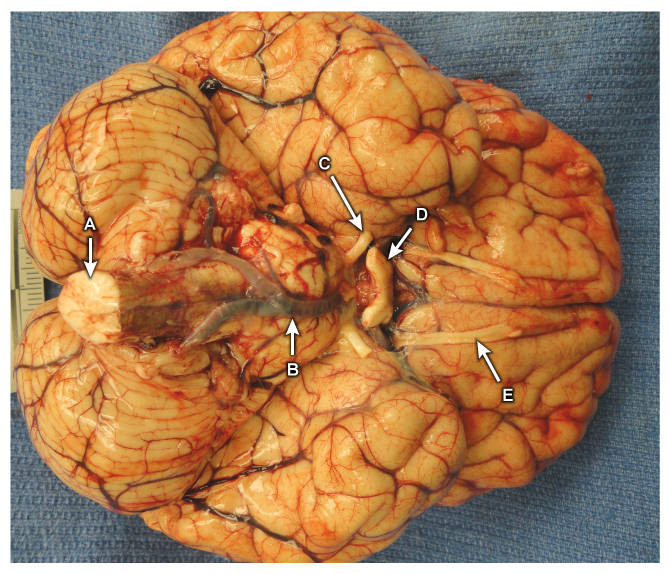
(Multiple Choice)
4.9/5 (82)
(82) A 68-year-old woman comes to the emergency department due to cough and shortness of breath. She has a history of chronic obstructive pulmonary disease and often coughs up clear sputum in the mornings. However, over the past 4 days, her cough has worsened significantly, and she now is expectorating thick, yellow sputum. The patient also feels "winded" when walking short distances or doing light house work. She is a former smoker with a 40-pack-year history. Temperature is 37.2 C (99 F), blood pressure is 130/70 mm Hg, pulse is 90/min, and respirations are 22/min. The patient is breathing with pursed lips. The expiration phase is prolonged. Lung auscultation reveals vesicular breath sounds with diffuse wheezes. Chest x-ray shows hyperinflated lungs with flattened diaphragm. There are no parenchymal opacities or pleural effusion. Respiratory infection with which of the following pathogens most likely triggered this patient's worsening symptoms?
(Multiple Choice)
4.9/5 (76)
(76) A 73-year-old woman comes to the physician complaining of progressive, severe pain and discharge from her left ear for the past 2 days. She has had type 2 diabetes for many years and has been noncompliant with her medications and follow-up appointments. On examination, moving or touching the pinna produces extreme pain. Otoscopic examination shows granulation tissue in the left ear canal with a scant amount of discharge. The tympanic membrane is clear, and there is no middle ear effusion. Initial cultures from the ear show a Gram-negative rod. Which of the following microbiological characteristics best describes the infecting organism?
(Multiple Choice)
4.9/5 (78)
(78) A 54-year-old man is brought to the emergency department due to a week of progressive headaches and confusion. He was treated for viral esophagitis 6 months ago and Pneumocystis pneumonia 2 months ago. Temperature is 38 C (100.4 F), blood pressure is 142/86 mm Hg, and pulse is 64/min. The patient is lethargic and oriented to person and place only. CT scan of the head shows a mildly increased ventricle size but no other abnormalities. Lumbar puncture reveals an elevated opening pressure, and cerebrospinal fluid analysis shows moderately increased protein concentration and pleocytosis. The latex agglutination test is positive for soluble polysaccharide antigen. Light microscopy of this patient's cerebrospinal fluid is most likely to reveal which of the following?
(Multiple Choice)
4.8/5 (79)
(79) A 25-year-old woman comes to the emergency department due to 2 days of abdominal pain and bloody diarrhea. A few days ago, she attended a church barbeque party. The patient lives alone and has no medical problems. She does not know if anyone else at the party developed similar symptoms. Her temperature is 37.1 C (98.8 F), blood pressure is 119/76 mm Hg, pulse is 92/min, and respirations are 16/min. There is abdominal tenderness with no rebound or guarding. Guaiac-positive bloody stools are detected on rectal examination. Stool cultures reveal an Escherichia coli strain that does not produce glucuronidase and does not ferment sorbitol on sorbitol-containing MacConkey agar. Which of the following best describes the mechanism of action of the toxin produced by these bacteria?
(Multiple Choice)
4.7/5 (87)
(87) A 30-year-old man is brought to the emergency department due to erratic behavior, progressive right-sided weakness, and difficulty walking for the last month. The patient was diagnosed with HIV several years ago and is not compliant with antiretroviral treatment. Physical examination shows a cachectic and disheveled man. Funduscopic examination shows no abnormalities. Motor strength in the right upper and lower extremities is decreased, and his gait is ataxic. Brain MRI reveals several discrete areas of demyelination in the subcortical and periventricular white matter with no surrounding edema or mass effect. CD4 cell count is 30/mm3. Reactivation of which of the following pathogens is most likely responsible for this patient's current symptoms?
(Multiple Choice)
4.7/5 (80)
(80) 
Filters
- Essay(0)
- Multiple Choice(0)
- Short Answer(0)
- True False(0)
- Matching(0)